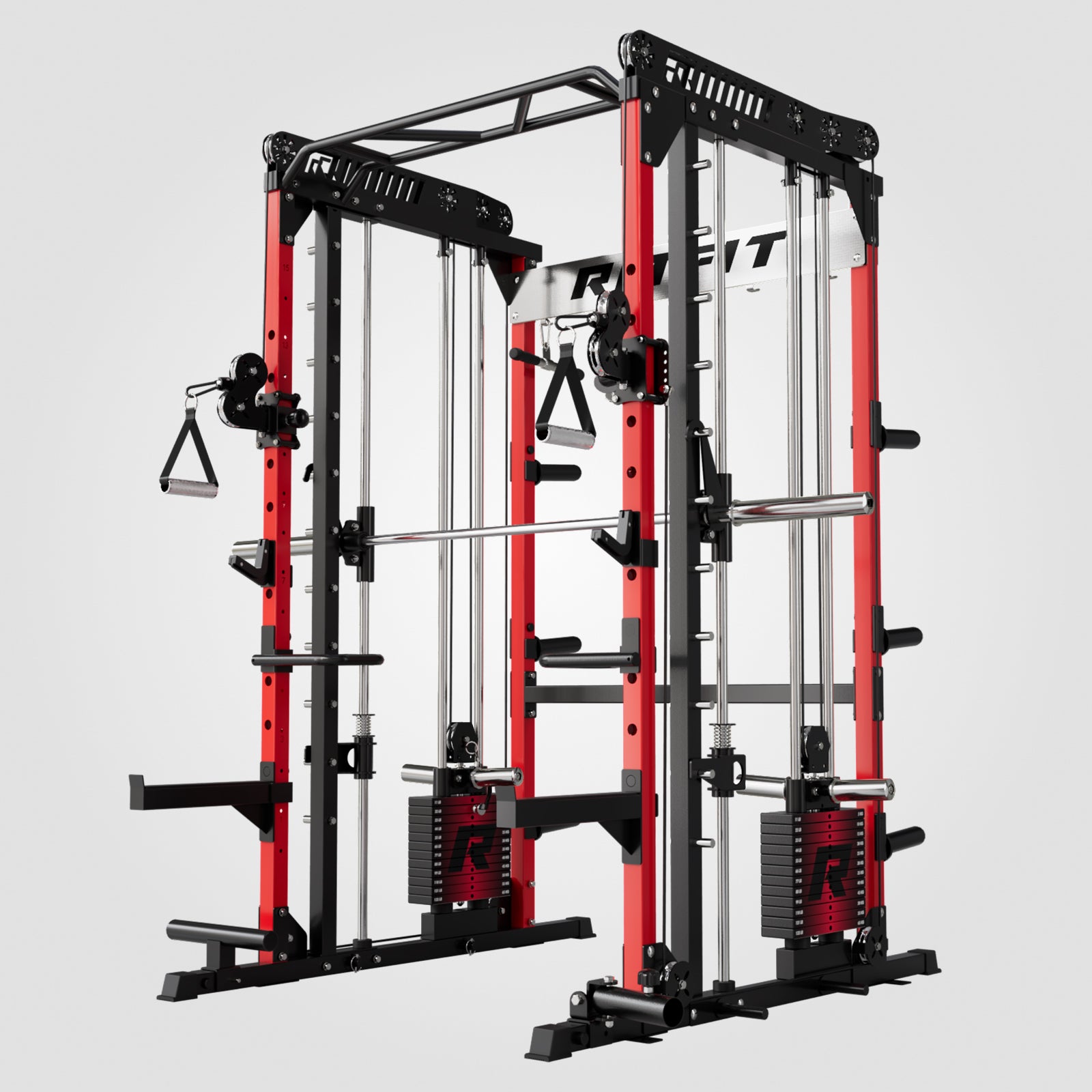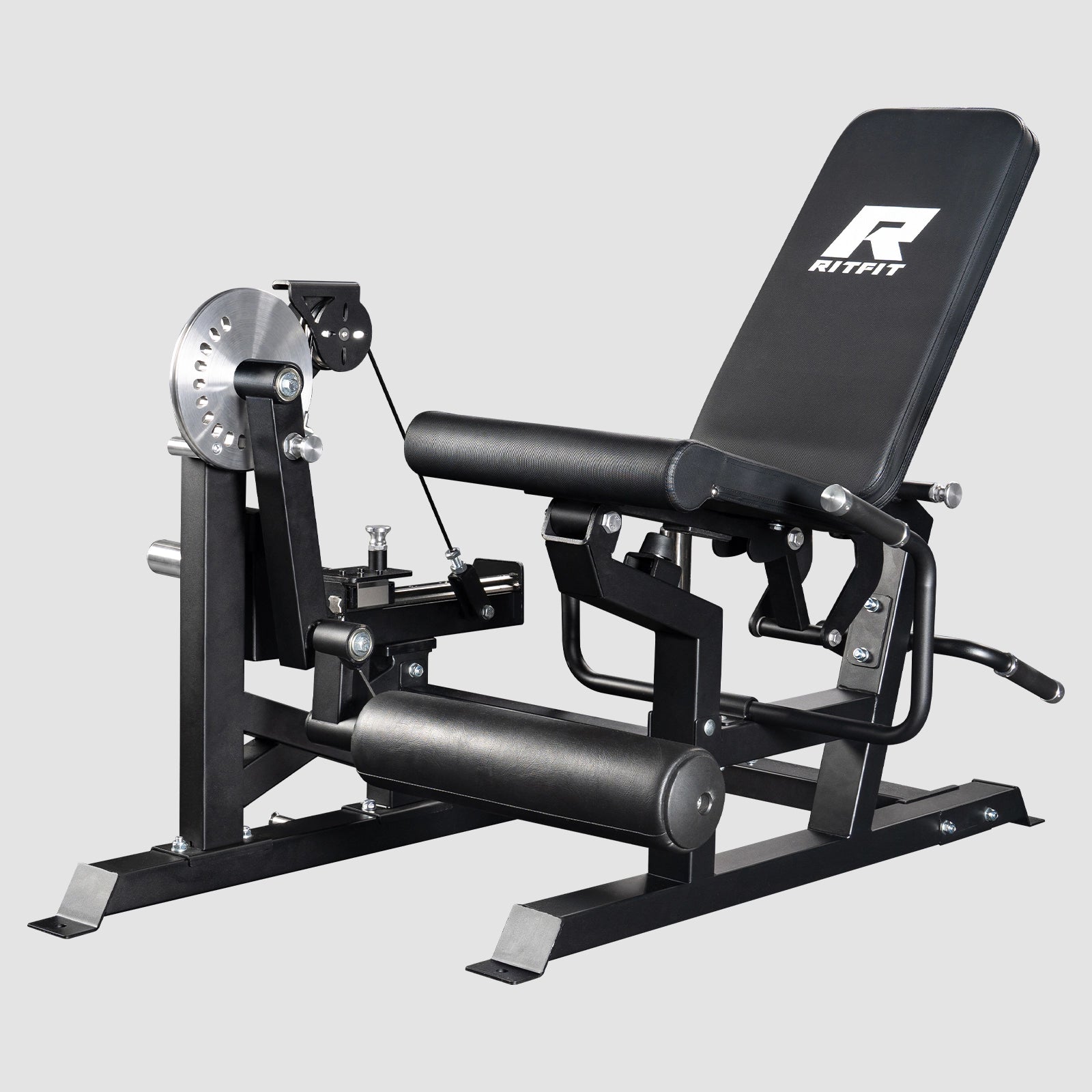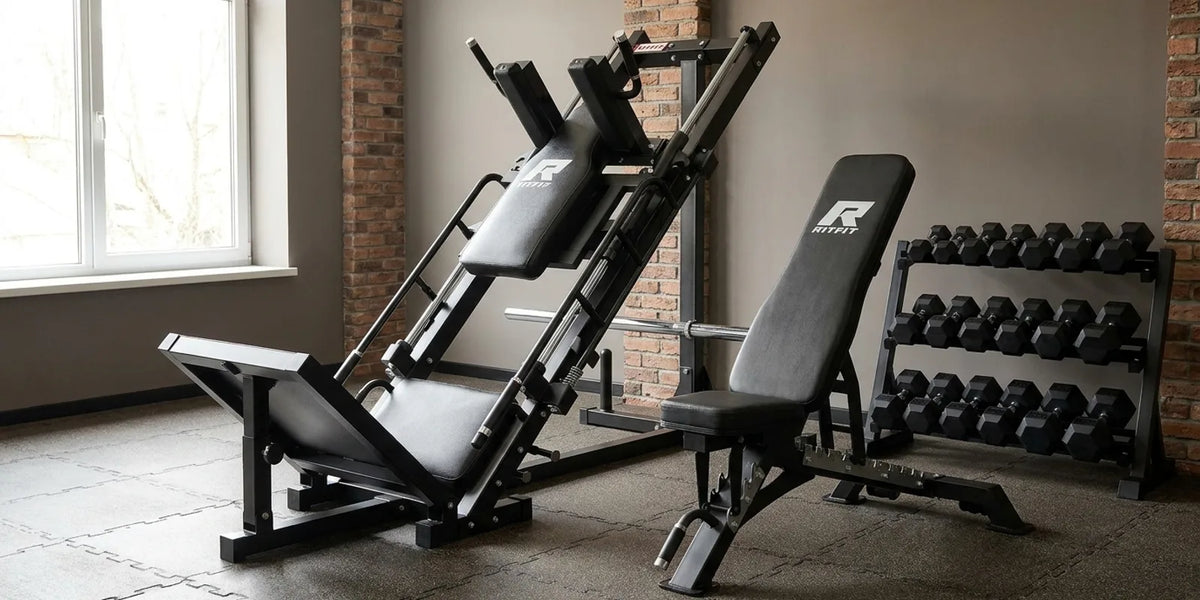
What Is a hack squat rack attachment? A hack squat rack attachment is a plate-loaded add-on that mounts to the uprights of an existing power rack, combining a footplate and back pad that travel a fixed path to replicate a hack squat machine.
This guide explains what the attachment is, which exercises it unlocks, how it compares to a standalone hack squat machine, and how to choose and use one safely in your home gym.
Quick Answer: A hack squat rack attachment is a plate-loaded add-on that mounts to an existing power rack, combining a footplate and back pad that travel a fixed path to replicate a hack squat machine. It saves floor space and cost, adds targeted quad and leg work, and fits only racks whose upright size, hole diameter, and hole spacing match its pins.
Key Takeaways
- What it is: A power rack add-on with a footplate plus a back pad that moves along a fixed path to simulate a hack squat machine.
- Space saver: Mounts to your rack and folds down when idle, instead of occupying 20 to 30 square feet like a standalone unit.
- Leg focus: Targets the quadriceps, glutes, and hamstrings with a guided trajectory, so balance is less limiting than in barbell squats.
- Not universal: Verify upright tube size, hole diameter, and hole spacing before you buy.
- Safety first: Use safety stops, counter-balance an unanchored rack, and start with a conservative load.
What Is a Hack Squat Rack Attachment?
A hack squat rack attachment is a plate-loaded accessory that bolts or pins onto the uprights of an existing power rack or squat stand to recreate the fixed-path leg press and hack squat movement of a commercial machine.
- Footplate and back pad: A platform for your feet and a padded support for your back and shoulders that travel together along a guided rail or leverage arm.
- Fixed trajectory: The path is controlled, so you can drive your body up and down with high stability and less balance demand than a free barbell.
- Uses your rack: It relies on the stability of the rack frame you already own, plus your current bar and plates, so you do not add another footprint-heavy machine.
The biggest win is versatility with a small footprint. A standard hack squat unit can eat up 20 to 30 square feet, while a rack attachment folds out of the way when idle.
To see the range of add-ons you can pair with your rig, browse the full lineup of rack attachments, or check the RitFit AT02A Hack Squat Rack Attachment for a ready-made example built for common home racks.
What Exercises Can You Do With a Hack Squat Rack Attachment?
A hack squat rack attachment is built primarily for hack squats and calf raises, but the sled-style platform lets you run several additional lower-body and upper-body movements using the same fixed path.
- Hack squats: The signature movement, driving quads, glutes, and hamstrings through a deep, stable range of motion.
- Calf raises: Stand tall on the footplate and work the calves with a clear stretch and squeeze.
- Presses: Many owners add strict overhead presses, push presses, and chest presses when the height is set right.
- Explosive work: Jump squats, loaded ankle hops, and loaded jumps give a lower-impact plyometric option.
Because the attachment moves in a guided arc, it effectively mimics a reverse hack squat or pendulum squat feel rather than a rigid machine, which many lifters find more natural. Pair it with a Belt Squat Attachment or a 3-in-1 Leg Press and Hack Squat Machine if you want even more lower-body variety in one corner of the room.
How Does a Hack Squat Rack Attachment Compare to a Standalone Hack Squat Machine?
An attachment differs from a standalone hack squat machine mainly in frame, footprint, and price, while the muscle activation profile is very similar for most lifters.
| Factor | Rack Attachment | Standalone Hack Squat Machine |
|---|---|---|
| Floor space | Mounts to your rack; folds down to a minimal footprint | Dedicated unit that can span 20 to 30 square feet |
| Cost | A fraction of a full machine; reuses your rack and plates | Frequently thousands of dollars at premium quality |
| Frame | Relies on the stability of your existing power rack | Own self-stabilizing frame and load system |
| Movement | Guided arc similar to a reverse hack or pendulum squat | Rigid fixed track with a locked back pad |
| Setup | Quick-release pins or a handful of bolts | Full assembly and more moving parts |
Comparison reflects typical design trade-offs and the RitFit AT02A; check the spec sheet and product manual for exact figures.
On activation, EMG research in Int J Exerc Sci indicates that free-weight squat variations generally engage the quadriceps and posterior-chain muscles more than machine-based isolation substitutes [3]. On that basis, some lifters run both: free squats for full recruitment and the attachment for overload, stability, and joint comfort.
This marries strength work with a fatigue-safe finisher on your leg days. See how a reviewer stacks the RitFit Leg Press Hack Squat Combo Review below to judge the real-world feel.
What Are the Main Benefits of a Hack Squat Rack Attachment?
A hack squat rack attachment pays for itself in four ways: floor-space savings, lower cost, quad-focused hypertrophy, and a joint-friendly way to push legs hard without a spotter.
- Space efficiency: Stores vertically or folds flat against the rack, freeing precious garage floor compared to a standalone unit.
- Cost effectiveness: A fraction of a dedicated machine because it reuses the rack and weight plates you already own.
- Quad hypertrophy: The fixed path lets you train close to failure without balance breaking down, keeping tension on the quads.
- Joint-friendly: The guided motion reduces lumbar shear compared with barbell back squats, useful when working around back or knee discomfort.
The quad focus is backed by data. One 7-week randomized trial found that a slower 4-second eccentric tempo produced significantly greater vastus lateralis hypertrophy [1], which fits how many lifters run the attachment at a controlled pace.
Separate research in PeerJ found that vastus medialis cross-sectional area was the strongest predictor of squat strength [2], supporting why dedicated quad work on a guided path builds the muscle that moves your squat numbers. Watch RitFit train legs on the hack squat below.
The best quad exercise in the world is going to be your hack squats.
You're always going to get more press on the front thighs.
If you can get into a hack squat machine and it does not hurt, this is the ultimate exercise to build those frontal thighs.
Jay Cutler, Four-time Mr. Olympia (Cutler Nutrition) — Generation Iron
How Do You Choose a Compatible Hack Squat Rack Attachment?
To choose a compatible rack attachment, match three rack measurements to the attachment pins: upright tube size, hole diameter, and hole spacing, then confirm your rack is stable enough for the leverages a protruding attachment applies.
- Upright size: Most attachments fit 2x2, 2x3, or 3x3 inch steel tubing, so measure your upright width and depth first.
- Hole diameter: The pin must seat fully through your rack holes, typically 5/8 inch standard or 1 inch commercial style.
- Hole spacing: Some attachments need a specific spacing pattern, such as Westside spacing, to lock in securely.
- Weight capacity: Ensure your rack is bolted down or counter-weighted to handle the leverage, especially near the top of the attachment rating.
For a drop-in match, the RitFit AT02A accepts 2x2, 2x3, and 3x3 uprights with a 25.4 mm pin for holes over 26 mm, plus a slotted design spanning 3.54 to 4.33 inch spacing and a 352 lbs net load capacity. Measure your rack, confirm the pin size, load the plate storage pegs, and do a gentle side push test before loading the attachment.
To expand your station, add a Rack Attachment Pulley Set for cable work or an Upgraded J Hook Attachment for safer bar handling, all part of the racks and packages lineup.
How Do You Set Up and Use a Hack Squat Rack Attachment Safely?
To set up and use a hack squat rack attachment safely, secure or counter-balance your rack, mount the brackets at the right height, pin everything solidly, run one dry pass with no weight, and keep the safety stops set below your lowest point of motion.
- Secure the rack: If it is not bolted down, load the plate storage pegs and counter-balance the opposite side to prevent tipping.
- Mount the brackets: Attach the hinge or rail brackets at the manufacturer-recommended height on the uprights.
- Insert locking pins: Push each pin fully through its holes; many include a locking catch to stop them backing out.
- Attach the pads: Install the back pad and footplate, tightening so nothing flexes or wobbles under bodyweight.
- Dry test: Move the sled through the full arc with no weight and check for binding or interference with the rack crossmembers.
For the movement, plant your back flat against the pad, place your shoulders under the harness, and set your feet shoulder-width apart. Higher foot placement shifts emphasis toward the glutes, while a lower placement pushes toward the quads.
Disengage the latches, brace, then lower slowly with the knees tracking over the toes until your thighs are at least parallel, and drive through your heels. Set the safety stops just below your lowest position so a failed rep rests on them rather than on you.
The full setup walkthrough lives in the Hack Squat Rack Attachment Guide.
FAQs About What Is a Hack Squat Rack Attachment
What is a hack squat rack attachment and how does it work?
A hack squat rack attachment is an add-on that mounts to the uprights of an existing power rack. It uses a footplate and a back pad that travel along a fixed path, guiding your body through a hack squat pattern. This locks you into a stable trajectory so you can train legs hard without needing a spotter.
Will a hack squat rack attachment fit my power rack?
Not every attachment fits every rack. You need to match upright tube size, typically 2x2, 2x3, or 3x3 inch steel, plus pin diameter and hole spacing. The RitFit AT02A accepts 2x2, 2x3, and 3x3 racks with a 25.4 mm pin for holes over 26 mm and 3.54 to 4.33 inch spacing.
Is a hack squat rack attachment as effective as a standalone hack squat machine?
For most lifters, yes. The muscle activation pattern is very similar and the angle focuses on the quadriceps. A rack attachment uses your existing rack and weights, saving space and money, while a standalone machine has its own frame and costs thousands. Stability depends on your rack.
What exercises can you do on a hack squat rack attachment?
The attachment is built for hack squats and calf raises for deep leg work on a fixed path. Many users also perform jump squats, loaded ankle hops, overhead presses, push presses, and chest presses. Keep the load within capacity and watch for tipping when it protrudes to the side.
How much weight can a hack squat rack attachment hold?
Capacity depends on the model and your rack. The RitFit AT02A is rated for 352 lbs net load. Near the upper end, counterbalance the opposite side of the rack or bolt it down, because a heavy attachment extending to the side can lift the far side of an unanchored rack off the floor.
Is a hack squat rack attachment safe for your knees and lower back?
It is often safer than free barbell squats because the fixed path supports your back and lowers balance demands. Safety stops catch a failed rep. The main risks are foot placement too low, which raises shear force on the knees, and an unsecured rack tipping, so set stops correctly and secure your rack.
Conclusion
A hack squat rack attachment is a space- and cost-efficient way to add commercial-grade leg work to an existing power rack, turning a single upright into a stable leg station for hack squats, calf raises, and presses. Its jobs are clear: save floor space, protect your budget, and push your quads hard with a spotter-free guide.
Measure your uprights, confirm the hole spacing, secure your rack, and start conservative while you dial in foot position. When you are ready, grab the RitFit discount to get the best value on this lower-body upgrade.
Disclaimer
This article is for general information only and is not medical, legal, or professional training advice. Consult a qualified professional before beginning any new exercise program, and always follow the manufacturer's instructions, verify your rack is compatible and secured, and use the attachment within its rated load capacity.
References
1. Kojic F, Mandic R, Duric S. The effects of eccentric phase tempo in squats on hypertrophy, strength, and contractile properties of the quadriceps femoris muscle. Front Physiol. 2025;15:1531926. PMCID: PMC11754408
2. Kojic F, Duric S, et al. Quadriceps femoris cross-sectional area and specific leg strength: relationship between different muscles and squat variations. PeerJ. 2021;9:e12435. PMCID: PMC8628634
3. Bautista D, Durke D, Cotter JA, Escobar KA, Schick EE. A Comparison of Muscle Activation Among the Front Squat, Overhead Squat, Back Extension and Plank. Int J Exerc Sci. 2020;13(1):714-722. PMCID: PMC7241624