A lat pulldown is a vertical pulling exercise performed on a high pulley cable system, and it trains the latissimus dorsi as the primary mover while the trapezius, rhomboids, and elbow flexors assist. The movement loads the same pulling pattern a pull-up demands without requiring you to lift your full bodyweight.
This guide covers the muscles a lat pulldown trains, step by step form, how grip and cable attachments change the work, how much weight to start with, and how to measure a home gym so a cable column actually fits.
Quick Answer: The lat pulldown is a seated cable pull that trains the latissimus dorsi as the primary mover, with the trapezius, rhomboids, posterior deltoid, and elbow flexors assisting. The front bar path produces greater latissimus dorsi excitation than pulling behind the neck, and grip choice changes accessory involvement far more than it changes the lats themselves.
Key Takeaways
- Primary mover: The latissimus dorsi extends, adducts, and internally rotates the humerus, which is why the lat pulldown builds back width rather than simply arm size.
- Measured intensity: In trained men pulling at 70 percent of a one-rep maximum, the latissimus dorsi averaged 45 to 50 percent of maximal voluntary contraction across the full movement and 56 to 62 percent during the pull.
- Bar path matters more than grip: The front path produced greater latissimus dorsi excitation than the behind the neck version, while grip width and hand orientation changed accessory muscles more than the lats.
- Progression beats variation: Small load increases on a comfortable grip build more back tissue than chasing a new attachment every week.
- Measure before you buy: A home cable column needs ceiling clearance plus at least 12 inches above the highest pulley, and a footprint that still lets you walk behind the seat.
What Muscles Does the Lat Pulldown Work?
The lat pulldown trains the latissimus dorsi as the primary mover, with the middle and lower trapezius, rhomboids, teres major, and posterior deltoid assisting the pull. The biceps brachii, brachialis, and brachioradialis provide the elbow flexion while the rotator cuff and trunk musculature steady the shoulder and spine.
That division explains why the movement feels different from a row. A pulldown drives the upper arm down against your side, so the lats carry the work unless your grip makes the elbows the weak link.
| Muscle | Role in the lat pulldown |
|---|---|
| Latissimus dorsi | Primary mover, extends and adducts the humerus to widen the upper back |
| Middle and lower trapezius | Retract and depress the scapulae as the bar travels down |
| Rhomboids and teres major | Assist scapular retraction and shoulder extension |
| Posterior deltoid | Assists shoulder extension and responds most to torso angle |
| Biceps brachii, brachialis, brachioradialis | Bend the elbow and take more of the load as the grip narrows or turns underhand |
| Rotator cuff and trunk | Stabilize the glenohumeral joint and keep the spine neutral |
Roles combine standard anatomy with the muscle groups measured in a 2025 surface electromyography comparison of seven lat pulldown variants.
- Measured intensity: In a 2025 surface electromyography comparison of 40 experienced men pulling at 70 percent of a one-rep maximum, the latissimus dorsi averaged 45 to 50 percent of maximal voluntary contraction across the full movement and 56 to 62 percent during the concentric phase.[1]
- Synergists: The middle and lower trapezius, rhomboids, teres major, and infraspinatus share the load, and the posterior deltoid fires hardest when the torso leans back about 30 degrees.[1]
- Elbow flexors: The biceps brachii, brachialis, and brachioradialis bend the elbow on every repetition, so they cap the set whenever the lats are not the weakest link.
- Stabilizers: The rotator cuff and trunk hold the glenohumeral joint and the spine steady so the pull stays vertical instead of turning into a row.
If your elbow flexors quit before your lats do, add direct arm work such as dumbbell bicep curls after your pulling sets so the smaller muscles stop capping your back volume.
How to Do a Lat Pulldown With Proper Form
Proper lat pulldown form locks your thighs under the pads, keeps the bar in front of your face, and pulls to the collarbone. The return is slow and the torso angle stays close to vertical for the whole set.
A high-density electromyography comparison of 14 resistance-trained men pulling 8RM loads found the front bar path produced greater latissimus dorsi excitation than the behind the neck version, with an effect size of 0.97.[2]
- Set the thigh pads: Slide the pads down until your legs cannot lift when you pull, because rising thighs turn the movement into a row.
- Take the grip: Wrap your hands just outside shoulder width with the thumbs around the bar, then sit tall with your feet flat and knees under the pads.
- Set the shoulder blades: Inhale and draw your shoulder blades down and back before your elbows bend, which keeps the first inch of the pull in the lats instead of the arms.
- Drive the elbows down: Exhale as your elbows travel toward your hip pockets, and let your hands follow rather than leading with them.
- Return under control: Take 2 to 3 seconds to let the bar rise until your arms are fully overhead, and keep the ribs down so your lower back does not arch.
Use a load that lets you repeat the same rep from start to finish. The moment your torso starts rocking, the set becomes a row and the lats stop being the target.
What Are the Best Grip Variations and Cable Attachments?
The best lat pulldown grip is the one that lets your shoulders and wrists stay comfortable under load. A 2025 electromyography comparison of seven variants reported no significant difference in latissimus dorsi activation across grip type, grip width, or torso angle.[1]

Because the lats behave the same way across grips, choose an attachment for range of motion, joint comfort, and how it fits the rest of your program.
| Attachment or grip | Forearm orientation | What actually changes | Use it when |
|---|---|---|---|
| Wide pronated bar | Pronated, hands outside shoulder width | Slightly more posterior deltoid involvement and a shorter path at the top | Your shoulders tolerate width and you want a broad line of pull |
| Shoulder-width pronated bar | Pronated, hands at shoulder width | No meaningful change for the lats and the easiest position to load heavy | You want a default for most working sets |
| Close neutral V handle | Neutral, hands together | Deeper stretch overhead and a straighter wrist path | You want the longest range of motion or your wrists dislike a straight bar |
| Underhand supinated bar | Supinated, hands at shoulder width | More elbow flexor involvement with a slightly straighter torso | Your biceps are not the limiting factor and you want a different stimulus |
| Single arm cable handle | Neutral, one arm at a time | Lets the shoulder rotate freely and exposes side to side differences | One side lags or a shoulder wants an unconstrained path |
Attachment behavior reflects the grip and forearm orientation conditions measured in a 2025 electromyography comparison of seven lat pulldown variants.
- The one muscle that moved: Posterior deltoid activation was higher with a wide pronated grip plus a 30 degree torso lean than with the same grip upright, and higher than a wide neutral grip.[1]
- Grip order matters less than grip comfort: A comparison of the wide grip pulldown, the reverse grip pulldown, and the seated row reported the wide grip pulldown and the seated row produced the greatest latissimus dorsi activation relative to the biceps.[3]
- Attachments are cheap variation: Swapping a handle costs far less than a new machine and lets you keep loading the same pattern.
Pick two attachments and rotate them on different days, then expand your handle options with RitFit lat pulldown attachments or browse the full cable attachments collection before you change anything about your load.
Lat Pulldowns vs Pull-Ups: Which Is Better?
Neither movement wins outright: the pulldown lets you dial in exact load and train past failure, while the pull-up adds relative strength and trunk demand. Most lifters should train both and let the pulldown carry the heavy volume.
The practical difference is not which exercise builds more muscle but which one you can actually progress this month.
| Factor | Lat pulldown | Pull-up |
|---|---|---|
| Load control | Exact, adjustable in small increments | Bodyweight plus whatever you can hang from a belt |
| Entry point | Workable on day one | Needs a baseline of pulling strength first |
| Range of motion | Set by pad position and your limb length | Full hang on every repetition |
| Training to failure | Safe without a spotter | Usually needs a band or a partner |
| Core demand | Low, because the thighs are anchored | High, because you control the whole position |
| Best use | Accumulating back volume and progressive overload | Relative strength and pull-up practice |
Comparison reflects typical execution rather than a measured trial; both movements load the same vertical pulling pattern.
- Substitutions: A close neutral handle closely mirrors the pull-up line of pull, while an underhand grip shifts work toward the elbow flexors.
- Bridging to your first rep: Heavy pulldowns at 5 to 8 reps plus assisted pull-ups cover the strength you need to hang unassisted.
- Weekly pairing: One heavier pulldown day and one bodyweight pull-up day keeps both qualities moving without overloading the elbows.
If your hands can only tolerate one vertical pull per week, keep the pulldown and add a horizontal row so the mid back still gets trained.
How Much Weight Should You Use on a Lat Pulldown?
Start with a load you can control for 10 to 12 clean reps, then judge the weight by how the last two reps of each set feel. Add weight only when you finish every set at the top of your rep range with the same range of motion you started with.
Because the cable system carries the resistance, the pulldown is one of the easiest lifts to progress in tiny steps, which is exactly why lifters overshoot it.
- First session: Pick a pin setting that leaves two or three good reps in reserve on the opening set, then repeat that same load for every working set.
- Hypertrophy: Use 8 to 12 reps per set with 2 to 3 minutes of rest so grip and elbow flexors recover enough to keep the lats as the limiting factor.
- Strength: Use 5 to 8 reps per set with heavier loads and full rest intervals, and keep the torso angle identical to your lighter sets.
- Technique and endurance: Use 15 to 20 reps with 60 to 90 seconds of rest, which is a useful entry point for beginners who cannot yet feel their lats working.
- When to add weight: Move the pin up by 5 lb once every working set reaches the top of your range with clean form for two sessions in a row.
- Frequency: Two pulldown sessions per week with about 48 hours between them covers most lifters, and a third only helps if your recovery keeps pace.
- When to hold: If the load stalls for three sessions, add one rep per set at the same weight before you chase the next plate.
- When to stop: End the set when your torso starts rocking or your shoulders shrug toward your ears, because both mean the lats stopped doing the work.
Write down the load and the rep count for each set. A pulldown session is easy to repeat and easy to drift, so the log is what turns 5 lb increments into a visible trend over a training block.
What Are the Most Common Mistakes and Pain Signals in a Lat Pulldown?
The most common lat pulldown mistakes convert the pull into a backward row, cut the overhead range short, and let the elbows flare outside the line of the cable. Pulling the bar behind the neck belongs on the same list because it demands extreme shoulder external rotation under load.
Most of these errors show up as soon as the load gets heavy, which is why they are easier to fix by reducing the weight than by concentrating harder.
- Rocking backward: Leaning 40 degrees turns a vertical pull into a sloppy row, so cap the lean at about 10 to 15 degrees and keep the ribs down.
- Pulling behind the neck: This path demands extreme shoulder external rotation under load and produced less latissimus dorsi excitation than the front path in a high-density electromyography comparison of 14 resistance-trained men.[2]
- Rising thighs: If your legs lift off the pads, the hips are helping, so slide the thigh pad down until your legs cannot move.
- Shrugging instead of depressing: Pulling with the shoulders riding up toward the ears keeps the scapulae elevated, so set them down and back before the elbows bend.
- Short overhead range: Stopping the return before the arms are fully overhead removes the stretch position that gives the latissimus dorsi its longest working length.
- Elbow flare outside the cable: Letting the elbows travel wide shifts work to the posterior deltoid, which is the one muscle that responded to grip changes in the 2025 comparison.[1]
Stop the set and reassess if you feel a pinch at the front of the shoulder, numbness or tingling down the arm, or sharp elbow pain. Those signals are not training feedback, so rest the pattern and get a qualified professional to look at it before you load it again.
How to Set Up Lat Pulldowns in a Home Gym
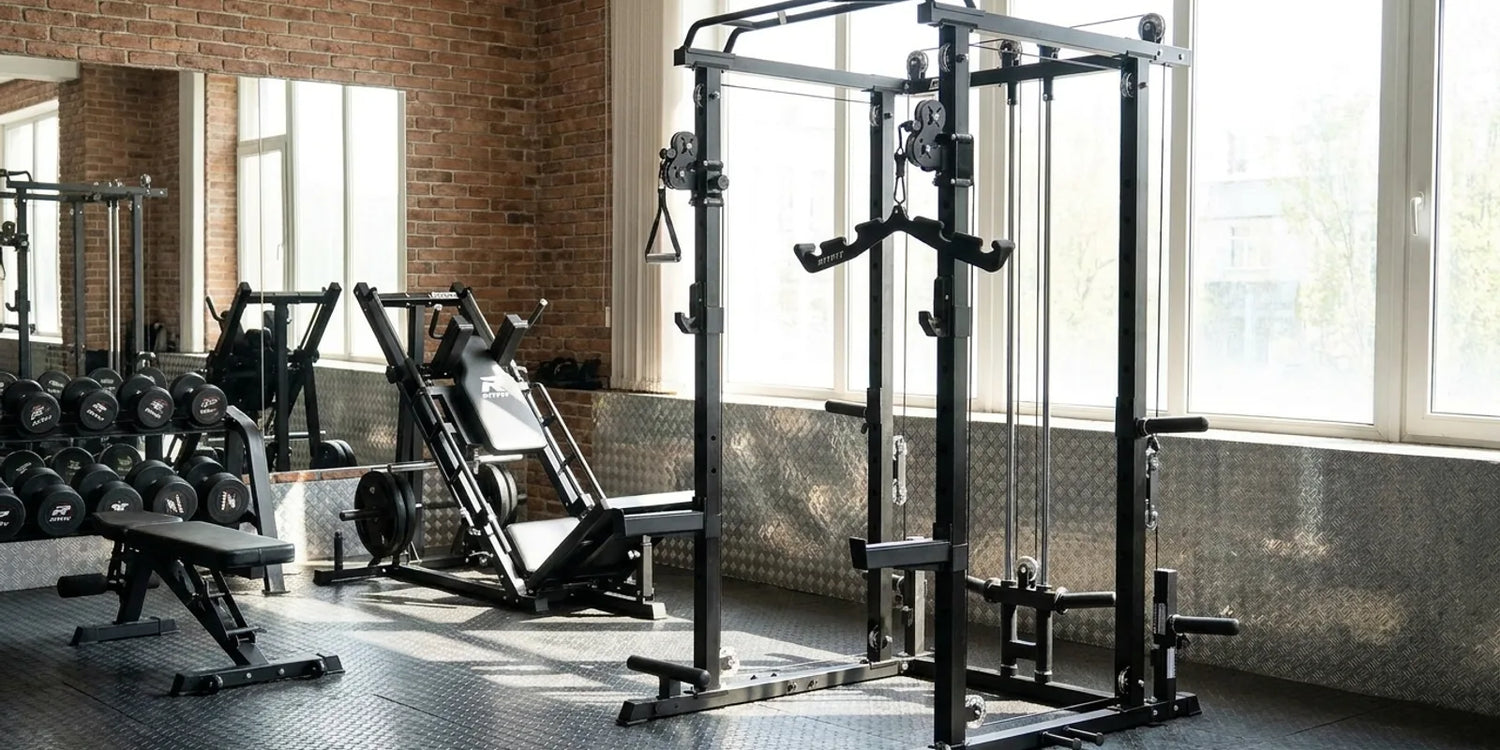
A home lat pulldown needs a high pulley that clears your head at full stretch, a frame that fits your ceiling, and floor space to sit and pull. Measure those three numbers before you compare machines, because the tallest frame is useless in a low basement.
Run the tape measure first, then match the frame to the room instead of the other way around.
- Ceiling clearance: Measure floor to ceiling at the exact spot the frame will stand, then subtract the rack height, and keep at least 12 inches of headroom above the top crossmember for your hands at full stretch.
- Footprint: Account for the frame plus the space you need to walk behind the seat with the arms extended, which is usually deeper than the published footprint alone.
- Bar path: Leave enough room in front of the seat to pull the bar to your collarbone without touching a wall, a shelf, or a parked car.
- Pulley positions: Count the cable adjustment holes, because more positions mean you can set the pulley high enough for a tall lifter and low enough for a lat pulldown and a seated row on the same frame.
- Resistance type: A built-in weight stack changes resistance with a pin and suits drop sets and shared training, while a plate loaded carriage costs less up front but needs plates you may already own.
- Pulldown hardware: Confirm the frame accepts a thigh hold-down, because anchoring the legs is what keeps heavy pulldowns from becoming rows.
| Specification | RitFit M1 Pro with stack | RitFit M2 3D | RitFit M3 Pro |
|---|---|---|---|
| Listed price | $2,199.99 | $2,199.99 | $3,099.99 |
| Frame capacity | 1,600 lb | 2,000 lb | 2,500 lb |
| Upright steel | 2 by 2 inch 14-gauge | 2.36 by 2.36 inch 13-gauge | 3 by 3 inch 11-gauge |
| Rack height | 85.3 inches | 86.14 inches | 84 inches |
| Footprint | 20.9 sq ft | 22.8 sq ft | 21.5 sq ft |
| Cable adjustment positions | 15 | 16 | 29 |
| Built-in weight stack | 264 lb | 286 lb | 360 lb |
Specifications and listed prices as shown on the RitFit M2 product page comparison table.
Frame capacity is the practical ceiling on how much you can load a pulldown, a low row, or a rack pull without the frame flexing under you. The M2 is rated to 2,000 lb with 13-gauge uprights, which leaves comfortable room for a 300 lb working set and still lets you pull heavy from the safeties.
The M3 Pro steps up to 2,500 lb and 3 by 3 inch 11-gauge steel, which matters if you plan to clamp several accessories to the uprights and expect them to stay put. The M1 Pro is the lightest of the three at 1,600 lb with a 20.9 sq ft footprint, so it fits a one-lifter garage where pressing and pulldown loads stay well inside its rating.
Cable adjustment positions decide how well one frame serves every person in the house. The M2 offers 16 positions and the M3 Pro offers 29, which is the difference between a tall lifter getting a full overhead stretch and a shorter lifter working with the pulley too high.
Pulldown hardware is specific to your model, so check compatibility before you buy. The RitFit LDM1 lat pulldown attachment fits the M1 Pro, while M2 owners can add the high row pulldown attachment or the RitFit ASM2 leg hold-down attachment that anchors the thighs for heavy sets.
All three frames ship with free shipping in the US continental, a 35 day return window, and lifetime support, and the M2 line arrives in seven to nine boxes depending on configuration. Budget an evening for assembly and stage the boxes where the frame will live, because the upright sections arrive in separate cartons.
If a full upright machine is more than your space allows, a RitFit BUFFALO Smith Machine home gym package still delivers a built-in lat pulldown with a cable crossover, and the RitFit PSR05 2.0 Smith Machine home gym package covers the same pattern in a power rack footprint.
Compare the RitFit M1 PRO Smith Machine and the rest of the Smith machines collection on footprint before you commit, then read the home gym lat pulldown machine comparison for a machine by machine walkthrough.
The RITFIT M2 3D Pro is a solid budget-friendly all-in-one home gym that works as a half-rack, a dual-cable functional trainer, lat-pulldown / low row machine, and perhaps the most unique feature: A 3D smith machine that can be used in 3D mode or as a standard fixed smith machine.
Eugene, Home Gym Equipment Reviewer, RITFIT M2 3D Pro Modular Home Gym Review, Good value?
For a walkthrough of how one of these frames fits into a real garage, watch the build below.
FAQs About Lat Pulldowns
Should the lat pulldown bar touch your chest on every rep?
The bar should reach your upper chest or clavicle level in a smooth motion without requiring torso compensation or backward leaning. If touching your chest causes shoulder rounding or elbow flare, stop the movement just below chin level to maintain lat tension.
Is wide-grip or close-grip better for lat pulldowns?
Wide-grip overhand pulldowns emphasize lat width through shoulder adduction, while close-grip neutral pulldowns allow heavier loading and deeper lat extension. Incorporating both variations across your training cycles delivers comprehensive upper-back hypertrophy and joint comfort.
Can lat pulldowns help improve pull-up performance?
Yes, lat pulldowns build the specific lat, rhomboid, and forearm pulling strength required for pull-ups through identical vertical pulling angles. Lifters can systematically overload the movement in small five-pound increments until their pulling capacity equals their body weight.
How many times per week should you do lat pulldowns?
Performing lat pulldowns one to two times per week within a push-pull-legs or upper-lower split delivers optimal back muscle growth. Allow forty-eight hours of recovery between heavy pulling workouts to support muscle recovery and tendon adaptation.
What rep range is most effective for lat pulldown growth?
A rep range of eight to twelve repetitions per set with two to three minutes of rest maximizes mechanical tension and metabolic stress. Training with controlled tempo and a two-second eccentric phase ensures deep muscular fatigue across the entire latissimus dorsi.
What is the difference between a lat pulldown and a pull-down machine?
The two names describe the same movement pattern performed on a high pulley. Lat pulldown usually refers to the free cable version where you supply the handles and the load, while pull-down machine refers to a dedicated station with a fixed bar and an enclosed weight stack, but the vertical pulling action and the primary muscles trained are identical.
Can you build back muscle with only a lat pulldown?
Yes. The lat pulldown trains the latissimus dorsi as the primary mover along with the trapezius, rhomboids and elbow flexors, and it can be overloaded in small increments, which makes it a complete driver of back development on its own. Adding a horizontal row keeps the mid back and scapular retractors balanced.
Should you lean back during a lat pulldown?
A slight lean of about ten to fifteen degrees is normal and helps the bar clear your face, but leaning far back turns the pulldown into a row and pulls the tension off the lats. Keep your ribcage lifted, your spine neutral, and your torso angle stable from the first rep to the last.
How long should you rest between lat pulldown sets?
Rest two to three minutes between heavy working sets so your grip and elbow flexors recover enough to keep the lats as the limiting factor. Shorter rest of sixty to ninety seconds suits lighter hypertrophy sets, while longer rest suits low rep strength work near your five rep maximum.
Is a lat pulldown enough for a beginner to build pulling strength?
Yes. A beginner can load a lat pulldown in small increments and train the exact vertical pulling pattern a pull-up demands, without needing to move their full bodyweight. Practicing it two times per week while chinning progressions improve usually produces the first unassisted pull-up.
Conclusion
The lat pulldown is the most controllable way to train a vertical pull, and it trains the latissimus dorsi as the primary mover while the trapezius, rhomboids, and elbow flexors assist. Keep the bar in front, lock the thighs down, and let small load increases do the work.
Start with the attachment your shoulders like, add 5 lb when you finish every set at the top of your rep range, and measure your ceiling before you buy. Our home gym guide walks through measuring a garage before you buy.
Disclaimer
This article provides general exercise and equipment information rather than medical advice. If you have a shoulder, elbow, or spine condition, or you feel pain during a set, consult a qualified healthcare or fitness professional before continuing.
References
1. Buonsenso A, Di Fonza D, Di Claudio G, et al. Electromyographic Analysis of Back Muscle Activation During Lat Pulldown Exercise: Effects of Grip Variations and Forearm Orientation. J Funct Morphol Kinesiol. 2025;10(3). doi:10.3390/jfmk10030345. PMCID: PMC12452428
2. Padovan R, Toninelli N, Longo S, et al. High-Density Electromyography Excitation in Front vs. Back Lat Pull-Down Prime Movers. J Hum Kinet. 2024;91(Spec Issue):47-60. doi:10.5114/jhk/185211. PMCID: PMC11057623
3. Lehman GJ, Buchan DD, Lundy A, Myers N, Nalborczyk A. Variations in muscle activation levels during traditional latissimus dorsi weight training exercises: An experimental study. Dyn Med. 2004;3(1):4. doi:10.1186/1476-5918-3-4. PMCID: PMC449729