








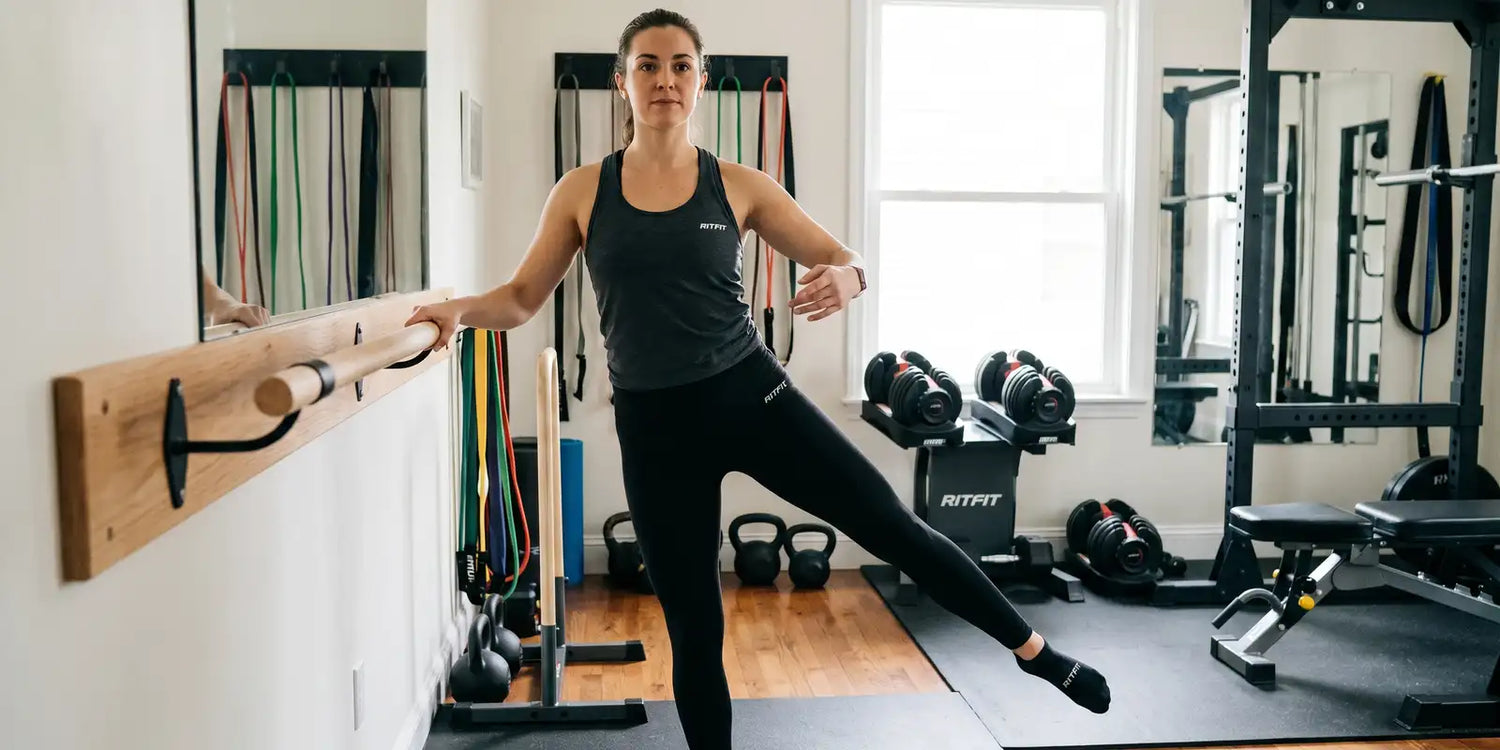
A barre class is a low-impact group fitness session that blends ballet, Pilates, yoga, and strength training into small, controlled movements at a stationary handrail. You hold positions, pulse, and work muscles to fatigue without heavy weights or jumping.
This guide explains what a class actually feels like, what to expect on your first visit, the realistic benefits, and how to start barre at home as a complete beginner.
Quick Answer: A barre class is a low-impact, beginner-friendly group fitness session that blends ballet, Pilates, yoga, and strength training. Using a stationary handrail called a barre for balance, you perform small, controlled pulses and isometric holds that fatigue your muscles without heavy weights or jumping.
Key Takeaways
- What it is: A barre class is a low-impact workout blending ballet, Pilates, yoga, and strength training at a stationary handrail.
- How it works: Small, controlled movements and isometric holds fatigue muscles using high reps instead of heavy weights.
- Main benefits: It builds strength, muscular endurance, flexibility, and posture while staying gentle on the joints.
- Not cardio: Barre is strength and flexibility focused, so pair it with other activity if you want intense aerobic work.
- Beginner friendly: No dance experience is needed, and you can start at home using a sturdy chair as a barre.
What Is a Barre Class?
A barre class is a low-impact workout that blends ballet, Pilates, and strength training, using small, precise movements at a ballet barre or sturdy surface for balance. The name comes from the handrail dancers use, but you do not need to be a dancer to benefit from it.
- Mixed influences: Classes borrow ballet positions, Pilates core work, and yoga-style stretching to build a full-body routine.
- Small movements: Most exercises use a short range of motion, called pulses, to keep target muscles under tension.
- No choreography: There are no routines to memorize, so the focus stays on form and muscle engagement rather than dance skill.
If you want the movement-level detail, our companion guide explains what a barre workout involves exercise by exercise.
What Happens in a Barre Class?
Most barre sessions follow a predictable rhythm so you always know what is coming next. One beginner guide notes that classes typically run about 60 minutes, opening with a warm-up and closing with a cool-down.
- Warm-up: Easy movements and dynamic stretches prepare your joints and raise your body temperature.
- Barre and floor work: You alternate standing work at the handrail with mat exercises for the core and glutes.
- Pulses and holds: Barre relies on high reps and isometric holds, so it is normal for a target muscle to start shaking.
- Cool-down: The class ends with stretching and yoga-like poses to improve range of motion.
Barre targets the core, glutes, thighs, and arms, so expect to feel worked in those areas without lifting anything heavy. If you want to layer in more focused work, our core workouts for beginners add targeted moves you can do on a mat.
How Does a Barre Class Compare to Yoga and Pilates?
The terms overlap, which causes confusion. A barre class is the guided group session, while a barre workout is the set of movements you perform, whether in a studio or at home.
- Versus yoga: Yoga emphasizes flexibility, breath, and sustained poses, while barre adds high-rep strength work and pulses.
- Versus Pilates: Pilates centers on core control and spinal alignment, while barre layers ballet-inspired standing work on top of that foundation. If you prefer the mat-only version, our guide to Pilates exercises for core strength at home walks through the fundamentals.
- Versus higher intensity: If you want sustained cardio, formats like higher-intensity formats like Tabata or metabolic conditioning workouts suit that goal better.
Barre sits between strength training and mobility work, borrowing the best of several disciplines without fully becoming any one of them.
What Are the Benefits of a Barre Class?
According to Cleveland Clinic, barre focuses on strength, flexibility, muscular endurance, and core engagement. The high-rep, low-weight format makes it a well-rounded option for everyday fitness.
- Strength and endurance: Isometric holds and pulses build muscular endurance in the core, glutes, thighs, and arms.
- Better posture: Strengthening the back, hips, and shoulders helps counter the hunching that comes from long hours of sitting.
- Joint friendly: With low resistance and no jarring impact, barre supports a strong yet gentle approach to training.
Ballet-style barre work helps develop strength, flexibility, and proper alignment, and the barre is used for roughly half of a typical class.[1] Dance-specific conditioning has also been shown to improve several measures of stability and balance in trained dancers, which supports barre-style work for motor control and joint stability.[2]
Who Is a Barre Class For?
Barre suits almost everyone, especially beginners and people returning to exercise. According to WebMD, barre is low impact with no jumping, which makes it gentle on the joints and a good option for those managing arthritis or joint pain.
- Complete beginners: No dance experience is required, and instructors offer modifications for every fitness level.
- Posture-focused movers: Anyone who sits for long hours benefits from the core and back work barre emphasizes.
- Joint-sensitive exercisers: The low-impact design keeps stress on the joints minimal while still challenging muscles.
Barre also engages the deep core and pelvic floor, which overlaps with pelvic floor and Kegel exercises many people already practice.
The short follow-along class below shows how approachable a beginner barre session looks at home.
How to Start Barre as a Beginner at Home
You can start barre at home without any special equipment. Use a sturdy chair, countertop, or wall for balance, and focus on slow, controlled form over speed.
- Find your barre: A stationary chair works well as a substitute, making standing exercises feasible and safe in a small space.[3]
- Start light: Begin with bodyweight movements, then add light dumbbells or a resistance band once the basics feel comfortable.
- Build a frequency: Aim for a few sessions each week, leaving recovery days so muscles can adapt between workouts.
For bodyweight-led routines beyond barre, our roundup of bodyweight strength routines offers more ways to train at home.
FAQs About Barre Classes
What is a barre class?
A barre class is a low-impact group fitness session that blends ballet, Pilates, yoga, and strength training.
You use a stationary handrail, called a barre, for balance while performing small, controlled movements and isometric holds.
Most classes run about an hour and focus on the core, glutes, thighs, and arms without heavy weights or jumping.
Is a barre class good for beginners?
Yes.
Barre is genuinely beginner friendly and needs no dance experience.
The movements are small, slow, and easy to follow, and instructors offer modifications so you can match your fitness level.
Because it is low impact with no jumping, it is also gentle on the joints, making it a comfortable starting point for new exercisers.
What should I bring to my first barre class?
Wear comfortable, fitted workout clothes so the instructor can see your alignment, and bring grippy socks since most studios do not allow bare feet or shoes.
A water bottle is helpful too.
Studios usually provide light weights, resistance bands, and small balls, so you rarely need to bring equipment to your first session.
Is barre a good cardio workout?
No.
Barre focuses on strength, muscular endurance, flexibility, and posture rather than sustained cardio.
Your heart rate will rise during faster sequences, but the slow, controlled pace means it is not an intense aerobic workout.
If cardio is your main goal, pair barre with higher-intensity formats or activities like brisk walking, cycling, or interval training.
How often should I do barre to see results?
Most people do best with about two to four barre sessions per week.
Barre creates real muscular fatigue, so recovery days matter, especially when you are starting out.
Combined with consistency and balanced nutrition, regular practice gradually improves strength, flexibility, posture, and body awareness over several weeks rather than overnight.
Can I do barre at home without a barre?
Absolutely.
You do not need a real ballet barre to start at home.
A sturdy chair, countertop, or wall works well for balance, and most beginner movements use only your body weight.
Follow a guided beginner class, focus on form over speed, and add light weights or a resistance band once the basics feel comfortable.
Conclusion
A barre class is an accessible, low-impact way to build strength, flexibility, and posture without heavy weights or high-impact moves. It welcomes beginners and adapts to any fitness level.
To get started, try a beginner class or follow a guided session at home using a chair for balance, and add light equipment as your confidence grows.
Disclaimer
This article is for general educational purposes only and is not medical or professional fitness advice. Consult a qualified healthcare provider or certified instructor before starting barre, especially if you have an injury, joint condition, or other health concern.
References
1. Weighart H, Dipasquale S. Insights on Ten Weeks of Classical Ballet Training and Postural Stability in Older Adults. International Journal of Exercise Science. 2020;13(1):101-112. PMCID: PMC7039482
2. Long KL, Milidonis MK, Wildermuth VL, Kruse AN, Parham UT. The Impact of Dance-Specific Neuromuscular Conditioning and Injury Prevention Training on Motor Control, Stability, Balance, Function and Injury in Professional Ballet Dancers: A Mixed-Methods Quasi-Experimental Study. International Journal of Sports Physical Therapy. 2021;16(2):404-417. PMCID: PMC8016435
3. Harrison EC, Haussler AM, Tueth LE, Baudendistel ST, Earhart GM. Graceful gait: virtual ballet classes improve mobility and reduce falls more than wellness classes for older women. Frontiers in Aging Neuroscience. 2024;16:1289368. PMCID: PMC10847569





