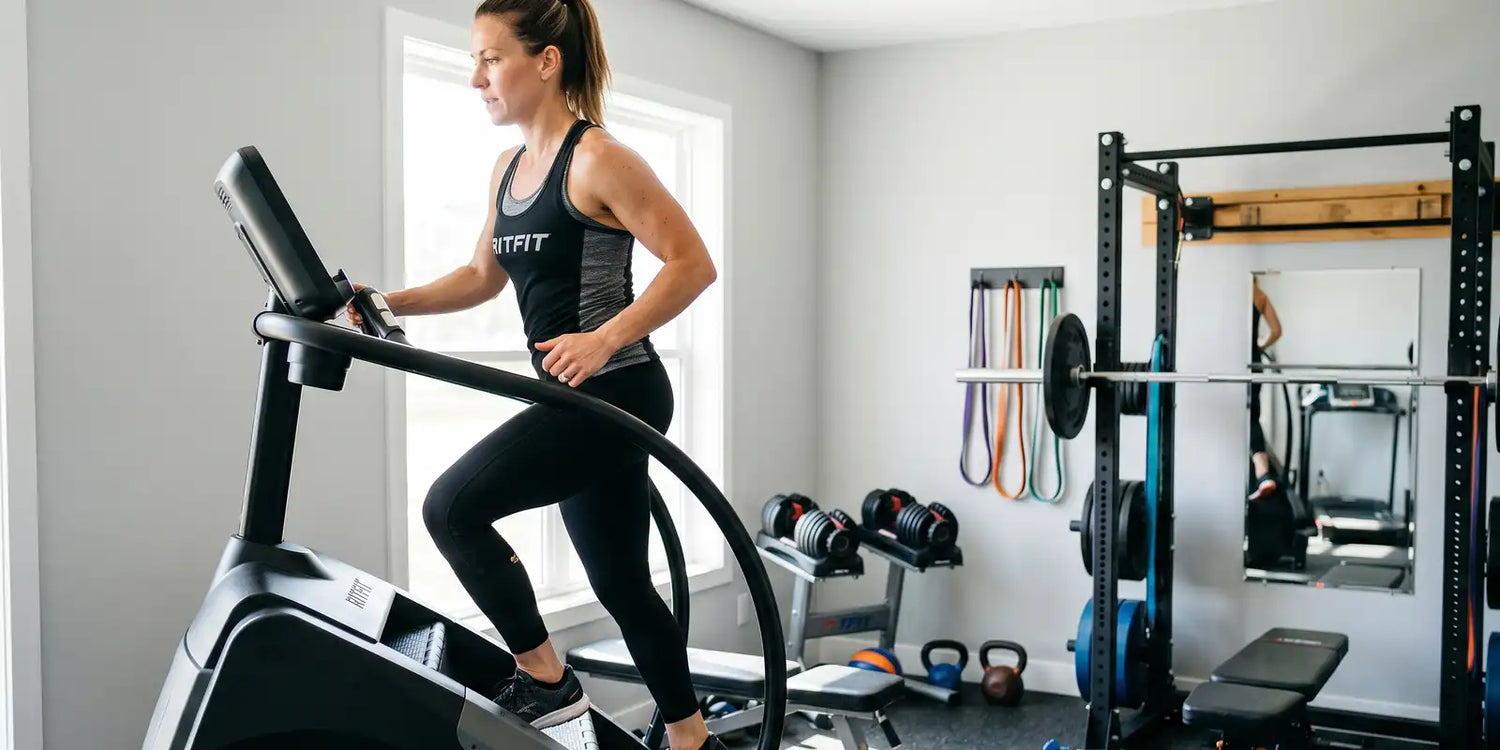
The StairMaster is a stair climbing cardio machine that trains your lower body while challenging your heart and lungs. This guide breaks down exactly which muscles it works and how to use it well.
You will learn the primary and stabilizing muscles involved, realistic tone versus build expectations, proper form, and simple ways to target specific muscle groups safely.
Table of Contents
- What Muscles Does the StairMaster Work?
- Which Primary Muscles Does the StairMaster Target?
- What Secondary and Stabilizing Muscles Are Involved?
- Does the StairMaster Build Muscle or Just Tone It?
- What Cardiovascular and Health Benefits Does It Offer?
- How Do You Use a StairMaster With Proper Form?
- How Can You Target Specific Muscles on the StairMaster?
- How Often Should You Train and When Should You Add Resistance?
- What Are Common Mistakes and When Should You Stop?
- How Do You Build a Complete Lower Body Routine?
Key Takeaways
- Primary muscles: The StairMaster mainly works the glutes, quadriceps, hamstrings, and calves with every step.
- Stabilizers too: Your core and hip flexors stay active to keep you balanced and upright.
- Tone, not bulk: It conditions and shapes the lower body but needs added resistance to build significant size.
- Strong cardio: It is a low impact aerobic workout that challenges your heart and lungs while sparing your joints.
- Form matters: Standing tall and driving through your heels improves glute activation and results.
What Muscles Does the StairMaster Work?
The StairMaster primarily works the glutes, quadriceps, hamstrings, and calves, while your core and hip flexors engage as stabilizers. Each upward step combines hip extension and knee extension, so the large muscles of the buttocks and thighs do most of the lifting.
- Movers: Glutes and quads power you up each step, with hamstrings assisting.
- Pushers: Calves contract to lift your heel and propel you forward.
- Stabilizers: Core and hip flexors maintain balance and posture.
This combination makes the machine a lower body and cardio workout in one session. For added strength, many people pair it with dedicated leg machines.
Which Primary Muscles Does the StairMaster Target?
The StairMaster targets four primary lower body muscle groups: the glutes, quadriceps, hamstrings, and calves. These muscles repeatedly contract to lift your bodyweight against gravity with each climbing motion.
Glutes (gluteus maximus, medius, and minimus)
The glutes are the strongest hip extensors in the body, and climbing relies heavily on them to drive you upward from each step.
Quadriceps
The quads are four muscles on the front of the thigh that extend the knee as you straighten your leg to rise to the next step.
Hamstrings
The hamstrings sit at the back of the thigh and work with the quads, bending the knee through a large range of motion as you climb.
Calves (gastrocnemius and soleus)
The calves contract every time you lift your heel to take a step, helping propel you upward and keeping you balanced.
What Secondary and Stabilizing Muscles Are Involved?
The StairMaster also recruits your core and hip flexors as secondary and stabilizing muscles. Staying steady on a moving staircase requires constant balance, so your abs and deep trunk muscles stay engaged throughout the workout.
- Core: Abdominals and lower back muscles keep your torso upright and stable.
- Hip flexors: The iliopsoas lifts your knee toward each new step.
- Posture benefit: A stronger core supports better posture and may reduce strain on the lower back.
Avoid slumping onto the handrails, since that shifts work away from these stabilizing muscles. You can build trunk strength further with focused MetCon workouts guide routines.
Does the StairMaster Build Muscle or Just Tone It?
The StairMaster tones and conditions your lower body but offers limited resistance for building significant muscle size. Because you mainly lift your own bodyweight at high repetitions, it favors endurance and shape over maximum hypertrophy.
A 12 week home based stair walking program done three times per week for 60 minutes per session improved lower extremity muscular strength, walking speed, and balance, and reduced body fat percentage in middle aged and older women[1].
- Great for: Endurance, toning, fat loss support, and functional fitness.
- Less ideal for: Maximum glute or quad growth without added load.
- Best approach: Combine climbing with resistance work for size and strength.
To add load, pair the machine with a leg press machine or a 3-in-1 leg press and hack squat machine.
What Cardiovascular and Health Benefits Does It Offer?
The StairMaster delivers strong cardiovascular benefits because it continuously challenges your heart and lungs as you lift your bodyweight. It is also low impact, making it gentler on the joints than running while still raising your heart rate quickly.
In one trial, eight weeks of short stair climbing bouts, progressing from one to five ascents a day at 90 steps per minute, produced a 17.1% increase in VO2max and a 7.7% reduction in LDL cholesterol relative to controls in sedentary young women[2]. Stair climbing based interval training is also a minimal equipment, low cost, time efficient option that improved cardiorespiratory fitness in supervised clinical studies[3].
- Heart and lungs: Builds aerobic capacity and endurance.
- Joint friendly: Low impact compared with running stairs or hills.
- Calorie burn: Supports fat loss when paired with a balanced routine.
Apply interval formats like a Tabata workout to vary intensity on the machine.
How Do You Use a StairMaster With Proper Form?
To use a StairMaster correctly, stand tall with your shoulders back and let your legs do the work instead of leaning on the handrails. Step at a controlled, steady rhythm and plant each foot fully before pushing up to the next step.
- Setup: Step on with firm footing, start slow, then increase speed gradually.
- Posture: Keep your chest up and core braced, with only light hand contact for balance.
- Drive through the heel: Pressing through your heel improves glute activation more than pushing off your toes.
The video below walks through stair climber setup, safety buttons, and pacing for beginners.
How Can You Target Specific Muscles on the StairMaster?
You can shift emphasis on the StairMaster by changing your step depth, foot position, and speed. Small adjustments redirect work toward your glutes, quads, or calves without changing machines.
- For glutes: Take slightly deeper steps and drive through the heel to load hip extension.
- For calves: Stay up on your toes for each step to emphasize the gastrocnemius and soleus.
- For intensity: Raise the speed or add intervals to increase load on the legs and heart.
For dedicated glute shaping, complement climbing with a hip abduction machine for glutes or the leg adduction abduction machine.
How Often Should You Train and When Should You Add Resistance?
Most people benefit from 2 to 4 StairMaster sessions per week, starting around 10 to 15 minutes and progressing toward 20 to 30 minutes. Increase duration or speed first, then add external resistance once steady climbing feels easy.
- Frequency: 2 to 4 sessions weekly fits most schedules and recovery needs.
- Progression: Add a few minutes or a faster pace each week before adding load.
- When to add resistance: A weighted vest or barbell training adds the load climbing alone lacks.
For progressive lower body loading, isolate the thighs with a leg extension and curl machine on strength days.
What Are Common Mistakes and When Should You Stop?
The most common StairMaster mistakes are leaning heavily on the handrails and taking short, choppy steps. These habits reduce muscle engagement and can strain your wrists, shoulders, and lower back over time.
- Avoid: Gripping the rails for support or hunching forward over the console.
- Avoid: Tiny rushed steps that bounce instead of full, controlled steps.
- Stop if: You feel sharp knee, hip, or chest pain, dizziness, or you cannot keep balance.
If you are new to exercise or have a heart or joint condition, check with a qualified professional before starting an intense climbing program.
How Do You Build a Complete Lower Body Routine?
A complete lower body routine pairs StairMaster cardio with resistance training that loads the same muscles. This combination develops both endurance and visible strength that climbing alone cannot fully deliver.
- Cardio base: Use the StairMaster for endurance and conditioning.
- Strength layer: Add squats, hip thrusts, and machine work for size and power.
- Balance: Train glutes, quads, hamstrings, and calves across the week.
Compare strength options in our leg press vs Smith machine guide, or explore best Smith machine exercises for glutes to round out your plan.
FAQs About the StairMaster
What muscles does the StairMaster work the most?
The StairMaster primarily works the glutes, quadriceps, hamstrings, and calves. Each upward step drives hip and knee extension, so your glutes and quads do most of the lifting. Your calves push you off each step, while your core and hip flexors engage to keep you balanced and upright throughout the climb.
Does the StairMaster build glutes or just tone them?
The StairMaster conditions and tones the glutes through high repetition, but it offers limited resistance compared to weights. To noticeably grow your glutes, pair stair climbing with progressive resistance training like hip thrusts, leg press, or hip abduction work. The machine is excellent for endurance and shape, less so for maximum muscle size.
Is the StairMaster good cardio?
Yes. The StairMaster is an effective low impact cardio machine. Because you continuously lift your bodyweight against gravity, it raises your heart rate quickly and challenges your heart and lungs. It is gentler on the joints than running, making it suitable for many fitness levels while still delivering a strong aerobic and calorie burning workout.
How do I use a StairMaster to target my glutes?
Stand tall with your shoulders back and avoid leaning on the handrails for support. Drive through your heel rather than your toes on each step, and take slightly deeper, fuller steps. Keeping a moderate, controlled pace lets your glutes do the work instead of your momentum, which improves glute activation and engagement.
How long should a StairMaster workout be?
Beginners can start with 10 to 15 minutes at a steady moderate pace and build from there. A common approach is 20 to 30 minutes of steady climbing or intervals alternating fast and slow phases. Listen to your body, prioritize good posture, and stop immediately if you feel sharp knee, hip, or chest discomfort.
Conclusion
The StairMaster trains your glutes, quads, hamstrings, and calves while engaging your core and hip flexors for balance. It is an efficient low impact way to combine cardio and lower body conditioning in one session.
Start with 10 to 15 minutes, stand tall, and drive through your heels. For visible strength gains, pair your climbs with resistance training that loads the same muscles.
Disclaimer
This article is for general educational purposes only and is not medical advice. Consult a qualified healthcare or fitness professional before starting any new exercise program, especially if you have a heart, joint, or other health condition.
References
1. Kang SJ, Ahn CH. The effects of home-based stair and normal walking exercises on lower extremity functional ability, fall risk factors, and cardiovascular health risk factors in middle-aged older women. Journal of Exercise Rehabilitation. 2019;15(4):584-591. https://pmc.ncbi.nlm.nih.gov/articles/PMC6732555/
2. Boreham CA, Kennedy RA, Murphy MH, Tully M, Wallace WF, Young I. Training effects of short bouts of stair climbing on cardiorespiratory fitness, blood lipids, and homocysteine in sedentary young women. British Journal of Sports Medicine. 2005;39(9):590-593. https://pmc.ncbi.nlm.nih.gov/articles/PMC1725304/
3. Valentino SE, Dunford EC, Dubberley J, et al. Cardiovascular responses to high-intensity stair climbing in individuals with coronary artery disease. Physiological Reports. 2022;10(10):e15308. https://pmc.ncbi.nlm.nih.gov/articles/PMC9120873/