








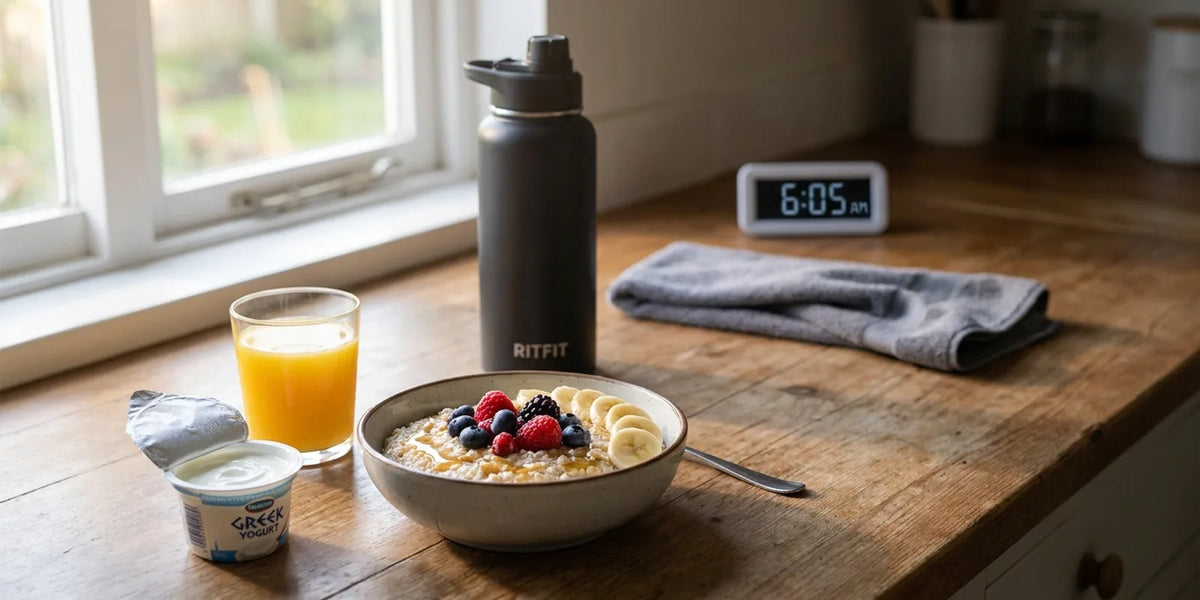
Early morning workouts raise one question before the sun is up. Should you eat first, and if so, what fits in 20 to 45 minutes?
It covers fasted versus fed training, simple timing rules, the best quick snacks, and what to avoid. It is written for healthy adults, not for medical or clinical conditions.
Table of Contents
Key Takeaways
- It depends on the session: Short, easy workouts are fine fasted, while longer or harder ones usually feel better with a little fuel.
- Go carbohydrate forward: The best early snacks are easy to digest and mostly carbs, such as a banana, toast, or applesauce.
- Timing is simple: A small snack sits fine 20 to 45 minutes before, while a full meal needs two to three hours.
- Fasted does not equal more fat loss: Fasted training can raise fat burning during the session, but total fat loss depends on your whole day calorie balance.
- Keep it light and hydrate: Avoid high fat and high fiber foods close to training, and drink water before you start.
Should You Eat Before an Early Morning Workout?
Whether you should eat before an early morning workout depends on how long and how hard the session is. For short, low intensity workouts under 60 minutes, most healthy adults can train fasted comfortably, while longer or harder sessions usually benefit from a small carbohydrate snack first.
- Train fasted if: Your session is short, easy, and you feel fine on an empty stomach.
- Eat first if: You are running long, lifting heavy, or doing high intensity intervals.
- When unsure: A small snack rarely hurts and often makes the workout feel smoother.
If you only have time for one decision before you head out, this is it. The food choices below build on that single judgment.
Fasted vs Fed: What the Evidence Shows
Fed training tends to support performance in longer sessions, while fasted training shifts fuel use toward fat without guaranteeing better results. A systematic review and meta analysis of 37 investigations concluded that pre exercise morning feeding enhanced prolonged aerobic performance over 60 minutes, but not shorter sessions under 60 minutes.[1]
The difference comes down to how your body powers the work, and how intense that work is.
"During lower-intensity exercise, your body tends to burn more fat for energy, but as the intensity increases, it relies more on stored carbohydrates or glycogen."
Brad Schoenfeld, PhD, Professor of Exercise Science, Lehman College, City University of New York
When Fasted Training Is Fine
Fasted exercise can raise post exercise circulating free fatty acids compared with fed exercise, which is why many people use it for easy morning cardio.[2]
- Best fit: Walking, easy jogging, gentle cycling, or mobility work under 60 minutes.
- The catch: Higher fat burning during a session does not automatically mean more fat loss over the day.
When Eating First Wins
Eating first tends to help when carbohydrate becomes the limiting fuel, which happens as intensity and duration rise. Long runs, heavy lifting, and high intensity interval work lean heavily on glycogen, so a little fuel can protect quality and focus.
- Best fit: Sessions over 60 minutes, heavy strength work, or intervals like a Tabata workout.
- Why it helps: Topping up available carbohydrate supports steadier energy and effort.
How Much to Eat and How Long Before?
The bigger the meal, the more time it needs, so most early risers do best with a small carbohydrate forward snack 20 to 45 minutes before training. Carbohydrate feedings before endurance exercise have generally been shown to enhance performance, and intake within 60 minutes of exercise does not appear to impair it.[3]
- Full meal: Allow about two to three hours, for example oatmeal with fruit and a little nut butter.
- Small snack: Eat 20 to 45 minutes before, aiming for roughly 15 to 30 grams of easy to digest carbs.
- Very short window: A few bites of fast carbs, like half a banana or a little juice, still help.
If you are heading out the door quickly, the small snack approach is the realistic and effective choice for most people.
What Are the Best Quick Pre-Workout Foods?
The best quick pre-workout foods for early mornings are easy to digest, mostly carbohydrate, and low in fat and fiber. A plain banana, toast, applesauce, or a few dates all fit, and you can add a small amount of protein when you have a little more time.
The video below breaks down simple, fast digesting options for early sessions.
If You Have 30 to 45 Minutes
Pick something carb forward with a small amount of protein or fat to steady the release of energy.
- Toast plus nut butter: Fast carbs with a thin layer of fat and protein.
- Oatmeal with fruit: A steady option if your stomach handles oats early.
- Greek yogurt with berries: Light, with a little protein for strength days.
If You Have Only 10 to 15 Minutes
Go simpler and faster, choosing foods that empty from the stomach quickly.
- Plain banana: Portable, gentle, and quick to digest.
- Applesauce or dates: Fast carbs in a small, easy package.
- Small glass of juice or milk: Liquid fuel when solids feel like too much.
How Should You Match Fuel to Your Workout Type?
You should match your fuel to the demand of the session, since cardio, strength, and long endurance work draw on energy differently. Lighter and shorter work needs little or nothing, while harder or longer work benefits from more available carbohydrate beforehand.
- Easy cardio: Often fine fasted, or a few bites of fast carbs if you feel low.
- Strength training: A small carb and protein snack can support a heavier bench workout or other lifts.
- Long endurance: Eat beforehand, since sessions over 60 minutes lean on glycogen.
For home gym lifters, simple gear like dumbbells, a sturdy option from our weight benches, or an Olympic barbell makes a fed morning strength session easy to set up. If you prefer conditioning, try MetCon workouts or bodyweight CrossFit workouts and fuel to match the intensity.
What Common Mistakes Should You Avoid?
The most common mistakes are eating the wrong foods or eating too close to a hard effort. High fat and high fiber foods digest slowly and can cause bloating or cramps, so keep pre-workout food small, simple, and carb forward.
- Heavy or fatty meals: Fried foods and large portions sit too long and can upset your stomach.
- Too much fiber: Big servings of beans or raw vegetables can cause gas and discomfort.
- Skipping water: It is easy to forget fluids early, so hydrate before you start.
- When to stop and rethink: If a food reliably causes cramps, drop it and refuel afterward instead.
Pairing the right food with a sensible bench workout routines plan keeps mornings comfortable and productive.
What If You Are Not Hungry in the Morning?
If you are not hungry first thing, go lighter rather than skipping fuel entirely. A plain banana, a small container of applesauce, a few dates, or a glass of juice or milk are easy to stomach early and signal that fuel is on the way.
- Liquid first: If solids feel hard, sip juice, milk, or a small smoothie.
- Start small: Even a few bites can keep you off a completely empty tank.
Browse our best-selling home gym gear if you are building a simple morning setup at home.
FAQs About Eating Before an Early Morning Workout
Should I eat before an early morning workout or train fasted?
It depends on the session. For short, low intensity workouts under 60 minutes, training fasted is generally fine for most healthy adults. For longer, harder, or high intensity sessions, eating a small carbohydrate rich snack beforehand usually improves energy, performance, and how you feel. When in doubt, a little fuel rarely hurts.
What is the best quick food to eat before a 6 a.m. workout?
Reach for easy to digest, carbohydrate forward foods such as a banana, a slice of toast, a small bowl of cereal, applesauce, or a few dates. If you have a little more time, add a thin layer of nut butter or some Greek yogurt for a small amount of protein. The goal is quick fuel, not a full meal.
How long before a morning workout should I eat?
The bigger the meal, the more time you need. A full breakfast needs about two to three hours, while a small snack can sit comfortably 20 to 45 minutes before training. For most early risers heading out the door quickly, a small carb forward snack eaten 20 to 45 minutes ahead is the realistic and effective choice.
Does working out fasted in the morning burn more fat?
Fasted exercise can increase fat oxidation and circulating free fatty acids during the session, but this does not automatically mean greater overall fat loss, since total weight change depends on your whole day calorie balance. Choose fasted or fed based on how you perform and feel, not on the promise of faster fat loss.
What foods should I avoid before an early morning workout?
Skip high fat and high fiber foods close to training, such as fried foods, large amounts of vegetables, beans, or heavy meals, because they digest slowly and can cause bloating, cramping, or stomach discomfort. Keep pre-workout food small, simple, and carbohydrate forward, and remember to hydrate before you start.
What if I am not hungry first thing in the morning?
Go simpler and lighter rather than skipping fuel entirely. A plain banana, a small container of applesauce, a few dates, or a glass of juice or milk are easy to stomach early and give your muscles a signal that fuel is on the way. Even a small amount can help you avoid starting on a completely empty tank.
Conclusion
Fueling before an early workout comes down to one judgment, then a simple food choice. Train fasted for short, easy sessions, and eat a small carb forward snack before longer or harder ones.
Start with a banana or toast 20 to 45 minutes before, hydrate, and adjust based on how you feel. Keep it light, keep it simple, and refuel afterward.
Disclaimer
This article is for general educational purposes for healthy adults and is not medical or nutritional advice for any condition. Consult a qualified healthcare professional or registered dietitian before making significant changes to your diet or exercise routine.
References
1. Stratton MT, Holden SL, Davis R, Massengale AT. The Impact of Breakfast Consumption or Omission on Exercise Performance and Adaptations: A Narrative Review. Nutrients. 2025;17(2). https://pmc.ncbi.nlm.nih.gov/articles/PMC11767684/
2. Dudar MD, Bode ED, Fishkin KR, et al. Pre-Sleep Low Glycemic Index Modified Starch Does Not Improve Next-Morning Fuel Selection or Running Performance in Male and Female Endurance Athletes. Nutrients. 2020;12(9). https://pmc.ncbi.nlm.nih.gov/articles/PMC7551949/
3. Ormsbee MJ, Bach CW, Baur DA. Pre-Exercise Nutrition: The Role of Macronutrients, Modified Starches and Supplements on Metabolism and Endurance Performance. Nutrients. 2014;6(5):1782-1808. https://pmc.ncbi.nlm.nih.gov/articles/PMC4042570/





