








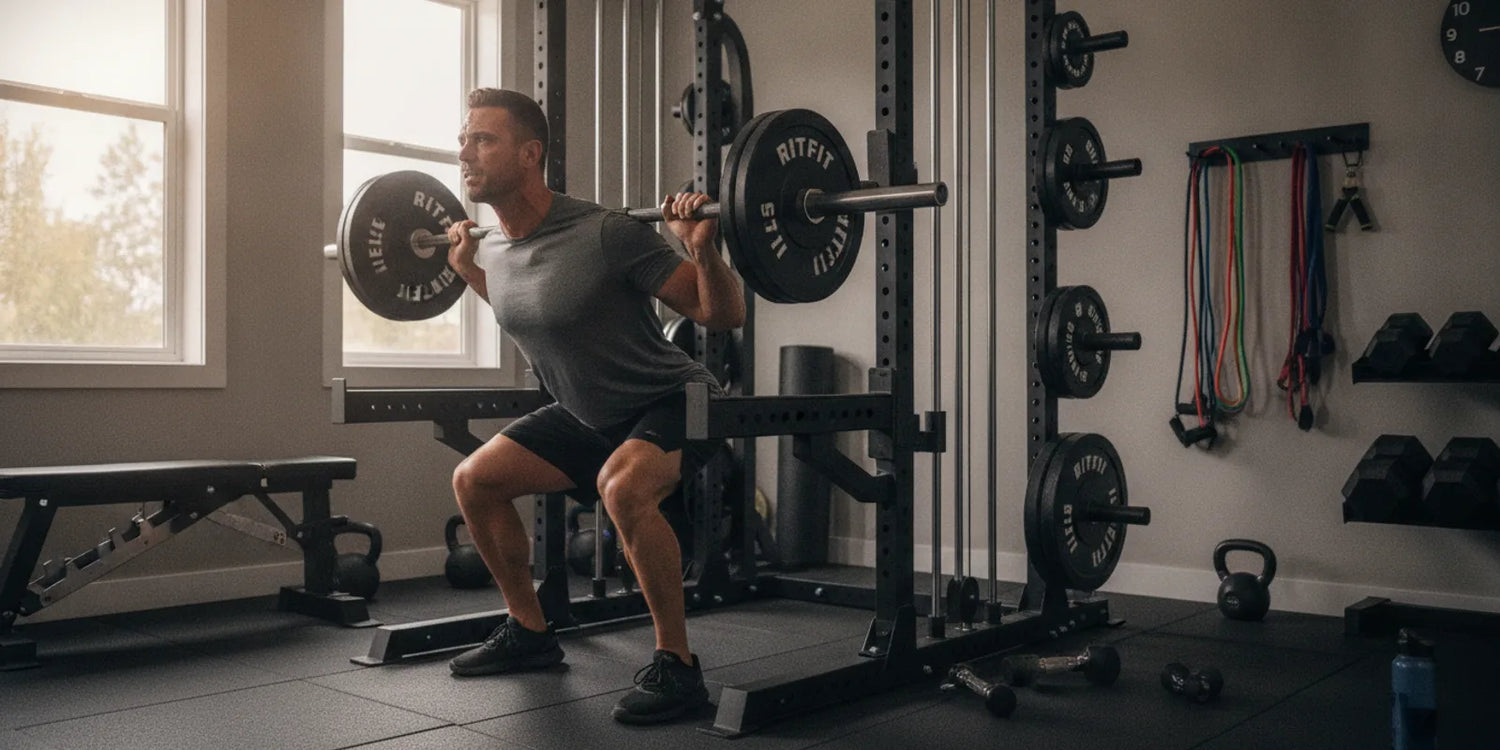
If the Smith machine feels heavier than the same plates on a free barbell, you are not imagining it. Bar weight differences, rail friction, missing counterbalance, and a fixed path that changes your body position can all make identical loads feel harder.
This guide breaks down the five mechanical and perceptual reasons, then gives you a quick diagnostic and a practical way to adjust your load and setup safely.
Key Takeaways
- No single cause: Bar weight, friction, missing counterbalance, body position, and reduced momentum can stack together to make the same plates feel harder.
- Bar weight varies: There is no universal Smith bar weight, so a solid steel bar can feel close to a 45 pound Olympic bar while a counterbalanced one feels much lighter.
- Friction is real: Worn or dry guide rods add drag you fight on every rep, which is why the same load feels different between gyms.
- Position matters: A fixed path can force an upright torso or altered stance that shifts the load onto less efficient angles.
- Adjust by effort: Do not copy free weight numbers directly, judge load by effort and rep quality and log the specific machine you use.
Why can the Smith machine feel heavier than free weights?
The Smith machine can feel heavier because several small factors stack on top of the plates you load. Bar weight, rail friction, a missing counterbalance, and an altered body position each add a little perceived or real resistance, and together they can make an identical load clearly harder.
- Mechanical factors: The bar itself and rail drag change the real resistance you move.
- Positional factors: A fixed path can put your joints at angles that feel weaker.
Output does not always follow feel, as a study of elite sprinters found squat jump heights were similar between Smith machine and free weight execution across loads from 40 percent to 120 percent of body mass.[2] If you are new to this equipment, start with our explainer on what is a Smith machine.
Does the Smith machine bar weigh more than an Olympic barbell?
Sometimes yes, the bar itself can weigh more than a standard Olympic barbell. There is no universal standard for Smith machine bars, so they commonly range from about 15 to 45 pounds depending on brand, material, and design.
- Solid steel bars: A heavy solid steel bar can feel close to a 45 pound Olympic bar before you add any plates.
- Lighter tube bars: Hollow or lighter bars start well below an Olympic bar, so the empty bar feels easier.
This is also why two machines with identical plates can feel completely different. For a full breakdown of the weight side of this question, see our companion guide on whether a Smith machine takes off weight.
How do rail friction and worn guide rods add resistance?
Rail friction makes the bar feel heavier by adding real drag on top of the plate load. The bar rides on guide rods through bushings or linear bearings, and when those rails are worn, dirty, or poorly lubricated, you fight extra resistance on every single rep.
- Smooth rails: High quality linear bearings let the bar glide, so the load feels close to the plates alone.
- Worn rails: Old bushings or dry rods create sticky drag that raises the real work slightly throughout the lift.
This is the main reason the same machine model can feel lighter in one gym and noticeably heavier in another. A well maintained multifunctional Smith machine with clean rails minimizes this drag.
Why does no counterbalance make it feel heavier?
A machine with no counterbalance feels heavier because nothing offsets the bar weight for you. Counterbalanced machines use internal weights, cables, or pulleys to cancel part of the bar, so a non counterbalanced bar gives you no assist and the full load reaches your muscles.
- Counterbalanced bars: Some systems offset roughly 10 to 20 pounds, making the displayed load feel lighter than free weights.
- Non counterbalanced bars: Without that assist, the bar feels closer to or heavier than a standard barbell.
If you train across different gyms, knowing whether your machine is counterbalanced explains a lot of the feel gap. Shoppers comparing models can review our guide to the best Smith machine for bodybuilding.
How does the fixed path change your body position?
The fixed path makes lifts feel heavier by locking the bar to one line and forcing your body to adapt around it. Instead of letting the bar follow your natural groove, you must align your stance, torso, and joints to the rail, which often loads weaker angles.
- Altered stance: On a squat you may shift your feet forward or stay more upright than you would with a free barbell.
- Joint angles: A locked line can push your knees, hips, or shoulders into positions that feel mechanically weaker.
A study using textile EMG found that quadriceps and hamstrings activation was greater with a free barbell path than with a fixed Smith machine path at a body mass load, while gluteus maximus activation showed no significant difference.[1] Kinematic and EMG comparisons of lower limb variations under different stabilities reinforce that path constraints change muscle demand.[3]
The video below shows how bench setup and bar positioning change on a Smith machine, where body position matters most.
You can see the same position effects on other lifts in our guides to the Smith machine squat and Smith machine lunges.
Why is there less stretch reflex and momentum help?
A Smith machine can feel heavier because the fixed path reduces the natural momentum and rhythm that help free weight lifts. With a free bar you subtly use the stretch reflex and a slight bounce out of the bottom, while the rail discourages that and demands more controlled effort.
- Less bounce: The strict vertical or angled line limits the small rebound many lifters rely on out of the bottom.
- More grind: Slower, more controlled reps raise the perceived effort even when the plate total is the same.
Because primary movers still do most of the work, the difference is often in feel and control rather than raw output. You can apply the same controlled approach to upper body work like the Smith machine row and Smith machine shrugs.
How do you tell which reason applies to your machine?
You can identify the cause with a few quick tests before you blame the load. Check the empty bar, feel for drag, and note the rail angle, and you will usually spot which factor is making your machine feel heavy.
- Test the empty bar: Lift the unloaded bar and judge whether it feels closer to a light tube or a full 45 pound bar.
- Feel for drag: Move the empty bar slowly through the full range and listen or feel for sticky, rough, or uneven rails.
- Note the angle: Check whether the rails are strictly vertical or angled, since a back angle changes how the load sits on you.
Run these checks once per new machine so you know what you are working with before loading heavy.
How should you adjust your load and setup?
Adjust by effort and rep quality rather than copying your free weight numbers. Because there is no reliable conversion between machines, test the empty bar, add load gradually, and judge each set by how it feels and how clean your reps stay.
- Start conservative: Begin lighter on an unfamiliar machine, then build up once the path and friction feel predictable.
- Log the machine: Record which specific Smith machine you used, since two units can behave very differently.
Remember that the strength you build can be specific to the tool you train on.
"It appears that gains in strength are modality-specific. If you want to gain strength in a machine-based exercise, you're likely better off predominantly training with machines. Likewise, the opposite applies, if you're competing in powerlifting or any other free-weight-based strength sport, it would behoove you to predominantly train with free weights and barbells."
Greg Nuckols, MA, Strength Researcher and Coach, Stronger By Science
What common mistakes make it feel harder?
The most common mistake is treating Smith machine numbers as interchangeable with free weight numbers. People also fight the fixed path with poor foot or bench placement, which makes a manageable load feel far heavier than it should.
- Copying free weight loads: Loading your barbell max onto an unfamiliar machine ignores friction and bar weight differences.
- Wrong foot or bench position: Standing or lying in the wrong spot forces an awkward angle against the locked path.
- Ignoring maintenance: Using a sticky, poorly maintained unit adds drag you could avoid by choosing a smoother machine.
Fixing your setup usually removes most of the extra heaviness without changing the plates at all.
When should you stop or reduce the weight?
Stop the set whenever the fixed path forces your joints into a painful position. If your knees, hips, or shoulders feel pinched or sharp pain appears, rack the bar immediately rather than pushing through to finish the reps.
- Sharp or pinching pain: Rack the bar, reduce the load, and reassess your stance or bench placement.
- Lost control: If reps slow to a grind and form breaks down, stop and lower the weight.
When the locked path simply does not suit your body, switch to a free weight version that lets your joints move on their natural line.
FAQs About Why the Smith Machine Feels Heavier
Why does the Smith machine feel heavier than free weights with the same plates?
Several factors stack up, as some Smith bars weigh as much as or more than an Olympic bar while worn guide rods add friction. The fixed path also forces an upright body position that can shift the load onto less efficient angles, so identical plates feel noticeably harder on poorly maintained machines.
Does a Smith machine bar weigh more than an Olympic barbell?
It depends on the model, because there is no universal standard and Smith bars commonly fall anywhere from about 15 to 45 pounds. Non counterbalanced solid steel bars can feel close to a 45 pound Olympic bar while lighter counterbalanced bars feel much lighter, so always test the empty bar before assuming.
Can friction really make the bar feel heavier?
Yes. The bar rides on guide rods through bushings or linear bearings. When those rails are worn, dirty, or poorly lubricated, the added drag means you fight extra resistance on every rep. A smooth high quality machine glides easily, which is why the same load can feel different from gym to gym.
How should I adjust my weight when a Smith machine feels heavier?
Do not directly copy your free weight numbers. Test the empty bar, then add load gradually and judge by effort and rep quality rather than the plate total. Log the specific machine you use so your progress stays consistent, since two Smith machines can behave very differently from each other.
Should I stop if a Smith machine lift feels wrong?
Yes. If the fixed path forces your knees, hips, or shoulders into a position that causes pinching or sharp pain, rack the bar and stop the set. Reduce the load, adjust your foot or bench placement, or switch to a free weight version that lets your joints move on their natural path.
Conclusion
When the Smith machine feels heavier, it is usually a mix of bar weight, rail friction, missing counterbalance, and a fixed path that changes your body position. None of these mean you are weaker, they just change how the load feels.
Check the empty bar first, judge each set by effort, and log which machine you used. Browse the full Smith machine range if you want a smoother, better maintained unit at home.
Disclaimer
This article is for general educational purposes only and does not replace personalized coaching or medical advice. Consult a qualified fitness or healthcare professional before starting any new training program, especially if you have an injury or health concern.
References
1. Svensson F, Aasa U, Strong A. Textile electromyography electrodes reveal differences in lower limb muscle activation during loaded squats when comparing fixed and free barbell movement paths. Front Sports Act Living. 2022;4:1021323. doi:10.3389/fspor.2022.1021323 https://pmc.ncbi.nlm.nih.gov/articles/PMC9745169/
2. Loturco I, McGuigan MR, Freitas TT, et al. Squat and countermovement jump performance across a range of loads: a comparison between Smith machine and free weight execution modes in elite sprinters. Biol Sport. 2022;39(4):1043-1048. doi:10.5114/biolsport.2022.112085 https://pmc.ncbi.nlm.nih.gov/articles/PMC9536377/
3. van den Tillaar R, Larsen S. Kinematic and EMG Comparison Between Variations of Unilateral Squats Under Different Stabilities. Sports Med Int Open. 2020;4(2):E59-E66. doi:10.1055/a-1195-1039 https://pmc.ncbi.nlm.nih.gov/articles/PMC7365712/





