Choosing the right workout bench for hip thrusts can make the difference between a glute exercise that fires perfectly and one that leaves your lower back doing all the work. The bench height, pad width, weight capacity, and base stability all directly affect how the barbell loads your hips through each rep.
This guide breaks down the exact specs to look for in a bench for hip thrusts, compares flat versus adjustable options, walks through setup step by step, and helps you pick the right RitFit bench for your home gym goals.
Quick Answer: The best workout bench for hip thrusts sits between 13 and 16 inches tall, has a firm pad at least 10 inches wide, and supports at least 600 to 1,000 lbs. A flat bench works for dedicated hip thrust users, while an adjustable bench set to flat gives you more versatility for your entire home gym routine.
Key Takeaways
- Bench Height: A height of 13 to 16 inches puts your torso at the correct angle for peak glute loading during hip thrusts.
- Weight Capacity: As your barbell load grows, you need a bench rated for at least 600 to 1,000 lbs to train safely without worrying about the frame.
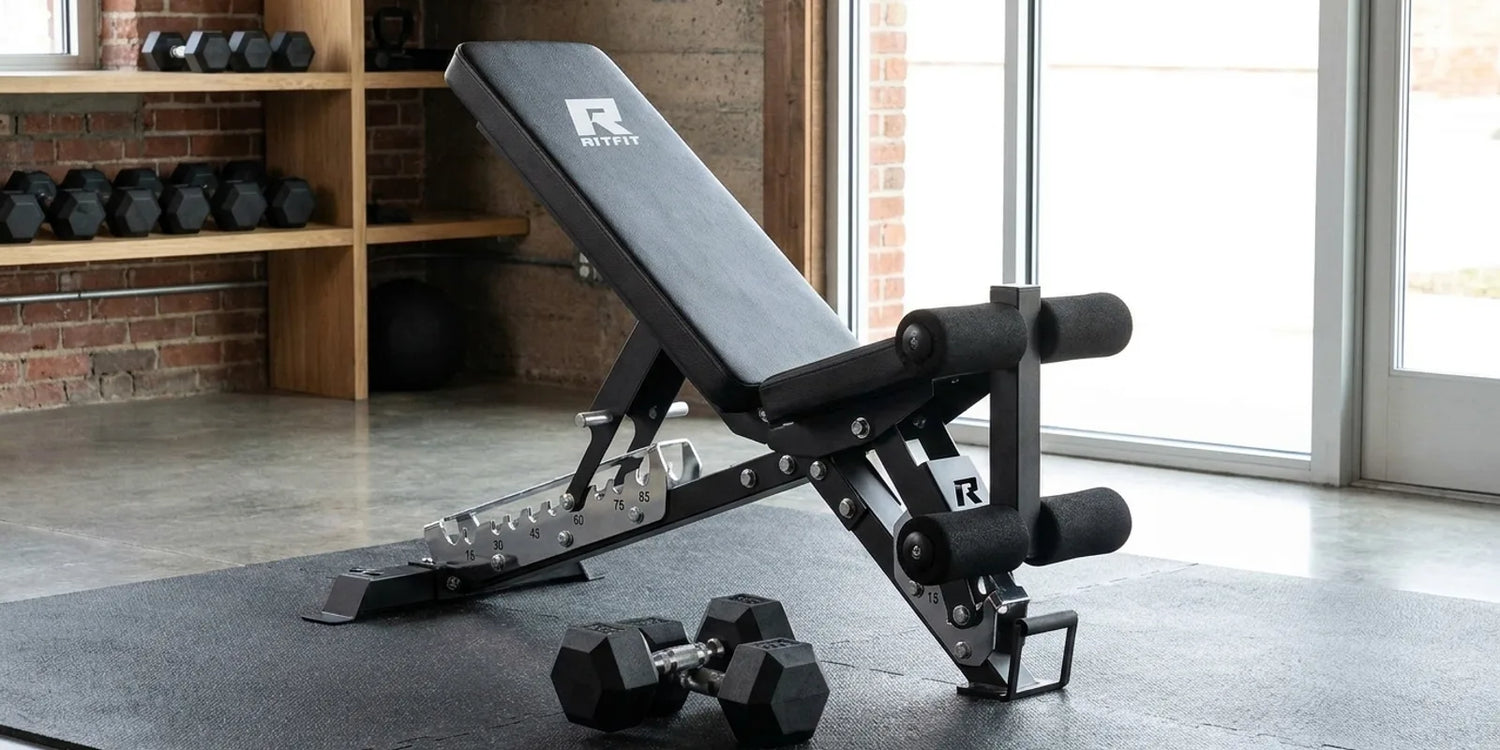
- Flat vs. Adjustable: Both work well for hip thrusts when set flat. An adjustable bench locked to 0 degrees gives you bench press and shoulder work in addition to hip thrusts.
- Stability Is Non-Negotiable: The bench must stay fixed during a heavy loaded hip thrust. Anchor it against a wall, power rack, or weight stack to prevent sliding.
- Pad Firmness Matters: A firm, dense pad provides consistent support under load. An overly soft cushion compresses and shifts your pivot point mid-set.
Why Does the Bench Matter So Much for Hip Thrusts?
The bench in a hip thrust is not just a prop. It is the pivot point that determines your torso angle, hip loading position, and the range of motion your glutes travel through every single rep.
A 2021 biomechanical study found that the barbell hip thrust produces significantly greater bilateral extensor demand at the hip joint compared with the knee and pelvic-trunk joints, confirming that hip extension mechanics depend on optimal positioning.[1]
A 2020 study following adolescent female soccer players found that 6 weeks of barbell hip thrust training improved hip thrust 3RM by 34% alongside meaningful gains in vertical jump, broad jump, and ball-kicking performance.[2]
- Pivot placement: The bench edge contacts your upper back just below the shoulder blades. Too high a bench pushes the pivot into your neck, while too low shifts it toward mid-back and reduces hip range of motion.
- Torso angle: At the correct 13-to-16-inch height, your torso starts at roughly 45 degrees or less, which lets your hips drop low and drive high through a full arc.
- Load transfer: During a barbell hip thrust, the bench absorbs significant horizontal force as you push up and forward. A narrow or wobbly bench bleeds energy from each rep.
- Injury prevention: A bench that slides mid-rep under a loaded barbell creates real risk. Anchoring the bench and choosing a stable base design is a basic safety requirement, not an upgrade.
Learn the mechanics in detail with the how to do a barbell hip thrust guide before selecting your bench.
What Bench Specs Actually Matter for Hip Thrusts?
Four specifications directly affect how well any workout bench performs for hip thrusts. Height, pad width, weight capacity, and base stability are the numbers to compare before you buy.
Optimal Bench Height: 13 to 16 Inches
According to Bret Contreras, PhD, known as "The Glute Guy," the optimal height is around 16 inches, with a workable range of 13 to 19 inches covering 99% of lifters. Benches taller than 18.5 inches place the torso too upright, shortening the effective range of motion at the hips.
Standard commercial gym benches frequently measure 17 to 19 inches. If you are training on a taller bench, place a folded mat or Airex pad under your hips to raise your body relative to the bench and restore a more favorable angle.
Pad Width and Firmness
A pad width of at least 10 to 12 inches gives your upper back a stable, even contact surface during hip thrusts. Narrower pads concentrate pressure on your spine, which becomes uncomfortable quickly under a loaded barbell and can affect your form.
- Firmness: A dense, firm pad holds its shape under bodyweight plus barbell load. Softer consumer-grade pads compress mid-set, lowering your effective bench height and shifting your pivot point.
- Surface grip: A grippy, non-slip vinyl or CleanGrip-style surface prevents your upper back from sliding back and forth, which is essential for keeping the barbell directly over your hips throughout each rep.
- Gap between pads: On adjustable benches, look for a minimal gap between the seat pad and back pad. A large gap can press into the mid-spine during hip thrusts, especially on lifters with shorter torsos.
Weight Capacity: Plan for 1.5 to 2 Times Your Body Weight on the Bar
Hip thrust strength builds quickly. A 2019 study found that trained males improved their barbell hip thrust 1RM by approximately 27.5 kg, or 24.8%, in just 4 weeks of training, which means your working weight can increase substantially within a single training cycle.[3]
For most intermediate lifters, the barbell load alone will eventually reach 135 to 315 lbs. Adding body weight, choose a bench rated to at least 600 lbs, while commercial-grade adjustable benches typically carry 1,000-lb flat-position ratings for a large safety buffer.
Stability and Base Design
Base design determines whether your bench stays put under horizontal thrust force. A wide rear base with rubber-tipped feet grips the floor significantly better than a narrow-legged frame.
- Wide rear base: A wider footprint distributes the backward force created during each rep, preventing tipping and sliding on rubber gym flooring.
- Rubber feet or floor anchors: Rubber-coated legs and base pads grip the floor far better than bare steel or plastic on a slick surface.
- Wall or rack anchor option: Even the most stable bench benefits from being placed against a wall, a power rack upright, or a weight plate stack. This eliminates sliding entirely on smooth flooring.
- Frame gauge: An 11-gauge or heavier steel frame does not flex under heavy loads. Lighter-gauge frames can develop a subtle rocking motion that grows noticeable as your working weight climbs.
Pair your bench with rubber interlocking gym floor mats to improve bench grip and protect your floor during heavy hip thrust sessions.
"I believe the optimal bench height is around 16 inches. This is what most clients feel most comfortable with, in general, a range of 13-19 inches will satisfy 99% of lifters."
Bret Contreras, PhD, PhD in Sports Science, known as The Glute Guy, Contreras Strength Institute
Flat Bench vs. Adjustable Bench: Which Is Better for Hip Thrusts?
Both bench types work well for hip thrusts when the height falls in the optimal 13-to-16-inch range. The decision comes down to your training goals and budget.
| Feature | Flat Bench | Adjustable Bench (set flat) |
|---|---|---|
| Hip thrust suitability | Excellent, no adjustment needed | Excellent, must be locked to 0 degrees |
| Height consistency | Fixed, always correct | Fixed at flat position, consistent |
| Exercise versatility | Limited to flat-position exercises | Full FID range: incline, decline, shoulder press |
| Pad gap between sections | None (continuous surface) | Minimal gap possible on quality models |
| Long-term value | Best if hip thrusts are the primary use | Best for lifters who want one bench for everything |
Table reflects general bench design characteristics. Always verify the flat-position height of any specific model before purchasing.
- Choose a flat bench if: Hip thrusts are your primary use, you prefer a continuous uninterrupted pad surface, and you want the simplest possible setup.
- Choose an adjustable bench if: You also do barbell bench press, dumbbell incline work, seated shoulder presses, or decline movements and want a single bench to handle your full training program.
- Long-term cost: An adjustable bench costs more upfront but eliminates the need to ever buy a second bench as your training evolves. A flat bench is the lower entry price but does not grow with you if you add upper-body pressing work later.
For most home gym setups, an adjustable bench locked to flat is the better long-term investment. Browse the full range of RitFit weight benches to compare specifications side by side.
How Do You Set Up a Workout Bench for Hip Thrusts?
Setting up a standard workout bench for hip thrusts correctly takes about 60 seconds. It makes a significant difference in glute activation and comfort during heavy sets.
Step 1: Position the Bench
Place the bench against a wall, a power rack upright, or a heavy weight stack to prevent it from sliding. On smooth flooring, add rubber mats under the bench feet for extra grip before every session.
Step 2: Sit in Front of the Bench and Find Your Pivot Point
Sit on the floor with your back against the bench. The bench edge should line up just below your shoulder blades, at roughly your bra-strap line.
Step 3: Position Your Feet and Check Knee Angle
Plant your feet flat on the floor, slightly wider than shoulder width, toes pointed forward or slightly out. When your hips are at the top of the movement, your shins should be roughly vertical with knees at about 90 degrees.
Step 4: Load and Pad the Barbell
Roll the barbell up your shins to your hip crease. Always use a thick barbell pad, hip thrust pad, or folded towel between the bar and your pelvis.
For lifters who cannot roll the bar up because the plates are too small, use bumper plates or have a training partner place the bar. For a variation without a barbell, try the banded hip thrust to build the movement pattern first.
Step 5: Execute the Rep
Drive through your heels and extend your hips until your thighs are parallel to the floor, forming a straight line from shoulders to knees. Squeeze your glutes hard at the top, hold for one second, then lower under control.
Common Setup Mistakes That Reduce Glute Activation
These errors consistently appear among lifters who find hip thrusts uncomfortable or feel them more in their hamstrings and lower back than their glutes.
- Bench too tall: A bench over 19 inches puts your torso too upright at the start, reducing the range of motion your glutes travel. If the bench is too tall, raise your hips with a folded mat underneath your seat.
- Upper back too high on the bench: Resting your shoulder blades flat on the pad, rather than just below them, shortens your hip travel at the top of the rep and loads the lower back instead of the glutes.
- Feet too close or too far: Either extreme removes the 90-degree shin angle at the top. Take a moment at the start of each set to confirm foot placement before loading the bar.
- No barbell pad: A bare barbell on the hip crease during a loaded hip thrust causes bruising and forces you to reduce weight long before your glutes are fatigued. Always pad the bar.
- Unstabilized bench: A bench that rocks or slides during the rep forces you to think about stability instead of glute contraction. Anchor the bench before every heavy session.
- Skipping the glute squeeze at lockout: Driving to hip extension without a deliberate pause and squeeze at the top reduces time under tension in the fully shortened position. Hold the top for one count on every rep.
If the dumbbell hip thrust feels more manageable for your current training level, it uses the same bench setup with lighter loads while you build the barbell movement pattern.
Watch this RitFit demonstration for a visual walkthrough of the setup and movement.
Which RitFit Bench Is Best for Hip Thrusts?
The right RitFit bench for hip thrusts depends on your current training load, the space in your home gym, and whether you also want the bench to handle pressing work. Match the model to your working weight and available footprint.
| Model | Weight Capacity | Adjustability | Best For |
|---|---|---|---|
| RitFit 1300lb Adjustable Bench | 1,300 lb | Multiple FID angles + flat | Heavy barbell hip thrusts and a full upper-body pressing program |
| RitFit GATOR Adjustable Bench | Mid-range capacity | Adjustable angles, compact build | Versatile home gym use with a smaller footprint |
| RitFit Foldable Utility Bench | Up to 750 lb | Flat + basic incline, foldable | Space-saving setups and moderate hip thrust loads |
Specifications may vary by model variant. Verify current specs on each product page before purchasing.
- For heavy barbell hip thrusts (135 lb and above): The RitFit 1300lb Adjustable Weight Bench is built for serious loading. Its 1,300-lb capacity means you will never outgrow it, and you can lock it flat for hip thrusts or angle it up for pressing work on the same bench.
- For a compact versatile setup: The RitFit GATOR Adjustable Bench offers a smaller footprint and multiple angle settings, making it a strong choice for garage gyms or smaller spaces where you need the bench to do double duty.
- For a budget-friendly or space-saving solution: The RitFit Foldable Utility Bench folds flat for storage after each session, which makes it practical for living spaces or shared rooms where gym equipment needs to disappear between workouts.
- Not sure which bench to pair with your existing setup: Check the adjustable workout bench guide for a deeper look at angle ranges, pad options, and frame construction differences.
Whatever model you choose, combine it with the full best bench workout routines guide to get more than hip thrusts out of your bench. Explore hamstring workouts with a bench to build the posterior chain alongside your glute training.
FAQs About Workout Bench for Hip Thrusts
What is the best bench height for hip thrusts?
The optimal bench height for hip thrusts is 13 to 16 inches, with 16 inches being the sweet spot for most lifters. At this height, your torso angle stays at 45 degrees or less at the start, which maximizes glute activation and keeps the movement comfortable through the full range of motion on every rep.
Can I use an adjustable bench for hip thrusts?
Yes.
An adjustable bench works well for hip thrusts when locked to the flat position at 0 degrees.
You get a stable surface for hip thrusts plus incline and decline settings for pressing exercises.
Choose a model with at least 600 lbs of capacity and a wide, stable base that stays put under a loaded barbell.
How do I stop the bench from sliding during hip thrusts?
Place the bench against a wall, a power rack upright, or a heavy weight plate stack to anchor it in place.
On hard floors, add rubber mats or non-slip pads under the bench feet.
A bench with a wide rear base and rubber-tipped feet is significantly more resistant to sliding under load than a narrow-legged bench on a smooth surface.
What weight capacity bench do I need for hip thrusts?
For most intermediate lifters, a bench rated to at least 600 to 1,000 lbs is the right starting point. As your hip thrust progresses, the barbell load alone can reach 135 to 315 lbs, so you need capacity that comfortably exceeds your working weight plus body weight combined.
Is a flat bench or an adjustable bench better for hip thrusts?
A flat bench is ideal if hip thrusts are your primary use, since it offers an uninterrupted pad surface with no gap and a consistent height. An adjustable bench works equally well for hip thrusts when locked flat, and adds incline and decline angles for pressing work, making it the better overall investment for most home gym lifters.
Where should my upper back be on the bench during hip thrusts?
Line the bench up so its edge sits just below your shoulder blades, at roughly your bra-strap line. This creates the pivot point that lets your hips drop low and drive upward through full extension. Placing the bench too high on your upper back or too far toward your mid-back shifts the load away from the glutes on every rep.
Conclusion
The best workout bench for hip thrusts sits 13 to 16 inches off the floor, has a firm wide pad, and holds at least 600 to 1,000 lbs. Both flat and adjustable benches work, but an adjustable model locked flat gives your home gym more long-term value.
Start by anchoring your bench, confirming your shoulder-blade pivot point, and dialing in foot position before adding weight. Check the workout bench guide to build a complete lower and upper-body program around your bench, and visit RitFit Sales for current offers.
Disclaimer
The information in this article is for general educational purposes and does not constitute medical or professional fitness advice. Consult a qualified fitness professional or healthcare provider before starting any new strength training program, particularly if you have a pre-existing injury or medical condition.
References
1. Brazil A, Needham L, Palmer JL, Bezodis IN. A comprehensive biomechanical analysis of the barbell hip thrust. PLoS One. 2021;16(3):e0249307. PMCID: PMC8006986
2. Millar NA, Colenso-Semple L, et al. In-season hip thrust vs. back squat training in female high school soccer players. Int J Exerc Sci. 2020;13(4):49-61. PMCID: PMC7039497
3. Hammond G, et al. The effects of a 4-week mesocycle of barbell back squat or barbell hip thrust strength training upon isolated lumbar extension strength. PeerJ. 2019;7:e7337. PMCID: PMC6662562