








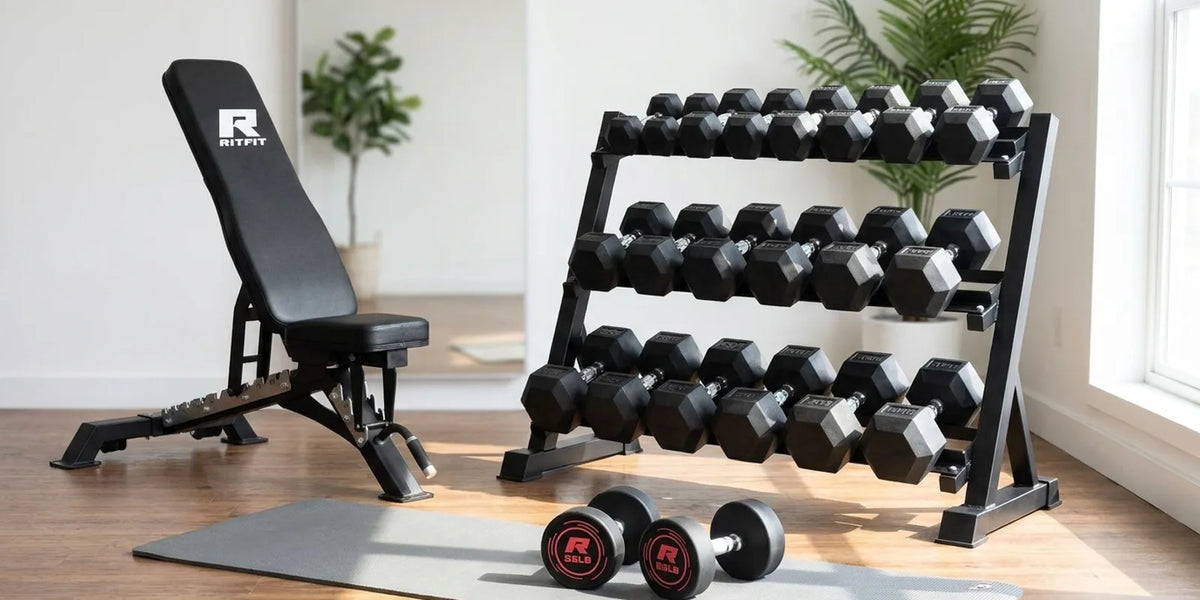
A workout routine for women to lose belly fat pairs total-body strength training with short conditioning sessions and core finishers, trained three to four days a week at home or in the gym. Belly fat is lost through an overall calorie deficit, so the compound lifts and full-body work below raise calorie burn and preserve muscle.
This guide covers how often to train, the exercises that actually reduce belly fat, and ready-to-follow home and gym routines, plus how to choose weights and progress safely.
Quick Answer: A workout routine for women to lose belly fat combines compound strength training with dumbbells or barbells, short conditioning sessions, and core finishers, done three to four days a week at home or in the gym. Fat loss happens through an overall calorie deficit, so consistency with training and eating matters more than any single move.
Key Takeaways
- Strength plus cardio: A balanced routine pairs total-body strength training with short conditioning sessions, because each one supports fat loss in a different way.
- No spot reduction: You cannot target belly fat with specific moves, so whole-body training and a calorie deficit are what shrink the waistline.
- Frequency: Three to four training days a week, with a rest day between sessions, is enough to drive fat loss and preserve muscle.
- Weight choice: Pick a weight you can control for the prescribed reps, with the last two reps feeling challenging but not sloppy.
- Progression: Add reps first, then add weight when every set finishes at the top of the rep range with good form.
How Often Should a Woman Work Out to Lose Belly Fat?
Most women lose belly fat effectively with three to four training days a week, with at least one full rest day between sessions and never more than three training days in a row. This schedule gives you enough volume to support fat loss while leaving room for recovery, which is when muscle is preserved and the metabolism stays active.
- Three to four strength sessions: Each session combines compound lifts with a short core or conditioning finisher, so every day earns its place in the plan.
- Two to three cardio or conditioning days: These can be separate short sessions or 10 to 15 minute finishers added to a strength day, whichever fits your week.
- Daily low-effort movement: Walking, taking stairs, and staying on your feet during the day adds meaningful calorie burn without extra recovery cost.
A simple weekly schedule looks like this. Adjust the order so it fits your work and family life, but keep the rest-day pattern intact.
| Day | Session |
|---|---|
| Monday | Full-body strength training |
| Tuesday | 20 minute conditioning or brisk walk |
| Wednesday | Rest or easy walk |
| Thursday | Full-body strength training |
| Friday | Full-body strength training |
| Saturday | 20 minute conditioning or brisk walk |
| Sunday | Rest |
Sample weekly schedule for a three-day strength plan with two conditioning days. If you prefer a structured four-day split, see the 4 Day Split Workout Routine for a ready-made alternative.
If you are just starting, begin with two or three strength days and add sessions only when you recover comfortably. Consistency over weeks, not intensity in one session, is what moves the scale.
Pair this frequency with whole-body work such as the Best Exercises To Lose Belly Fat so every training day targets the large muscle groups that drive calorie burn.
What Type of Workout Burns the Most Belly Fat for Women?
The most effective fat-loss workout for women combines compound strength lifts that recruit several large muscle groups with short high-effort conditioning, because this combination raises calorie burn during the session and preserves the muscle that keeps your metabolism active. No single exercise spot-reduces belly fat, so fat is lost from the whole body as your overall calorie deficit adds up.
- Strength training preserves muscle: Resistance training helps you hold onto muscle while dieting, and muscle burns more calories at rest than fat tissue, which supports daily calorie burn and a leaner body composition.
- Compound lifts earn more per minute: Squats, deadlifts, rows, and presses work several joints and muscle groups at once, so each set raises your heart rate and energy expenditure more than an isolation move.
- Conditioning raises the ceiling: Short bursts of intense work, such as sled pushes, rower sprints, or circuit finishers, improve cardiovascular fitness and add calorie burn on top of the strength session.
This is why the routines below always lead with compound movements and finish with a short conditioning or core block. The goal is to work the whole body hard enough to support a calorie deficit, rather than chasing the idea of burning fat from one area.
If you want to understand why targeted ab work will not shrink your waistline on its own, the What Workouts Target Belly Fat article explains the difference.
"Real fat loss requires total-body strength training and conditioning that drives results. That means combining functional movements with compound lifts, aiming for the largest muscle groups that elevate heart rate and improve energy expenditure the most."
Jeff Cavaliere, MSPT, CSCS, Athlean-X
A Sample Home Workout Routine for Women to Lose Belly Fat
The home workout routine for women to lose belly fat below needs just a set of dumbbells and a mat, and it works every major muscle group in about 35 to 40 minutes. Run through the circuit twice, resting 60 to 90 seconds between rounds, and finish with a short core block.
| Exercise | Sets x Reps |
|---|---|
| Goblet squat | 3 x 10 |
| Dumbbell bent-over row | 3 x 10 per arm |
| Dumbbell floor press | 3 x 10 |
| Dumbbell reverse lunge | 3 x 10 per leg |
| Dumbbell Romanian deadlift | 3 x 12 |
| Plank | 3 x 30 to 45 seconds |
| Dead bug | 3 x 10 per side |
Home full-body circuit with dumbbells, 35 to 40 minutes per round including rest.
- Substitutes for limited space: No bench means the floor press replaces a bench press, and a sturdy box or step replaces a bench for the reverse lunge. Every move below can be done in a small room.
- Make the rounds work for you: Beginners run the circuit twice with longer rest; fitter lifters run it three times or shorten rest to 45 seconds.
- Add resistance you control: A set of RitFit 550 lb Rubber Coated Dumbbells Set With Rack Stand lets you progress from 10 pound light work to the heavier loads that keep results coming.
If space is tight, an Adjustable Dumbbells set replaces an entire rack in a fraction of the footprint. For more home-specific moves and set-by-set detail, the Exercise To Reduce Belly Fat For Female At Home guide is a strong companion read.
A Sample Gym Workout Routine for Women to Lose Belly Fat
If you train in a full gym, split your three or four days into an upper body day and a lower body day so each session has enough room for the barbell, bench, and machine work that build the strongest fat-loss stimulus. Both days below take 50 to 60 minutes and finish with a short core block.
Upper Body Day
| Exercise | Sets x Reps |
|---|---|
| Incline dumbbell press | 3 x 10 |
| Wide-grip lat pulldown | 3 x 12 |
| Seated cable row | 3 x 10 |
| Dumbbell shoulder press | 3 x 10 |
| Triceps pushdown | 3 x 12 |
Upper body day, 50 to 60 minutes including rest and the core finisher.
Set the bench to a shallow incline when you press, because a study comparing bench inclinations found around 30 degrees emphasizes the upper chest while steeper angles shift more work to the front shoulder [1]. Keep the rest of the day focused on the back and shoulders so the whole upper body is covered.
Lower Body Day
| Exercise | Sets x Reps |
|---|---|
| Barbell or Smith machine squat | 3 x 8 to 10 |
| Barbell hip thrust | 3 x 10 to 12 |
| Walking lunge | 3 x 12 per leg |
| Leg curl | 3 x 12 |
| Standing calf raise | 3 x 15 |
Lower body day, 50 to 60 minutes including rest and the core finisher.
Build the lower day around the squat and the hip thrust, the two movements that drive the most total-body work. A biomechanical study found the hip thrust produces greater extensor demand at the hip than at the knee, making it an effective glute and hamstring movement that shapes the back of the body while supporting fat loss [2].
- Match machines to your gym: A Smith machine squat is a safe, stable option for beginners, and leg press or hack squat machines work the same muscles if free-weight bars feel intimidating.
- Swap in machines freely: The Best Exercise Machines For Belly Fat Loss And Core Strength guide covers which machines deliver the most work for the time you invest.
- Detail your upper day: For a complete chest and back pairing with set and rep detail, see the Chest And Back Workout For Women Gym.
Core Work and Conditioning Finishers That Speed Up Fat Loss
Core exercises strengthen the abdominals and improve posture, but they do not remove belly fat on their own, so use them as finishers after your strength work rather than as the main event. Conditioning finishers, by contrast, raise your heart rate and add real calorie burn, which is what accelerates the fat-loss process.
- Choose core moves that brace and stabilize: Dead bugs, planks, bird dogs, and bicycle crunches train the deep core and obliques without the spinal loading of endless crunches.
- Add a 10 minute conditioning finisher: Alternate 30 seconds of work with 30 seconds of recovery using mountain climbers, jump squats, high knees, or kettlebell swings to elevate heart rate at the end of a session.
- Keep low-effort cardio in the week: Walking, rowing, or a steady treadmill session adds calorie burn and aids recovery without draining your strength sessions, as covered in the Does Walking On A Treadmill Every Day Burn Belly Fat Effectively article.
A simple finisher circuit is three rounds of 30 seconds of mountain climbers, 30 seconds of jump squats, and 30 seconds of high knees, resting 60 seconds between rounds. This takes about 10 minutes and is enough to lift your heart rate after any strength session.
How to Choose Weights, Progress, and Know When to Stop
Choose a weight you can lift with control for every rep in the set, with the last two reps feeling challenging but not sloppy, and progress by adding reps first, then weight. When you can complete every set at the top of the rep range with good form two weeks in a row, increase the load by the smallest available step.
A study found that muscle activity increases significantly as bench press intensity rises from 70 percent to 100 percent of one-rep max, which is why heavier loads you can control recruit more muscle and drive more adaptation [3].
- Weight selection: For fat-loss ranges of 10 to 15 reps, start lighter and let the last two reps of each set feel hard. If you can finish the set easily, go heavier.
- Add weight in small steps: Move up 2.5 to 5 pounds per dumbbell when you hit the top of the range on all sets, and add a few pounds on the bar for hip thrusts and squats.
- Stop on pain, not on fatigue: Muscle soreness is normal, but sharp joint pain, dizziness, chest pain, or pain that does not settle between sessions means stop and check your form or see a professional.
- Pair training with the habits that drive results: A modest calorie deficit built from whole foods and protein, seven to nine hours of sleep, and daily walking turn a good routine into visible fat loss, with guidance in the What To Eat After Workout To Lose Weight article.
Common Mistakes to Avoid
- Training every day without rest: More sessions do not speed up fat loss, and skipping rest days raises injury risk and stalls recovery.
- Choosing weights too light: If the last two reps feel easy, you are not creating enough stimulus to preserve muscle during a calorie deficit.
- Doing only ab work: Crunches will not shrink belly fat on their own, so keep the total-body strength and conditioning sessions in the plan.
New to lifting? The Strength Training Routine For Women 4 Things You Should Know covers the four fundamentals to get right before you add load.
A single adjustable dumbbell set is enough to run this entire plan, and it is the most space-efficient way to add weight at home.
FAQs About Workout Routine for Women to Lose Belly Fat
Can a woman lose belly fat by doing ab exercises alone?
Ab exercises strengthen the core but do little to remove the fat covering it.
Fat is lost from the whole body through a calorie deficit, so women need total-body strength training, conditioning, and consistent eating habits.
Crunches and planks tone the muscle underneath once overall body fat drops.
How long does it take for a woman to see belly fat loss results?
Results depend on the size of your calorie deficit and how consistently you train.
75 percent of body weight per week, which often shows as a slimmer waistline within four to eight weeks.
Patience and daily movement matter more than any single workout.
What is the best home workout for a woman to lose belly fat?
A full-body routine that combines dumbbell compound lifts such as squats, rows, and presses with short conditioning finishers. Training three to four days a week, choosing a challenging weight, and finishing with a few minutes of core work gives a sustainable fat-loss effect with a small home setup.
Is cardio or strength training better for losing belly fat?
They work best together.
Strength training builds and preserves muscle, which keeps metabolism active, while cardio raises daily calorie burn.
A routine that leads with compound strength work and adds two to three short cardio or conditioning sessions per week is the most effective approach for most women.
How many days a week should a woman work out to lose belly fat?
Most sustainable programs use three to four training days a week, with at least one rest day between sessions and no more than three consecutive training days.
Add daily walking or other low-effort movement on off days.
Recovery is where fat loss and muscle preservation actually happen.
Do planks and crunches burn belly fat?
They strengthen the abdominal muscles and improve posture, but they burn relatively few calories.
Belly fat is lost by lowering overall body fat through a calorie deficit, consistent strength training, and cardio.
Planks and crunches are best used as finishers once total-body training is in place.
How much do diet, sleep, and daily movement matter for losing belly fat?
Yes, they matter as much as the workout itself. Belly fat is lost through a calorie deficit, so eating whole foods with enough protein and sleeping seven to nine hours a night keep your hormones and recovery on track.
Daily walking and low-effort movement add calorie burn that supports the plan.
Conclusion
A workout routine for women to lose belly fat does not need to be complicated, but it does need to be consistent. Train three to four days a week with compound lifts and two to three short conditioning sessions, and finish with core work.
Fat loss comes from the calorie deficit these habits create, so pair the plan with whole-food eating, better sleep, and daily walking.
Start this week with the home routine above, choose a weight you control, and add a small load increase every two weeks. Check the latest deals at RitFit Sales.
Disclaimer
This article is for general fitness information only and is not medical advice, and you should consult a doctor before starting a new exercise program, especially if you have an injury, a health condition, or have been inactive for a long time. Stop any exercise that causes sharp pain or unusual symptoms.
References
1. Rodriguez-Ridao D, Antequera-Vique JA, Martin-Fuentes I, Muyor JM. Effect of Five Bench Inclinations on the Electromyographic Activity of the Pectoralis Major, Anterior Deltoid, and Triceps Brachii during the Bench Press Exercise. Int J Environ Res Public Health. 2020. PMCID: PMC7579505
2. Brazil A, Needham L, Palmer JL, Bezodis IN. A comprehensive biomechanical analysis of the barbell hip thrust. PLoS One. 2021;16(3):e0249307. PMCID: PMC8006986
3. Krol H, Golas A. Effect of Barbell Weight on the Structure of the Flat Bench Press. J Strength Cond Res. 2017;31(5):1321-1337. PMCID: PMC5400411





