








Zercher squats on a Smith machine are a real and practical way to train a front-loaded squat without balancing a free bar. You set the guided bar at elbow-crook height, cradle it in the crooks of both elbows, and squat while the rails keep the load on a fixed path.
This guide covers hook height, padding, step by step form, muscles worked, load selection, and clear pain and safety limits. You will learn exactly how to get into and out of the bar and when to add weight.
Quick Answer: Yes, zercher squats on a Smith machine work when the bar is set at elbow-crook height on the hooks and cradled in the crooks of both elbows. The guided rail holds a fixed bar path, so the movement trains the quads, glutes, and trunk hard without the balance demand of a free bar.
Key Takeaways
- It works: The Smith machine Zercher squat is a real variation, and the guided rail replaces the balance demand of a free bar.
- Setup decides comfort: Hook height at your elbow crooks, bar padding, and safety catches below your lowest depth make the hold tolerable and the set safe.
- Unique training effect: The load sits in front of your hips, so the quads, spinal erectors, and core take more of the work than in shoulder-loaded squats.
- Progress slowly: Start with the empty guided bar and add weight only when every rep looks identical.
- Watch pain signals: Forearm pressure is normal, and sharp pain in the back, knees, or biceps means stop the set.
Can You Do Zercher Squats on a Smith Machine?
Yes, the Smith machine Zercher squat is a real exercise, and the guided bar makes it easier to learn than the free-bar version. The bar starts on the hooks at elbow-crook height, you cradle it in the crooks of both elbows, and the rails hold a fixed bar path while you squat. Nothing about the movement needs shoulder rotation or a spotter.
The Smith machine Zercher squat is a standard variation in most exercise libraries, and it fills a real gap for lifters who want a deep front-loaded squat at home.
- Bar placement: The bar rests in the elbow crooks against the upper body instead of on the back or shoulders.
- Guided path: The rails hold the bar path steady, which solves the wobble that comes with holding a load close to the body with bent arms.
- No shoulder rotation: The elbows hold the bar, so lifters with limited shoulder mobility can still train a deep squat pattern.
- Fail-safe hooks: A twist of the wrists returns the bar to the hooks at the end of every set.
The rest of this guide covers hook height, padding, step by step form, loading, and the pain signals that mean stop. If you want the wider family first, our complete guide to Smith machine squats covers every shoulder-loaded variation.
How to Set Up the Smith Machine for Zercher Squats
Setting up a Smith machine for Zercher squats takes three moves: set the hooks at elbow-crook height, pad the bar, and set the safety catches below your squat depth. Get these three details right and the bar sits exactly where your arms naturally cradle it. Each one has a clear measurement you can follow.
Set the Hooks at Elbow-Crook Height
Stand tall with your arms hanging and find the crease where each forearm meets the upper arm. Set the bar in the hooks at that height, roughly mid to lower chest for most lifters, and rehearse the cradle before adding any plates.
Pad the Bar and Your Forearms
Wrap the bar with a foam pad or fold a towel under each elbow crook so the pressure sits on the forearm instead of the biceps tendon. Padding changes nothing about the squat itself, and it keeps the hold tolerable across every set.
Set the Safety Catches
Move the safety catches to one or two holes below the lowest depth you plan to reach. The catches give you a hard stop when the legs fail, so you can train close to failure without a spotter.
Foot position is a real training variable, and a study of front and back squats found that changing foot position alters the neuromuscular response of the lift[1]. Start with a shoulder-width stance and toes turned slightly out, then adjust until the knees track over the toes through the full range of motion.
How to Perform the Smith Machine Zercher Squat Step by Step
To perform a Smith machine Zercher squat, cradle the bar in both elbow crooks at hook height and squat with an upright torso. Stand tall to unrack the bar and descend until the elbows approach the thighs. The full setup takes five steps you can follow in order on your first session.
- Step 1: Set your stance: Stand with your feet about shoulder width under the bar path and the toes turned slightly out. The stance you use for a back squat is usually too far back for this position.
- Step 2: Cradle the bar: Bend the elbows and slide the bar into the crooks of both arms, then clasp your hands or cross the forearms to lock the bar against your upper body.
- Step 3: Unrack and brace: Stand tall to lift the bar off the hooks, rotate the bar to clear the hooks, and brace the trunk like you would for any heavy squat. Keep the chest tall before the first rep.
- Step 4: Squat down: Bend the knees and hips and sit between your hips, keeping the torso tall and the elbows from dropping. Descend until the thighs reach parallel or until the elbows approach the thighs.
- Step 5: Stand and re-rack: Drive up through the midfoot to full height, then rotate the bar back onto the hooks at the end of the set. Never chase the hooks with a tired torso.
Foot placement fine-tunes the feel more than any other cue, because a slight forward step keeps the torso upright through the whole rep. Match the stance to your limb lengths and keep it identical from set to set.
What Muscles Do Smith Machine Zercher Squats Work?
Smith machine Zercher squats work the quadriceps, glutes, and adductors as prime movers, and the front-held load adds heavy work for the spinal erectors, upper back, and deep core. The elbow crooks and forearms also hold the bar isometrically for the whole set. The muscle mix is what makes the exercise worth the learning curve.
A biomechanical review of the squat explains how bar placement, stance, and depth shape which muscles do the work[2]. A study of competitive bodybuilders found that activation of the glutes, thighs, and lower back differs across squat variations[3].
- Quadriceps: Deep knee flexion with an upright torso drives the quads hard through the full range of motion.
- Glutes and adductors: Hip flexion out of the bottom and a wide, stable stance bring the glutes and inner thighs into the lift.
- Spinal erectors and core: The anterior load pulls the chest forward, so the muscles along the spine and the deep core fight to keep the torso upright.
- Upper back and arms: The upper back stays rigid to keep the bar close, while the elbow crooks and forearms hold the load isometrically.
The result is a squat that trains the legs hard while also training the trunk to resist forward pull. That trunk demand is the main reason lifters choose the Zercher position.
Smith Machine Zercher Squat vs Free-Bar Zercher Squat
The Smith machine Zercher squat keeps the same elbow-cradled load position as the barbell version, and the guided rail removes the balance problem that makes free-bar sets shake. That single difference changes how the lift feels and who can train it hard. The table below lays out the trade-offs.
| Factor | Smith Machine Zercher Squat | Barbell Zercher Squat |
|---|---|---|
| Bar path | Fixed guided path that keeps the load close to the body | Free path that you stabilize in the elbow crooks yourself |
| Torso position | More upright, with the center of mass kept closer to the hips | Similar angle, but any forward drift is yours to correct |
| Trunk demand | High anti-flexion work from the anterior load | High demand plus full-body balance work |
| Failure safety | Hooks and safety catches let you end a set alone | Needs bumper plates or a spotter to bail out |
| Best for | Home lifters training without a spotter | Lifters with free-bar skill and platform access |
Training trade-offs compare the guided and free-bar versions of the same exercise.
Where you place the bar changes muscle activity in the squat[4], so moving the load from the back to the elbow crooks shifts the training effect even when the rep looks similar. Stance width changes squat biomechanics too[5], which is why the coached stance tweaks in this guide matter more than they look.
The Zercher position is unique among squat variations because of where the load sits. Every shoulder-loaded variation, including back squats, front squats, and pause squats, holds the bar on the shoulders or chest, while the Zercher squat hangs the weight at the elbow crooks, pulling your center of mass forward and down relative to the hips.
That forward load is why the torso stays more upright and why the lower back and core meet a demand they never see from shoulder-loaded squats.
The free-bar version of the movement is covered in our barbell Zercher squat guide, and the shoulder-loaded baseline lives in our Smith machine squat form guide. Our Smith machine squat vs barbell squat breakdown covers the wider fixed-path debate.
"Next, I do Smith machine squats for the quads and glutes. Here I get as deep as I can and explode out of the hole. Doing these on the Smith allows me to push my last set to failure without worrying about dumping the bar."
Jeff Nippard, Science-Based Natural Bodybuilder and Powerlifter at JeffNippard.com, on Jeff Nippard's Science-Backed Leg Workout for Massive Quads at Men's Health UK
Does the RitFit M2 Smith Machine Work for Zercher Squats?
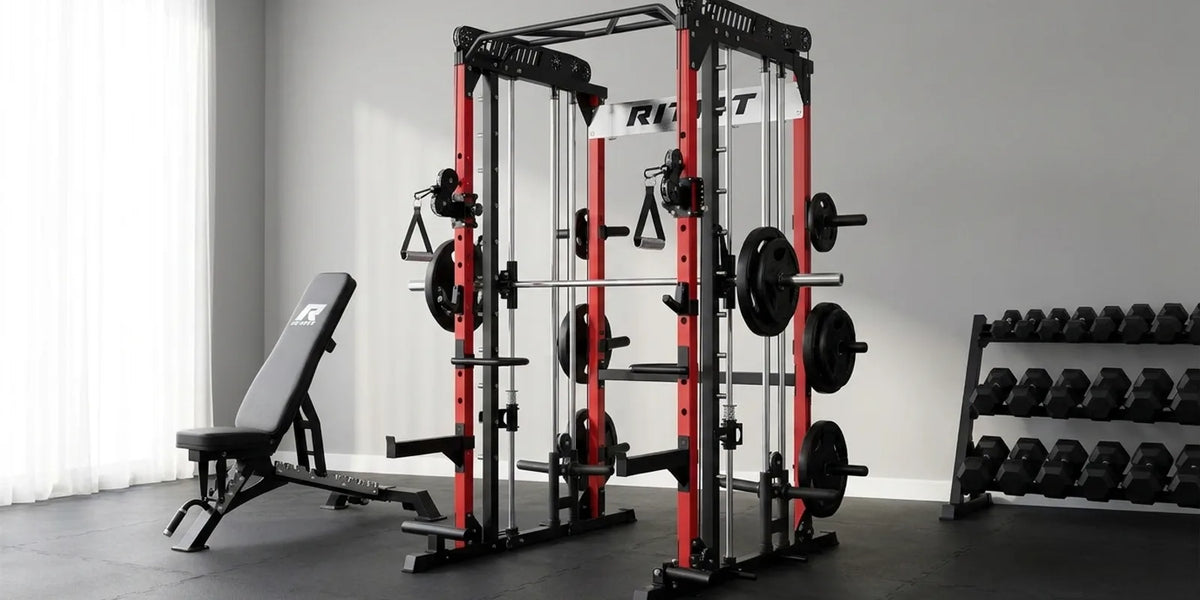
The RitFit M2 Smith machine handles Zercher squats well because its bar hooks adjust to 10 positions, so the bar can sit at your exact elbow-crook height. The 33 lb guided bar, 2,000 lb frame rating, and 660 lb safety arms cover the whole progression from empty bar to heavy working sets. For a home gym lifter training without a spotter, the machine meets every requirement this exercise places on equipment.
The M2 combines a Smith machine, power rack, cable crossover, pull-up station, low row, and landmine in one 22.8 sq ft footprint. A garage lifter can superset Zercher squats with rows on the same frame without walking across the room.
Frame durability is a spec question, and the M2 answers it with 2.36 by 2.36 inch, 13-gauge steel uprights rated to 2,000 lb and safety arms rated to 660 lb of static load. In practice that means the frame holding your elbows-up squat carries far more capacity than the movement will ever ask of it.
The M2 3D lists at $2,199.99 with lifetime support and 35-day returns, and the same frame replaces a squat rack, a Smith machine, and a cable station. For garage gym owners building one station at a time, that math is why the M2 shows up in so many home setups.
Shoppers still comparing frames can start with the Smith machine collection, which covers every frame from entry level to full power racks.
The M1 multi-functional home gym Smith machine fits tighter budgets and spaces, while the M3 power rack with Smith machine brings the heavier 3x3 frame for lifters chasing maximal loads. The multifunctional Smith machine rounds out the line for lifters who want cable work in the same footprint.
Why Choose the RitFit M2 for Zercher Squats
The 3D Smith option lets the bar travel slightly side to side as well as up and down, so your elbows find a natural path instead of forcing a perfectly rigid line. Family members of different heights can move the bar between hook positions in seconds, which keeps leg day moving when the machine is shared.
"Easy to assemble and works like a charm! Love the variety of exercises i can do with this machine!"
Dena, Verified Buyer, RitFit M2 Multi-Functional Modular Home Gym Smith Machine Tailored to All Fitness Levels
How Much Weight Should You Use for Smith Machine Zercher Squats?
Start Smith machine Zercher squats with the empty 33 lb guided bar and add small plates only after the elbow cradle feels secure. The crooks register load more directly than the shoulders do, so the movement feels heavier than the same weight on the back. Every working set should end feeling like two or three good reps were still in reserve.
The fastest way to sour the elbows and wrists on this exercise is jumping up in weight too quickly. If a load forces you to shift the bar up the arms or round the chest, drop back to the previous weight and earn it again next session.
- First session: Empty bar for sets of 8 to 10 reps while the elbow crooks find their position.
- Early weeks: Add one small plate per side only when the bar sits still in the crooks and depth is consistent.
- When to add weight: Move up one small step after a session where every rep looked identical and the last reps stayed pain free.
- When to hold: Keep the same load for another week if the elbows, wrists, or lower back complain during warm-up sets.
Small consistent jumps beat one heroic session every time on this lift.
How to Program Smith Machine Zercher Squats
Most lifters do well with 2 to 4 sets of 5 to 10 reps of Smith machine Zercher squats, once or twice a week alongside their other leg work. The exercise is demanding on the trunk, so it fits best as the main squat of the session or a heavy second movement. Frequency and load should climb slowly, never at the same time.
- Placement: Program the Zercher squat early in leg day, either in place of the main squat or right after it.
- Sets and reps: Two to four sets of 5 to 10 reps build both strength and size in the pattern.
- Frequency: Once a week maintains the lift, and twice a week progresses it, as long as the elbows and lower back recover between sessions.
- Progression: Add reps first, then load, and give the movement an easy week every 4 to 6 weeks if the trunk stays sore.
The exercise rewards patience more than intensity, so treat it like a skill that also happens to build your legs.
Common Mistakes with Smith Machine Zercher Squats
Most Zercher squat problems come from bar height, padding, and torso control rather than leg strength. Every mistake below has a simple fix you can apply on the very next set. Fix them one at a time so the setup stays consistent.
- Hooks set too high: If the bar sits above your elbow crooks, you end up on tiptoe to unrack it. Set the bar at crook height so the unrack is a simple stand.
- No padding: Bare bar pressure turns a good set into a grip fight. Wrap the bar or pad each elbow crook before the first working set.
- Collapsing the chest: Letting the bar roll the shoulders forward turns the lift into a lower back stress test. Keep the chest tall and the elbows pointing forward through every rep.
- Bouncing off the knees: Cutting depth short or bouncing shifts stress to the joints. Pause briefly at the bottom and drive up through the midfoot.
- Rushing the load: Adding weight before the hold feels secure is the fastest path to elbow pain. Earn each jump with clean reps first.
Film one working set from the side now and then, because bar height and torso angle are easy to see on camera.
When to Stop: Pain Signals and Safety Limits
Stop any Zercher squat set when sharp pain appears in the lower back, knees, or biceps, because forearm pressure is normal while joint or tendon pain is not. The hooks and safety catches exist so you can end a set alone at any point. No single rep is worth training through sharp pain.
- Normal: Heavy forearm and elbow-crook pressure that settles within a minute between sets.
- Not normal: Sharp pain along the spine, in the kneecap, or through the biceps tendon.
- Stop conditions: Numbness in the hands, sudden loss of grip, or any pain that changes your form mid-set.
- What to do instead: If the crook hold keeps aggravating the elbows, switch to a front squat or goblet squat for a few weeks and rebuild tolerance slowly.
General training limits like these keep the exercise productive for years instead of weeks.
Zercher Squat Alternatives and Variations
Good alternatives to Smith machine Zercher squats include dumbbell Zercher squats, barbell Zercher squats, and the shoulder-loaded Smith machine squat variations. The best substitute depends on what limits you: elbow comfort, equipment, or training experience. The options below cover each case.
- Dumbbell Zercher squat: Hold one dumbbell in the crooks of both elbows for the same front-loaded position with a lighter, softer load.
- Barbell Zercher squat: The free-bar version trains the same pattern with a full balance demand, and it belongs in any serious squat rotation.
- Smith machine front squat: Rest the bar on the front of the shoulders to train the quads with zero elbow loading.
- Anderson squats: Start each rep from the safety pins to attack the sticking point above parallel.
- Pause and tempo squats: Pause squats build strength out of the hole, and tempo squats own the descent on the same machine.
- Full roundup: The complete menu of Smith machine squat exercises covers every variation worth programming.
Whichever variation you choose, keep the same rule: own the empty bar before you chase load. Rotate one variation at a time so you can tell what is actually working.
FAQs About Smith Machine Zercher Squats
Can you do Zercher squats on a Smith machine?
Yes, you can do Zercher squats on a Smith machine by setting the bar at elbow-crook height on the hooks, then cradling it in both elbow crooks before unracking. The guided bar keeps the load on a fixed path, so you can squat close to the bar without balancing it.
How do you get into and out of the bar with your elbows?
Bend your elbows and slide the bar into the crooks of both arms at hook height, then stand tall to unrack it. At the end of the set, rotate the bar back onto the hooks while your legs are still fresh, and step back once the bar is secure.
How high should the bar be for Smith machine Zercher squats?
Set the bar in the hooks at the height of your elbow crooks when you stand tall with your arms hanging, roughly mid to lower chest for most lifters. The safety catches go one to two holes below the lowest squat depth you plan to reach.
What muscles do Smith machine Zercher squats work?
Smith machine Zercher squats train the quadriceps, glutes, and adductors through the squat, while the front-held load makes the spinal erectors, upper back, and deep core work harder to keep your torso upright. The elbow crooks and forearms hold the bar isometrically.
Are Zercher squats on a Smith machine bad for your lower back?
No, but the elbow-crook load pulls your torso forward more than a back squat, so your lower back works harder to stay braced. Keep the load light while you learn, stop if you feel sharp pain, and build up gradually so the trunk muscles adapt.
How much weight should you use for Smith machine Zercher squats?
Start with the 33 lb Smith bar alone or one light plate per side, because the elbow crooks feel the load directly and the bar path is fixed. Add weight only when every rep looks the same and no rep causes elbow, back, or knee pain.
Do you need a pad for Smith machine Zercher squats?
Most lifters want some padding. Wrap the bar with a foam bar pad or fold a towel under each elbow crook so the pressure sits on the forearm rather than the biceps tendon. Padding does not change the movement, it just keeps the hold tolerable across sets.
What is the difference between Zercher squats and front squats on a Smith machine?
In a Zercher squat the bar sits in the elbow crooks against the upper body, while a front squat rests the bar on the front of the shoulders with the arms up. The Zercher position keeps the load closer to your center of mass and needs no shoulder rotation to hold the bar.
Conclusion
Smith machine Zercher squats are a real exercise, not a compromise.
Set the bar at elbow-crook height, pad the crooks, keep the torso tall, and let the guided rail carry the balance so you can focus on the squat.
Start with the empty bar, add load slowly, and respect the pain signals in your elbows and back.
If you are building out your gym, plan the station around the machine that fits your space and budget. Check our discount guide before you buy so the next piece of gear costs less.
Disclaimer
This article provides general training information and is not medical advice or a substitute for individual assessment. Consult a qualified physician or physical therapist before starting any new exercise program, especially with a history of back, elbow, or knee injuries.
References
1. Bozkurt Ö, Erdağ D, Tinazci C, Burgul N, Bekiroğulları H. Mechanobiological and neuromuscular responses to foot-position variations during front and back squat exercises. Front Physiol. 2025;16:1727141. doi:10.3389/fphys.2025.1727141. PMCID: PMC12820588
2. Straub RK, Powers CM. A Biomechanical Review of the Squat Exercise: Implications for Clinical Practice. Int J Sports Phys Ther. 2024;19(4):490-501. doi:10.26603/001c.94600. PMCID: PMC10987311
3. Coratella G, Tornatore G, Caccavale F, Longo S, Esposito F, Cè E. The Activation of Gluteal, Thigh, and Lower Back Muscles in Different Squat Variations Performed by Competitive Bodybuilders: Implications for Resistance Training. Int J Environ Res Public Health. 2021;18(2). doi:10.3390/ijerph18020772. PMCID: PMC7831128
4. Larsen S, Kristiansen E, Helms E, van den Tillaar R. Effects of Stance Width and Barbell Placement on Kinematics, Kinetics, and Myoelectric Activity in Back Squats. Front Sports Act Living. 2021;3:719013. doi:10.3389/fspor.2021.719013. PMCID: PMC8440835
5. Sinclair J, Taylor PJ, Jones B, Butters B, Bentley I, Edmundson CJ. A Multi-Experiment Investigation of the Effects Stance Width on the Biomechanics of the Barbell Squat. Sports (Basel). 2022;10(9). doi:10.3390/sports10090136. PMCID: PMC9503729





