








Dumbbell workouts for men are one of the most practical ways to build muscle and strength with a single pair of weights that fits almost anywhere. This guide ranks the 10 best dumbbell exercises for men, each with sets, reps, form cues, and the evidence behind free-weight training.
You will also get weight-selection rules, training frequency, and clear safety cues. If an exercise causes sharp pain or your form breaks down, stop the set and adjust before continuing.
Quick Answer: The 10 best dumbbell workouts for men are the goblet squat, Romanian deadlift, dumbbell bench press, bent-over row, overhead press, dumbbell thruster, Bulgarian split squat, bicep curl, tricep extension, and renegade row. Trained with 3 to 4 sets of 8 to 12 reps, they build muscle across the whole body with just dumbbells.
Key Takeaways
- Evidence backs dumbbells: A 2023 meta-analysis of 13 studies found no meaningful difference between free-weight and machine training for building muscle or strength.
- Compound moves first: Squats, deadlifts, presses, and rows deliver the most muscle per minute, so build your routine around them.
- Eight to twelve reps for size: Three to four sets of 8 to 12 reps with a challenging weight is a reliable hypertrophy formula.
- Three sessions a week works: Full-body dumbbell workouts three days a week balance growth, recovery, and progress.
- Progress slowly, safely: Add reps first, then weight, and stop any set where form breaks or pain appears.
Why Dumbbells Work for Men: What the Evidence Says
Dumbbell workouts build muscle and strength as effectively as most machines, and the published evidence strongly supports free weights for general training goals. A 2023 meta-analysis of 13 studies with 1,016 participants found no significant difference in muscle hypertrophy or strength gains between free-weight and machine-based training [1].
A 10-week randomized trial in 36 novice men also found significant strength and muscle-size gains whether they trained with free weights, machines, or a mix of both [2]. That means dumbbells alone are enough to build a solid base at home.
- Full range of motion: Dumbbells let your joints move naturally, and presses and rows get a deeper stretch than most machine versions.
- Fixes imbalances: Each side works independently, so your weaker arm or leg has to catch up over time.
- Beginner friendly: You can start light and master the movement pattern before you ever load a bar.
That is why a pair of dumbbells is enough for a complete home setup. Browse the dumbbells collection and build a routine from the 10 movements below.
The 10 Best Dumbbell Workouts for Men
The 10 best dumbbell exercises for men are the goblet squat, Romanian deadlift, dumbbell bench press, bent-over row, overhead press, dumbbell thruster, Bulgarian split squat, bicep curl, tricep extension, and renegade row. Run them for 3 to 4 sets of 8 to 12 reps to build muscle across your whole body with a single pair of dumbbells.
1. Goblet Squat
The goblet squat is the best lower-body starter for men, hammering the quads and glutes while teaching an upright torso. Hold one dumbbell vertically against your chest, sit down and back, and lower until your thighs reach parallel.
- Muscles: Quads, glutes, core, upper back
- Sets and reps: 3 to 4 sets of 8 to 12 reps
- Variation: Tempo goblet squat with a three-second descent for more time under tension
2. Romanian Deadlift
The Romanian deadlift is the top hamstring builder you can do with dumbbells, and it also strengthens your glutes and lower back. Push your hips back with a soft knee bend, lower the weights to mid-shin, and stand by driving your hips forward.
- Muscles: Hamstrings, glutes, spinal erectors
- Sets and reps: 3 to 4 sets of 8 to 12 reps
- Variation: Single-leg Romanian deadlift to add balance and stability work
3. Dumbbell Bench Press
The dumbbell bench press is a proven chest builder that gives your pecs a deeper stretch than a barbell. Lie on a flat bench, press both dumbbells from your chest to full lockout, and control the descent on every rep.
- Muscles: Chest, triceps, front shoulders
- Sets and reps: 3 to 4 sets of 8 to 12 reps
- Variation: Incline dumbbell press to shift the emphasis to your upper chest
4. Bent-Over Dumbbell Row
The bent-over row is the backbone of a balanced back, working your lats, upper back, and biceps together. Hinge at the hips with a flat back, pull both dumbbells to your ribs, and squeeze your shoulder blades at the top.
- Muscles: Lats, rhomboids, rear delts, biceps
- Sets and reps: 3 to 4 sets of 8 to 12 reps
- Variation: One-arm row for a longer stretch and more anti-rotation work
5. Overhead Press
The overhead press builds strong, wide shoulders and a stable core in a single movement. Press both dumbbells from shoulder height to lockout overhead, keep your ribs down, and avoid arching your lower back.
- Muscles: Shoulders, triceps, upper chest
- Sets and reps: 3 to 4 sets of 8 to 12 reps
- Variation: Single-arm press to keep your torso upright and challenge core control
6. Dumbbell Thruster
The dumbbell thruster combines a front squat with an overhead press, making it a high-value full-body conditioning move. Hold the dumbbells at your shoulders, squat down, and drive through your legs to press them overhead.
- Muscles: Quads, glutes, shoulders, core
- Sets and reps: 3 sets of 10 to 15 reps
- Variation: Use a lighter pair and a faster pace for a conditioning effect
7. Bulgarian Split Squat
The Bulgarian split squat is a demanding single-leg move that builds strong quads and glutes while improving balance. Place your rear foot on a bench, lower until your front thigh is parallel, and drive through your front heel.
- Muscles: Quads, glutes, hamstrings, core
- Sets and reps: 3 sets of 8 to 12 reps per leg
- Variation: Rear-foot-elevated goblet hold for an extra core challenge
8. Bicep Curl
The bicep curl is the direct way to build bigger arms, targeting the biceps and forearms with a simple movement. Keep your elbows pinned to your sides and curl the dumbbells to shoulder height with a controlled squeeze.
- Muscles: Biceps, brachialis, forearms
- Sets and reps: 3 sets of 10 to 12 reps
- Variation: Hammer curl to hit the brachialis and add forearm thickness
9. Tricep Extension
The tricep extension builds the muscle that makes up most of your upper arm, working the triceps through a full range of motion. Hold one dumbbell overhead with both hands, lower it behind your head, and extend back to full lockout.
- Muscles: Triceps
- Sets and reps: 3 sets of 10 to 12 reps
- Variation: Single-arm kickback to finish the long head of the tricep
10. Renegade Row
The renegade row combines a plank with a one-arm row, building your back while hammering your core for anti-rotation stability. Hold a dumbbell in each hand in a high plank and row one weight to your ribs without letting your hips twist.
- Muscles: Lats, upper back, core, shoulders
- Sets and reps: 3 sets of 8 to 10 reps per side
- Variation: Knees-down renegade row to reduce the core demand while you learn
Pair these moves with a solid press and pull on a bench workout, and add the how to do dumbbell fly guide for a chest finisher.
How to Choose the Right Dumbbell Weight
Choose a weight you can lift with clean form for the target rep range, typically 8 to 12 reps per set for muscle growth. If the last two reps feel easy, go heavier, and if your form breaks before you finish the set, go lighter.
- Isolation moves: Start around 10 to 20 pounds for curls, tricep extensions, and raises.
- Presses and rows: Use 20 to 40 pounds for bench presses, rows, and overhead presses.
- Lower-body moves: Reach for 30 to 50 pounds for squats, deadlifts, and split squats.
- Adjustables simplify this: A pair of adjustable dumbbells lets you step up in small increments as you get stronger.
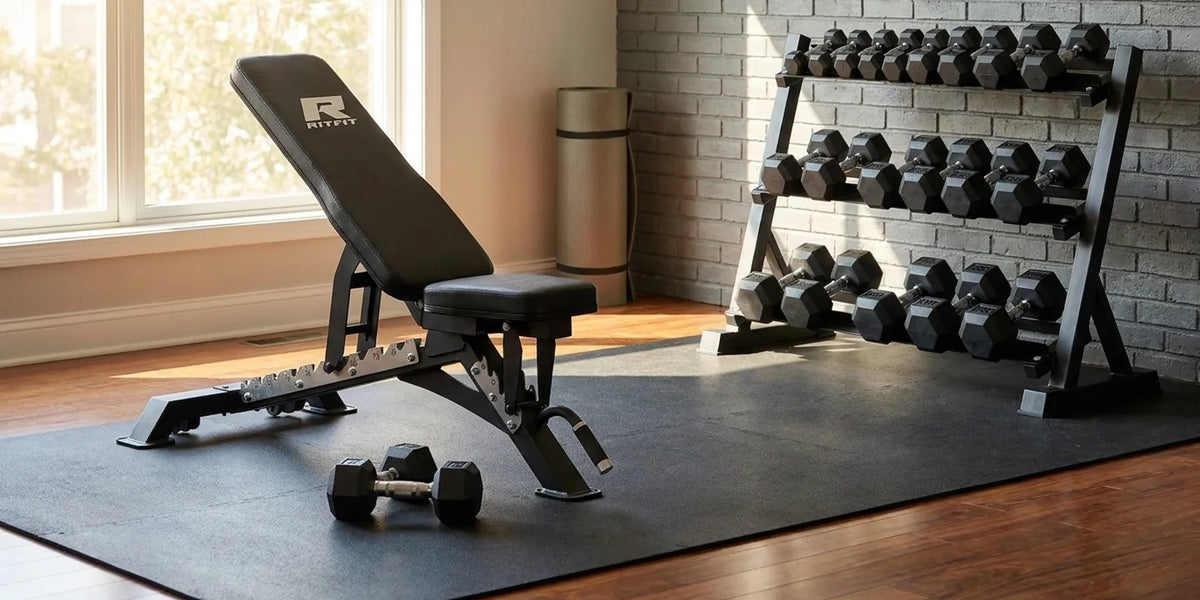
Most men only need two pairs to run the whole program above. A dumbbells and rack package pairs a full set with storage, and rubber hex dumbbells protect your floor when you set the weights down.
How Often Men Should Do Dumbbell Workouts and How to Progress
Train with dumbbells three to four times per week with at least one rest day between sessions for the same muscle group. Full-body workouts three days a week build muscle and strength reliably, and you can add a fourth day once you adapt.
- Start with full-body: Two to three sessions a week covering every major muscle group is enough for most beginners.
- Progress with double progression: Add reps until you hit the top of your range, then add weight and rebuild from the bottom.
- Rest deliberately: Take 60 to 90 seconds between sets for muscle growth and two to three minutes for heavier strength work.
- Raise volume over time: When weight increases stall, add one set per exercise or one extra session per week.
For a higher-volume option, follow the 5-day workout routine for men, or pair dumbbells with conditioning in the metcon workouts guide.
"If your space is limited, a good set of adjustable dumbbells might be your better option. They will allow you to progress to heavier weight as you get stronger."
Jeff Cavaliere, MSPT, CSCS, Creator of ATHLEAN-X
Common Dumbbell Workout Mistakes and How to Fix Them
The most common dumbbell mistakes are lifting too heavy, rounding the lower back, and skipping a warm-up, and each one slows your progress or raises your injury risk. Fix the form first, then chase heavier weight.
- Too heavy too soon: Drop the load and master the movement before you add weight.
- Rounding the back: Brace your core and keep a neutral spine on rows and deadlifts.
- Skipping the warm-up: Spend five to ten minutes on light sets and dynamic movements.
- Too many isolation moves: Put compound lifts first and use curls and extensions as finishers.
- Dropping weights carelessly: Control the negative and set the dumbbells down gently.
Solid pressing form starts on the bench, so master that movement before your next chest session.
When to Increase the Weight (and When to Hold Back)
Increase the weight when you can complete the top of your rep range with clean form on every set, which usually happens every two to four weeks. Hold back when your form slips, your joints ache, or you are coming back from a layoff.
- Add reps first: Work up to the top of your 8 to 12 range before touching heavier dumbbells.
- Then add small weight: Jump up 2.5 to 5 pounds per side and rebuild your reps from the bottom.
- Take a lighter week: Every four to six weeks, cut the load by 20 to 30 percent to let your joints recover.
- Know when to pause: If fatigue or soreness carries into your next session, rest before pushing heavier.
When you are ready to expand beyond dumbbells, the smith machine leg workouts guide shows how to add a rack to your lower-body training.
When to Stop a Set: Pain, Form Breakdown, and Safety
Stop a set immediately if you feel sharp joint pain, hear an audible pop, or your form breaks down beyond a controlled rep. Muscle burn and fatigue are normal, but sharp pain is a signal to stop and reassess.
- Sharp pain: Pain in your shoulder, lower back, or elbow means end the set and switch to a safer variation.
- Form breakdown: If you start rounding your back or bouncing the weights, the set is over.
- Dizziness or chest tightness: Stop, sit down, and take a break before you continue.
- Protect your pressing: Use a spotter or safety racks whenever you press heavy dumbbells.
When your gym is ready, add conditioning with the battle rope workouts for beginners to round out your home training.
FAQs About Dumbbell Workouts for Men
How often should men do dumbbell workouts?
For strength and muscle, aim for three to four dumbbell sessions per week with at least one rest day between sessions for the same muscle group. Full-body sessions three times a week are a reliable starting point, and you can add a fourth day as you adapt.
How heavy should dumbbells be for men starting out?
Choose a weight you can lift with clean form for the target rep range, typically 8 to 12 reps per set for muscle growth.
If the last two reps feel easy, go heavier.
For pressing and squatting moves pick a heavier pair than for isolation moves like curls.
Can men build muscle with dumbbells alone?
Yes.
A randomized trial in novice men and a 2023 meta-analysis both found free-weight training produces gains comparable to machines.
As long as you apply progressive overload, a pair of dumbbells can build muscle across your whole body at home or in the gym.
What is the best dumbbell workout for beginners?
Beginners should start with a full-body routine built around five to six compound moves: goblet squats, Romanian deadlifts, dumbbell bench presses, bent-over rows, and overhead presses. Perform two to three sets of 8 to 12 reps, and focus on learning clean form before adding weight.
Are dumbbell workouts good for men over 40?
Dumbbells are a smart choice after 40 because they load each side independently, improve balance, and allow you to control range of motion and start with lighter weights. Train two to three times per week and always warm up properly to protect joints.
How many reps and sets should men do with dumbbells?
For hypertrophy, three to four sets of 8 to 12 reps per exercise works well.
For strength, drop to five to six reps with heavier weight.
Rest 60 to 90 seconds between sets for muscle growth, and 2 to 3 minutes when lifting heavy.
Conclusion
Dumbbell workouts for men deliver a complete, time-efficient path to muscle and strength with a single pair of weights, and the evidence shows free-weight training works as well as machines. Run the 10 exercises above three or four times a week, add weight when your reps get easy, and you will build a balanced body at home.
Start with the goblet squat and overhead press today, track your reps, and upgrade your weights as you progress. Check the latest RitFit sales to build your setup without overspending.
Disclaimer
This article is for general fitness information only and is not medical advice. Consult a qualified professional before starting any new exercise program, especially if you have an existing injury or health condition.
References
1. Haugen ME, Vårvik FT, Larsen S, Haugen AS, van den Tillaar R, Bjørnsen T. Effect of free-weight vs. machine-based strength training on maximal strength, hypertrophy and jump performance - a systematic review and meta-analysis. BMC Sports Sci Med Rehabil. 2023;15(1):103. doi:10.1186/s13102-023-00713-4. PMCID: PMC10426227
2. Aerenhouts D, D'Hondt E. Using Machines or Free Weights for Resistance Training in Novice Males? A Randomized Parallel Trial. Int J Environ Res Public Health. 2020;17(21). doi:10.3390/ijerph17217848. PMCID: PMC7662789





