








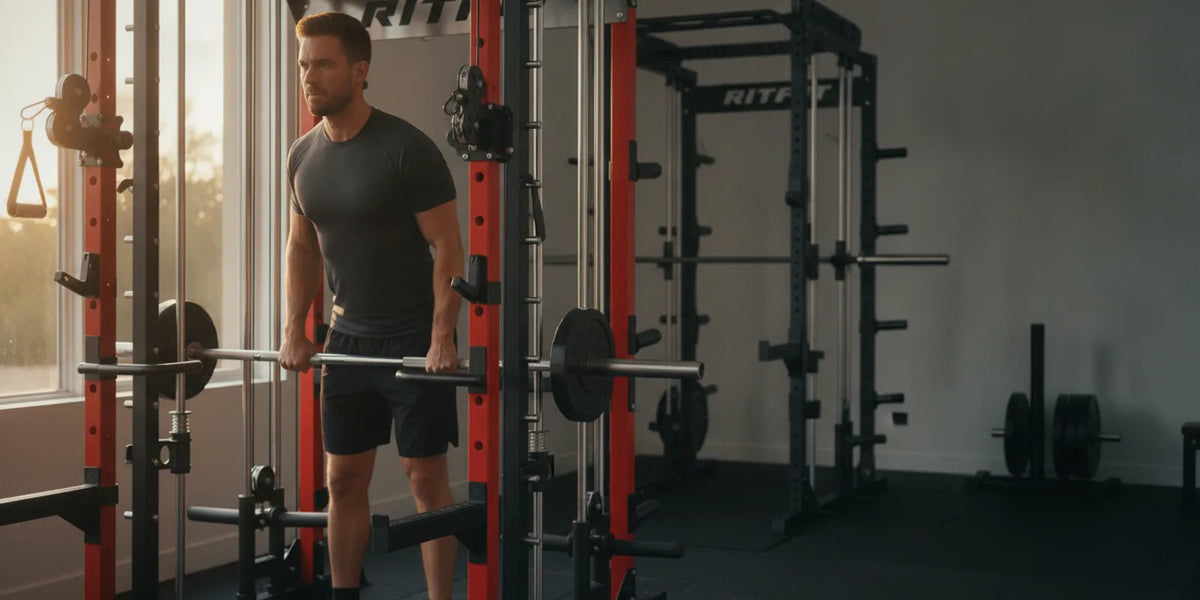
Yes, some Smith machines really are heavier than others, and the gap is wider than most lifters expect. Two units can look identical yet start anywhere from about 6 pounds to a full 45 pounds of effective resistance.
This guide explains the engineering behind that spread, shows you how to measure your own machine, and helps you log progress accurately when you train across different gyms.
Quick Answer
Some Smith machines are heavier than others because the effective starting weight varies with counterbalance design, rail angle, bearing friction, and bar construction. Counterbalanced commercial units can feel as light as 6 to 15 pounds, while non counterbalanced home machines often feel closer to 25 to 45 pounds at takeoff.
Key Takeaways
- The weight really does vary: Effective Smith machine starting resistance ranges from about 6 pounds to 45 pounds depending on the model.
- Counterbalance is the biggest factor: Internal counterweights, cables, and pulleys offset part of the bar so it feels lighter at takeoff.
- Commercial usually feels lighter: Commercial units prioritize smooth, light movement, while home and hybrid machines often feel heavier and more direct.
- There is no universal conversion: Smith machine load should not be directly equated to a free barbell number.
- Measure and log once: Estimate your specific machine starting weight, write it down, and reuse that reference for consistent progress.
Are some Smith machines actually heavier than others?
Yes, Smith machines genuinely differ in effective weight, not just in feel. The empty bar on one unit can sit near 6 pounds while another starts close to 45 pounds, even though both look the same on the rack.
- Effective weight, not plate weight: The plates you load are identical, but the resistance you must overcome to start the bar moving differs by machine.
- Design drives the gap: Counterbalance, rails, bearings, and bar build all shift where a machine lands in that 6 to 45 pound range.
This matters most when you move between gyms or shop for a home unit. To ground the discussion, it helps to know what a Smith machine is and how its guided bar differs from a free barbell.
What actually changes a Smith machine bar weight?
Four engineering levers change how heavy a Smith machine feels at the start of a lift. They are the counterbalance system, the rail angle and bearing friction, the bar construction, and the design priorities of commercial versus home models.
- Counterbalance system: Cables, pulleys, or internal counterweights cancel part of the bar mass, lowering takeoff resistance.
- Rail angle and friction: The track angle and the smoothness of the bearings change how much effort the bar takes to glide.
- Bar construction and hardware: Material, thickness, hooks, and bearings add or subtract physical mass.
- Commercial versus home priorities: Commercial designs chase a light, smooth feel, while home units often favor durability.
The next sections break down the two levers that surprise lifters most. Browse the full Smith machines range to see how these choices play out across real units.
How does a counterbalance system change the weight?
A counterbalance system lowers the effective weight by offsetting part of the bar with hidden counterweights, cables, or pulleys. A Journal of Strength and Conditioning Research analysis modeled the common Smith machine resistance variants and found that the counterweighted design adds a reactive resistance component that reduces the effective load felt by the lifter[1].
- How it works: The counterweight pulls in the opposite direction of gravity, so you feel only the remaining net load.
- Why it is hidden: Counterweights usually sit inside the uprights under safety covers, which is why two machines feel different despite identical plates.
- Why it is never zero: A perfectly balanced bar would drift on the lightest touch, so makers leave some residual starting weight on purpose.
This is the single biggest reason a commercial bar feels feather light and a basic home bar feels closer to a true barbell. For loaded movements, see Smith machine squats where this takeoff difference is most noticeable.
Do rail angle and bearing friction matter?
Rail angle and bearing friction both change how heavy the bar feels, even on machines with similar counterbalance. Smooth linear bearings reduce drag so the bar glides easily, while worn or poorly maintained rails add resistance you have to overcome.
- Rail angle: Some machines angle the track to follow a natural pressing or squatting path, which shifts the perceived load through the range of motion.
- Bearing quality: High quality linear bearings feel lighter and more consistent than basic bushings.
- Maintenance state: The same model can feel lighter in one gym and heavier in another simply because the rails are cleaner and better lubricated.
Bar construction adds the final piece, since thicker steel, extra hooks, and heavy bearings raise physical mass. Heavy hybrid combo units can push the effective takeoff load toward 45 pounds, much like a standard Olympic bar.
How does counterbalanced compare to non counterbalanced at takeoff?
A counterbalanced machine feels noticeably lighter at takeoff because internal weights offset part of the load, while a non counterbalanced bar feels heavier and more direct. The guided rail also removes most balancing demand, so a study describing Smith machine mechanics notes that motion constrained to a single degree of freedom lets lifters focus on the target movement instead of stabilizing the bar[1].
- Counterbalanced feel: Light and assisted, often beginner friendly, common in commercial gyms.
- Non counterbalanced feel: Heavier and closer to a true bar load, common in home and hybrid units.
- Shared trait: Both reduce balance demand compared with a free barbell, so the lift feels easier than the plate count alone suggests.
Because the machine path is fixed, your results depend heavily on which unit you train on. As one strength expert put it, the design dictates the experience.
"The machine does what it does, and if you don't like it, you're going to keep getting your joints hurt."
Dr. Mike Israetel, PhD, Co-founder, Renaissance Periodization
This is also why popular movements like Smith machine shrugs feel deceptively easy on a counterbalanced unit. To understand the broader use cases, read up on what a Smith machine is good for.
How do I measure my own machine starting weight?
You can estimate your machine starting weight in a few minutes with a simple test. The most reliable method is to attach a known load to the empty bar and note how much it takes to start it moving, then log that number as your reference.
- Step 1, clear the bar: Unrack the empty bar and remove all plates so you measure only the bar and its mechanism.
- Step 2, use a luggage scale: Hook a handheld luggage scale to the bar and lift gently until the bar just begins to rise, then read the value.
- Step 3, or add small plates: Add light plates in small increments until the bar moves freely, and use that total as a rough starting figure.
- Step 4, compare to a known bar: Press or squat the empty Smith bar against your memory of a standard 45 pound Olympic barbell to sense whether it is lighter or heavier.
- Step 5, log it: Write the estimate next to the machine name and reuse it every session for consistency.
Always keep the safety catches set during this test so the bar cannot drop unexpectedly. For exact figures by model, our guide on how much a Smith machine bar weighs covers typical ranges in detail.
How should I track progress across different machines?
Track each machine as its own system rather than chasing one universal number. Research on the free weight and Smith machine Bulgarian split squat recommends establishing the load reference separately for each device, because the fixed trajectory changes the effective load[2].
- Name your machine: Note the specific gym and machine in your log so you compare like with like over time.
- Use the same logging method: Record total plates plus your estimated starting weight, and keep that format every session.
- Expect machine specific results: Load velocity profiling on the Smith machine squat is machine specific, which reinforces tracking each unit on its own terms[3].
When you switch to a free barbell, reduce the load, since stabilizing muscles now carry work the machine used to handle. Many lifters apply this to movements like the Smith machine row, where the guided path changes the feel.
What mistakes do people make comparing Smith machine numbers?
The most common mistake is assuming the same plate load means the same difficulty on every machine. Lifters also wrongly convert Smith numbers to free barbell numbers, which leads to confusion and ego lifting.
- Treating all machines as equal: Two units with identical plates can differ by up to 30 or more pounds in effective starting load.
- Direct free weight comparison: A Smith bench or squat is not the same as a barbell version, so the numbers are not interchangeable.
- Ignoring maintenance: Forgetting that rail friction changes feel can make you think you got weaker when the machine simply runs rougher.
- Chasing a number across gyms: Trying to match one machine total on a different unit can push you into unsafe loads.
Avoid these traps by anchoring to your own logged reference. For training context, our guide to the best Smith machine for bodybuilding shows how to match a unit to your goals.
How do RitFit Smith machines handle starting weight?
RitFit designs its Smith machines to give a controlled, predictable starting feel suited to home gym training. The guided bar path keeps the load consistent, and the 3D Smith design adds horizontal motion that brings the experience closer to a free barbell.
- Predictable takeoff: A consistent guided bar lets you log a stable starting reference and track progress accurately.
- 3D Smith movement: The bar follows both vertical and horizontal paths, restoring some stabilizer demand for a more natural lift.
- Home gym focus: Built for durability and space efficiency, matching the priorities of a home setup.
The video below shows how a 3D Smith bar path actually feels compared with a traditional fixed bar. To build a full setup, explore the multifunctional Smith machine.
FAQs About Smith Machine Weight Differences
Are some Smith machines heavier than others?
Yes, the effective starting weight of a Smith machine bar varies widely between models. Counterbalanced commercial units can feel as light as 6 to 15 pounds, while non counterbalanced home machines often feel closer to 25 to 45 pounds because of counterweight systems, rail angle, and bar construction.
Why does a Smith machine feel lighter than a regular barbell?
A Smith machine often feels lighter because internal counterweights, cables, or pulleys offset part of the bar resistance. The fixed rail also removes most balancing demand, so the lift feels easier than a free 45 pound Olympic bar, and smooth bearings reduce friction further.
How do I find out how much my Smith machine bar weighs?
There is no universal number, so measure it on your specific machine. Hang a luggage scale from the empty bar and note when it begins moving, then log that reference number and reuse it so your progress tracking stays consistent across sessions.
Can I compare my Smith machine numbers to free weight numbers?
No, you should not assume a direct conversion between the two. Research recommends establishing the load reference separately for each, because the fixed trajectory and counterbalance change the effective resistance, so treat Smith machine and barbell numbers as two different tracking systems entirely.
Do commercial gym Smith machines weigh less than home gym ones?
Often yes in terms of effective starting weight at takeoff. Commercial units usually prioritize smooth, light movement with stronger counterbalance systems, while home and hybrid machines frequently use heavier bars for durability and feel closer to a true bar load.
Conclusion
Some Smith machines are genuinely heavier than others because counterbalance, rail angle, friction, and bar build shift the effective starting weight across a wide range. The plates never lie, but the takeoff resistance can differ by 30 pounds or more between units.
Measure your machine, log the number, and track each unit on its own terms. For more on this, read whether a Smith machine takes off weight and pick the model that fits your goals.
Disclaimer
This article is for general educational purposes only and does not replace professional fitness or medical guidance. Consult a qualified trainer or healthcare provider before starting any new resistance training program.
References
1. Migliaccio GM, Dello Iacono A, Ardigò LP, et al. Leg Press vs. Smith Machine: Quadriceps Activation and Overall Perceived Effort Profiles. Front Physiol. 2018;9:1481. doi:10.3389/fphys.2018.01481 https://pmc.ncbi.nlm.nih.gov/articles/PMC6206431/
2. Liao K, Bian C, Chen Z, et al. Repetition velocity as a measure of loading intensity in the free weight and Smith machine Bulgarian split squat. PeerJ. 2023;11:e15863. doi:10.7717/peerj.15863 https://pmc.ncbi.nlm.nih.gov/articles/PMC10437032/
3. Senturk D, Kumak A, Janicijevic D. Sensitivity of the load-velocity relationship variables to discriminate the level of fatigue induced by multiple sets of the smith-machine squat exercise. BMC Sports Sci Med Rehabil. 2026;18(1). doi:10.1186/s13102-026-01615-x https://pmc.ncbi.nlm.nih.gov/articles/PMC12980983/





