








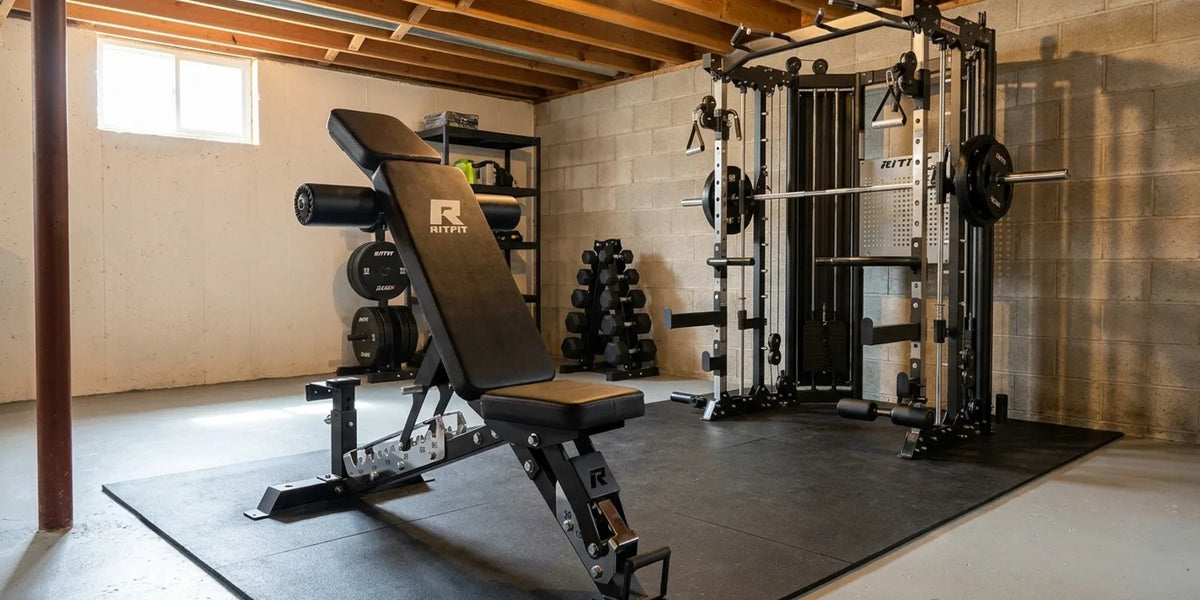
If you want one bench that supports serious strength work without permanently giving up basement floor space, the RitFit GATOR adjustable weight bench is one of the strongest options in this category. It pairs heavy-duty construction, upright storage, and a wide angle range for low ceilings and tight layouts.
This guide covers what the GATOR does well, its official specs, how it compares with other bench types, and which exercises suit a compact basement setup. You will also get setup and safety tips plus a sample bench-centered workout.
Quick Answer: The RitFit GATOR adjustable weight bench is a heavy-duty option for basement gyms that need real capacity without permanent floor space. It rates a 1600 lb load capacity, offers 18 adjustment positions, and stores upright in about 3.5 square feet so most home lifters can press, row, and train lower body without giving up room.
Key Takeaways
- Heavy-duty capacity: The RitFit GATOR adjustable weight bench rates a 1600 lb load capacity, which suits lifters who want a primary bench rather than a light occasional model.
- Basement-friendly storage: Upright wall parking and a compact parked footprint help the bench fit tighter rooms without giving up valuable floor space.
- Useful adjustment range: Adjustable back, seat, and support settings expand pressing, rowing, core, and lower-body training options.
- Better long-term value: A reinforced steel frame and higher load rating leave more room to progress over time.
- Best fit: It suits basement gym owners who value stability and versatility over ultra-light portability.
Why Is an Adjustable Weight Bench Important for a Basement Gym?
An adjustable weight bench matters in a basement gym because one footprint can cover flat pressing, incline work, seated training, decline core work, and supported rows, which replaces several single-purpose stations.
Versatility in Small Spaces
A single bench footprint keeps more open floor area for dumbbells, racks, and movement. That makes it easier to replace several single-purpose stations and keep the room usable for shelves, laundry access, or general storage.
Basement-Specific Constraints
Basement gyms often force buyers to think about low ceilings, stair access, concrete floors, exposed pipes, and narrow parking space before they think about load capacity. Upright storage, wheel-assisted movement, and stable floor contact therefore matter as much as raw strength specs.
Long-Term Value and Exercise Variety
A better adjustable bench expands how you press, row, thrust, split squat, and train your core without adding more machines.[1]
Bench angle also changes pressing muscle emphasis, which is one reason adjustable models offer more practical variety than flat-only benches.[2]
What Should You Look For in a Basement Adjustable Bench?
The best basement adjustable bench balances a small parked footprint, stable high-capacity construction, and enough angles to keep training flexible when ceiling height limits standing movement.
- Size, footprint, and storage: A bench needs a small parked footprint and realistic daily storage, not just strong specs on paper. If the room also holds shelves or laundry, upright wall parking becomes a practical advantage.
- Stability and load capacity: A basement bench should stay planted under pressing, rowing, and hip thrust work. Higher load capacity, wider base support, and stronger steel matter when one bench must handle years of progression.
- Adjustment range and pad design: Enough angles keep training flexible when ceiling height limits standing lifts. Pad width, pad gap, and seat support matter because uncomfortable contact points become obvious on heavy sets.
- Materials and basement durability: Basement equipment should tolerate sweat, dust, and minor temperature swings without turning maintenance into a chore. Stronger steel and a wipe-clean pad surface usually age better than lighter starter-bench construction.
- Convenience for busy home users: Fast setup and easy use matter because home training works best when the barrier to starting stays low. Home-based resistance exercise also tends to work better when the format is simple, practical, and easy to stick with over time.[3]
These criteria explain why the GATOR's upright storage, reinforced frame, and wide adjustment range make it a natural candidate for a basement gym.
What Are the Key Specs and Load Capacity of the RitFit GATOR?
The RitFit GATOR adjustable weight bench rates a 1600 lb total load capacity with 18 adjustment combinations, and it stores upright in about 3.5 square feet, which is strong capacity for a compact home footprint.
Quick Snapshot
The RitFit GATOR Adjustable Weight Bench is built for buyers who want heavy-duty stability without giving permanent floor space to a bench. Official GATOR information lists a 1600 lb total load capacity and 18 total adjustment positions.
Official GATOR Specifications
| Spec | Official GATOR Info |
|---|---|
| Total Product Length | 57.8 in |
| Product Width | 25.2 in |
| Product Height | 14.6 in to 51.3 in |
| Product Weight | 109.1 lbs |
| Total Load Capacity | 1600 lbs |
| Back Pad Adjustment | 10 levels, 0 to 85 degrees |
| Seat Pad Adjustment | 3 levels, 0 to 30 degrees |
| Total Adjustment Combinations | 18 positions |
| Pad Thickness | 2.7 in |
| Seat to Backrest Gap | 2 in |
| Safety Lock System | Enclosed bracket plus magnetic lock pin |
| Storage Claim | Stores upright, about 3.5 sq. ft. |
Specs reflect official RitFit GATOR product information as listed on the product page.
Matching Basement Gym Needs
The GATOR fits basement use especially well because its upright storage, substantial frame, and low to high working range help in rooms with short ceilings and tight traffic lanes. It also supports common basement priorities such as seated pressing, chest-supported work, hip thrusts, and compact wall parking.
Why It Stays Relevant
This bench is most useful when you want one primary bench instead of rotating between a light foldable model and a heavier flat bench. It gives home lifters more long-term training headroom while staying easier to store than many bulkier commercial-style benches.
Built with 14-gauge steel, the RitFit Gator Adjustable Weight Bench offers a robust weight capacity of 1,600 pounds. With 10 back pad angles, three seat pad positions, three decline settings, and a five-way adjustable head rest, you have ample options to support your strength and muscle building goals.
Stephen Sheehan, CPT, CNC, Certified Personal Trainer and Nutritionist, Garage Gym Reviews, RitFit Gator Adjustable Weight Bench Review
How Does the RitFit GATOR Perform in a Basement Gym?
The RitFit GATOR performs as a stable, high-capacity primary bench in a basement gym because its reinforced frame, widened rear base, and substantial 109.1 lb body stay planted under demanding work.
Design and Construction
The frame uses reinforced 14-gauge steel with a widened rear base and welded support structure, which fits its heavy-use positioning. That matters most for pressing, chest-supported rows, and hip thrusts where bench shift quickly becomes distracting.
Adjustability and Angles
The GATOR gives 10 back pad levels, 3 seat pad levels, plus headrest and rear adjustment settings for more setup flexibility. That range helps basement users train around ceiling limits by moving work into seated or inclined positions instead of relying on tall standing lifts.
Comfort and Ergonomics
Pad comfort is not just about softness because a basement bench still needs firm support under load. The GATOR pairs 2.7 inch padding with an 11.8 inch max pad width and a 2 inch seat-to-back gap, a practical balance for pressing, supported rows, and general strength work.
Stability, Capacity, and Performance
The 1600 lb load rating places the GATOR above many entry-level adjustable benches and gives more confidence for long-term progression.[4] That matters for home lifters who want one bench that can grow with heavier dumbbell work, rack presses, and loaded hip thrust variations.
Ease of Use, Assembly, and Storage
RitFit says most people finish setup in about 10 minutes, which lowers assembly friction. Once built, the 109.1 lb frame is substantial, but transport wheels and upright storage make day-to-day repositioning more realistic than a fixed commercial-style bench.
Durability in Basement Conditions
A basement bench should tolerate sweat, dust, and regular cleaning without turning maintenance into a chore. The GATOR uses a substantial steel frame and wipe-clean pad materials that suit repeated home training better than lighter starter-bench construction.
How Does the RitFit GATOR Compare With Other Bench Types?
The RitFit GATOR earns its spot over lighter bench styles when basement fit matters more than the smallest footprint or the lowest starting cost, because it pairs serious capacity with upright storage.
- Versus a foldable bench: The GATOR offers more loading confidence and a more substantial frame, while a foldable bench usually wins on carrying ease and the lowest starting cost.
- Versus a basic flat bench: The GATOR opens incline, decline, seated, and supported variations that matter when basement ceiling height limits standing lifts.
- Versus heavier commercial benches: The GATOR stays closer to the home-gym sweet spot because it combines serious specs with upright storage that many bulky benches do not offer.
- Versus a lighter entry-level adjustable bench: A model like the RitFit 1300 lb Adjustable Weight Bench covers a smaller budget, while the GATOR adds load headroom and a wider adjustment range for long-term use.
For more comparison detail, see this best adjustable weight bench under 500 GATOR guide and this RitFit PWB01 beginner bench guide to see where heavy-duty value starts and where portability becomes the priority. If you are still deciding between styles, this adjustable vs flat vs foldable bench comparison helps match bench type to room size and training style.
How Do You Set Up the RitFit GATOR in a Basement Gym?
Set up the RitFit GATOR in a basement by measuring training clearance and stored height first, then protecting the floor and parking the bench in a zone that does not block shelves or walkways.
Measure Ceiling and Parking Space First
Measure both training clearance and stored height before you buy because a bench can fit your workout area but still fail your wall-storage plan. Check around pipes, ducts, stair turns, and rack spacing instead of measuring only open floor length.
Protect the Floor and Improve Grip
Concrete and older basement surfaces can feel hard, slick, or noisy under shifting equipment, so floor prep matters. A guide like this home gym flooring guide can help you decide whether rubber mats or tiles make more sense for grip, sound, and surface protection.
Build a Smarter Bench Zone
The cleanest basement layout is a bench zone that supports pressing, rows, and dumbbell work without blocking shelves or walkways. For buyers planning a fuller room, the RitFit weight benches collection and this best basement gym equipment package guide can help map the next pieces around your main bench.
Which Exercises Work Best on the RitFit GATOR?
The RitFit GATOR works best for incline presses, chest-supported rows, seated shoulder presses, Bulgarian split squats, hip thrusts, and decline core work, which keep training variety high in a compact room.
Foundational Pressing Movements
Flat presses, incline dumbbell presses, and seated shoulder presses are the most obvious strength staples on this bench. For angle-specific pressing ideas, this best incline for your bench press guide and these dumbbell chest exercises with a bench are useful next reads.
Pulling and Supported Upper-Body Work
Chest-supported rows and rear-delt work are especially useful in basements because they add back volume without requiring extra floor depth or tall cable stations. They also give lifters a more lower-back-friendly option on days when rack work or basement layout already feels demanding.
Lower-Body and Core Work
Bulgarian split squats, step-ups, hip thrusts, decline sit-ups, and seated curls all make practical use of an adjustable bench in compact rooms. These movements keep training variety high even when ceiling height or layout limits bigger standing lifts.
Sample Basement Gym Bench-Centered Workout
Start with incline dumbbell press, move to chest-supported row, then use Bulgarian split squats and hip thrusts for the lower body, and finish with decline core work. That structure keeps one bench doing pressing, pulling, unilateral leg work, and trunk training without forcing a crowded room to act like a commercial gym.
How Do You Use an Adjustable Bench Safely in a Basement?
Use an adjustable bench safely in a basement by checking the lock system, floor contact, and pad angle before heavy sets, and by choosing exercises that respect low ceiling height.
Check Bench Lock, Floor Contact, and Rack Position
Every session should start with a fast inspection of the lock system, floor contact, and pad angle before the first heavy set. Uneven concrete, humidity, and tight rack spacing can magnify small setup mistakes.
Train Around Basement Limits, Not Against Them
Seated pressing and supported work are smarter than forcing tall standing lifts into a room that does not allow clean overhead movement. When ceiling height is tight, safer exercise selection beats trying to squeeze commercial-gym patterns into a residential room.
Recheck Hardware Over Time
Heavy home use still requires periodic bolt checks, surface cleaning, and attention to any change in bench feel under load. A quick maintenance routine protects both training confidence and the useful life of the bench.
FAQs About the RitFit GATOR Adjustable Weight Bench
What makes the RitFit GATOR a strong fit for a basement gym?
The GATOR works well in a basement gym because it combines high load capacity, compact upright storage, and a wide range of bench angles in one piece. That mix helps lifters train hard in rooms with limited floor space, lower ceilings, and tighter movement paths.
How much space does the RitFit GATOR need in a basement gym?
The bench is easier to place than many heavy duty models because it stores upright and uses about 3.5 square feet when parked against a wall. You still need safe lifting clearance around the bench, especially if you train with dumbbells, a rack, or exposed basement obstacles.
Can the RitFit GATOR handle heavy pressing safely?
Yes.
The official load rating is 1600 pounds, and the bench uses reinforced steel, a widened rear base, and an enclosed bracket with a magnetic lock pin.
That setup is designed to feel more stable than entry level benches during heavy presses, rows, and hip thrust work.
Is the RitFit GATOR easy to assemble and move?
Yes.
RitFit says most people finish setup in about 10 minutes, which lowers the barrier for buyers who want a faster start.
1 pounds it is not a light bench, but transport wheels and upright storage make daily repositioning more manageable in a home gym.
Which exercises work especially well on an adjustable bench in a basement gym?
Incline presses, chest supported rows, seated shoulder presses, Bulgarian split squats, hip thrusts, and decline core work are all practical choices. These movements help basement lifters keep training variety high even when ceiling height, floor layout, or rack placement limits bigger standing lifts.
Should you choose the GATOR over a foldable weight bench for a basement gym?
You should choose the GATOR when stability, heavier loading, and long term primary bench use matter more than the lightest storage solution. A foldable bench is still the better fit when your main priority is the smallest footprint, easier carrying, or a lower starting budget.
How many adjustment positions does the RitFit GATOR offer?
The RitFit GATOR offers 18 total adjustment positions, built from 10 back pad levels and 3 seat pad levels plus added headrest and rear settings. That range lets you move between flat, incline, and decline work without changing benches, which is useful when basement ceiling height limits tall standing lifts.
What are the dimensions of the RitFit GATOR adjustable weight bench?
The RitFit GATOR measures 57.8 inches long, 25.2 inches wide, and 14.6 to 51.3 inches tall, with a product weight of 109.1 pounds. Those numbers matter for basement buyers because stored height and parked footprint decide whether the bench clears pipes and still leaves room to move.
Conclusion
The RitFit GATOR adjustable weight bench earns a place on any basement gym shortlist because it combines heavy-duty confidence, a genuinely useful angle range, and upright storage in one frame. Its 1600 lb rating and 18 positions give lifters room to progress without sacrificing floor space.
If your basement has low ceilings or a tight traffic plan, measure your space first, then browse RitFit bench options and match the GATOR to your training goals.
Disclaimer
Training needs, room constraints, and equipment tolerance vary by user, so treat this guide as educational product information rather than personal advice. Always confirm your room dimensions, follow RitFit assembly and safety instructions, and consult a qualified professional before starting or changing a strength training program.
References
1. Currier BS, Mcleod JC, Banfield L, et al. Resistance training prescription for muscle strength and hypertrophy in healthy adults: a systematic review and Bayesian network meta-analysis. Br J Sports Med. 2023;57(18):1211-1220.
2. Rodríguez-Ridao D, Antequera-Vique JA, Martín-Fuentes I, Muyor JM. Effect of five bench inclinations on the electromyographic activity of the pectoralis major, anterior deltoid, and triceps brachii during the bench press exercise. Int J Environ Res Public Health. 2020;17(19):7339.
3. Fyfe JJ, Dalla Via J, Jansons P, Scott D, Daly RM. Feasibility and acceptability of a remotely delivered, home-based, pragmatic resistance exercise snacking intervention in community-dwelling older adults: a pilot randomised controlled trial. BMC Geriatr. 2022;22(1):521.
4. Benito PJ, Cupeiro R, Ramos-Campo DJ, Alcaraz PE, Rubio-Arias JA. A systematic review with meta-analysis of the effect of resistance training on whole-body muscle growth in healthy adult males. Int J Environ Res Public Health. 2020;17(4):1285.





