








Full body circuit training is one of the easiest ways for beginners to build strength, improve cardiovascular fitness, and stay consistent with short, structured workouts you can do at home or in the gym.
This guide covers simple bodyweight, dumbbell, and low-impact circuits, plus safety tips, weekly schedules, and gradual progression so you can start with confidence and stay motivated.
Quick Answer: Full body circuit training for beginners combines 5 to 8 simple strength, core, and cardio exercises performed in sequence with short rest, repeated for 2 to 3 rounds. A beginner-friendly full body circuit can be done in about 20 to 30 minutes with bodyweight or one pair of dumbbells, 2 to 3 times per week.
Key Takeaways
- Efficient format: Full-body circuit training builds strength, cardio, and muscular endurance in one beginner workout.
- Simple structure: The best beginner circuits pair simple exercises with controlled pacing and enough rest to protect technique.
- Scalable options: Bodyweight, dumbbell, and low-impact circuits all work well depending on your fitness level and equipment.
- Gradual frequency: Most beginners train 2 to 3 sessions per week and progress slowly over time.
- Quality first: Consistency, exercise quality, and recovery matter more than speed or intensity at the start.
What Is Circuit Training?
Circuit training is a workout method that moves you through a series of exercises with minimal rest between movements, then repeats the full series for several rounds. It trains the legs, upper body, core, and cardiovascular system in one session, which makes it an efficient full-body format.
You can adjust the exercises, pace, and training volume to fit your space, schedule, and current fitness level. The two most common formats are time-based circuits and repetition-based circuits, both of which work well for beginners.
Unlike body-part split routines, full-body circuit workouts keep the whole session organized while covering multiple muscle groups. For more beginner routines, see our list of the best circuit training workouts.
Benefits of Full Body Circuit Training for Beginners
Full body circuit training is effective for beginners because it builds fitness without requiring advanced skills or long gym sessions. It also supports exercise adherence by making workouts more structured, varied, and manageable.
- Time efficiency: Most beginner circuits can be completed in about 20 to 30 minutes, which makes them easier to fit into a busy schedule.
- Cardio and strength in one session: Short rest periods keep your heart rate elevated while resistance movements help build muscular strength and endurance.
- Calorie burn and conditioning: Full-body circuits use large muscle groups and repeated effort, which can support energy expenditure and general fitness goals.
- Beginner-friendly progression: You can make a circuit easier or harder by adjusting work time, rest time, exercise variation, load, or number of rounds.
- Convenience: Many routines work well in a small home gym, living room, garage gym, or apartment space.
- Movement variety: Alternating squat patterns, pushing, pulling, core work, and cardio make training more engaging and less repetitive.
- Skill building: Repeating basic movement patterns helps beginners improve coordination, exercise technique, and training confidence.
For a faster cardio-forward option, pair your circuits with the best HIIT workouts for beginners.
"Real fat loss requires total-body strength training and conditioning that drives results. That means combining functional movements with compound lifts, aiming for the largest muscle groups that elevate heart rate and improve energy expenditure the most."
Jeff Cavaliere, MSPT, CSCS, Physical Therapist and Strength Coach and former Head Physical Therapist for the NY Mets, Athlean-X
Safety First: How Beginners Should Prepare
Beginners should prepare by choosing manageable exercises, warming up properly, and using an effort level they can control. This approach lowers injury risk and makes it easier to maintain good form throughout the session.
- Start with a readiness check: If you have been inactive for a long time, have joint pain, or have a medical condition, get appropriate medical clearance before starting a new training routine.
- Warm up for 5 to 10 minutes: Use light cardio and dynamic mobility work such as arm circles, leg swings, bodyweight squats, and marching to prepare your muscles and joints.
- Prioritize technique over speed: Move with control and keep your range of motion stable instead of rushing through reps.
- Use moderate effort: A beginner circuit should feel challenging but sustainable, and you should still be able to say a short sentence during recovery.
- Watch for red flags: Stop and modify the workout if you feel sharp pain, dizziness, chest discomfort, or clear form breakdown.
- Respect recovery: Leave at least one rest day or light activity day between harder beginner sessions.
How to Structure Beginner Friendly Circuit Training Circuits
A good beginner circuit includes simple exercises that cover the lower body, upper body, core, and light cardio. This balanced structure improves movement quality while keeping fatigue more manageable.
- Choose 5 to 8 exercises: Include 1 to 2 lower body moves, 1 to 2 upper body moves, 1 to 2 core exercises, and 1 to 2 cardio or conditioning movements.
- Use a simple work and rest format: Start with 20 to 40 seconds of work and 20 to 40 seconds of rest, or use 10 to 12 reps per movement with short rests between exercises.
- Alternate muscle groups: Switching between lower body and upper body exercises helps manage local muscle fatigue and supports better exercise quality.
- Complete 2 to 4 rounds: Most beginners do well with fewer total rounds while they learn pacing and exercise technique.
- Rest between circuits: Take 60 to 120 seconds between rounds so your breathing and movement quality can recover.
- Train 2 to 3 times per week: This frequency gives most beginners enough practice without making recovery too difficult.
Best Beginner Full Body Circuit Training Workouts
The best beginner full body circuit training workouts use simple, scalable exercises that cover the lower body, upper body, core, and light cardio. Choose the option that matches your current fitness level and the equipment you have at home.
Bodyweight Only Beginner Circuit
This circuit is a strong starting point for beginners who want a simple full-body workout without equipment. It works especially well for home workouts, small spaces, and people who want low-complexity movement patterns.
- Best for: New exercisers, home workouts, limited space, no equipment
- Format: 30 seconds of work and 30 seconds of rest per exercise
- Rounds: 2 to 3
- Rest between rounds: 1 to 2 minutes
-
Exercises:
- Chair squat or bodyweight squat
- Wall push-up or countertop push-up
- Glute bridge
- Standing row pattern with shoulder blade squeeze
- Dead bug
- March in place or do a low-impact step jack
Dumbbell Beginner Full-Body Circuit
This circuit adds external resistance while keeping the exercise selection beginner-friendly and easy to follow. It is a practical option for building full-body strength, muscular endurance, and movement confidence with one pair of dumbbells.
- Best for: Beginners ready for resistance training, home gym users, general strength development
- Format: 10 to 12 reps per exercise with minimal rest
- Rounds: 2 to 3
- Rest between rounds: 60 to 90 seconds
-
Exercises:
- Goblet squat
- Dumbbell chest press on the floor or bench
- Dumbbell bent-over row
- Dumbbell Romanian deadlift
- Dumbbell overhead press
- Plank for 20 to 30 seconds
- Brisk walk, step-ups, or another short light cardio finisher
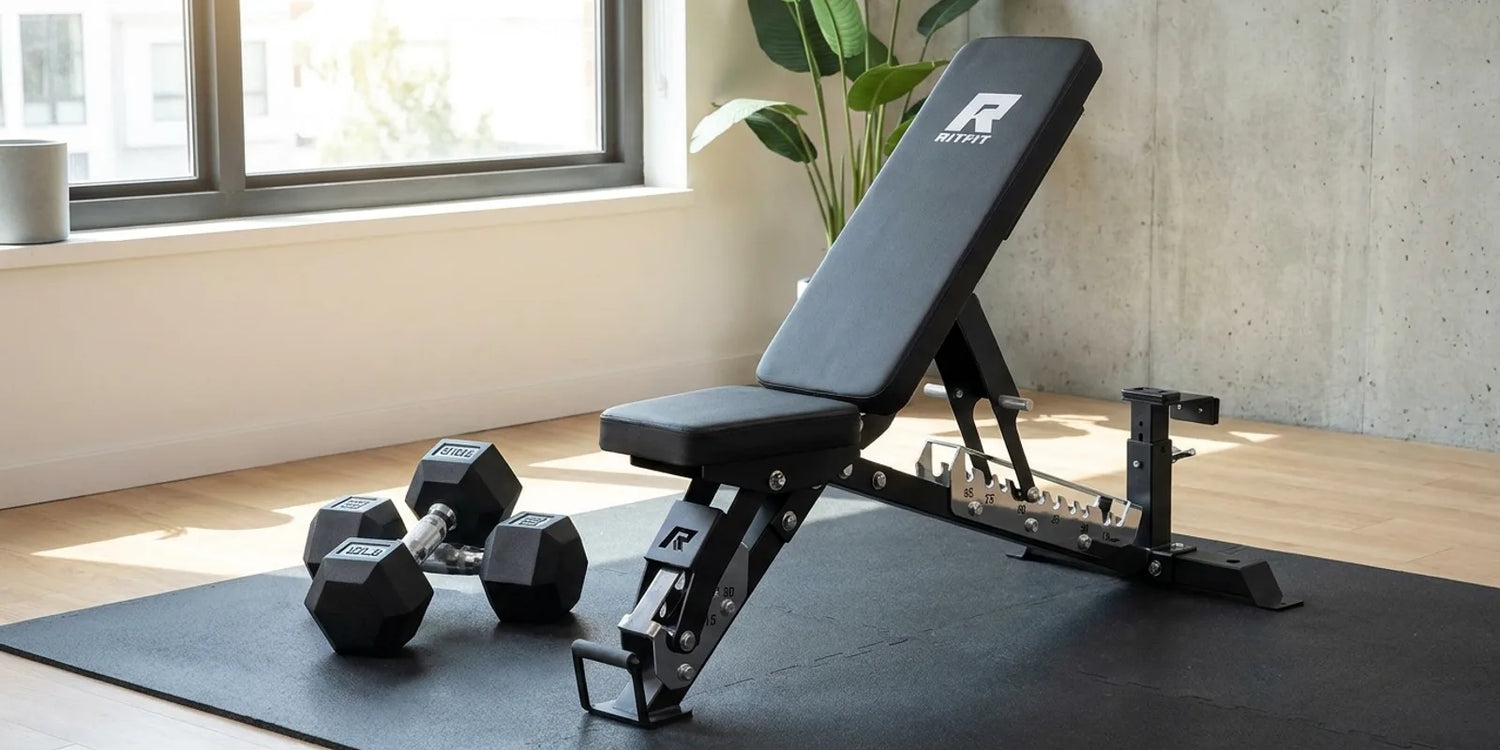
You only need one pair of dumbbells to start, and you can scale the load easily with an adjustable dumbbells collection or a dumbbell set with rack.
Low-Impact Cardio and Strength Circuit for Absolute Beginners
This circuit is designed for beginners who need more support, more stability, or lower joint stress. It introduces full-body training with controlled, joint-friendly exercises that can be scaled more easily.
- Best for: Absolute beginners, larger bodies, joint sensitivity, mobility limitations
- Format: 20 to 30 seconds per exercise and 30 to 40 seconds of rest
- Rounds: 1 to 3
- Rest between rounds: 1 to 2 minutes as needed
-
Exercises:
- Supported squatting to a chair
- Wall push-up
- Low step-up with support
- Seated back squeeze
- Standing side leg lift with balance support
- Seated knee lift
- Standing calf raise with support
At Home Minimal Equipment Circuit
This circuit works well if you have a yoga mat and one pair of dumbbells but still want a complete, full-body session. It balances lower body work, upper body pushing and pulling, core training, and simple conditioning.
- Best for: Small home gym setups, beginner dumbbell training, minimal equipment routines
- Format: 40 seconds of work and 20 seconds of rest
- Rounds: 3
- Rest between rounds: 60 to 90 seconds
-
Exercises:
- Dumbbell squat
- Incline push-up or knee push-up
- One-arm dumbbell row
- Hip thrust or floor bridge
- Dumbbell curl to overhead press
- Dead bug or Russian twist
For more equipment-based options, explore full body workouts with a home workout bench, our best full body workout smith machine guide, and the all in one machine full body training breakdown.
How to Progress Your Circuit Training Over Time
Beginners should progress gradually by changing only one variable at a time. This helps you build work capacity without sacrificing exercise quality or recovery.
- Add one round: Increase from 2 rounds to 3 rounds before making every exercise harder.
- Increase work time: Move from 20 or 30 seconds to 35 or 40 seconds once pacing feels stable.
- Reduce rest slightly: Shorten recovery only when your breathing and movement quality stay under control.
- Increase load: Use slightly heavier dumbbells when you can complete every round with strong technique.
- Advance the exercise variation: Progress from wall push-ups to incline push-ups, then to knee push-ups or standard push-ups, guided by our push up workouts for total body strength guide.
- Track your sessions: Log reps, load, work intervals, and round count so you can see progressive overload over time.
When you outgrow your beginner circuits, consider the ultimate beginner kettlebell workout guide, the Murph workout complete beginner guide, or a 5 3 1 strength training program for structured progression.
Sample Weekly Beginner Circuit Training Schedule
Most beginners improve best with a weekly plan that includes recovery time and simple repetition. A consistent schedule matters more than trying to train hard every day.
Two Days a Week
- Monday: Bodyweight full-body circuit
- Wednesday: Walking, mobility work, or light cardio
- Thursday: Dumbbell full-body circuit
- Other days: Gentle movement and recovery
Three Days a Week
- Monday: Bodyweight beginner circuit
- Wednesday: Low-impact cardio and strength circuit
- Friday: Dumbbell full-body circuit
- Other days: Walking, mobility, stretching, or rest
If you want a similar structure tailored to your goals, review this beginner workout plan for more weekly guidance.
Tips to Stay Consistent and Motivated
Consistency improves when your workouts feel practical, repeatable, and easy to start. Beginners usually get better results from a simple routine they can sustain than from an aggressive plan they abandon after one week.
- Set realistic goals: Start with 2 sessions per week and a manageable number of rounds.
- Reduce setup friction: Keep your mat, dumbbells, bench, or resistance bands in one ready-to-use space.
- Use a timer: A timer makes interval training easier and helps you stay focused on the workout.
- Pair training with a routine: Link your workout to the same time of day, music playlist, or post-work habit.
- Celebrate small wins: Better form, steadier breathing, and one extra round are all signs of progress.
- Focus on adherence: A repeatable routine builds a stronger long-term fitness foundation than random hard workouts.
Cool Down and Recovery Essentials
A short cool-down helps bring your heart rate down and supports recovery after circuit training. Recovery also depends on sleep, hydration, nutrition, and appropriate training frequency.
- Cool down for 3 to 5 minutes: Walk slowly or move lightly until your breathing returns closer to normal.
- Stretch key muscle groups: Focus on the quads, hamstrings, calves, hips, chest, and upper back.
- Rehydrate and refuel: Drink water and eat balanced meals that support recovery and energy needs.
- Sleep enough: Quality sleep supports muscular repair, energy levels, and workout consistency.
- Monitor soreness: Mild soreness is normal, but lasting fatigue or joint pain means you may need less volume or easier exercise choices.
FAQs About Beginner Circuit Training
How long should a beginner circuit workout last?
Most beginner circuit workouts last about 20 to 30 minutes, including the warm-up and cool-down. That is enough time to train the full body without creating unnecessary fatigue for most new exercisers.
Can beginners do circuit training every day?
Most beginners should not do hard full-body circuits every day because recovery is part of progress. A better plan is 2 to 3 circuit sessions per week with walking, mobility work, or light cardio on other days.
Is circuit training good for weight loss?
Circuit training can support weight loss because it combines resistance exercise, cardiovascular demand, and total body movement. It works best when paired with consistent training, appropriate nutrition, and realistic recovery habits.
Do I need a gym membership to start?
You do not need a gym membership to begin because many beginner circuits use bodyweight exercises or a small amount of equipment. A mat, a sturdy chair, and one pair of dumbbells can cover many basic full-body movement patterns.
When should I move to more advanced circuits?
Move to a more advanced circuit when you can complete your current plan with controlled form, stable breathing, and manageable recovery. If your current workout no longer feels meaningfully challenging, it is a good time to increase load, rounds, or exercise difficulty.
How many exercises should a beginner circuit include?
A beginner circuit usually includes 5 to 8 exercises that cover the lower body, upper body, core, and light cardio. This balanced mix trains the full body while keeping the session short, simple to follow, and easy to recover from.
Can beginners do circuit training with just dumbbells?
Yes.
One pair of dumbbells is enough for a complete beginner full body circuit using goblet squats, rows, overhead presses, and dumbbell deadlifts.
A full dumbbell set with a rack makes scaling the load easier as you progress.
Conclusion
Full body circuit training is one of the best beginner workout formats for building strength, improving endurance, and creating a consistent exercise habit. Start with a simple bodyweight or dumbbell circuit that matches your current ability, focus on good movement quality, and progress gradually as your fitness, confidence, and recovery improve.
When you are ready to add resistance at home, explore the RitFit sale page to keep your setup simple and affordable.
Disclaimer
This article is for general educational purposes only and does not replace medical advice, diagnosis, or treatment. Consult a qualified healthcare professional before starting a new workout routine, especially if you have a medical condition, injury, joint pain, dizziness, or chest discomfort.





