The best handle for cable crunch sets the difference between a session that truly loads your abs and one that turns into an awkward hip-hinge. Choosing the right attachment shapes your grip, your range of motion, and how deeply your rectus abdominis contracts on every rep.
This guide covers every major cable crunch handle type, explains what the mechanics actually demand, and matches each handle to the right training goal so you can buy once and train confidently.
Quick Answer: The best handle for cable crunch is a rope attachment because it lets your hands travel naturally toward your temples as you crunch, creating deeper spinal flexion and stronger rectus abdominis contraction than a rigid bar. For unilateral oblique work, a single D-handle is the next best option.
Key Takeaways
- Rope wins: A rope attachment allows the most natural hand path during spinal flexion, producing the deepest ab contraction available from a cable setup.
- D-handle for obliques: A single D-handle enables unilateral cable crunches that force your obliques to resist rotation, adding a dimension bodyweight crunches cannot replicate.
- Avoid the straight bar: Straight bars lock your wrists into a fixed position, limiting range of motion and increasing wrist discomfort during the crunch arc.
- Material and swivel matter: An aluminum alloy construction with a 360-degree swivel prevents handle torque from competing with your ab contraction during the movement.
- Start lighter than you think: Proper spinal flexion, not load, drives rectus abdominis activation. Dialing back weight and prioritizing form produces better results than heavier loads with compensated technique.
Why Does the Handle Matter for Cable Crunches?
The handle you choose directly determines the arc your hands follow, which either supports or disrupts the spinal flexion that makes cable crunches effective. A systematic review on core muscle activity confirmed that the crunch pattern produces high rectus abdominis EMG activation, but only when the movement stays in true spinal flexion rather than converting into a hip hinge.[1]
The Mechanics of Spinal Flexion vs. Hip Hinge
A cable crunch works by shortening the distance between your ribs and pelvis through lumbar rounding, not by bending forward at the hips. Your hands must hold the load at or near your temples while your abs generate all the movement.
- Rigid handles: Force your wrists and elbows into a fixed plane, restricting how your torso folds and shifting load toward your hip flexors.
- Flexible or swiveling handles: Allow your hands to track naturally inward toward your shoulders as your spine rounds, preserving the intended spinal flexion arc.
- Swivel mechanism: Prevents rotational torque from the cable itself fighting your wrist position mid-rep, which is a common hidden source of form breakdown.
- Grip diameter: A handle that is too thick or too thin forces an awkward grip that fatigues your forearms before your abs reach a meaningful stimulus.
The right cable machine handles remove these mechanical penalties so every rep delivers the stimulus to the correct target muscle.
Is a Rope Attachment the Best Handle for Cable Crunches?
A rope attachment is the best handle for cable crunches because its split design allows each hand to travel independently toward your shoulders as you round your spine, creating a wider and deeper contraction than any rigid attachment can match. Traditional crunch mechanics show high upper and lower rectus abdominis activation when genuine spinal flexion is maintained throughout the rep.[2]
Why Natural Hand Path Maximizes Rectus Abdominis Activation
When your hands are free to move inward, your elbows naturally follow the arc of your contracting torso instead of blocking it. This keeps load on your abs rather than transferring to your shoulders or lats.
- Split ends: Let each hand move independently so your torso can fold around its own center of mass.
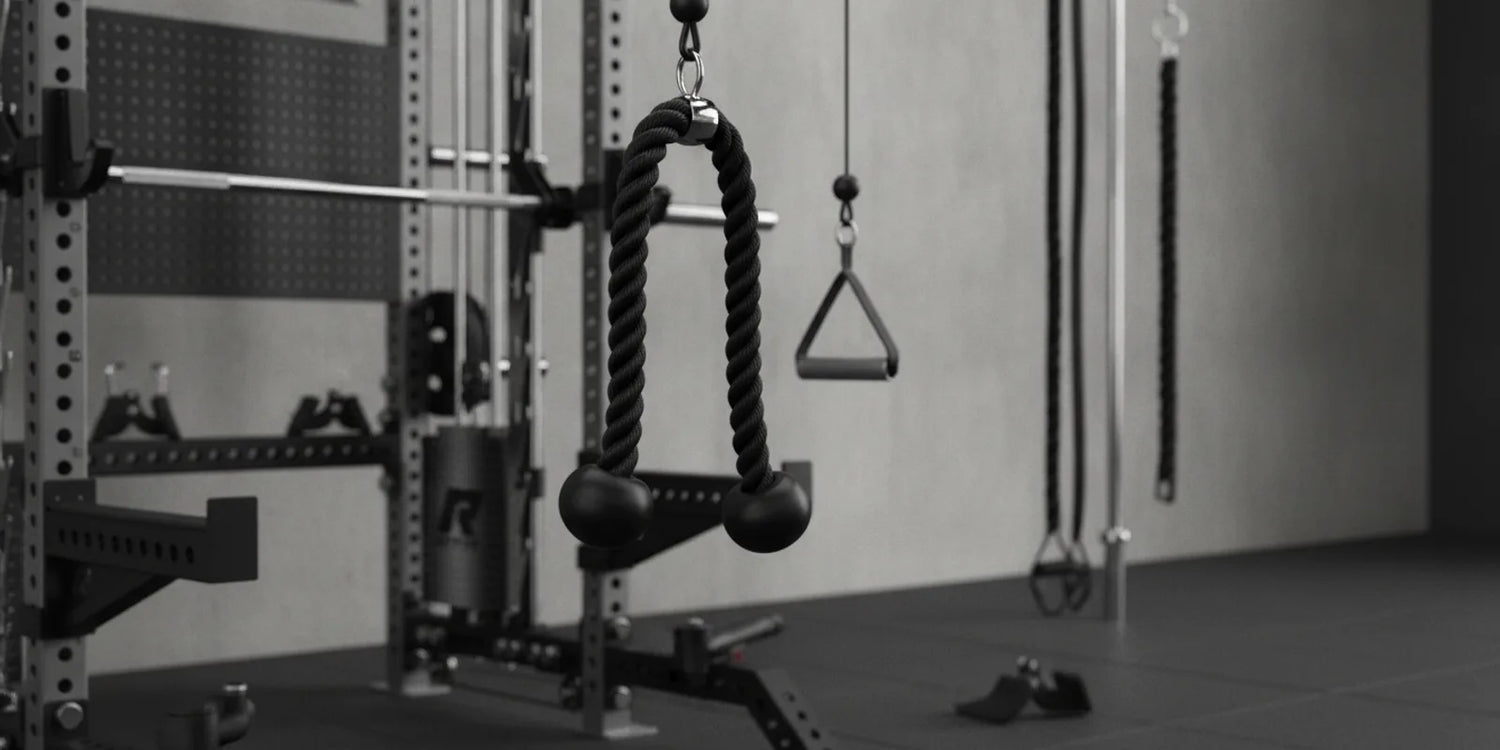
- Temple placement: Holding rope ends lightly at the sides of your forehead reduces grip fatigue and ensures your arms serve as passive hooks, not active drivers.
- Constant cable tension: The rope stays taut through both the concentric crunch and the controlled eccentric return, loading your abs in both directions.
- Bilateral or unilateral: You can crunch with both ends together for standard rectus abdominis work, or hold one end to introduce an oblique challenge.
Science-based coach Jeff Nippard recommends the rope cable crunch as one of only two ab exercises needed for hypertrophy:
"For the loaded crunch you can do a cable crunch where you grab a rope, kneel down and crunch while allowing your lower back to round as you squeeze your abs."
Jeff Nippard, Natural Bodybuilder and Science-Based Fitness Coach, Jeff Nippard Fitness
What to Look for in a Quality Rope Attachment
Not all rope attachments deliver the same feel, and the differences matter over hundreds of reps.
- Rubber end caps: Prevent the rope from slipping through your hands and soften contact against your temples.
- Nylon or steel core: A braided core resists fraying under repeated high-tension use far longer than a hollow rubber construction.
- Swivel carabiner clip: Allows the rope to rotate freely as the cable pulley changes angle, eliminating wrist torque during the movement.
- Appropriate length: A 27-inch rope suits most users for kneeling crunches. A longer 35-inch option gives taller athletes more comfortable elbow room.
The RitFit W-Shaped Aluminum Alloy Handle is engineered for exactly this type of controlled cable loading, with a precision swivel and reinforced grip that supports both kneeling and standing crunch variations.
How Do D-Handles Work for Cable Crunches?
D-handles are a good handle choice for cable crunches, especially when training the obliques or working one side at a time. A single D-handle introduces an element of instability that forces your obliques and deep stabilizers to fire harder to keep your torso from rotating toward the cable stack.[2]
How Single-Handle Cable Crunches Target the Obliques
Pulling a single D-handle diagonally across your body toward the opposite hip loads the external oblique on the pulling side while the internal oblique on the opposite side contracts to resist rotation.
- Unilateral loading: Each side works independently, which surfaces strength imbalances that bilateral crunches mask.
- Anti-rotation demand: Resisting the cable's pull to one side activates deep stabilizers that a standard bilateral crunch does not reach.
- Pair of D-handles: Using two handles simultaneously gives beginners a stable, symmetrical setup that closely mimics a rope without requiring one, and maintains independent hand movement.
- Progressing the challenge: Once bilateral cable crunches feel controlled at your working weight, single-arm D-handle crunches add a new stimulus without increasing load.
Choosing a D-Handle: Swivel, Grip Width, and Comfort
D-handle quality varies more than most gym accessories, and the differences show up immediately during cable crunches where wrist angle changes constantly.
- 360-degree swivel: Prevents cable torque from twisting the handle against your wrist at the bottom of the crunch where the cable angle is most acute.
- Grip width: A standard 4-to-5-inch grip width suits most hand sizes. A wider grip increases forearm involvement and can feel awkward during the inward arc.
- Aluminum alloy construction: Resists corrosion and maintains consistent feel across humidity and temperature changes common in home gyms.
The RitFit exercise handles for cable machines and the RitFit Adjustable Aluminum Alloy Gym Handle both feature 360-degree swivels suited to single-arm cable crunch variations.
Is a Straight Bar Good for Cable Crunches?
A straight bar is not the best handle for cable crunches because its rigid design forces your wrists into a fixed horizontal position that conflicts with the natural inward arc your hands need to follow during spinal flexion. This restriction commonly causes wrist discomfort and shifts load away from the rectus abdominis toward the shoulders and lats.
- Fixed grip plane: A straight bar prevents your hands from tracking inward as your ribcage descends toward your pelvis, cutting range of motion short.
- Wrist strain risk: The crunch arc demands the handle rotate relative to the cable; a rigid bar transfers that torque directly to your wrists.
- Better uses: Straight bars excel at pulldowns, cable rows, and overhead tricep extensions where a fixed grip is an advantage rather than a liability.
- Exception: If you are experimenting with a standing cable crunch while holding the bar at chest level, the fixed width can provide a stable reference point for some users, though a rope still produces better spinal flexion.
Reserve your RitFit lat pulldown attachments and straight bars for the exercises they are designed for, and use a rope or D-handle for any crunch variation.
Which RitFit Cable Handle Is Best for Your Crunch Goal?
RitFit offers several aluminum alloy cable handles that each suit a different training priority, from deep bilateral ab loading to advanced unilateral oblique work and full cable machine versatility. The decision comes down to your primary movement pattern and how many cable exercises you run in a session.
W-Shaped Aluminum Alloy Handle: Best for Control and Wrist Comfort
The RitFit W-Shaped Aluminum Alloy Handle is purpose-built for cable movements that demand wrist-neutral positioning throughout a long arc of motion.
- Best for: Intermediate to advanced lifters who perform kneeling or standing cable crunches as a primary weighted ab movement.
- Why it works: The W-shape allows both hands to hold at a natural inward angle that closely mimics the rope hand path without the flexibility of a standard rope.
- Material: Aircraft-grade aluminum alloy resists corrosion and maintains consistent grip texture across years of use.
- Upgrade path: Pair with any cable machine that features a standard carabiner pulley attachment for immediate compatibility.
Aluminum Alloy Handle Set (Long W + Short Straight): Versatility Pick
The RitFit Aluminum Alloy Handle Set bundles the long W-shaped handle with a short straight bar, giving you a dedicated crunch handle and a pulldown or row handle in one purchase.
- Best for: Home gym owners who want to run full upper body cable sessions without switching between incompatible attachments.
- Crunch use: Use the long W-shaped handle for kneeling crunches and save the short straight bar for cable rows and face pulls.
- Value: Two purpose-built handles for the price of one bundle reduces per-handle cost compared to buying each separately.
Adjustable Aluminum Alloy Handle: Advanced Option
The RitFit Adjustable Aluminum Alloy Gym Handle with locking mechanism adds a variable angle feature that lets you dial in the exact grip position your wrist anatomy prefers before locking it in place for a given set.
- Best for: Advanced lifters who train with higher cable crunch volume and experience wrist fatigue with fixed-angle handles.
- Locking mechanism: Prevents angle drift mid-set so the handle stays exactly where you set it through every rep, unlike standard non-locking D-handles.
- Also suitable for: Single-arm cable crunch variations where fine-tuning the angle maximizes oblique engagement per individual hip anatomy.
Browse the full range of cable machine attachments to compare grip styles and find the configuration that fits your current cable setup.
Cable Crunch Handle Comparison
The table below summarizes how each major cable crunch handle type performs across the factors that matter most for ab training effectiveness.
| Handle Type | Rating for Crunches | Best Used For | RitFit Option |
|---|---|---|---|
| Rope Attachment | Best | Deepest contraction, natural hand path, bilateral crunches | RitFit W-Shaped Handle |
| D-Handle (Single) | Good | Unilateral oblique focus, instability training | RitFit Exercise Handles / Adjustable Handle |
| D-Handle (Pair) | Good | Bilateral stability, beginner-friendly symmetrical setup | RitFit Handle Set |
| Straight Bar | Average | Pulldowns, rows (not recommended for crunches) | RitFit Lat Pulldown Attachments |
Ratings reflect suitability for the cable crunch movement pattern specifically, not overall handle quality.
How Do You Set Up a Cable Crunch Handle Correctly?
Setting up the handle correctly before your first rep determines whether your abs or your hip flexors do the work during every set. The setup takes under 60 seconds and the same sequence applies regardless of which handle type you use.
Step-by-Step Setup
- Set the pulley high: Attach your handle to the highest available pulley position so the cable runs downward at an angle toward your kneeling position.
- Select your starting weight: Begin with a load that challenges you at 10 to 12 reps while allowing a full pause at the bottom. If you cannot feel your abs engage, the weight is too heavy.
- Kneel 1 to 2 feet from the stack: Position your knees close enough that the cable stays angled, but far enough that you have room to round fully without your chest hitting the floor.
- Hold the handle at your temples: Keep your hands parked here for the entire set. Your arms are anchors, not levers.
- Crunch ribs toward pelvis: Think of shortening the front of your torso by rounding your spine, not by tilting forward from your hips.
- Pause 1 to 2 seconds at the bottom: This eliminates momentum and forces your abs to maintain the contraction without assistance.
- Return under control: Resist the cable on the way back up to the starting position rather than letting it snap you upright.
Watch this demonstration of proper kneeling cable crunch setup and technique:
Starting Weight and Progressive Overload
One study on resistance-based core training found that dialing back load and prioritizing correct spinal flexion pattern increased rectus abdominis and internal oblique muscle activation compared to heavier loads where form broke down.[3]
- Beginners: Start at a weight where 10 reps feel controlled and the last 2 require genuine effort. Increase by one plate or approximately 5 lb when you can complete 12 clean reps across 3 sets.
- Frequency: Three sets of 10 to 12 reps, performed twice per week alongside a complementary leg raise, is a straightforward programming baseline supported by coaching practice.
- Progressive overload marker: Add weight only when the pause at the bottom feels effortless, not when you can simply move the load through a wider range.
Common Mistakes and How to Fix Them
- Hinging at the hips: If your hips are moving downward toward your heels rather than staying fixed, reduce the load and focus the movement on your upper spine rounding.
- Pulling with the arms: If you feel the set in your lats or shoulders, you are actively driving with your arms. Re-park your hands at your temples and relax your grip.
- Standing too close or too far: Too close limits range of motion. Too far pulls you forward rather than allowing downward spinal flexion. A foot to two feet from the stack is the reliable starting zone.
- Going too heavy too soon: Ego-loading on cable crunches consistently produces hip hinge compensation that removes the intended stimulus from the abs entirely.
For a deeper look at the full crunch movement pattern, the crunch workout guide covers technique principles that transfer directly to the cable variation. The bicycle crunch guide pairs well as a rotation-focused companion in the same training session.
For other cable movements that use the same handle set, the seated cable row guide walks through technique fundamentals.
FAQs About the Best Handle for Cable Crunch
What handle is best for cable crunches?
A rope attachment is the best handle for cable crunches because it allows your hands to move naturally toward your shoulders as you crunch, creating a deeper spinal flexion and better rectus abdominis contraction compared to rigid bars. Look for a thick-grip rope with solid rubber ends for comfort.
Can you use a D-handle for cable crunches?
Yes. A single D-handle is a great option for unilateral cable crunches, where you pull the handle diagonally across your body to target the obliques and deep core stabilizers. Using two D-handles simultaneously works well for beginners who prefer a stable, symmetrical setup.
Is a straight bar good for cable crunches?
A straight bar is not ideal for cable crunches because its rigid grip forces your wrists into a fixed position, restricting the natural arc of spinal flexion and causing wrist discomfort. Reserve the straight bar for cable pulldowns and rows where a fixed grip is an advantage.
Where should you hold the rope for a cable crunch?
Hold the rope ends lightly against your temples or the sides of your forehead, with elbows angled slightly forward. Keep your hands parked in this position for the entire set, using your abs to generate movement through spinal flexion rather than driving the motion with your arms.
How much weight should I use for cable crunches?
Start with a weight that lets you perform 10 to 12 controlled reps with a clear pause at the bottom. If you cannot feel your abs working or you are hinging at the hips rather than rounding your spine, the load is too heavy and should be reduced immediately.
Conclusion
The best handle for cable crunch is a rope attachment for most lifters, followed by a single D-handle for oblique-focused work. Straight bars are the one handle type to avoid for crunches specifically because their rigid grip restricts the spinal flexion that defines an effective cable crunch rep.
Start with the correct handle, anchor it at the high pulley, and focus on the ribs-to-pelvis cue before adding load. Browse the full cable machine handles collection to find the attachment that matches your current setup and training goals.
Disclaimer
The information in this article is intended for general fitness education only and does not constitute medical, physical therapy, or personalized training advice. Consult a qualified fitness professional or healthcare provider before starting a new exercise program, especially if you have a prior injury or medical condition.
Save on your next RitFit order
Tap the button to copy your code, then paste it at checkout.
References
1. Oliva-Lozano JM, Moreno-Perez V, Muyor JM, et al. Core Muscle Activity during Physical Fitness Exercises: A Systematic Review. Int J Environ Res Public Health. 2020;17(12):4306. doi:10.3390/ijerph17124306. PMCID: PMC7345922
2. Sarabon N, Kozinc Z, et al. Electromyographic Comparison of an Abdominal Rise on a Ball with a Traditional Crunch. Int J Environ Res Public Health. 2022;19(5):2932. doi:10.3390/ijerph19052932. PMCID: PMC8915105
3. Kim HJ, Sung JH, Ryu JK, Jung HC, Wang J. Effect of Reformer Spring Resistance Modifications on Core Muscle Activity During Basic Core Muscle Exercises. Healthcare (Basel). 2024;12(23). doi:10.3390/healthcare12232395. PMCID: PMC11641042