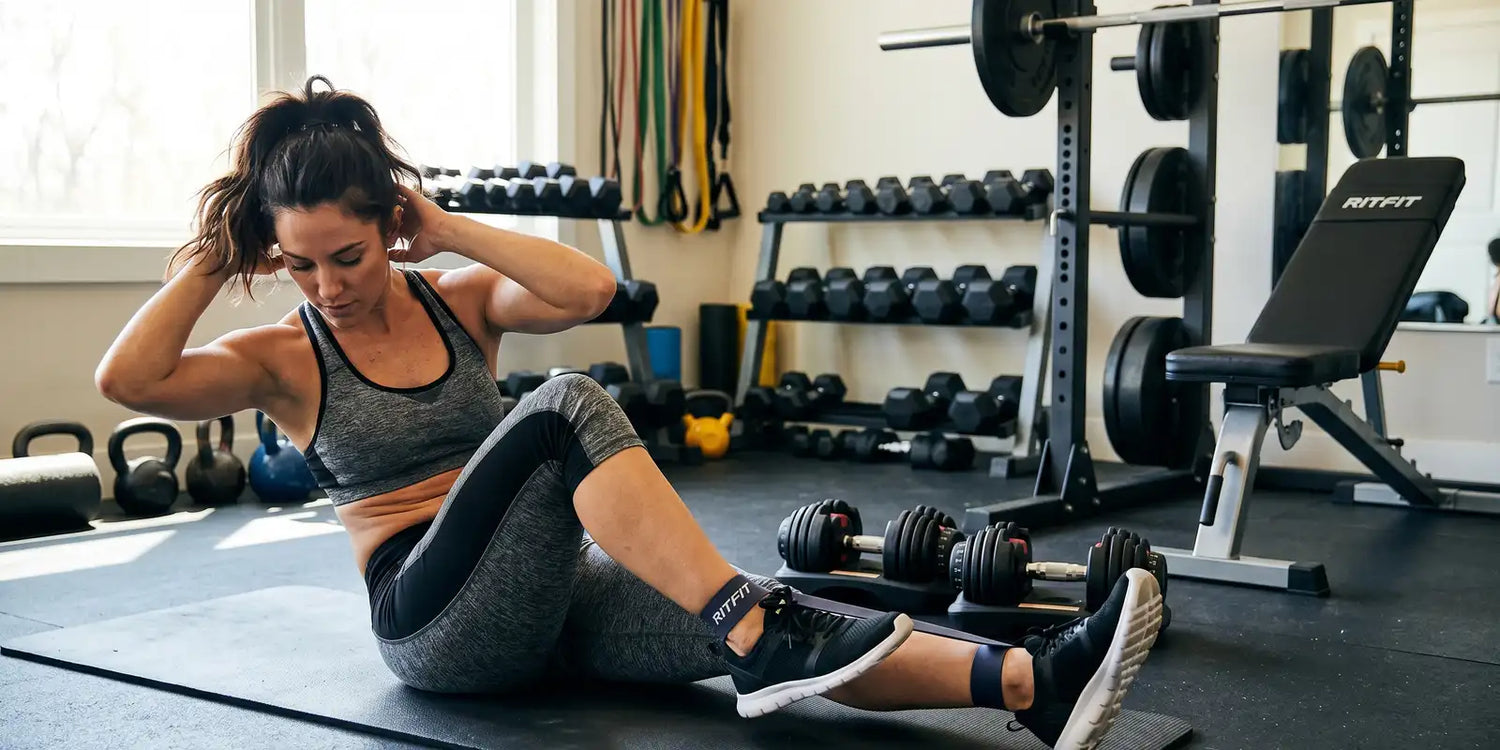
The bicycle crunch is a rotational core exercise that pairs a pedaling leg motion with a twist of the torso, training the abs and obliques together in one move. This guide covers the muscles it works, exact form, common mistakes, and how to progress safely.
It needs no equipment and scales from beginner to advanced. If you have neck or back issues, read the safe-stop section before starting and check with a qualified professional.
Table of Contents
Key Takeaways
- Two muscle groups at once: Bicycle crunches train the rectus abdominis and the obliques together, which a basic crunch does not.
- Rotation is the key cue: Drive your shoulder and rib cage across, not just your elbow, to actually load the obliques.
- Protect your spine and neck: Keep your lower back pressed to the floor and cradle your head lightly instead of pulling on it.
- Go slow to start: Controlled reps beat fast, jerky pedaling for muscle engagement and safety.
- Scalable for any level: Beginners can plant one foot, while advanced lifters hold a hovering hollow-body position.
What Is a Bicycle Crunch?
A bicycle crunch is a bodyweight core exercise where you lie on your back, pedal your legs like riding a bike, and rotate your torso so each elbow travels toward the opposite knee. The American Council on Exercise has ranked it among the top exercises for activating the rectus abdominis and obliques.
It requires no equipment and can be done anywhere, which makes it a staple in home core circuits and full-body routines. The move combines trunk flexion with rotation, so it trains more of the midsection than a flat crunch.
For a structured plan around it, see our guide to the best core workouts for beginners, intermediate, and advanced levels.
Which Muscles Do Bicycle Crunches Work?
Bicycle crunches primarily work the rectus abdominis and the internal and external obliques, with the transverse abdominis and hip flexors acting as stabilizers. Surface EMG research on crunch-type trunk flexion has found the rectus abdominis and external obliques to be among the highest-activated muscles during these movements.[1]
- Rectus abdominis: The long "six-pack" sheet that shortens to lift your shoulders off the floor.
- Obliques: The side abs that fire as you rotate your torso toward the opposite knee.
- Transverse abdominis: The deep corset muscle that braces to stabilize your spine on every rep.
- Hip flexors: Help cycle the legs, which is why leg involvement increases lower-ab demand.
EMG research comparing abdominal exercises has found that movements involving the hips and legs raise demand on the lower and deep abdominal region, while also recruiting the hip flexors such as the rectus femoris.[2] EMG comparisons also confirm the transverse abdominis and obliques are meaningfully activated during abdominal trunk-flexion work, supporting their stabilizer role.[3]
If you want to train these muscles with added support, explore our weight bench exercises for abs and the matching adjustable weight bench.
How Do You Do a Bicycle Crunch Step by Step?
To do a bicycle crunch, lie on your back, lift your shoulders and legs off the floor, and alternate driving each elbow toward the opposite knee while pedaling your legs. Keep your lower back pressed into the floor throughout to protect your spine.
- Set up: Lie on a mat, hands cradling your head, elbows wide, lower back flat.
- Lift: Raise your shoulder blades off the floor and bring your knees up to about a 90-degree bend.
- Pedal and rotate: Extend one leg to roughly a 45-degree angle while bringing the opposite elbow toward the bent knee.
- Switch: Smoothly reverse, rotating to the other side in a controlled cycling motion.
- Breathe: Exhale as you crunch and rotate to reinforce the deep-core brace.
A non-slip surface helps you stay stable, so a quality non-slip yoga mat is worth having for floor work.
The short clinical demonstration below shows the setup and the elbow-to-knee rotation at a controlled pace.
What Are the Most Common Bicycle Crunch Mistakes?
The most common bicycle crunch mistakes are swinging the elbows without rotating the torso, pulling on the neck, arching the lower back, and racing through reps. Each one reduces oblique engagement or adds strain, so fixing them makes the exercise both safer and more effective.
- Swinging instead of rotating: Lead with your shoulder and rib cage, not your elbow, so the obliques actually load.
- Pulling on the neck: Cradle your head lightly with elbows wide and lift through your abs, not your hands.
- Arching the lower back: Press your lower back into the floor for the whole set to protect the spine.
- Going too fast: Momentum lets larger muscles take over, reducing the work your abs do.
When should you stop or modify?
Stop or reduce your range of motion if you feel pain in your neck or lower back, and consult a qualified professional before continuing if discomfort persists. For lower-impact options, browse our notes on home gym equipment for low-impact training.
What Bicycle Crunch Variations Should You Try?
The main bicycle crunch variations are the beginner partial, the advanced hovering full version, and the slow-tempo crunch. Each changes the difficulty by adjusting how much your core has to stabilize and how long it stays under tension.
- Beginner partial: Keep one foot planted and one elbow near the floor for extra stability while you learn the rotation.
- Advanced full: Lift both shoulders, hover both legs a few inches off the ground, and never let them touch down during the set.
- Slow-tempo: Take roughly three seconds per rotation to maximize time under tension.
Pair these with related ab moves such as ab roller exercises or a bench ab workout for variety across a week.
How Many Sets and Reps Should You Do?
A practical starting point is 12 to 20 controlled reps per side for about 3 sets, prioritizing quality over speed. Beginners can start with 8 reps per side, and advanced exercisers can build toward slow-tempo sets of up to 30.
- Frequency: Train core 2 to 3 times per week with rest days in between.
- How to progress: Add reps, slow the tempo, or switch to the hovering full variation rather than only chasing speed.
- When to make it harder: Advance once you can complete your target reps with clean rotation and no neck strain.
To round out a deep-core program, see how an ab roller builds core muscle alongside bodyweight work.
How Do Bicycle Crunches Fit Into a Core Routine?
Bicycle crunches work best as one part of a balanced core routine that also includes anti-rotation and isometric holds. Combining them with planks and bird-dogs trains the core to both produce and resist movement, which builds more complete stability.
- Pair with isometrics: Add forearm planks for static anti-extension strength.
- Add anti-rotation: Bird-dogs and dead bugs teach the core to resist twisting.
- Build the setup: Browse functional training equipment and broader functional fitness equipment to expand your options.
FAQs About Bicycle Crunches
What muscles do bicycle crunches work?
Bicycle crunches primarily target the rectus abdominis, the long muscle that creates the six-pack appearance, and the internal and external obliques along the sides of your torso. The deep transverse abdominis braces to stabilize your spine, while the hip flexors help cycle your legs. The torso rotation is what loads the obliques most.
Are bicycle crunches good for belly fat?
Bicycle crunches strengthen and build the abdominal muscles, but they do not directly burn fat from your stomach, since spot reduction is not possible. Visible abs come from lowering overall body fat through a calorie deficit, combined with full-body training. Crunches build the muscle definition that shows once body fat decreases.
How many bicycle crunches should I do?
A common starting point is 12 to 20 controlled repetitions per side for about three sets, resting between sets. Beginners can start with 8 reps per side, while advanced exercisers may perform slow-tempo sets of up to 30. Prioritize controlled rotation and quality over speed rather than chasing a high rep count.
Why do bicycle crunches hurt my neck?
Neck pain usually means you are pulling your head forward with your hands instead of lifting through your abdominal contraction. Keep your hands cradling your head lightly, with your elbows wide, and let your core do the lifting. If discomfort continues, reduce your range of motion or stop and consult a qualified professional.
Are bicycle crunches better than regular crunches?
Bicycle crunches add a rotational component that recruits the obliques far more than a basic crunch, which mainly trains trunk flexion. The leg-pedaling motion also increases involvement of the lower abdominal region. For combined rectus abdominis and oblique training, the bicycle crunch is generally a more complete single movement.
Conclusion
The bicycle crunch is a simple, equipment-free way to train your abs and obliques together, as long as you rotate your torso instead of just swinging your elbows. Keep your lower back flat, move with control, and stop if your neck or back hurts.
Start with the beginner partial, then progress to the hovering full version or slow-tempo sets as your control improves. Add it to a balanced core routine with planks and anti-rotation work for the best results.
Disclaimer
This article is for general fitness education only and is not medical advice or a substitute for professional guidance. Consult a qualified healthcare provider or physical therapist before starting any new exercise, especially if you have neck, back, or other health concerns.
References
1. Sundstrup E, Jakobsen MD, Andersen CH, Jay K, Andersen LL. Swiss ball abdominal crunch with added elastic resistance is an effective alternative to training machines. International Journal of Sports Physical Therapy. 2012;7(4):372-80. https://pmc.ncbi.nlm.nih.gov/articles/PMC3414069/
2. Hildenbrand K, Noble L. Abdominal Muscle Activity While Performing Trunk-Flexion Exercises Using the Ab Roller, ABslide, FitBall, and Conventionally Performed Trunk Curls. Journal of Athletic Training. 2004;39(1):37-43. https://pmc.ncbi.nlm.nih.gov/articles/PMC385260/
3. Dolenec A, Svetina M, Strojnik V. Electromyographic Comparison of an Abdominal Rise on a Ball with a Traditional Crunch. Sensors (Basel). 2022;22(5). https://pmc.ncbi.nlm.nih.gov/articles/PMC8915105/