The seated cable row is a horizontal pulling exercise that trains the latissimus dorsi, rhomboids, and middle trapezius while the fixed cable path keeps your spine stable through every repetition. It suits beginners who are learning to feel their back work and experienced lifters who need controllable horizontal pulling volume.
This guide covers the muscles involved, step by step form, common errors, scapular position, grip and attachment choices, programming, and the home equipment that makes the movement repeatable.
Quick Answer: The seated cable row is performed at a low pulley with the torso upright, the feet braced, and the elbows leading the pull to the lower abdomen. Pause at the finish, return over about three seconds, and train 3 to 4 sets of 8 to 15 reps close to failure.
Key Takeaways
- Primary Movers: The seated cable row trains the latissimus dorsi, rhomboids, and middle trapezius as primary movers, with the posterior deltoid, biceps brachii, and erector spinae assisting.
- Form Foundation: Leading with the elbows and pulling to the lower abdomen keeps tension on the back instead of the biceps.
- Scapular Choice: A 2025 HD-EMG study in 14 resistance-trained men found fixed-scapular rows raise middle trapezius and latissimus dorsi activation during the eccentric phase, with comparable overall excitation.
- Programming: Seated cable rows work best at 3 to 4 sets of 8 to 15 reps taken close to failure and paired with vertical pulling.
- Attachment Options: A V-bar emphasizes the lats and mid-back, while a wide-grip bar shifts work to the upper back and rear deltoids.
What Is the Seated Cable Row?
The seated cable row is a horizontal pulling exercise performed at a low pulley cable machine with the feet braced and the torso upright. Shoulder extension and scapular retraction drive the movement, so the lats, rhomboids, and middle trapezius share the load in one repeatable pattern.
Beginners use the movement to learn back engagement cues, while experienced lifters use it to accumulate horizontal pulling volume without loading the lower back.
Small weight stack increments make progressive overload simple to track from session to session.
Which Muscles Does the Seated Cable Row Work?
The seated cable row works six muscles: the latissimus dorsi, rhomboids, middle and lower trapezius, posterior deltoid, biceps brachii, and erector spinae.
The latissimus dorsi drives shoulder extension, the rhomboids and the middle and lower trapezius retract and stabilize the shoulder blades, and the posterior deltoid assists that same shoulder extension as the handle reaches the torso. The biceps brachii adds elbow flexion as a synergist, while the erector spinae stabilizes the spine so the torso stays upright through every rep.
An EMG comparison of lat pulldown and row variations found that seated cable rows produced the highest middle trapezius and rhomboid myoelectric activity of all exercise types tested, while biceps brachii activation stayed consistent regardless of exercise type.[1]
Primary muscles:
- Latissimus dorsi: The large flat muscles on each side of the back, running from the spine out to the upper arm.
- Rhomboids: Smaller muscles that sit between the spine and the shoulder blades.
- Middle and lower trapezius: A broad band of fibers across the upper back and between the shoulder blades.
Secondary muscles:
- Posterior deltoid: The rear head of the shoulder muscle, at the back of each shoulder.
- Biceps brachii: The two-headed muscle on the front of the upper arm.
- Erector spinae: The long muscles that run up the length of the spine.
How Do You Perform a Seated Cable Row?
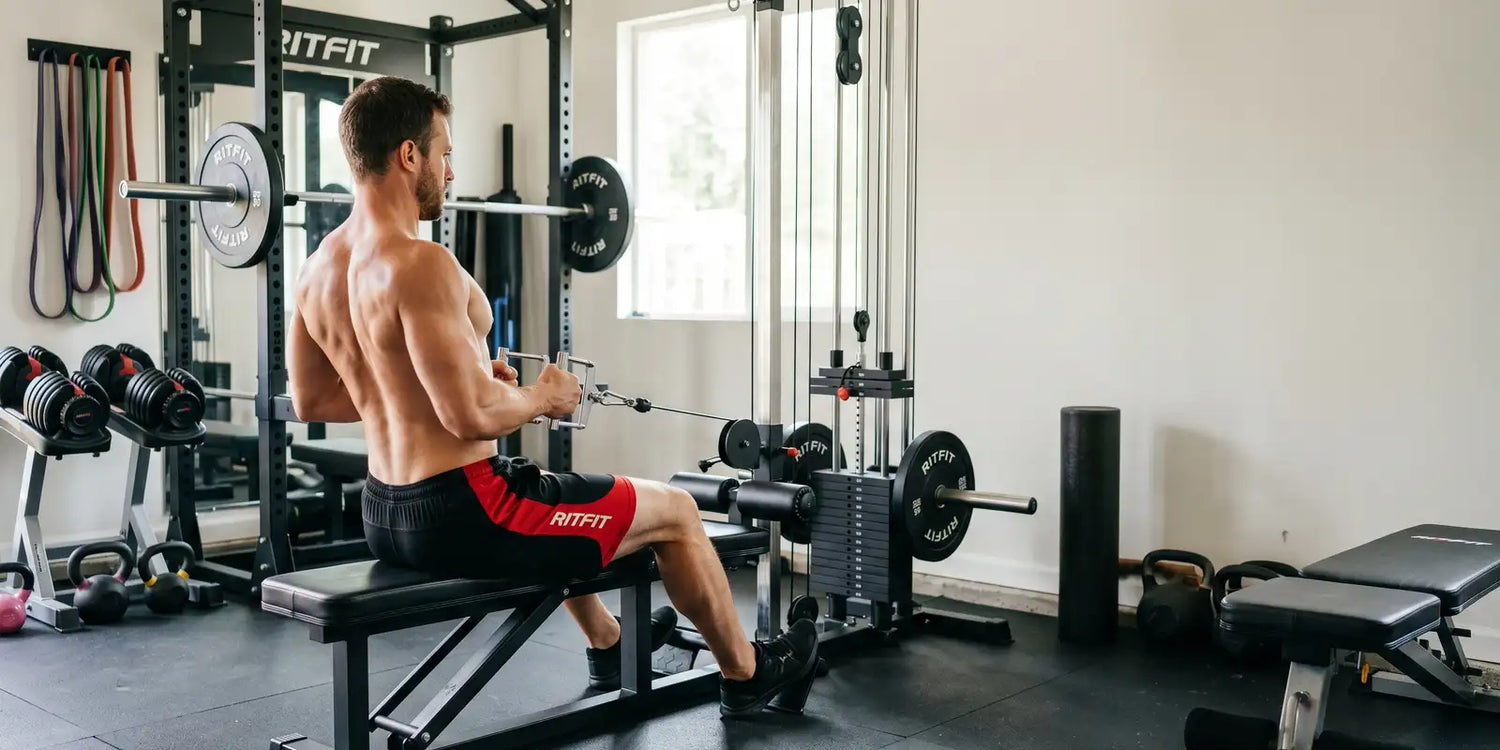
A seated cable row starts with the torso upright, a slight bend in the knees, and the arms fully extended, and it finishes with the elbows behind the ribcage and the shoulder blades drawn together. The cues below describe the standard V-bar variation, and the same principles carry over to every grip and attachment option.
Setup
Attach a V-bar or a set of RitFit exercise handles for the cable machine to the low pulley, sit on the foot platform, and place both feet flat on the footrests with a slight bend in the knees. Grip the handle, lean back until the torso is upright and the arms are extended, then set the shoulder blades before the first rep.
Execution Cues
Each repetition follows a pull and return cycle in which the elbows, not the hands, lead the movement, and dependable cable machine attachments keep the pulley path smooth through the full range of motion.
- Lead with your elbows: Drive them back and behind the torso rather than focusing on the handle to keep the load on the back rather than the biceps.
- Pull to the lower abdomen: The handle should finish just above the navel, with the elbows behind the ribcage at the top position.
- Pause at peak contraction: Hold the contraction for a full count to maximize upper back stimulus before beginning the return.
- Control the return: Let the cable extend the arms over approximately 3 seconds and allow the shoulder blades to spread apart at the end to pre-load the lats.
What Are the Most Common Seated Cable Row Mistakes?
The most common seated cable row mistakes are swinging the torso to start the pull, pulling with the hands, cutting the range short, and releasing the eccentric too quickly. Each of these errors shares the same fix, which is to slow down and restore control over every phase of the rep.
- Excessive torso lean: Swinging backward to initiate the pull uses momentum and shifts the load from the back to the lower back and hips, which reduces back muscle stimulus.
- Hands leading instead of elbows: Pulling with your hands causes the biceps to take over before the lats engage, turning a back exercise into an arm exercise.
- Cutting the range short: Stopping before the elbows pass the ribcage reduces rhomboid and middle trapezius activation at the most productive part of the movement.
- Rushing the eccentric: Releasing tension on the return eliminates the stretched position the lats need to generate force at the start of the next rep.
Should You Keep the Scapula Fixed or Free?
Both scapular strategies work, and the better choice depends on whether you want more upper back stabilization or a longer stretch under load during the seated row.
A 2025 HD-EMG study in 14 resistance-trained men found that fixed-scapular rows produced greater middle trapezius and latissimus dorsi activation during the eccentric phase than free-scapular rows, while overall muscle excitation was comparable between the two conditions.[2]
- Fixed scapula: Keeps the shoulder blades retracted throughout each rep, which increases stabilization demands on the upper back and emphasizes controlled humeral motion during the pull.
- Free scapula: Allows a full dynamic range of scapular movement, which enables greater muscle stretch at longer lengths and a more complete range of motion on each rep.
Neither approach is strictly correct, so pick the one that matches your training objective and keep it consistent enough to track progress.
Which Attachment Should You Use for Cable Rows?
A V-bar is the most balanced attachment for seated cable rows, while a wide-grip bar shifts emphasis toward the upper back and rear deltoids. A range of cable machine handles lets you rotate between these options inside the same training block.
| Attachment | Grip Type | Primary Emphasis |
|---|---|---|
| V-Bar | Neutral, palms facing each other | Lats and mid-back |
| Wide-Grip Bar | Overhand, pronated | Upper back and rear deltoids |
| Single-Arm Handle | Neutral, unilateral | Unilateral balance and rotational core demand |
| Underhand Bar | Supinated | Lats, with greater biceps contribution |
Emphasis follows the grip position and joint angle created by each attachment.
The V-bar remains the most balanced choice for most training goals, and the emphasis shifts predictably once you rotate attachments inside a single block.
How Should You Program Seated Cable Rows?
Seated cable rows work best at moderate to high rep ranges taken close to failure, most commonly 3 to 4 sets of 8 to 15 repetitions for back hypertrophy. The stable seated position makes that range safe to train hard without loading the lower back heavily.
A reliability study of 29 athletes confirmed that seated cable rows are a dependable tool for tracking back muscle force output, with intraclass correlation coefficients of 0.86 to 0.96 across two testing sessions, and side to side concentric strength differences greater than 15 percent were detected in approximately one third of participants.[3]
Pair cable rows with a vertical pull such as the lat pulldown so the back is trained through both pulling directions each week.
- Volume: Count seated cable rows as one horizontal pull in your weekly back plan alongside any chest supported work.
- Rest: Take 90 to 120 seconds between working sets so each set starts with a stable torso and fresh grip.
- Progression: Add the smallest available increment once you reach the top of the rep range with clean form on every set.
What Are the Best Alternatives to Seated Cable Rows?
Inverted rows, barbell rows, chest supported rows, Smith machine rows, and dumbbell rows all train the same horizontal pulling pattern with different stability and loading demands.
- Inverted rows: A bodyweight horizontal pull that requires no cable machine and challenges the same primary movers through a different loading angle.
- Barbell row: A free weight option with higher load potential, suited to strength focused training phases where heavier loads are the priority.
- Chest supported row: Eliminates lower back involvement entirely, isolating the upper back and lats without any torso stabilization.
- Smith machine row: A guided alternative for learning the hip hinge rowing pattern in a controlled, predictable environment.
- Dumbbell row: A unilateral option that allows independent arm training and accommodates lifters with significant strength asymmetries.
Keep at least one horizontal pull and one vertical pull in every back session, and rotate between these variations when equipment or fatigue demands it.
Which Home Cable Machine Is Best for Seated Cable Rows?
A home cable machine suits seated cable rows when it provides a low pulley, a guided cable path, and a weight stack that adjusts in small increments. Those three features decide how smoothly the movement loads, progresses, and repeats from session to session.
Home cable stations usually pair a low pulley with a lat pulldown tower or a cable crossover, so one upright frame covers rows, pulldowns, and presses inside a single footprint.
Choose the RitFit M1 PRO for Home Cable Rows
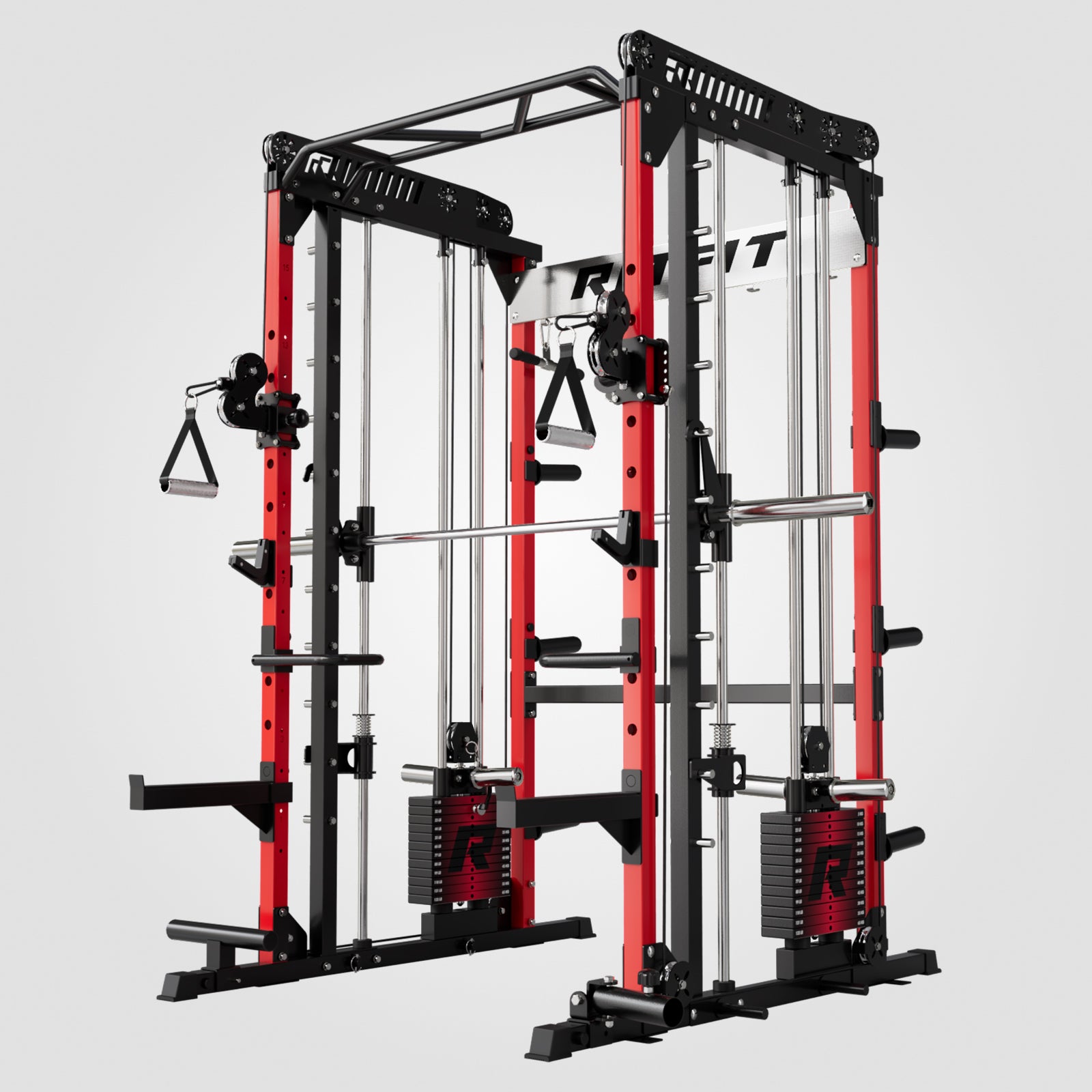
The RitFit M1 PRO Multi-Functional Smith Machine combines a guided Smith bar path with a cable crossover station, so you can run seated cable rows at the low pulley and then move straight into a press or a pulldown without changing equipment. If you want a modular frame that can be expanded later, the RitFit M2 Multi-Functional Modular Home Gym Smith Machine applies the same low pulley and cable station layout in a modular build.
"Few pieces of equipment in the home exercise industry are as comprehensive and versatile as this all-in-one gym system. The robust system provides a natural, centered bar path for compound lifts like squats, presses, and rows, and incorporates a dual cable crossover station with a full rack of precision-engineered attachments."
Tom Eskey, CF-L1, CPT, Home Gym Equipment Reviewer, Garage Gym Revisited, RitFit M1 Multi-functional Smith Machine Review
"This item was the best investment for me and my family"
Jenny, Verified Buyer, RitFit Pink Power Pro
FAQs About Seated Cable Row
What muscles does the seated cable row work?
The seated cable row primarily targets the latissimus dorsi, rhomboids, and middle trapezius as its main back muscles. Secondary movers include the posterior deltoid, teres major, biceps brachii, and erector spinae, which assist with elbow flexion and spinal stability throughout every rep.
How far should I pull the cable in a seated row?
Pull the handle to your lower abdomen, just above the navel. At the end position, your elbows should be behind your torso and your shoulder blades fully retracted. Pulling to the chest or sternum shifts tension away from the lats and upper back.
Should I retract my scapula during seated cable rows?
Yes. Pre-setting the scapula before pulling creates a stable base and maximizes lat force output. Research shows that fixed-scapular rows and free-scapular rows produce comparable overall muscle excitation, though fixed-scapular execution increases middle trapezius and latissimus dorsi activation specifically during the eccentric phase of each rep.
How many sets and reps of seated cable rows should I do?
For hypertrophy, most coaches recommend 3 to 4 sets of 8 to 15 repetitions. The stable, seated position allows you to work close to failure safely. Pair seated cable rows with vertical pulling exercises like lat pulldowns and include both in a well-rounded back training plan.
What is the difference between a V-bar and a wide-grip bar for cable rows?
A V-bar uses a neutral grip and emphasizes the mid-back and lats through a comfortable pulling angle. A wide-grip bar shifts more work to the upper back and rear deltoids. Neither option is superior, so choose based on which area you want to prioritize in a given session.
Conclusion
The seated cable row builds the lats, rhomboids, and middle trapezius through a stable path that makes progressive overload easy to measure. Master the elbow led pull, test the attachments that change emphasis, and pair the movement with vertical pulling for balanced back development.
If you train at home, set the low pulley at a height that keeps your torso upright and your feet planted, then add weight as each rep standard becomes consistent. For a first setup, the RitFit discount guide covers how to save on the equipment you need.
Disclaimer
This article is intended for informational and educational purposes only and does not constitute medical advice, diagnosis, or treatment. If you have a pre-existing injury, joint condition, or any health concern, consult a qualified healthcare professional or certified personal trainer before beginning or modifying your exercise program.
References
1. Lehman GJ, Buchan DD, Lundy A, Myers N, Nalborczyk A. Variations in muscle activation levels during traditional latissimus dorsi weight training exercises: an experimental study. Dyn Med. 2004;3:4. PMCID: PMC449729
2. Padovan R, Cè E, Longo S, Tornatore G. High-density surface electromyography excitation of prime movers across scapular positions in the seated row. J Funct Morphol Kinesiol. 2026;11(1):6. PMCID: PMC12821611
3. Rodríguez-Perea Á, Vila H, Ferragut C, et al. Reliability of the seated unilateral cable row and strength differences between dominant and non-dominant sides in young athletes. J Funct Morphol Kinesiol. 2025;10(4):390. PMCID: PMC12551020