








The best mid back exercises train one job, pulling your shoulder blades back and down. That job belongs to the rhomboids and the middle trapezius rather than the lats, which is why a back day built on pulldowns can leave the area between your shoulder blades untrained.
This guide ranks the moves that load the mid back, explains how to hit the middle back at home, and gives you load, rep, and frequency rules that keep the work on the rhomboids and middle trapezius instead of the biceps.
Quick Answer: The best mid back exercises finish with the shoulder blades squeezed, including chest-supported dumbbell rows, seated cable rows with a wide elbow path, face pulls, prone Y raises, and band pull-aparts. Train them twice a week, three sets of 10 to 15 reps, and add load once you can hold the top squeeze for a second.
Key Takeaways
- Target the right muscles: The mid back is the rhomboids plus the middle trapezius, and both answer to scapular retraction rather than to shoulder extension.
- Vertical pulling is not enough: Pulldowns and pull-ups load the lats while the shoulder blades stay fairly still, so they miss most of the mid back.
- Horizontal pulls lead the list: Chest-supported rows, wide elbow cable rows, face pulls, prone Y raises, inverted rows, single-arm rows, and band pull-aparts cover the region with two or three pieces of equipment.
- Moderate loads work best: Three sets of 10 to 15 reps with a one second squeeze at the top beat heavy sets with a short range of motion for the rhomboids and middle trapezius.
- Pain is a stop signal: Pinching or sharp pain during a row means changing the elbow path or swapping the exercise, never adding load.
What Muscles Make Up the Mid Back?
The mid back is the band of muscle between your shoulder blades. Its main residents are the rhomboids, which sit under the trapezius and pull the shoulder blade toward the spine, and the middle trapezius, which retracts and steadies that blade.
- Rhomboids: Two muscles, major and minor, that run from the thoracic spine to the inner edge of the shoulder blade and create the squeeze you feel when you pinch a pencil between your shoulder blades.
- Middle trapezius: The mid section of the trap, holding the shoulder blade flat against the rib cage while the rhomboids retract it.
- Upper trapezius: The shrug muscle above the mid back, and the one that takes over when a row gets too heavy.
- Thoracic spine: The middle back bones the rhomboids attach to, and the segment that needs extension for the shoulder blades to travel freely.
- Lats: The prime mover for pulldowns and pull-ups, and a poor substitute for retraction work.
You will see this region described in a few different ways, and the anatomy behind all of them is the same. The upper mid back muscles form a layer that pulls the shoulder blade toward the spine, with the lats sitting below and the upper trapezius sitting above.
Why Do Lat Pulldowns Alone Miss the Mid Back?
Lat pulldowns mostly extend the shoulder, so the lats do the work while the shoulder blades stay still. A row asks the rhomboids and middle trapezius to pull those blades toward the spine, which is the real difference between a lat exercise and a mid back exercise.
Not every lifter distributes that work the same way. One comparison study reported that scapular retraction ratios differ between people with a protracted scapula and an asymptomatic group, which helps explain why two people can row identical weight and feel it in different places.[1]
Exercise choice moves the balance as well. A systematic review examined which exercises produce optimal muscle ratios among the scapular stabilizers in normal shoulders, and the answer depends on the movement pattern rather than on how much weight is on the bar.[2]
None of this makes vertical pulling useless. One eight-week trial found that lat pulldown training with an unstable cable setup improved pull-up endurance 45.5% more than the same training with a stable setup.[3]
Keep the pulldowns in your program and add horizontal pulling on top rather than replacing one with the other.
What Are the Best Mid Back Exercises?
The best mid back exercises are horizontal pulls that end with a one second squeeze of the shoulder blades. The list below runs from the heaviest option to the lightest, so you can pick two or three movements and still cover both muscles.
1. Chest-Supported Dumbbell Row
Set an adjustable bench to about 30 degrees, lie face down, and row two dumbbells toward your lower ribs with the elbows at roughly 45 degrees. Because the bench removes your lower back from the lift, you can chase a hard squeeze without shortening the range of motion.
2. Wide Elbow Seated Cable Row
Sit tall at a low pulley, use a wide or neutral handle, and let the elbows travel out to about 45 degrees as you pull toward the sternum. The wider elbow path is what separates a middle back row from a lat-focused row, and it is the version most people are missing when they say rows never hit the mid back.
3. Cable Face Pull
Set a rope at eye height, pull it toward your forehead, and finish with the hands beside your ears and the shoulder blades pulled back. In one small study of 12 healthy adults, retraction performed with the shoulder externally rotated and the elbow extended produced higher middle trapezius activation and lower rhomboid activation than a bent elbow rowing position.[4]
4. Prone Y Raise
Lie face down on an incline bench with light dumbbells or no weight at all and raise the arms into a Y shape with the thumbs up. The movement is small on purpose, and it is one of the few options that trains the middle trapezius without asking much of the lats.
5. Single-Arm Dumbbell Row
Brace one hand on a bench, keep the hips square, and row the dumbbell toward the hip rather than the shoulder. The single-arm setup lets you rotate slightly and follow the shoulder blade through a longer arc, which is useful for lifters who feel stuck in the middle of a range of motion.
6. Inverted Row
Set a bar or a smith machine at hip height, hang underneath it, and pull your chest to the bar while the heels stay on the floor. Body angle sets the difficulty, so walking the feet forward makes the movement harder without adding any weight at all.
7. Band Pull-Apart
Hold a light band at shoulder height with straight arms and pull it apart until it touches your chest, pausing for a beat at the end. This is the easiest movement to add on non-training days, and the high rep range builds volume without leaving you sore for the next session.
Which Movements Produce the Strongest Scapular Retraction?
Rows with the elbow path held wide and the shoulder rotated slightly outward ask the most from the middle trapezius, while prone raises and band pull-aparts add the highest quality reps at the lightest load. Choose by the equipment you own rather than by a ranking, because every movement here retracts the scapula.
Common Mistakes That Keep Rows Out of the Middle Back
Leading with the hands, shrugging the shoulder toward the ear, and ending the rep before the blades finish moving are the three errors that keep a row in the arms. Fix the cues first, because adding load to a broken pattern only makes the compensation stronger.
Because the rhomboids sit so close to the spine, some lifters describe this work as inner back exercises or inner back workouts. Others use center back exercises as the label for anything between the shoulder blades, which is the same region either way.
Either way, every middle back exercise on this list starts with the shoulder blade rather than the elbow.
If you keep only one movement, the best exercise for middle back work is the chest-supported row, because the bench takes the lower back out of the lift. A gym version and a garage version differ in the load, not in the cue.
Any upper middle back workout should begin with a wide elbow row and finish with a light isolation set. For the middle back, the best exercises for mid back growth are the ones you can pause at the top for a full second.
The same movements work at home or at a commercial gym, so a bench is the only real requirement. You do not need a gym membership for mid back exercises, because one band covers the pull-aparts and the prone raises.
Two or three of these movements cover the whole region, and the dumbbell versions can be swapped for cable versions without changing the intent. If you already own a dumbbell setup, the dumbbell back exercises that pair with this list give you plenty of variety for the same muscles.
"Not only is the face pull an excellent movement to grow your upper back muscles, it can also improve poor posture. The rear shoulder muscles play a big role in preventing the bad posture so many people get from time spent sitting at desks jobs and hunched over their electronics."
Jeff Cavaliere, MSPT, CSCS, Physical Therapist and Strength Coach, Athlean-X, Upper Back Workout
How Do You Do a Mid Back Workout at Home?
A home mid back workout needs one horizontal pull, one overhead pull, and one light isolation movement. That combination covers the rhomboids, the middle trapezius, and the rear shoulder muscles without a full commercial gym.
Dumbbells and a bench are the cheapest route, because chest-supported rows, single-arm rows, and prone raises cover everything except the cable variations. A pair of 20 to 40 lb adjustable dumbbells handles most lifters for years, and the dumbbells at RitFit include fixed and adjustable sets.
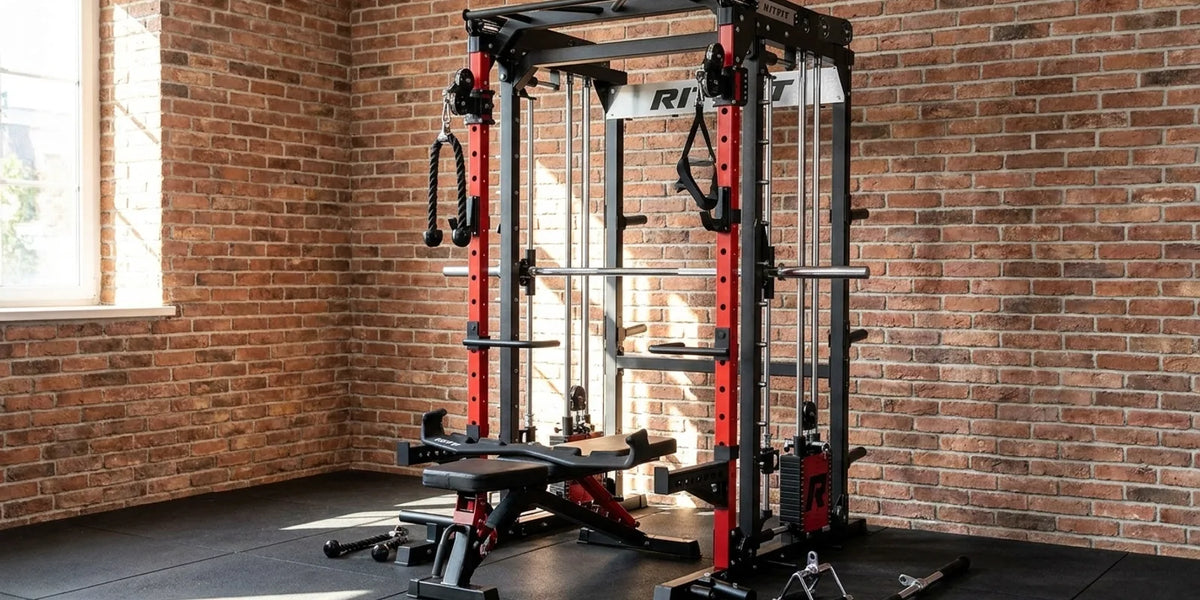
A cable station or an all-in-one machine opens up the face pull and the wide elbow row. The cable machines at RitFit run from single stack units to full tower systems, and swapping the handle changes your elbow path more than swapping the machine does.
A neutral grip multi-grip lat pulldown bar or a set of cable machine attachments covers both the wide and neutral positions, which is the entire adjustment most people need. If you train on a Smith machine, the same cues carry over, and our guide to Smith machine exercises walks through the setup.
This independent review of the RitFit Buffalo Smith Machine covers how the cable section behaves under load in a garage setup.
How Do You Keep the Work on the Mid Back Instead of the Biceps?
Start every rep by moving the shoulder blade rather than the elbow. If the elbow bends first, the biceps and the lats take the set and the rhomboids never receive the signal.
- Set the blade first: Pull the shoulder blade back and down before the handle travels an inch.
- Lead with the elbows: Drive the elbows past the ribs instead of pulling with the hands.
- Hold the squeeze: Pause for a full second at the top, where the rhomboids are shortest.
- Keep the ribs down: A little thoracic extension opens room for the blades, while arching the lower back hands the work to the erectors.
- Change the pulling angle: One study found that pulling with the arm raised to about 120 degrees of shoulder flexion increased rhomboid activity and reduced upper trapezius activity compared with lower arm positions.[5]
- Loosen the grip path: A palm up or neutral grip is a common coaching cue for keeping the elbow path clean and the shoulders out of the movement.
Once the cues click, how to train the mid back becomes simple, because one row and one isolation movement cover everything the region needs. If you are unsure how to target the mid back on a busy day, run two sets of band pull-aparts between your pressing sets instead of skipping the work.
The most common mistake is chasing load before the pattern is clean. Shrugging is the second most common, and it shows up the moment the upper trapezius takes over at the start of a heavy set.
How Much Weight and How Many Reps Should You Use?
Pick a load you can move for 10 to 15 reps with the last two reps slowing down. If you can finish 15 reps while still holding the top squeeze for a full second, the weight is too light.
- Sets: Three working sets per movement, or four if the mid back is your priority for the block.
- Reps: 10 to 15 for rows and face pulls, 12 to 20 for prone raises and band pull-aparts.
- Tempo: One second to squeeze, two seconds to lower, with no bouncing at the bottom.
- Rest: 60 to 90 seconds between sets, which is enough to keep the quality high without cooling down completely.
- Effort: Stop each set two reps short of failure so the last rep still looks like the first one.
Add 5 lb, or move up one band level, once you reach the top of the rep range on every set with the squeeze still intact. That single rule is the whole progression for a small muscle group, and it is easier to follow than a percentage chart.
Heavier pulling still has a place in the program. Bracing under load carries over to rows, and the trap bar deadlift is one of the simplest ways to train that stiffness without loading the mid back directly.
Mid back strength training follows the same progressive overload rule as any other lift. Knowing how to train middle back for size comes down to adding reps before adding weight, which is why the best middle back workouts look almost identical from week to week.
What Should You Do When Your Mid Back Hurts During a Set?
Stop the set when you feel pinching or sharp pain instead of muscular fatigue. Soreness in the rhomboids a day later is normal, but pain during the repetition is a signal to change something.
- Pinching at the front of the shoulder: Lower the elbow path, switch to a neutral grip, and shorten the range of motion before you reduce the weight.
- Pain with overhead pulling: Swap to prone Y raises or band pull-aparts, which train the same muscles from a much shorter arc.
- Lower back fatigue during rows: Move to a chest-supported variation that takes the hinge out of the lift entirely.
- Pain that travels down the arm or comes with numbness: Stop training the area and have it assessed by a physician or physical therapist.
A simple substitution rule keeps you training without pushing into pain.
Any movement that hurts can be replaced by the next option on the list above, and most lifters find that one change is enough to keep the session productive.
Knowing how to target middle back muscles through a shorter range often solves the problem without changing the exercise at all.
If the area still hurts after two weeks of lighter work, get it looked at rather than working around it indefinitely.
How Do You Build a Mid Back Workout Into Your Week?
Run two mid back sessions a week and place them after your main pressing or pulling work. The muscles are small, so they need consistent volume rather than a dedicated training day.
| Training Day | Mid Back Work | Sets |
|---|---|---|
| Day 1 | Chest-supported rows and face pulls | 3 plus 3 |
| Day 2 | Prone Y raises and band pull-aparts | 3 plus 3 |
| Day 3 | Wide elbow cable rows and single-arm rows | 3 plus 3 |
Sample weekly layout for a lifter training three days a week, with the mid back work placed at the end of each session.
If you only train twice a week, one row variation per session with a band pull-apart finisher is enough to keep progressing. A back day structure that starts with the big pulls and finishes with the mid back work is the simplest way to fit it in, and the back day template covers that order in detail.
Two short sessions show how little time working the middle back actually takes, and nothing here requires a fourth training day.
If your week is tight, this is how a short workout can train the middle back from two angles without turning into a second back day.
For the hinge side of the equation, a dedicated RitFit BE01 back extension machine keeps the lower back and thoracic extension work loaded without a training partner. This upper body routine shows how the mid back work fits into a full session.
FAQs About Mid Back Exercises
What is the difference between mid back exercises and a middle back workout?
They describe the same training. The middle back covers the rhomboids and the middle trapezius, the muscles between your shoulder blades, and it is sometimes written as one word. A midback workout is simply the session that trains them, and midback exercises follow the same rule, shoulder blades back and down before the elbow bends.
How do you hit the mid back with dumbbells at home?
Set up a chest-supported row with a bench at about 30 degrees and pull the dumbbells toward your lower ribs with the elbows at roughly 45 degrees. Pause for one second with the shoulder blades squeezed. Because the bench removes the lower back from the lift, you can focus on retraction and use lighter dumbbells without losing the training stimulus.
How many days a week should you train the middle back?
Two to three sessions a week is plenty for most lifters, with at least one full day between heavy pulling days. The mid back recovers quickly because the loads stay moderate, so many people spread three to four sets across two days and add a short band pull-apart series on their other training days.
Why do you feel rows in your arms instead of your mid back?
The biceps and the forearms take over when the elbow bends first and the shoulder blades never move. Start every rep by setting the shoulder blade back and down, keep the elbow path close to the ribs, and pause at the top. Lower the load until you can hold that squeeze for a full second.
Can you build the upper middle back muscles without a cable machine?
Yes. A single pair of dumbbells, a bench, and one resistance band cover the whole list. Chest-supported rows and single-arm rows load the rhomboids, prone Y raises train the middle and lower trapezius, and band pull-aparts add high rep volume on days when you are not lifting heavy.
How long does it take to feel mid back strength gains?
Most lifters notice better control and a stronger squeeze within three to four weeks of consistent twice weekly training. Visible size changes take longer, usually eight to twelve weeks, and depend on total weekly volume, protein intake, and whether you keep adding load or reps over time.
Do you need a gym for the best mid back workouts?
No. A bench, one pair of dumbbells, and a resistance band are enough to train the rhomboids and the middle trapezius, and most middle back exercises in a gym have a home equivalent. A cable station makes face pulls and wide elbow rows easier to load, and an inverted row needs nothing more than a bar at hip height. Choose the version you will actually repeat twice a week.
Do upper middle back exercises differ from mid back exercises?
No. Exercises for the upper mid back and exercises for the upper middle back are the same rows and prone raises that train the rhomboids and the middle trapezius. Upper and mid back exercises, mid and upper back exercises, and mid to upper back exercises all describe one region, so a single row variation answers every version of the question.
Conclusion
Mid back exercises work when the shoulder blades move before the elbows do, and the rhomboids and middle trapezius need horizontal pulling rather than another set of pulldowns. Pick two or three movements from the list, train them twice a week, and hold the top squeeze for a full second on every rep.
Start with chest-supported rows and face pulls this week, then add band pull-aparts on your off days. If you are still shopping for the equipment to run the plan, check the RitFit discount guide before you order.
Disclaimer
This article is general fitness education and is not medical advice, diagnosis, or treatment for any shoulder, spine, or back condition. Consult a qualified physician or physical therapist before starting a new mid back training program, especially if you have a current injury, a history of shoulder problems, or pain that persists or radiates.
References
1. Yoo WG. Comparison of Isolation Ratios of the Scapular Retraction Muscles between Protracted Scapular and Asymptomatic Groups. J Phys Ther Sci. 2013;25(8):905-6. doi:10.1589/jpts.25.905. PMCID: PMC3820207
2. Schory A, Bidinger E, Wolf J, Murray L. A SYSTEMATIC REVIEW OF THE EXERCISES THAT PRODUCE OPTIMAL MUSCLE RATIOS OF THE SCAPULAR STABILIZERS IN NORMAL SHOULDERS. Int J Sports Phys Ther. 2016;11(3):321-36. PMCID: PMC4886800
3. Li Q, Yan J, Qiao M, et al. Eight-week lat pull-down resistance training with joint instability leads to superior pull-up endurance performance and reduced antagonist coactivation in recreationally active male college students. Eur J Sport Sci. 2025;25(1):e12243. doi:10.1002/ejsc.12243. PMCID: PMC11667758
4. Fennell J, Phadke CP, Mochizuki G, Ismail F, Boulias C. Shoulder Retractor Strengthening Exercise to Minimize Rhomboid Muscle Activity and Subacromial Impingement. Physiother Can. 2016;68(1):24-8. doi:10.3138/ptc.2014-83. PMCID: PMC4961314
5. Yoo WG. Effects of pulling direction on upper trapezius and rhomboid muscle activity. J Phys Ther Sci. 2017;29(6):1043-1044. doi:10.1589/jpts.29.1043. PMCID: PMC5468195





