Pull-up alternatives at home solve a very specific problem: you want to train your back and you have no bar, no ceiling clearance, or not enough strength yet to move your own bodyweight. This guide sorts the most useful replacements by the equipment you already own, from a full cable machine down to a single towel.
Every section names the pull-up quality the movement replaces, whether that is lat width, scapular control, or grip endurance. If you are working around shoulder pain, read the last section before you start.
Quick Answer: The lat pulldown is the closest pull-up alternative at home because it matches the overhead pull and lets you adjust the load. Dumbbell rows cover the horizontal pull, band pulldowns cover setups with no machine, and a towel row is the best choice when you have no equipment at all.
Key Takeaways
- Closest substitute: The lat pulldown repeats the overhead pull pattern against an adjustable load, so it is the closest pull-up substitute you can put in a garage.
- Dumbbells cover thickness: Dumbbell rows are horizontal pulls, so pair them with a pullover or a band pulldown to cover the vertical path as well.
- Bands subtract bodyweight: A band removes part of your bodyweight from the bar, which makes it the assisted pull up alternative most home lifters start with.
- No equipment still works: Bodyweight rows and towel rows train the same muscles, with a lighter load and more demand on your grip.
- Grip changes the angle: Across seven lat pulldown variants in 40 experienced men, grip type and width did not significantly change normalized muscle activation.
What Do Pull-Ups Train That an Alternative Has to Replace?
A pull-up is a vertical pull that loads the lats, biceps, rear delts, and rhomboids at once. Any replacement worth using has to train at least the latissimus dorsi and the elbow flexors through a full range of motion, and the better options also train scapular retraction and grip.
- Latissimus dorsi: The primary mover in every pulling exercise and the main reason pull-ups build a V taper. A replacement that never takes your arms overhead still trains it, just less directly.
- Biceps brachii: Every time the elbow bends under load the biceps contribute, which is why pulldowns and rows carry over to the bar so well.
- Rear deltoids and rhomboids: These take over as your elbows travel behind your torso, and they are where the scapular retraction and posture benefit of a pull-up comes from.
- Teres major: It works alongside the lats and is often undertrained, because most home routines skip the fully lengthened overhead position.
- Grip and core: Without a seat or back pad, your midsection stabilizes the whole movement and your hands hold on for the entire set.
That list is the checklist for everything below. If an option trains the lats and the grip but skips scapular control, it only covers part of the job, and the alternative exercises for pull ups that follow are grouped so you can cover the gaps.
Pull-Up Alternatives With a Cable Machine
A cable machine gives you the closest pull-up alternative at home because the pulley holds tension through the entire arc. The load also adjusts in small steps, so you can start light and add weight without waiting for your bodyweight to change.
In one trial, eight weeks of lat pulldown training improved pull-up endurance and lat pulldown peak force in recreationally active male college students, and the group that trained with joint instability completed 45.5% more pull-up repetitions than the stable group.[1]
- Lat pulldown: The substitute exercise for pull ups that most people can set up in under a minute, because you pull a bar from overhead to your chest against an external load. Set the bar slightly wider than shoulder width, lean back about 15 degrees, and drive your elbows toward the floor.
- Seated cable row: A study found the seated row produced the highest middle trapezius and rhomboid activity of the four pulling exercises tested, and it tied with the wide grip pulldown for the highest lat to biceps activation ratio.[2]
- Cable straight arm pulldown: With the elbows almost locked the biceps cannot take over the rep. Set the pulley high, step a foot or two back, and sweep the bar down toward your thighs.
- Single arm cable row: One side pulls at a time, which is the simplest way to expose a left to right strength gap that a two handed row hides. Drive the elbow toward your hip rather than your ribcage.
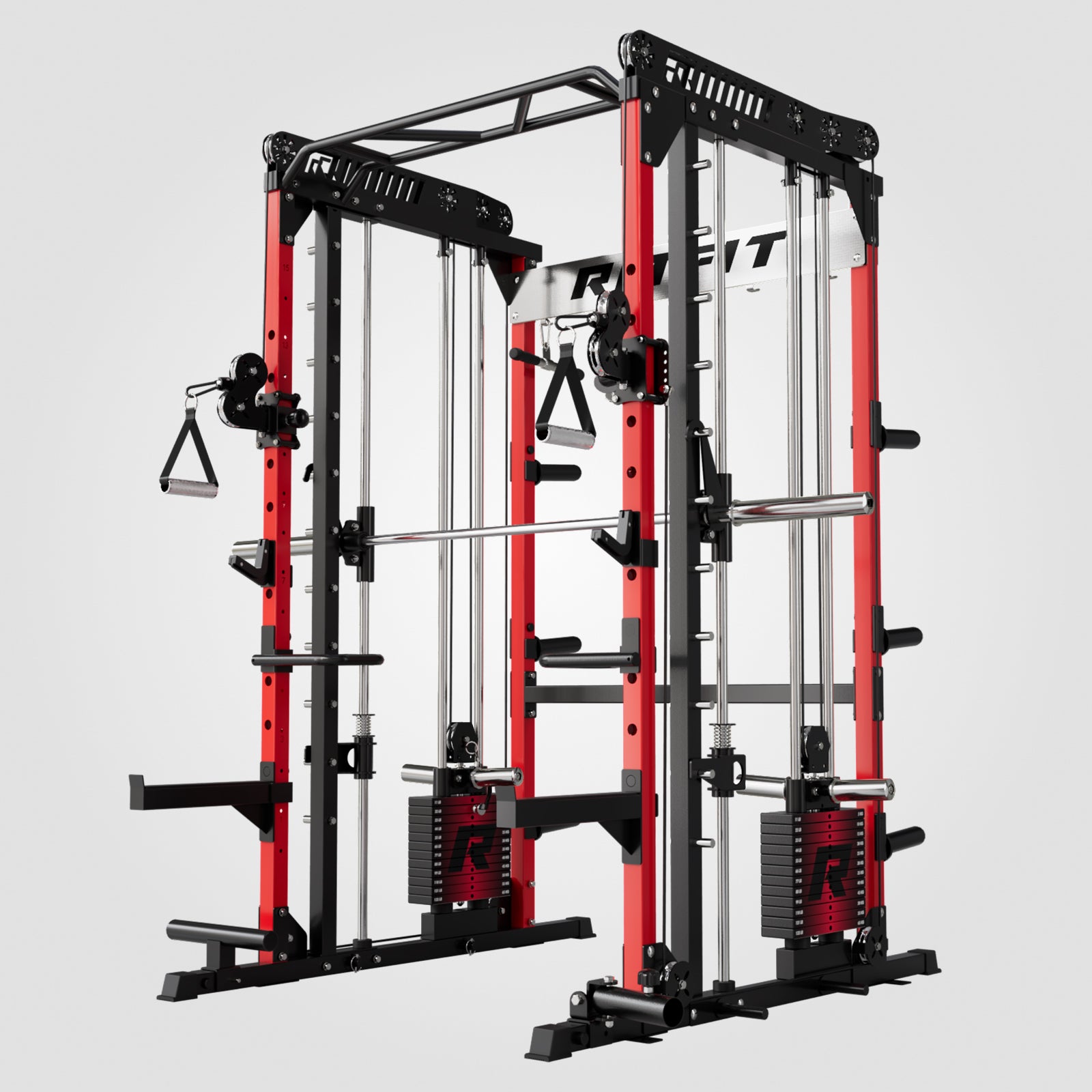
If you are comparing exercises similar to pull ups, a cable machine covers both the vertical and the horizontal path, which is why it leads this list. A cable machine paired with a RitFit all in one multi grip lat pull down bar lets one stack cover both a wide grip pull up alternative and a neutral grip pull up alternative.
Pull-Up Alternatives With Dumbbells
Dumbbells cover the horizontal pull well, but they cannot reproduce the overhead path of a pull-up. A pull up dumbbell alternative is therefore a thickness builder, so pair it with something that takes your arms overhead.
The single arm row is the version most home lifters can load heaviest, and the bent over row forces your torso to hold position for the whole set. Both are solid alternatives for pull ups when the goal is mid-back thickness rather than width.
A dumbbell pullover is the exception, because it loads the lat in a fully lengthened position and shares more with the overhead path than any row does. Treat pullover alternatives as a finisher that reinforces the lat engagement pattern rather than a replacement for heavy rows.
- Single arm dumbbell row: Brace one hand and knee on a RitFit folding utility bench, let the dumbbell hang all the way down, then drive your elbow toward your hip.
- Bent over dumbbell row: Hinge until your torso sits between 45 and 90 degrees and pull both dumbbells toward your lower ribs. A neutral grip is usually kinder to the wrists as the weight climbs.
- Dumbbell pullover: Lie across a bench with your upper back on the pad and lower the dumbbell behind your head in a slow arc. Keep the elbows nearly straight so the lats do the work instead of the triceps.
The dumbbells you already own decide how far this setup goes, because rows stop being productive once the weight is too light.
"The RitFit dumbbells are phenomenal quality! Adding them to my home gym has made all the difference!"
Letha C. Verified Buyer, RitFit PVC-Coated Round Dumbbells Set with Rack
Pull-Up Alternatives With Resistance Bands
Bands are the assisted pull up alternative most people can afford and store, because they subtract part of your bodyweight. That makes them a practice tool for the full movement rather than a way to build maximum strength.
A band pulldown trains the same vertical path when you have nothing overhead to hang from. Anchor the band above head height, kneel underneath it, and pull the ends down toward your chest with your elbows driving down and back.
Band resistance rises as you pull, which is the opposite of a cable stack and closer to bodyweight at the top of the rep. Once the band stops helping, it is time to move to an alternative to assisted pull ups that adds real load.
- Band pulldown: Loop the band over a door frame anchor or any solid point at height, then pull the ends down and back. It is the easiest way to practice the pulling pattern before you own a machine.
- Band assisted pull-up: Put one foot or knee in the band and pull yourself up. Use the lightest band that still gets you through the set so the lats keep doing most of the work.
The resistance bands listing shows the tension range for each band, and the pull up assist band set specifications page breaks down what each level is built for.
What Can You Do for Pull Ups With No Equipment at Home?
A towel row is the most practical no equipment pull up alternative you can set up in a minute. Bodyweight rows and doorway rows also work, and both ask more of your grip than a bar does.
An electromyographical comparison of traditional, suspension device, and towel pull-ups in 15 resistance-trained adults found no significant differences in latissimus dorsi, biceps brachii, or posterior deltoid activation, and all three reached activation levels considered sufficient to promote strength and hypertrophy.[3]
- Towel row: Loop a towel around a door handle at waist height, lean back with straight arms, and row your chest toward the anchor. Lean back further to make it harder and bend your knees to make it easier.
- Doorway row: Stand in an open doorway, grip both sides of the frame, and sit back until your arms take your weight. It is the gentlest way to build pulling strength with nothing in the house.
- Inverted row with two chairs: Rest a broomstick across two sturdy chairs and row yourself up underneath it. Push down on the setup to test it before you put your full weight on the stick.
- Floor pull: Lie face down with your arms overhead and pull your elbows toward your hips without pushing off the ground. Hold the bottom position for two to three seconds to build the lat contraction.
Treat these as the substitute for pull ups at home that keeps the pattern alive while you save for equipment, not as a long term ceiling. The towel and doorway versions are also the easiest pull up substitute at home to travel with, and a guide on how to train to do a pull-up at home shows how to progress from them toward the bar.
What Is a Good Pull-Up Bar Alternative for a Small Home Gym?
A power cage with a built in pull-up bar is the most durable pull-up bar alternative at home. It does cost floor space you may not have, so the right answer depends on whether you own the walls you would be drilling into.
A wall mounted or doorway bar is the cheapest pull-up bar alternative and takes almost no floor space. It still needs enough overhead clearance for your full reach, and many rental leases do not allow the drilling.
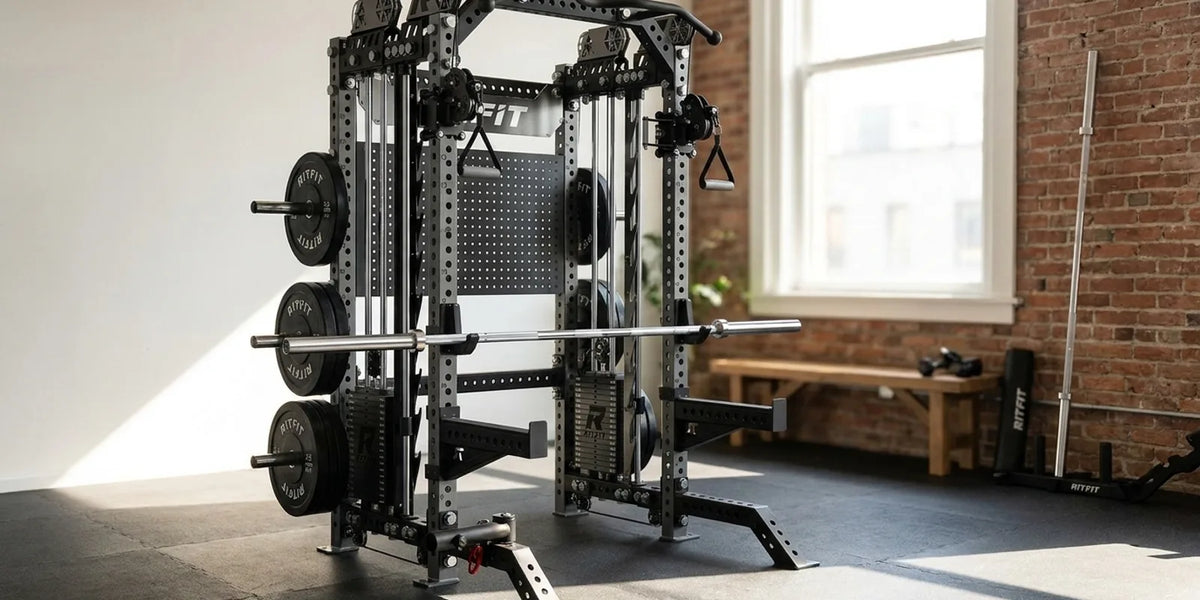
- Power cage: Gives you a pull-up bar plus a place to squat and press in the same footprint. A comparison of the power cage with a pull-up bar options covers the height and depth numbers that decide whether it fits.
- Smith machine or all in one: Puts a fixed bar, a lat pulldown, and a cable column in one unit, which is the smallest way to keep every option on this list available.
- Doorway bar: Cheap and removable, but limited by door width and by the ceiling height above the frame.
If you want one frame that covers both jobs, a RitFit PSR05 2.0 Smith machine with lat pull down combines the pulldown station with a cable crossover in a single footprint.
Do Wide Grip and Neutral Grip Pull Up Alternatives Work the Same Muscles?
Grip width changes where you feel the pull, but it does not change how much muscle you use. A wider grip shifts more of the load toward the lats, while a chin up alternative with a supinated grip hands more of the work to the biceps.
In 14 resistance trained men, the front lat pulldown produced greater latissimus dorsi excitation than the behind the neck version during the descending phase, with an effect size of 0.97.[4]
Across seven lat pulldown variants in 40 resistance-trained men, each with at least five years of experience, grip type, grip width, and trunk inclination did not significantly change normalized muscle activation.[5]
Practically, pick the grip you can load hardest and control through a full range of motion. The wide grip pull ups alternative and the neutral grip version are both reasonable choices, and the Smith machine guide on doing pull-ups on a Smith machine shows how to set the same grip options at a fixed bar height.
How Do You Choose the Right Substitute for Pull Ups at Home?
Pick the substitute that matches the equipment you already own, not the one that scores highest on paper. If you went looking for an alternative to pullups you could do tonight, the honest answer is whatever is already sitting in your garage.
- You own a cable machine or a Smith machine: Build around lat pulldowns and seated rows, because the load is adjustable and the movement path is closest to the bar.
- You own dumbbells only: Anchor the week with single arm rows and bent over rows, then add a pullover for the fully lengthened lat position.
- You own bands only: Alternate band pulldowns with band assisted pull-ups, which covers both the strength side and the practice side.
- You own nothing yet: Use towel rows and inverted rows until you decide which machine earns the space.
If the machine purchase is the next step, the RitFit Buffalo Smith machine home gym package is the full route, while the lat pulldown attachments for cable machines are the upgrade route if a stack already lives in your gym.
Every home gym starts with the rack and bench. All your heavy lifts (and bodyweight moves like pull-ups) take place in the rack. And today's home benches are the backbone of any gym, overloaded with so much functionality that you'll do everything from Nordic curls to hanging sit-ups on them.
Ebenezer Samuel, C.S.C.S. Fitness Director, Men's Health, How Our Fitness Director Overhauled His Garage Gym
How Often Should You Train Pull-Up Alternatives and When Do You Add Weight?
Train pulling two or three times a week with at least one full day between sessions. That spacing gives the same muscles time to recover before you load them again.
Start with three sets of eight to twelve reps on the heaviest alternative you can control. Control the eccentric on every rep rather than letting the weight drop, then add the smallest available increment once you finish every set at the top of the range.
- Beginner: Two sessions a week is plenty, and the exercise to replace pull ups that comes closest to your current strength is the lat pulldown or a band pulldown.
- Intermediate: Three sessions a week, alternating a vertical pull with a horizontal one, keeps both the width and the thickness work moving.
- When to hold back: Skip the load increase for a week if your grip fails before your lats do, because that is a sign the smaller muscles need more time.
The substitutions for pull ups in this guide trade one pulling angle for another, which is what makes them a useful alternative workout for pull ups when your rack is occupied or you are training somewhere else. A band assisted pull-up is the best pull up replacement early on, and the lat pulldown becomes the best pull ups replacement once you own one.
If you want a replacement for pull ups exercise that you can load indefinitely, a weighted lat pulldown progresses further than any bodyweight movement. Think of it as an alternative to pull up exercise volume rather than a full swap, and track reps the same way you would on the bar, since progressive overload is what drives the adaptation either way.
A guide to back workouts at home shows where these pulling days fit into a full week.
If your search for a rack pull alternative brought you here, note that a rack pull is a partial range deadlift, so the nearest home substitute is a heavy pull from just below the knee rather than anything on this page.
When Should You Stop a Pull-Up Alternative If It Hurts?
Stop the set if you feel sharp shoulder pain rather than ordinary muscle fatigue. Muscle burn that fades within a few minutes is normal, and pain that changes how you move is not.
Switching from overhead pulling to a horizontal row is a reasonable first step when something in the shoulder feels off. Rows keep the mid-back and the rhomboids working without putting your arm in the same overhead position.
- Sharp pain during the rep: End the set immediately instead of pushing through for another repetition.
- Pain that lingers after training: Swap the overhead pull for rows for a week and see whether the discomfort settles down.
- Numbness or tingling in the arm: Stop training the pattern and have a clinician look at it before you load it again.
None of this is a diagnosis, and a shoulder that keeps hurting deserves a professional opinion rather than a program tweak.
Common Mistakes With Pull-Up Alternatives
Most stalled back programs come down to two mistakes. One is loading the wrong muscle, and the other is changing the exercise before it has had time to work.
- Pulling with the hands: If your forearms and biceps burn out first, think about pulling your shoulder blades down and driving your elbows toward your hips instead.
- Skipping the lengthened position: Letting the weight stack bang at the top of a pulldown cuts off the stretch where the lats are loaded hardest.
- Chasing a new exercise every week: A replacement only works once you can measure progress on it, so keep the same movement for at least a month.
- Ignoring the setup: A chair and broomstick inverted row needs a stability check before you put your whole bodyweight on it.
- Training pulling only once a week: One session a week maintains a pull, but two or three sessions is what builds one.
FAQs About Pull-Up Alternatives
What can I do instead of pull-ups if I have no bar?
You can train the same pulling pattern with bodyweight rows, towel rows, or a resistance band anchored overhead. None of these loads your lats as heavily as a bar, but each one trains scapular retraction and grip. Start with three sets of eight to twelve reps and progress by lowering the bar height or leaning back further.
What is the best pull-up substitute at home?
A lat pulldown is the closest substitute because the movement path matches a pull-up almost exactly. You pull a bar from overhead to your chest while controlling an external load, so you can start light and add weight as you get stronger. Dumbbell rows and band pulldowns work well when you have no cable machine.
Is a lat pulldown a good substitute for pull ups?
Yes. A lat pulldown trains the same vertical pulling pattern, the same lats, and the same elbow flexors as a pull-up. Eight weeks of lat pulldown training has carried over to better pull-up endurance in trained men. Set the bar slightly wider than shoulder width and pull your shoulder blades down before your elbows bend.
Can dumbbell rows replace pull-ups for back growth?
No. Dumbbell rows are a horizontal pull, so they build mid-back thickness more than the vertical pull that gives you width. Pair them with a vertical option such as a pullover, a band pulldown, or a lat pulldown. Together they cover what pull-ups develop, and rows let you load each side separately.
What is a no equipment pull up alternative for travelers?
A towel row is the most practical no equipment option. Loop a towel around a door handle or any fixed anchor at waist height, lean back with straight arms, and row your chest toward the anchor. Lean back further to make it harder, or bend your knees to reduce the load.
Is a chin-up easier than a pull-up for beginners?
Yes. A chin-up uses a supinated grip, so your biceps assist more and the movement usually feels easier. The chin-up alternative is the same lat pulldown with a supinated handle. Most beginners can manage more reps on a chin-up, which makes it a useful entry point before switching to an overhand grip.
How often should I train these pull-up alternatives?
Train pulling two or three times a week with at least one full day between sessions. That spacing matches the recovery window most lifters need before training the same muscles again. Add weight or switch to a harder variation once you can complete all of your sets at the top of the rep range.
Can a band-assisted pull-up work as a pull-up replacement?
Yes. A band takes some of your bodyweight off the bar, so you can practice the full movement while your lats and grip catch up. It is the assisted pull-up alternative most people start with. Lower the band tension over time until you can complete a rep unassisted.
What is a rack pull alternative if I cannot use a rack?
A rack pull is a partial range deadlift, so it is a different exercise from the pull-up alternatives on this page. If you want that pattern at home, load a barbell on the floor and pull from just below the knee, or use a heavy band anchored low to train the same top range.
Conclusion
The best pull-up alternatives at home are the ones your equipment can actually load, not the ones that look strongest on a list. A lat pulldown covers the vertical pull, a row covers the horizontal one, and a band or a towel covers the days when you have neither.
Pick one vertical and one horizontal movement, train them two or three times a week, and add weight when every set finishes at the top of the rep range. Then hold the same movement for a month before you change anything, because consistency is what shows up on the bar.
Disclaimer
This article is general fitness information and is not medical advice. Consult a qualified clinician before starting a new training program, especially if you have a shoulder, elbow, or wrist injury or ongoing pain.
References
1. Li Q, Yan J, Qiao M, et al. Eight-week lat pull-down resistance training with joint instability leads to superior pull-up endurance performance and reduced antagonist coactivation in recreationally active male college students. Eur J Sport Sci. 2025;25(1):e12243. doi:10.1002/ejsc.12243. PMCID: PMC11667758
2. Lehman GJ, Buchan DD, Lundy A, Myers N, Nalborczyk A. Variations in muscle activation levels during traditional latissimus dorsi weight training exercises: An experimental study. Dyn Med. 2004;3(1):4. doi:10.1186/1476-5918-3-4. PMCID: PMC449729
3. Snarr RL, Hallmark AV, Casey JC, Esco MR. Electromyographical Comparison of a Traditional, Suspension Device, and Towel Pull-Up. J Hum Kinet. 2017;58:5-13. doi:10.1515/hukin-2017-0068. PMCID: PMC5548150
4. Padovan R, Toninelli N, Longo S, et al. High-Density Electromyography Excitation in Front vs. Back Lat Pull-Down Prime Movers. J Hum Kinet. 2024;91(Spec Issue):47-60. doi:10.5114/jhk/185211. PMCID: PMC11057623
5. Buonsenso A, Di Fonza D, Di Claudio G, et al. Electromyographic Analysis of Back Muscle Activation During Lat Pulldown Exercise: Effects of Grip Variations and Forearm Orientation. J Funct Morphol Kinesiol. 2025;10(3). doi:10.3390/jfmk10030345. PMCID: PMC12452428