








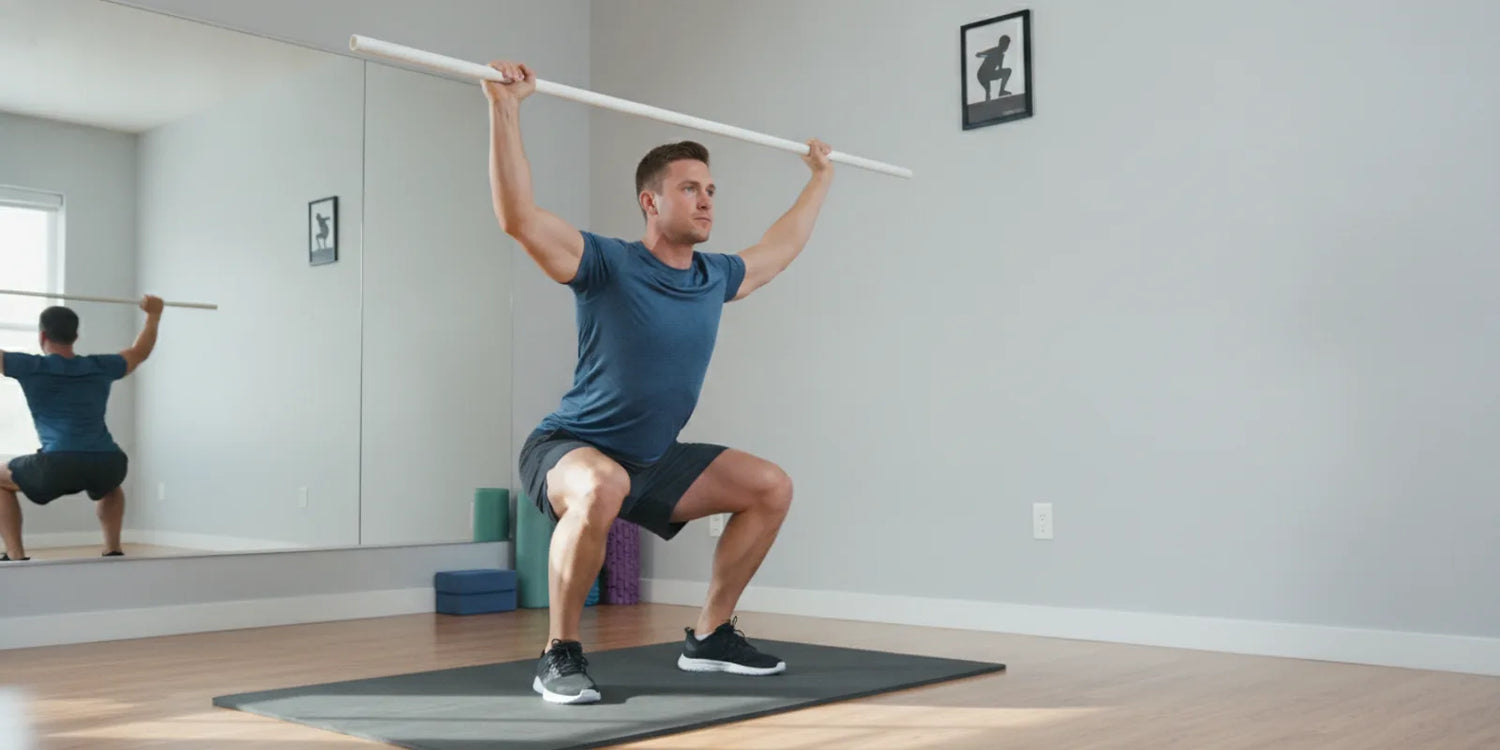
Best quadriceps workouts with a PVC pipe use overhead squats, front holds, and lunges to teach correct form and build baseline quad strength without adding load. A lightweight pipe is a low-cost training tool anyone can use at home.
This guide covers six PVC pipe quad exercises, sets and reps guidance, common mistakes, and clear signs you are ready to progress to a barbell or leg machine.
Quick Answer: The best quadriceps workouts with a PVC pipe are the overhead squat hold, front-loaded goblet squat, paused squat, assisted Bulgarian split squat, reverse lunge to rotation, and single-leg sit-to-stand, performed for 2 to 3 sets of 10 to 15 reps, 2 to 3 times per week, to build squat form and baseline quad strength before adding weight.
Key Takeaways
- Zero-load form training: PVC pipe quad exercises teach squat and lunge mechanics without adding load, making them ideal for beginners and pre-lift warm-ups.
- Six core movements: The overhead squat hold, front-loaded goblet squat, paused squat, assisted Bulgarian split squat, reverse lunge to rotation, and single-leg sit-to-stand cover the main quad patterns.
- Right size pipe: A 4 to 5 foot long, 1 inch diameter PVC pipe fits most adults for overhead and front-rack holds.
- Training dose: Aim for 2 to 3 sets of 10 to 15 reps, 2 to 3 times per week, with a slow, controlled tempo.
- Clear progression signal: Move to a barbell, dumbbells, or a leg press and hack squat machine once you can hold full squat depth with square knees for 3 clean sets of 15.
Why train your quads with a PVC pipe instead of jumping straight to weights?
A PVC pipe lets you groove the squat and lunge patterns that build the quadriceps before any load is added, so form faults get fixed early instead of getting loaded and reinforced. Light, simple equipment can still meaningfully challenge the quads.
A controlled EMG study found that an elastic band knee extension produced higher peak quadriceps activation than a machine-based knee extension, at 93.3 percent versus 74.9 percent of maximal EMG.[1] That finding supports using low-tech tools, including a PVC pipe, as a legitimate quad training option rather than just a warm-up prop.
- Form first: The pipe gives instant visual and tactile feedback on bar path, torso angle, and knee tracking.
- Zero cost: A single length of pipe from a hardware store covers dozens of exercise variations.
- Small space friendly: No rack, bench, or plates are required, so it works in a bedroom, garage, or living room.
- Mobility carryover: Overhead and front-rack holds with a pipe improve shoulder, hip, and ankle mobility needed for deeper squats.
- Coaching cue for advanced lifters: Many coaches still use a pipe or stick as a warm-up check before loading a heavier barbell squat.
If you want more bodyweight and light-equipment options for leg day, this collection of good leg workouts pairs well with the PVC pipe drills below.
What size PVC pipe works best for squat training?
A 4 to 5 foot long, 1 inch diameter PVC pipe works best for most adults performing overhead squats, front holds, and lunges. A longer pipe gives a wider, more comfortable grip for overhead holds, while a shorter length suits front-rack or goblet-style holds against the chest.
- Length: 4 to 5 feet for overhead work, 2 to 3 feet for front-rack or goblet holds.
- Diameter: 1 inch is easy to grip for most hand sizes, schedule 40 pipe is sturdy enough for repeated use.
- Grip width: Set your hands slightly wider than shoulder width for overhead squats to protect the shoulders.
- Edges: Sand or tape any cut ends so the pipe does not scratch your skin or floor.
One fitness guide notes that a PVC pipe is lightweight and inexpensive, which is why trainers commonly use it to groove squat and overhead-squat form before adding a barbell. If your space allows more variety, pairing this with leg workouts at home with a bench extends your training options once the pipe work feels easy.
What are the best quad exercises you can do with a PVC pipe?
The best quad exercises with a PVC pipe are the overhead squat hold, front-loaded goblet squat, paused squat, assisted Bulgarian split squat, reverse lunge to rotation, and single-leg sit-to-stand. Each targets the quadriceps through a slightly different squat or lunge pattern.
- PVC Overhead Squat Hold: Hold the pipe overhead with a wide grip, squat to full depth keeping the pipe stacked over mid-foot, then stand. This builds quad strength, shoulder mobility, and core bracing at once.
- PVC Front-Loaded Goblet Squat: Hold the pipe vertically against your chest, squat down keeping elbows tucked, then drive up through the heels. This is an easy entry point for beginners still learning squat depth.
- PVC Paused Squat: Squat down and hold the bottom position for 2 to 3 seconds before standing, keeping the pipe stable overhead or at the chest. The pause increases quad time under tension without any added weight.
- PVC Assisted Bulgarian Split Squat: Rest your back foot on a low bench, hold the pipe for balance, and lower your front knee toward the floor. This isolates one quad at a time and exposes side-to-side strength gaps.
- PVC Reverse Lunge to Rotation: Step back into a lunge, pause at the bottom, rotate the torso with the pipe held at chest height, then return to standing. This adds trunk stability work on top of the quad-dominant lunge.
- PVC Single-Leg Sit-to-Stand: Sit on the edge of a chair, extend the pipe forward for balance, then stand on one leg without using your hands. A one-legged squat and sit-to-stand pattern like this elicited higher peak quad activity than a machine leg press, at 86.7 percent versus 66.8 percent of maximal EMG.[2]
The reverse lunge to rotation is easiest to learn by watching it performed first.
For more structured leg-day pairings once you have these movements down, see these best leg exercises for leg day.
How many sets and reps should you do for PVC pipe quad training?
Beginners should start with 2 to 3 sets of 10 to 15 reps per exercise, 2 to 3 times per week. Because the pipe adds almost no resistance, the goal is slow, controlled reps at full depth rather than speed or fatigue.
- Tempo: Use a 3 second lowering phase, a 1 second pause at the bottom, and a controlled stand.
- Rest: 30 to 60 seconds between sets is enough since the load is minimal.
- Weekly frequency: 2 to 3 sessions per week is sufficient for form practice and light quad conditioning.
- Session placement: Use PVC pipe work as a full session for beginners, or as a 5 to 10 minute warm-up before a heavier leg day.
If you are ready to build a full program around these patterns, this 8-week home gym leg strength plan shows how to structure progressive squat training.
What mistakes ruin PVC pipe squat and lunge form?
The most common mistake is letting the knees cave inward or letting the pipe drift forward overhead, both of which mask poor hip and ankle mobility instead of fixing it. Squat depth and stance also change how much the quads actually work.
A squat-variation study found that a Spanish squat produced greater rectus femoris and vastus lateralis activation than a general squat or a wall squat, showing that depth and setup meaningfully change quad engagement.[3] Small setup errors, not just heavy loading, can quietly limit results.
- Knee valgus: Knees caving inward reduces quad engagement and adds stress to the knee joint, actively push the knees outward on every rep.
- Pipe drifting forward: An overhead pipe that drifts in front of the ears usually signals a forward lean, keep it stacked over mid-foot.
- Rushing the tempo: Fast, bouncy reps skip the control the pipe is meant to teach, slow down the descent.
- Stopping short of depth: Shallow squats limit quad recruitment, aim for hips at or below knee level when mobility allows.
- Using a pipe that is too short: A pipe under 3 feet forces a narrow, shoulder-unfriendly grip for overhead work.
- Treating it as only a warm-up: Beginners can use PVC pipe work as real quad training, not just a 2 minute warm-up.
Once your form is clean, learning correct machine setup matters just as much, this guide on how to use a leg press hack squat machine covers the next skill set.
When should you progress from a PVC pipe to a weighted leg machine?
Progress once you can perform 3 sets of 15 controlled reps of a PVC overhead squat or lunge with no knee cave, no forward lean, and full depth. At that point, a light barbell, dumbbells, or a leg press and hack squat machine is the natural next step.
- Consistent depth: You reach full squat depth on every rep without losing the pipe position.
- Square knees: Your knees track outward and stay square through the entire set.
- Stable torso: You can hold the pipe overhead or at the chest without excessive forward lean.
- Comparing equipment: If you are unsure which piece of equipment to add next, this leg press vs squat rack comparison breaks down the tradeoffs.
- Machine option: A 3-in-1 leg press and hack squat machine lets you add resistance in a guided, joint-friendly path as you move past bodyweight and PVC work.
- Barbell option: If you prefer free-weight squats, these smith machine leg workouts offer a guided bar path for your next progression.
Is PVC pipe quad training safe, and when should you stop?
PVC pipe quad training is safe for most healthy adults because it adds no external load, but any sharp or persistent knee, hip, or lower back pain is a signal to stop immediately. Mild muscle fatigue is normal, joint pain is not.
- Stop for sharp pain: Any sharp or pinching pain in the knees or lower back means stop the set and reassess your form.
- Watch for knee pain during descent: Pain specifically when bending the knee often points to depth or knee tracking issues, not a strength problem.
- Reduce range of motion if needed: A partial squat is safer than forcing full depth with poor mobility.
- Check footwear and floor: A stable, flat surface and supportive shoes reduce ankle and knee strain during holds.
- Progress gradually: Add reps or sets before adding any external weight, and only once form is consistent.
"So we take any kind of a stick that we can put on the ground here, and we know that if you want to squat, and squat properly, you should be square."
Jeff Cavaliere, MSPT, CSCS, Athlean-X
FAQs About Quadriceps Workouts With a PVC Pipe
Can a PVC pipe really work my quads?
Yes, a PVC pipe adds an overhead or front-loaded hold to squats and lunges, which forces your quads and core to stabilize through a full range of motion. It will not build heavy strength like a barbell or leg machine, but it is effective for form work, mobility, and light metabolic quad training.
What size PVC pipe should I use for squats?
A 4 to 5 foot long, 1 inch diameter PVC pipe works well for most adults performing overhead squats, front holds, and lunges. Longer pipes give a wider grip for shoulder comfort, while a shorter pipe suits front-rack or goblet-style holds against the chest.
How many sets and reps should beginners do with PVC pipe quad exercises?
Beginners can start with 2 to 3 sets of 10 to 15 reps per exercise, 2 to 3 times per week, focusing on quad-dominant squat and lunge patterns. Because the pipe adds little resistance, prioritize slow, controlled tempo and full depth over speed or high rep counts.
When should I move from a PVC pipe to a real barbell or leg machine?
Progress once you can perform 3 sets of 15 controlled reps of a PVC overhead squat or lunge with no knee cave, no forward lean, and full depth. At that point, a light barbell, dumbbells, or a leg press and hack squat machine is the natural next step.
What is the most common mistake with PVC pipe squats?
The most common mistake is letting the knees cave inward or the pipe drift forward overhead, both of which mask poor hip and ankle mobility instead of fixing it. Keep the pipe stacked over mid-foot and actively push the knees outward on every rep.
Is PVC pipe training only for beginners?
No. Beginners use it to learn squat and lunge mechanics, but experienced lifters also use a PVC pipe for warm-ups, mobility work, and coaching cues like checking hip square-up and knee tracking before slowly loading a much heavier barbell squat.
Conclusion
The best quadriceps workouts with a PVC pipe give beginners a free, low-impact way to learn squat and lunge mechanics while still challenging the quads. Six core movements, trained 2 to 3 times per week, are enough to build a solid form base.
Start with the overhead squat hold and goblet squat, track your depth and knee position weekly, and move to a leg press machine or barbell once your form is consistent. For more equipment options as you grow your setup, browse this affordable home gym equipment guide.
Disclaimer
This article is for general informational and educational purposes only and is not a substitute for personalized fitness or medical advice. Consult a qualified healthcare provider or certified trainer before starting any new exercise program, especially if you have an existing injury or medical condition.
Save on your next RitFit order
Tap the button to copy your code, then paste it at checkout.
References
1. Jakobsen TL, Jakobsen MD, Andersen LL, Husted H, Kehlet H, Bandholm T. Quadriceps muscle activity during commonly used strength training exercises shortly after total knee arthroplasty: implications for home-based exercise-selection. J Exp Orthop. 2019;6(1):29. doi:10.1186/s40634-019-0193-5
2. Thongduang P, Chatchawan U, Puntumetakul R, Yamauchi J, Peungsuwan P. Quadriceps Electromyographic Activity in Closed and Open Kinetic-Chain Exercises with Hip-Adductor Co-Contraction in Sedentary Women. Int J Environ Res Public Health. 2022;19(19). doi:10.3390/ijerph191912929
3. Lee JH, Kim S, Heo J, Park DH, Chang E. Differences in the muscle activities of the quadriceps femoris and hamstrings while performing various squat exercises. BMC Sports Sci Med Rehabil. 2022;14(1):12. doi:10.1186/s13102-022-00404-6





