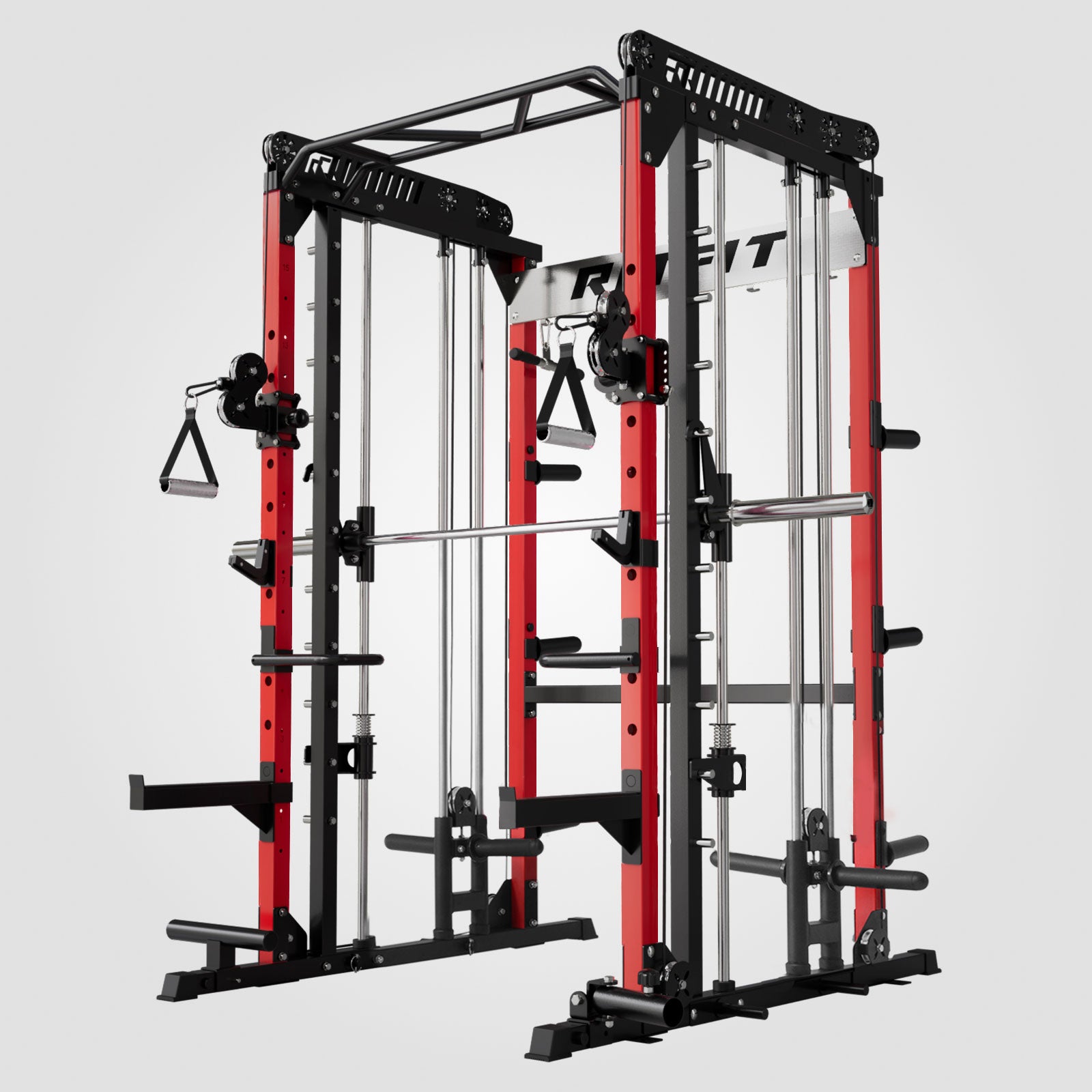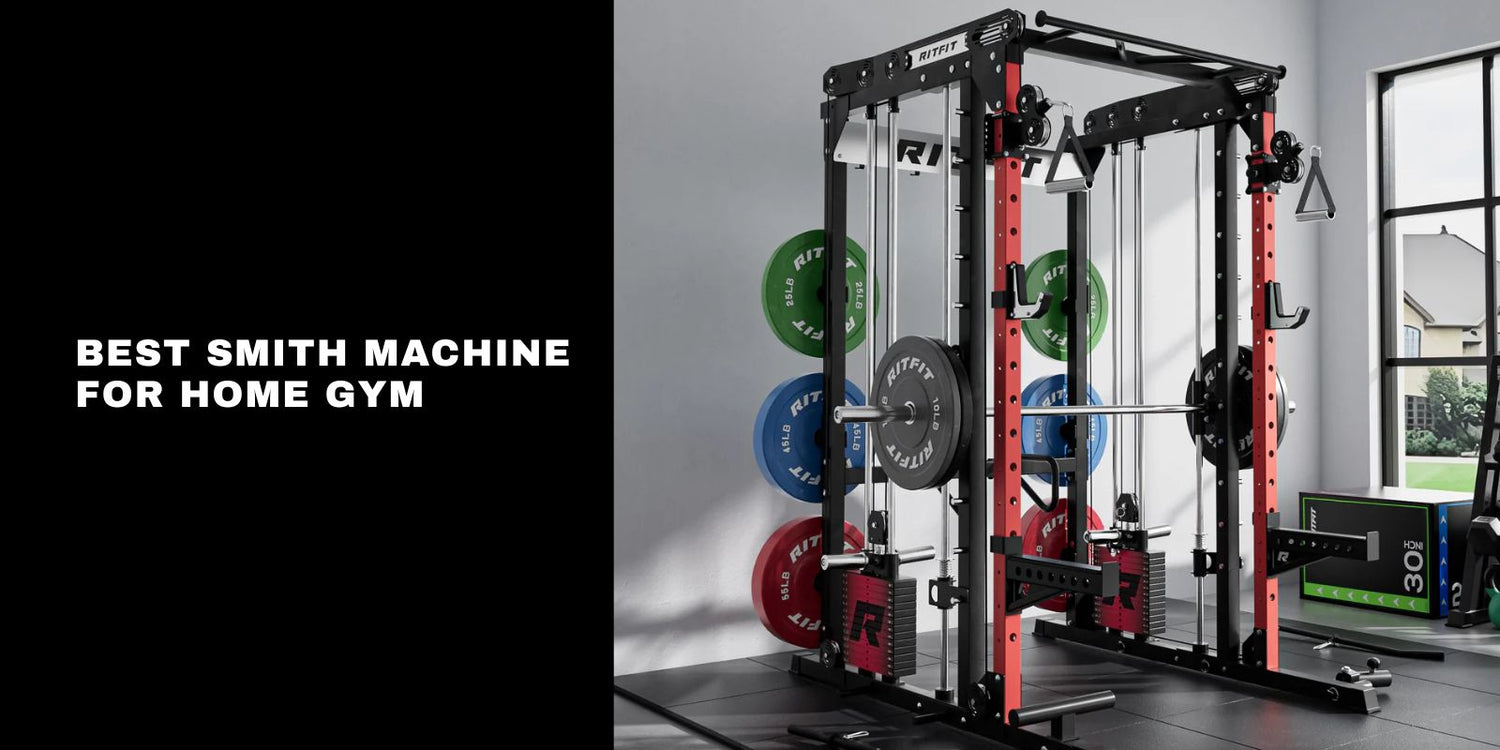
The RitFit M2 Pro is one of the strongest home gym Smith machine options for buyers who want guided bar training, cable work, and faster weight changes in one footprint. It makes the most sense for solo lifters, serious home gym users, and families who want more safety, more versatility, and less equipment clutter.
Key Takeaways
- Best buyer: The RitFit M2 Pro is best for home lifters who want a premium all in one station, not a basic starter rack.
- Main advantage: It combines Smith training, rack work, cable work, pull ups, storage, and faster selectorized resistance in one organized setup.
- Real fit check: Official rack size is 78.7 inches by 68.75 inches by 86.14 inches, but working clearance matters more than listed footprint.
- Why it feels different: The 2 to 1 cable ratio, stainless steel rails, and Pro weight stacks make transitions smoother and faster.
- Not for everyone: Buyers who mainly want open barbell practice at the lowest cost may still be better served by a simpler power rack.
Why the RitFit M2 Pro Works for a Home Gym
Quick Answer
A good home gym Smith machine should save space, improve solo training safety, and still let you train hard enough to build strength and size. Resistance training remains one of the most reliable ways to improve lean mass, strength, and body composition across a wide range of adults, which is why a versatile home setup can be a smart long term investment.[1]
- Home gym value: One machine can cover squats, presses, rows, pulldowns, flyes, lunges, and accessory work.
- Solo training appeal: Guided bar paths and safety arms help many lifters train with more confidence at home.
- Workflow benefit: Faster load changes matter when you want supersets, shared use, or shorter sessions.
Overview of the RitFit M2 Pro
What It Is
The RitFit M2 Pro is the premium weight stack configuration within the RitFit M2 modular Smith machine platform. It blends a Smith machine, power rack functions, cable work, pull up training, and storage into one footprint that is built for heavier and more refined home use than entry level combo units.
- Platform logic: The M2 line includes standard, 3D, Pro, and Pro 3D versions.
- Why Pro matters: The Pro versions add dual 143 lb weight stacks for faster resistance changes.
- Who it fits: It is a strong match for intermediate lifters, advanced home users, and buyers who want one final station instead of a temporary upgrade.
- Related reading: If you want the foundation first, start with what a Smith machine is and then compare it against your goals.
Official Specs at a Glance
Current Platform Numbers
The official M2 platform numbers are strong enough to move this article from opinion into real buying guidance. These are the details that matter most before you think about training style, accessories, or price.
- Rack length: 78.7 inches, including the Smith bar.
- Rack width: 68.75 inches.
- Rack height: 86.14 inches.
- Footprint: 22.8 square feet.
- Smith bar weight: 33 lb.
- Maximum weight: 2000 lb.
- Uprights: 2.36 x 2.36 x 0.08 inch, 13 gauge steel.
- Upright hole size: 1 inch.
- Cable system rail material: Stainless steel.
- Cable pulley ratio: 2 to 1.
- Basic Smith positions: 11.
- 3D Smith positions: 10 on the 3D version.
Key Features That Make the RitFit M2 Pro a Top Pick
Training Feel and Adjustability
The M2 platform is built around smoother transitions and better individual fit. Officially, it uses 16 adjustment holes on both the main and fly slider uprights, which makes setup easier across different body sizes and exercise heights.
- Better fit: More adjustment points usually mean cleaner setup for presses, pulldowns, rows, and cable isolation work.
- Smoother cable work: Stainless steel rails and selectorized stacks reduce friction and wasted time.
- Why it matters: A machine that feels easier to adjust gets used more often and with less frustration.
Faster Resistance Changes
The biggest practical difference between the M2 Pro and many plate loaded combo units is speed. When resistance changes happen with selector pins instead of repeated plate stripping, supersets, drop sets, and shared sessions become much easier to run.
- Session flow: Faster changes keep workouts moving.
- Household use: It is easier for two people with different strength levels to share the machine.
- Commercial feel at home: That convenience is one reason the Pro configuration feels more premium than simpler home gym racks.
- Deeper comparison: Buyers deciding between stack based and plate based systems should also read weight stack vs plate loaded Smith machines.
Storage and Room Control
A crowded room can make a good machine feel worse than it really is. The M2 platform helps by adding six storage pegs and four accessory hooks so your plates and cable handles are not scattered across the floor.
- Safety win: Better storage means fewer tripping hazards.
- Setup win: You spend less time searching for collars and attachments.
- Small room benefit: Storage matters even more in garage gyms and spare rooms where every step counts.
Optional 3D Smith Path
One of the more interesting parts of the M2 platform is the optional 3D Smith version. RitFit describes it as a system that allows both vertical and horizontal movement, which can feel more natural for some lifters during multi direction patterns.
- Why that matters: Some users prefer a path that feels less locked into one strict line.
- Who should care: Buyers who do more varied accessory work or want a more natural motion may find the 3D option attractive.
- More context: For movement specific use cases, see 3D Smith machine benefits and exercises.
RitFit M2 Pro vs Other Options
M2 Pro vs M1 Pro
The RitFit M1 vs M2 Smith machine comparison comes down to value versus refinement. The M1 Pro is usually the smarter budget friendly entry point, while the M2 Pro is the stronger choice for buyers who want heavier feel, smoother workflow, and more long term ownership confidence.
- Choose M1 Pro if: You want a practical all in one station at a lower spend.
- Choose M2 Pro if: You train more seriously, want a more premium feel, and do not want to outgrow the setup quickly.
- Main split: The M2 Pro is less about saving money and more about reducing compromise.
M2 Pro vs a Traditional Power Rack
Machines and free weight systems can both build muscle and strength, so this decision is usually more about setup, specificity, and convenience than ideology alone.[2] If your priority is guided bar work, integrated cables, and fast exercise changes, the M2 Pro wins, but if your priority is open barbell practice and the lowest possible entry cost, a rack still has a strong case.
- Choose M2 Pro if: You want Smith work, cable work, and rack features in one station.
- Choose a rack if: You mainly care about free barbell lifts and simpler hardware.
- Best side by side guide: Read Smith machine vs power rack before you buy.
Setting Up the RitFit M2 Pro
What to Check Before Ordering
The listed footprint is only the starting point. Real world setup also depends on rear wall plate clearance, side access, bench movement, pull up headroom, and whether you want room for attachment swaps without scraping walls.
- Ceiling height: Compare your actual room height against the official 86.14 inch rack height, then leave extra room for pull ups, head clearance, and assembly work.
- Rear clearance: Leave enough space behind the unit for plate storage access and easier loading.
- Side clearance: Give yourself room to move a bench, load attachments, and work the cables without crowding.
- Flooring: Add protective flooring under the machine and bench to improve grip, reduce noise, and protect the surface below.
- Useful pairing: A strong bench like the RitFit GATOR adjustable weight bench makes the platform far more complete.
- More planning help: If your room is unfinished or noise sensitive, review this home gym flooring guide.
Training Guide
Core Exercises That Make Sense on the M2 Pro
The M2 Pro is strongest when you use each part of the machine for the job it handles best. Use the Smith bar for guided strength and high effort hypertrophy work, then use the cable system for accessory volume, range control, and quicker transitions.
- Best Smith bar lifts: Back squats, front squats, incline bench presses, flat bench presses, shoulder presses, split squats, hip thrusts, and rows.
- Best cable lifts: Lat pulldowns, seated rows, cable flyes, triceps pressdowns, lateral raises, curls, and rear delt work.
- Best all in one workflow: Pair a Smith compound lift with a cable isolation lift for efficient upper and lower body sessions.
- Useful tutorials: See Smith machine with cable system complete workout guide and best Smith machine chest workouts for muscle growth.
How to Think About Loading
Programming should match the outcome you actually want. Heavier loading tends to matter more for maximal strength, while hypertrophy can be built across a wider loading range when effort and exercise selection are good.[3]
- Strength focus: Use the Smith bar for lower rep, higher load work on squats, presses, and rows.
- Hypertrophy focus: Use moderate rep Smith work plus higher rep cable volume.
- Beginner focus: Start with simple patterns, stable setup, and conservative loading before chasing complexity.
Pros and Cons
Honest Verdict on Strengths and Tradeoffs
The M2 Pro has real advantages, but it is not automatically the right answer for every room or every buyer. It is best viewed as a premium home gym station that rewards people who will actually use its extra features.
- Pros: Guided safety for solo training, strong feature density, faster weight changes, built in storage, cleaner room workflow, and more premium long term ownership feel.
- Pros: Strong fit for households that want one machine to cover many movement patterns.
- Cons: Higher buy in than a simpler rack, more assembly complexity, and more room planning than the raw footprint suggests.
Buying Guide
Who Should Buy the RitFit M2 Pro
The best way to judge this machine is to ask whether it solves your room, training, and workflow problems better than two or three separate pieces would. If the answer is yes, the price and feature set become much easier to justify.
- Buy it if: You want guided bar training, cables, storage, and faster resistance changes in one station.
- Buy it if: You train alone often and value safeties and smoother session flow.
- Skip it if: Your room is too tight for proper working clearance or you mainly want a basic rack and barbell.
- Skip it if: Your budget is better spent on a simpler setup, plates, and a bench first.
FAQs
Is the RitFit M2 Pro a good Smith machine for a home gym?
Yes. The RitFit M2 Pro works well for home gyms because it combines a Smith machine, rack, cable system, pull up station, and storage in one footprint. It suits buyers who want guided bar training, fast cable transitions, and a cleaner all in one setup without filling the room with separate stations.
How much space do you need for the RitFit M2 Pro?
You need enough room for the machine, plate loading, bench movement, and safe walk around clearance. The official rack size is 78.7 inches long, 68.75 inches wide, and 86.14 inches high, but most users should leave extra side and rear space so plates, safeties, and attachments stay easy to use.
Does the RitFit M2 Pro use a 2 to 1 pulley ratio?
Yes. The RitFit M2 platform uses a 2 to 1 pulley ratio, which usually makes cable movement smoother and gives longer travel for flyes, raises, and rows. The tradeoff is that the felt resistance at the handle is lower than the stack number, so strength focused buyers should understand that before ordering.
What makes the RitFit M2 Pro different from the RitFit M1 Pro?
The M2 line is the more premium direction for buyers who want a heavier feel, more refinement, and stronger long term upgrade potential. The M1 Pro is usually the easier value pick, while the M2 Pro makes more sense if you train often, care about cable feel, and want a more final setup from the start.
Can beginners use the RitFit M2 Pro safely?
Yes. Beginners can use the RitFit M2 Pro safely if they set the safeties correctly, learn the bar path, and choose manageable loads. A Smith machine can lower the coordination barrier for squats, presses, lunges, and rows, but new lifters still need correct setup, controlled range of motion, and patient progression.
Should you buy the RitFit M2 Pro or a power rack instead?
It depends on your training style, space, and budget. Choose the M2 Pro if you want guided lifting, integrated cables, quick exercise changes, and more all in one convenience. Choose a power rack first if your priority is open barbell practice, lower cost entry, and fewer moving parts to assemble or maintain.
Final Verdict
The RitFit M2 Pro is a strong buy if you want one machine that covers Smith work, rack work, and cable training without forcing a room full of separate stations. It is not the cheapest route, but it is one of the smartest long term choices for home lifters who value smoother workflow, guided safety, and real upgrade headroom.
Disclaimer: This guide is educational and buying focused, not medical coaching. Check your room dimensions, floor protection, assembly plan, and training level before ordering, and set safeties correctly before every working set.
References
- Lopez P Taaffe DR Galvão DA Newton RU Nonemacher ER Wendt VM Bassanesi RN Turella DJP Rech A. Resistance training effectiveness on body composition and body weight outcomes in individuals with overweight and obesity across the lifespan: a systematic review and meta-analysis. Obesity Reviews. 2022;23(5):e13428.
- Haugen ME Vårvik FT Larsen S Haugen AS van den Tillaar R Bjørnsen T. Effect of free-weight vs. machine-based strength training on maximal strength, hypertrophy and jump performance: a systematic review and meta-analysis. BMC Sports Science, Medicine and Rehabilitation. 2023;15(1):103.
- Schoenfeld BJ Grgic J Van Every DW Plotkin DL. Loading recommendations for muscle strength, hypertrophy, and local endurance: a re-examination of the repetition continuum. Sports. 2021;9(2):32.