








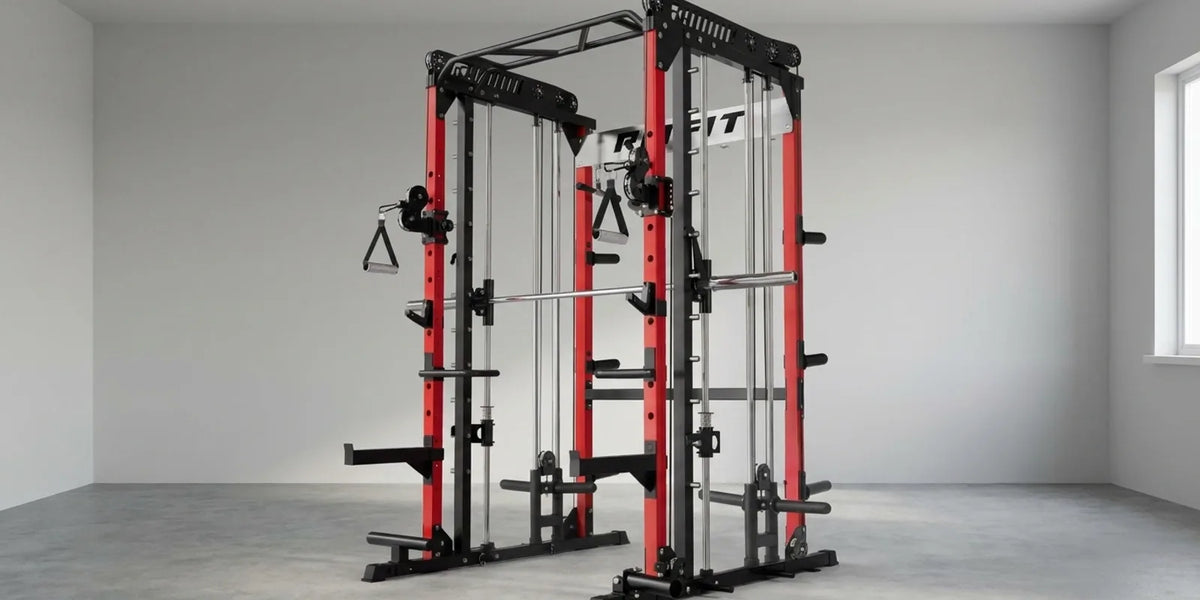
The best Smith machine for strength training is the one that supports your main lifts, leaves usable loading room and fits the way you train between sets. This RitFit guide shortlists machines by those tasks, from repeatable squat and press sessions to cable work in a shared home gym.
Choose the training setup first, then verify the exact configuration, working clearances and component limits before buying.
Quick Answer: The best Smith machine for strength training depends on your sessions: shortlist RitFit M1 PRO for Smith lifts plus cable accessories, RitFit BUFFALO for a plate-loaded training split. Check Smith-specific load limits and retain free-weight practice for barbell-specific goals.
Key Takeaways
- Start with your sessions: A squat and press routine needs usable bar travel and stops, while cable-heavy sessions also need convenient resistance changes.
- Separate the limits: Frame capacity, Smith capacity, cable loading and storage ratings describe different jobs.
- Buy useful headroom: A larger frame rating does not automatically provide a higher working Smith limit.
- Keep records comparable: Log the same machine, setup and movement before judging progressive overload.
- Preserve your target skill: A barbell competition goal still calls for practice with the competition movement.
Choose by the Lifts You Want to Progress
A strength-focused Smith machine purchase should begin with your main lifts and the accessory work you actually perform.
A review comparing free-weight and machine training found that strength changes were specific to the training modality, without detecting clear overall superiority across the directly compared outcomes.[1] That supports choosing equipment around your goal rather than treating every strength number as interchangeable.
| Your training priority | Model to shortlist | Why it fits the task | Decision boundary |
|---|---|---|---|
| Repeatable Smith squats and presses with cable accessories | RitFit M1 PRO | Fixed Smith system with linear bearings and adjustable cable stations | Confirm usable bar travel, bench positioning and your future Smith loading needs |
| Plate-loaded upper and lower sessions with rows and pulldowns | RitFit BUFFALO | Smith and dual cable functions for a training split built around plates | Allow room for loading and moving between stations |
This is a RitFit selection guide based on current official specifications and identified public feedback, not our hands-on testing or an industry-wide ranking.
How we picked: The shortlist uses documented exercise functions, separately identified component limits, cable configuration, current listed price and service coverage. Each choice is conditional on your working loads and room layout, with no invented performance score.
The pulley requirement for this shortlist is machined aluminum wheels with sealed bearings, rather than plastic or nylon wheels. RitFit describes that construction in its official pulley guide, while the shortlisted product pages specify aluminum; confirm the exact ordered generation and all pulley wheels before purchase.
Use the RitFit Smith machine collection to check available configurations, then bring your actual exercise list to the decision.
Choose RitFit M1 PRO for Repeatable Smith and Cable Sessions
RitFit M1 PRO suits a home lifter who wants Smith squats and presses followed by cable accessories on one frame.
The dedicated Smith specification lists a 352 lb capacity and 11 height settings, while the cable system offers 15 adjustment positions and a 2:1 pulley ratio. Those are different functions: the Smith settings help establish a repeatable unracking position, and the cable adjustments support changing from rows to flyes or pushdowns.
- For your main lifts: Rehearse squat depth and bench placement with the empty mechanism, then confirm that the stops work at your intended range of motion.
- For accessories: Plan cable rows and pushdowns after your press or squat work, keeping plates accessible if you choose the plate-loaded configuration.
- For later changes: An optional 264 lb total stack set changes cable loading convenience; it does not raise the Smith bar limit.
The listed height is 85.3 inches, with a length including the Smith bar of 79.1 inches and a width of 63 inches. These are equipment dimensions, so leave additional working room for plate loading, your bench, pull-ups and your route around the station.
The listed Smith bar mass is 33 lb, which should not be assumed to equal effective starting resistance. Confirm the actual resistance and load accounting for your configuration, especially if the empty mechanism is already challenging.
The official video below shows an M1-family home setup, not verification of every current PRO specification. For exercise positioning, use the Smith machine bench press setup alongside your exact machine instructions.
"Love the M1 Pro. Much sturdier than i expected, cable and smith system is very smooth."
Breton W. Verified Buyer, RitFit M1 PRO Multi-Functional Smith Machine with Cable Crossover System and Squat Rack for Home Gym
Choose RitFit BUFFALO for a Plate-Loaded Training Split
RitFit BUFFALO suits a plate-loaded routine that combines Smith compound lifts with rows, pulldowns and other cable accessories.
Picture a lower session built around Smith squats and a separate upper session with presses, rows and pulldowns. This layout earns its place when you use those stations regularly and can leave enough room to move the bench and load each carriage.
- Working load: The product page separately lists a 352 lb Smith capacity and a 2:1 cable pulley ratio, so neither the frame rating nor a plate total describes every exercise.
- Room fit: The listed overall height including the pull-up bar is 83 inches, compared with an 81-inch frame-only height; measure for the complete setup.
- Session flow: Plate-loaded cables make sense if you already own compatible plates and accept changing them between accessory exercises.
BUFFALO is not automatically a higher-load Smith choice than M1 PRO, because their dedicated listings share the same stated Smith capacity. Choose between them for the layout, adjustments and exercise transitions that suit your sessions.
In an affiliate-disclosed review, The Iron Clinic's BJ Nelson described the BUFFALO as a platform for a training week. The price in his original quotation is historical review context, rather than the current store price.
"For $1,800, this machine delivers a combination of build quality, stability, and versatility that is rare at this price. The BUFFALO is not a machine that excels at one thing. It is a platform that lets you program an entire training week without ever stepping off the frame."
BJ Nelson, Head of Field Testing, The Iron Clinic, RitFit Buffalo Smith Machine Review
"Legit cage with a ton of functionality. Full body workouts and it looks great while doing it! Love the leg press attachment."
Theadore M. Customer review, RitFit BUFFALO Multifunctional Smith Machine with Lat Pull Down and Cable Crossover for Versatile Strength Training
Match Load Headroom and Bar Path to Your Main Lifts
Usable loading headroom depends on the Smith mechanism, your range of motion and the exact exercise setup.
Start with your intended squat, press or Romanian deadlift and ask whether the empty bar reaches the right starting and finishing positions. A machine that cannot support your working range or safe stop placement is a poor match even when its headline frame number looks impressive.
- Keep ratings separate: A frame capacity, single-side cable rating, storage rating and Smith mechanism rating cannot substitute for one another.
- Clarify load accounting: Ask whether a stated Smith limit includes the bar, and whether the rating describes dynamic use or a static load.
- Check effective resistance: A 2:1 pulley ratio means stack mass is not the same number as handle resistance; routing, attachments and friction also affect what you feel.
- Reserve progression room: Compare your planned working loads with the confirmed component limit, rather than buying at an unverified ceiling.
For M1 PRO, use the dedicated Smith table's 352 lb figure rather than the 1,600 lb frame number; a conflicting FAQ is a reason to obtain confirmation before near-limit use. The Smith machine specification checklist can support that final check after you have chosen the training workflow.
Bar-path choice: RitFit M2 3D provides vertical and horizontal movement, a different configuration from a fixed Smith path. The third-party M2 video below illustrates that distinction, without establishing equivalence to a free barbell or a higher lifting capacity.
A different bar path is worth considering only when it solves an actual exercise-fit problem. Confirm the exact configuration, pulley construction and component limits before treating a 3D option as a purchase recommendation.
Build a Repeatable Strength Progression Plan
A useful strength progression plan makes the exercise setup repeatable and changes loading only when your current work is controlled.
A randomized trial in novice adult males found similar strength improvements with machine, free-weight and combined approaches within its program.[2] The result supports useful training with either approach, without identifying a winning RitFit model or guaranteeing the same result for advanced competitors.
- Step 1: Establish the movement. Rehearse with the empty mechanism, set the safety stops and choose a load you can control through your intended range of motion.
- Step 2: Fix the setup. Record the machine, bench angle, stance, hook position, working weight and repetitions so the next session is comparable.
- Step 3: Complete the planned work. Keep the load steady until the prescribed sets and repetitions are controlled without shortening the movement or changing the setup.
- Step 4: Add a manageable increment. Use the smallest practical increase permitted by your plates or stack and repeat the same checks, while staying inside the confirmed equipment limits.
For a squat session, use the Smith machine squat technique guide to review positioning before progressing. A repeatable press, a squat and a cable pull can form a practical exercise menu, but the complete program should match your experience and recovery.
Training specificity also matters when your goal is performance in a particular lift; a narrative review describes matching training demands to the target task as a basis for transfer.[3] Keep free-weight practice when the goal is a competition barbell movement, and use the Smith machine versus squat rack guide to plan that combination.
Stop conditions: Stop the set for sharp pain, sticking travel, failed locking, an unstable bench or damaged cables. Fix the equipment or setup problem before adding load, and seek qualified guidance for persistent pain or uncertainty about technique.
Decide What Is Worth Paying for and Upgrading
A higher price earns its place when the added function improves a training task you will use regularly.
| Selected configuration | Listed price | What you are paying for | Check before adding upgrades |
|---|---|---|---|
| RitFit M1 PRO, no weight stack | $1,299.99 | Smith main lifts and plate-loaded cable accessories | Available color and configuration, bench and plates, exact stack-kit compatibility |
| RitFit BUFFALO, plate-loaded | $1,899.99 | Smith and dual-cable exercise stations for a split routine | Working layout and plate handling between exercises |
Listed official product-page prices checked October 20, 2026, before checkout promotions or configuration changes. Availability varies by variant; confirm the complete order and current total.
- If you already own plates: Plate-loaded cables can reuse compatible plates, while a stack adds convenience rather than a new Smith loading limit.
- If you share sessions: A selectorized stack can reduce plate handling between different cable loads, but confirm the usable resistance and increments for each person.
- If you plan attachments: Price the exact model and generation-specific kit, any installation work and the space it needs before relying on a future upgrade.
- If you only want heavier Smith lifts: Do not pay for a larger frame or cable stack expecting it to raise the separately rated Smith capacity.
Include a compatible bench, usable plates, collars where specified, flooring and delivery access in your complete setup plan. Buy the configuration that supports your next training phase without depending on an unverified attachment or unconfirmed load rating.
RitFit Model Warranty Coverage
The current RitFit policy provides category coverage for this comparison, without separately confirming every shortlisted model name.
| Model | Category | Frame | Parts | Pads/Upholstery |
|---|---|---|---|---|
| M1 PRO | Power Cage Basic Warranty fallback; policy names M1, not PRO separately | 3 years | 1 year | 90 days for cover and upholstery |
| BUFFALO | Power Cage Basic Warranty category fallback; model not separately named | 3 years | 1 year | 90 days for cover and upholstery |
Source: current RitFit warranty policy, checked October 20, 2026. These rows show the power-cage category fallback, not a model-specific coverage promise; confirm the ordered SKU with support.
Coverage applies to the original purchaser from the order date, is non-transferable and excludes products leaving the United States lower 48 states. Misuse, ordinary cosmetic wear and environmental or force majeure damage are among the policy exclusions.
FAQs About Smith Machines for Strength Training
Which RitFit Smith machine fits a strength focused home gym?
RitFit M1 PRO is a starting shortlist for repeatable Smith squats and presses with cable accessories. RitFit BUFFALO suits a plate loaded training split when its layout works better in your room. Confirm current availability, the exact pulley hardware and the dedicated Smith limit before choosing either configuration.
How should Smith machine strength be compared with free weights?
Track Smith machine performance separately from barbell performance because bar path, equipment resistance and setup differ. Use the same machine, stance, bench position and range of motion when judging progress. If your goal is a competitive barbell lift, retain practice with the actual free weight movement and suitable supervision.
What Smith machine capacity matters for heavier strength training?
The dedicated Smith mechanism rating matters for loaded Smith lifts. Frame, storage, cable and safety arm ratings describe different components and cannot replace that limit. Confirm whether the stated limit includes the bar and whether it is a dynamic or static rating before planning loads near the maximum.
When is a Smith machine weight stack upgrade worth buying?
A stack upgrade is worth considering when changing plates repeatedly interrupts cable accessories or a shared session. Compare the exact kit compatibility, resistance at the handle, available increments and installation cost first. A cable stack upgrade does not increase the permitted load on the Smith bar or replace plates for Smith lifts.
What should a solo lifter check before Smith machine training?
Check assembly, cable routing, locking action, bench security and safety stop placement before adding working weight. Rehearse the lift with the empty mechanism and verify that the stops catch the bar before an unwanted position. Stop for sticking, cable damage, failed locking, sharp pain or an unstable setup and resolve the problem first.
Conclusion
The best Smith machine for strength training supports the sessions you want to repeat: shortlist M1 PRO for Smith lifts and accessories or BUFFALO for a plate-loaded split. Confirm your available configuration, exercise fit and Smith-specific capacity before ordering.
Write down your main lifts and complete setup costs, then check the RitFit discount guide for current buying options.
Disclaimer
This guide provides general equipment selection and training information, not individualized medical advice or a guarantee of performance or safety. Follow the exact machine manual and confirmed load limits, and consult a qualified professional for technique guidance or persistent pain.
References
1. Haugen ME, Vårvik FT, Larsen S, Haugen AS, van den Tillaar R, Bjørnsen T. Effect of free-weight vs. machine-based strength training on maximal strength, hypertrophy and jump performance - a systematic review and meta-analysis. BMC Sports Sci Med Rehabil. 2023;15(1):103. doi:10.1186/s13102-023-00713-4. PMCID: PMC10426227
2. Aerenhouts D, D'Hondt E. Using Machines or Free Weights for Resistance Training in Novice Males? A Randomized Parallel Trial. Int J Environ Res Public Health. 2020;17(21). doi:10.3390/ijerph17217848. PMCID: PMC7662789
3. Stone MH, Hornsby WG, Suarez DG, Duca M, Pierce KC. Training Specificity for Athletes: Emphasis on Strength-Power Training: A Narrative Review. J Funct Morphol Kinesiol. 2022;7(4). doi:10.3390/jfmk7040102. PMCID: PMC9680266





