








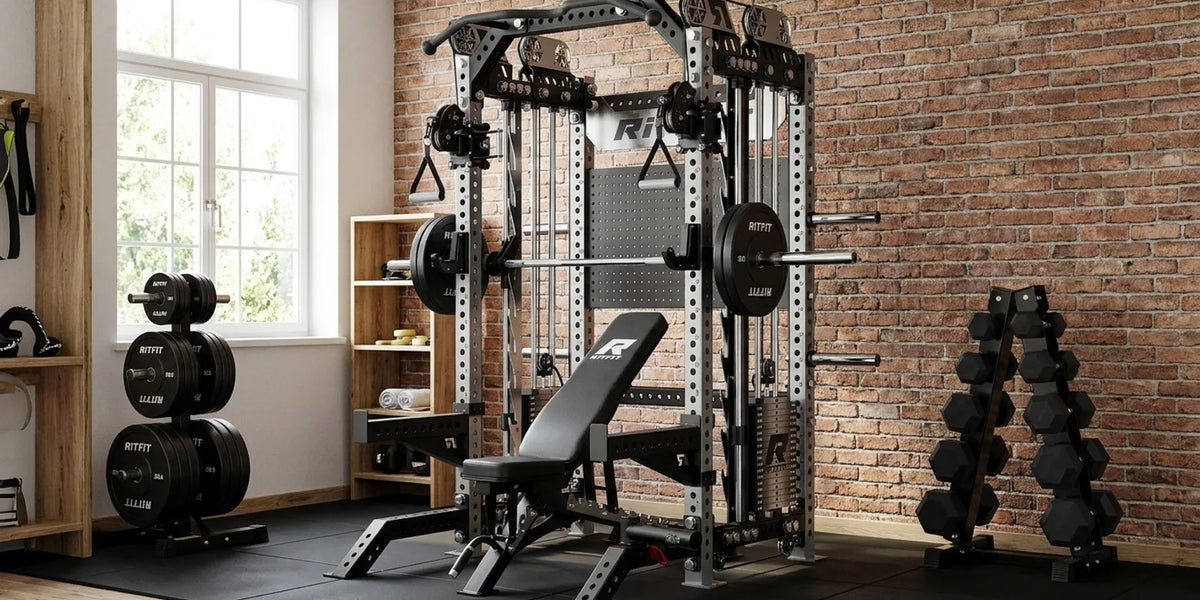
The best Smith machine for weightlifters and powerlifters has to do two jobs at once: guard a true one-rep max when nobody is home to spot, and keep real free-weight barbell work in the program. This guide explains why the RitFit M3 Pro is the strongest pick for 2026 and how to train on it.
Inside you get frame and bar specifications with static and dynamic ratings kept separate, what Smith machine training actually does for strength athletes, a sample strength week, a lineup decision matrix, and the space numbers you need before you order.
Quick Answer: The best Smith machine for weightlifters and powerlifters at home in 2026 is the RitFit M3 Pro, a 2,500 lb power rack with an Olympic-length Smith bar, 650 lb static safety arms, and dual 360 lb cable stacks on uniform 3x3 11-gauge steel, so one 21.5 sqft platform covers competition-style barbell lifts, spotter-free maxes, and heavy accessory volume.
Key Takeaways
- Best overall pick: The RitFit M3 Pro puts a 2,500 lb power rack, an Olympic-length Smith bar, and dual 360 lb cable stacks on one uniform 3x3 11-gauge steel frame.
- Solo max safety: The 22 inch safety arms are rated at 650 lb static, and the Smith bar's 10 quick-rack positions catch a missed rep without a spotter.
- Real strength demands: A study of 12 resistance-trained men found that one-rep-max Smith squats still produce a genuine sticking region where force output drops.
- Lineup value: RitFit lists the M3 Pro at $3,099.99 with 360 lb of built-in stacks, a 5-year steel warranty, and a 21.5 sqft footprint smaller than most all-in-one trainers.
What Powerlifters and Weightlifters Actually Need From a Home Smith Machine
Powerlifters and weightlifters need a home Smith machine that keeps free-weight barbell work, survives max attempts without a spotter, and stores plates in one footprint. A guided bar alone is not enough, because squat, bench press, and overhead press progress still depends on a rack, an Olympic barbell, and room to fail safely. For a wider look at what this machine category adds to a garage setup, see our guide to the best Smith machine benefits for your home gym.
- Free-weight rack work: J-hooks and safety arms must accept a free Olympic barbell for squats, presses, and rows, since the competition lifts stay barbell-only.
- Spotter-free safety: A failed single near your max needs a catch system, not a hope that the garage floor forgives you.
- Olympic-length bar: A full-size guided bar keeps hand spacing and rack positions close to what you use on a free barbell.
- Plate storage: Storage posts keep loaded plates off the floor and cut turnaround time between heavy sets.
- Accessory volume: Cable work for face pulls, rows, and pull-aparts builds the upper back stability that heavy lifting chews through.
If your priority is simply moving the heaviest possible loads at home, our companion piece on the best Smith machine for heavy lifting at home covers that load-first angle. This guide stays on the strength athlete's side: how a lifter programs the machine into a training week.
Why the RitFit M3 Pro Is the Best Smith Machine for Strength Athletes in 2026
The RitFit M3 Pro is the best Smith machine for strength athletes because one 2,500 lb frame carries a power rack, an Olympic-length guided bar, and dual cable stacks. It is the same dual action Smith machine concept of pairing a guided bar with cable training, built on the heaviest steel in the RitFit lineup.
Frame Steel and Capacity Built for True 1RM Work
According to RitFit's spec sheet, the M3 Pro uses uniform 3x3 inch, 11-gauge, 3 mm A36 steel uprights front to back, with front, middle, and rear posts sharing the same specification. The static frame capacity is 2,500 lb and the rack itself weighs 1,093.5 lb, so a loaded bar and a lifter driving into the floor do not shift the platform mid-set.
- Why it matters for maxes: Under a heavy squat or bench, rigid uniform uprights are what keep the J-hooks and safety arms where you set them.
- Inside the lineup: The same-spec steel outrates the 2x2 14-gauge M1 Pro and the 2.36x2.36 13-gauge M2 series on every load rating, per RitFit's comparison table.
An Olympic-Length Smith Bar With 10 Quick-Rack Positions
RitFit rates the Smith bar at 352 lb dynamic and 572 lb static, with an 86.8 inch (2,205 mm) Olympic-length shaft, 1.2 inch diameter, and 10 quick-rack positions on stainless hanging plates. The full-size length keeps your setup positions close to free-barbell habits, so switching between rack work and guided overload needs no relearning.
- Static versus dynamic load ratings: The 352 lb dynamic rating covers heavy controlled reps, while the 572 lb static rating describes the bar at rest, and mixing the two numbers is how buyers get burned.
- Bar weight math: For load planning on the guided bar, read how much a Smith machine bar weighs before you program your first session.
"This machine is fabulously sturdy and gives the opportunity to do a complete body workout in one place!"
Charla W. Verified Buyer, M3 Power Rack Cable Crossover Smith Machine
Is Smith Machine Training Real Strength Work for Powerlifters?
Smith machine training counts as real strength work for powerlifters when it supplements free-weight lifts instead of replacing them. The guided bar still imposes genuine maximal demands, and the findings below show why it earns a slot in a strength block.
In one trial of 12 active men, five sets of Smith machine back squats at a 10-rep max produced significantly more total work than the horizontal leg press, 43.0 kJ versus 29.1 kJ, with stronger cortisol, growth hormone, and lactate responses.[1] Every variable returned to baseline within 24 hours, so the session cost fits inside a normal weekly plan.
One study measured surface electromyography (sEMG) activity of the vastus lateralis and vastus medialis across loads in trained male athletes, then built equations to convert equivalent working loads between Smith squats and leg press.[2] That gives lifters a defensible way to match effort across exercises instead of guessing.
A study of 12 resistance-trained men found that during one-repetition maximum (1RM) Smith machine squats, force output dropped in the sticking region, and almost all measured muscles showed higher activity at a one-rep max than in isometric attempts.[3] The sticking region, the stretch where a max single slows to a crawl, is exactly where the guided bar lets you overload safely.
- Use it for weak-range work: The fixed bar path lets you load the exact range where your free squat stalls.
- Keep the competition lifts free: Nothing here says the Smith bar replaces a free barbell for meet-specific skill.
- Plan the recovery: The trial above saw full recovery within 24 hours, so Smith overload fits alongside your rack days.
How Safety Arms and a Guided Bar Keep Solo Heavy Sessions Safe
Safety arms and a guided Smith bar keep solo max attempts safe on the M3 Pro. The 22 inch (560 mm) safety arms are rated at 650 lb static and 285 lb dynamic, and the Smith bar's 10 quick-rack positions catch a missed rep without a spotter in the room.
The sandwich-style J-hooks are rated at 650 lb static per side, so a free barbell racked at the top of a heavy squat or bench stays put. On the guided side, the quick-rack tabs mean a failing single never reaches the floor, which is the whole point of training alone.
- Set the arms once: Place the safety arms just below your deepest reliable squat depth so the bar can sit down on them cleanly.
- Use the tabs early: Twist the bar into a quick-rack position the moment a rep stalls instead of fighting a lost single.
- Respect the ratings: Static and dynamic load ratings are different tests, so plan heavy controlled reps against the 352 lb dynamic bar rating, not the static number.
For a wider set of protocols, read our guide on how to train safely on the Smith machine at a home gym.
"The smith machine is great because it's going to take a lot of the pressure out of your shoulders because it's supporting itself and you can do a little bit more weight on here. So it can help you break some barriers too, and also if you don't have a spotter you can utilize the tabs — put that right here so if you drop it it'll just bounce and then you won't hurt yourself."
Scott Herman, ScottHermanFitness, How To: Smith Machine- Bench Press (YouTube)
How to Program a Strength Week Around Rack Work, Smith Overload, and Cable Volume
A strength week on this three-station platform runs competition lifts on the rack, Smith overload sets on the guided bar, and cable accessories on the dual stacks. Here is one way to lay out a three-day strength block.
- Day 1, squat focus: Back squats on the rack for 3 to 5 sets of 3 to 5 reps, then close-stance Smith squats for 3 sets of 8 to 10 reps in the exact range where your free squat stalls.
- Day 2, press focus: Bench press on the rack for 3 to 5 sets of 3 to 5 reps, then Smith incline presses for 3 sets of 8 to 10 reps, finishing with face pulls.
- Day 3, pull focus: Barbell rows on the rack for 4 sets of 6 to 8 reps, then Smith rows or shrugs, finishing with cable pull-aparts and lat work.
The spec sheet lists 16 aluminum pulleys at a 2:1 pulley ratio, 180 lb of built-in weight per side for 360 lb total in 18 plates of 4.5 kg per side, and 29 cable trolley positions. That stack range covers the light upper-back and shoulder-health work heavy barbell weeks demand, and the 2:1 ratio keeps weight jumps small enough for steady progressive overload.
For a full exercise menu, see our top 10 must-do Smith machine exercises.
Which RitFit Smith Machine Should You Buy for Strength Training?
The right RitFit Smith machine depends on your loads: the M3 Pro leads the lineup on frame capacity, while the M1 Pro and M2 series cover lighter or tighter setups. The matrix below stays inside the RitFit lineup, per RitFit's comparison table, so you can route yourself by steel, capacity, and price.
| Model | Price | Steel | Frame Capacity | Smith Type | Built-in Stack | Footprint | J-hook Rating |
|---|---|---|---|---|---|---|---|
| M1 Pro | $1,299.99 without stack, $2,199.99 with stack | 2x2 14-gauge | 1,600 lb | Basic Smith | 264 lb (with-stack version) | 20.9 sqft | 287 lb static |
| M2 3D | $2,199.99 | 2.36x2.36 13-gauge | 2,000 lb | 3D Smith | No built-in stack | 22.8 sqft | 330 lb static |
| M2 Pro | $2,799.99 | 2.36x2.36 13-gauge | 2,000 lb | Basic Smith | 286 lb | 22.8 sqft | 330 lb static |
| M2 Pro 3D | $3,099.99 | 2.36x2.36 13-gauge | 2,000 lb | 3D Smith | 286 lb | 22.8 sqft | 330 lb static |
| M3 Pro | $3,099.99 | 3x3 11-gauge uniform | 2,500 lb | Basic Smith with 10 quick-rack positions | 360 lb dual stacks, 29 cable positions | 21.5 sqft | 650 lb static |
Source: RitFit's comparison table and product pages, prices as listed in 2026.
- Choose the M1 Pro if: You are starting a garage gym and your working weights sit comfortably inside its 1,600 lb frame and 287 lb static J-hooks.
- Choose the M2 series if: You want the freer 3D bar path on a 2,000 lb frame and prefer adding your own plates to built-in stacks.
- Choose the M3 Pro if: You squat, bench, and pull heavy, want 650 lb static J-hooks and safety arms, and would rather have 360 lb of built-in stacks than buy plates.
For a deeper model-by-model breakdown, read which RitFit Smith machine to buy, M3 Pro vs M2 vs M1 Pro. If you are still weighing the whole category, start with how to choose a Smith machine, or browse the full RitFit Smith machine collection.
Is the RitFit M3 Pro Worth $3,099 for a Home Strength Gym?
The RitFit M3 Pro is worth $3,099 for lifters who would buy a rack, a cable station, and plate storage, because 360 lb of built-in stacks removes the add-on cost. RitFit lists the M3 Pro at $3,099.99 sale price against a $3,399.99 regular price, with free continental US shipping.
- Stack math: The dual 180 lb stacks arrive installed, so you skip buying and storing hundreds of pounds of plates for accessory work.
- Warranty: RitFit backs the frame with a 5-year steel warranty, and wearing parts like cables, pads, and hardware carry 2 years, serviced directly by RitFit.
- Upgrade path: The 29 cable trolley positions, quick mount landmine mounting, and plate storage rods give the platform room to grow without a new purchase.
Who should pass: lifters whose working weights sit inside the M1 Pro or M2 series ratings can start smaller in the same lineup and spend the difference on plates. Everyone else gets the full three-station platform in one purchase.
"Very Solid 3x3 setup. Cables are smooth. Love that it came in pink. Great all in one piece. Hope you add more accessories and attachments for the m3 ! I use it daily!!!!"
Katharine B. Verified Buyer, M3 Power Rack Cable Crossover Smith Machine
Space, Ceiling Height, and Setup Planning
The M3 Pro needs a 21.5 sqft footprint and a standard 8 foot ceiling, with the rack standing 84 inches (2,134 mm) tall including the pull-up bar. Most all-in-one trainers take 36 to 39 sqft, so the M3 Pro fits three strength stations into a one-car garage corner, a basement, or a spare room.
- Ceiling: The highest upright hole sits at 78 inches (1,980 mm), so an 8 foot ceiling covers squats and presses for the suggested user range of 4 ft 9 in to 6 ft 5 in (145-195 cm).
- Layout: Leave working room on the rack side for a free barbell and on the cable side for full lunging and rowing range.
- Floor protection: Plan on a level surface plus gym flooring so dumped plates and stack drops stay quiet.
FAQs About Smith Machines for Weightlifters and Powerlifters
Is a Smith machine good for powerlifters?
Yes, as a supplement rather than a replacement. A study of 12 resistance-trained men found that one-rep-max Smith machine squats still produce a genuine sticking region where force output drops, so the guided bar imposes real maximal strength demands. Powerlifters benefit most by keeping free-weight lifts as their core work and using the Smith bar for controlled overload and accessory volume.
Can you do free barbell squats and bench presses on the RitFit M3 Pro?
Yes. The M3 Pro is a power rack first, with 35 numbered upright holes, 650 lb static-rated J-hooks, and 22 inch safety arms, so you can rack a free Olympic barbell for squats, presses, and rows. The guided Smith bar with 10 quick-rack positions is a second station on the same frame, not a replacement for barbell work.
How much weight can the RitFit M3 Pro Smith bar hold?
RitFit rates the M3 Pro Smith bar at 352 lb dynamic and 572 lb static, with 10 quick-rack positions on stainless hanging plates. The rack frame carries a 2,500 lb static capacity, the safety arms hold 650 lb static, and each J-hook is rated at 650 lb static, which covers true one-rep-max lifting for most home strength athletes.
Is the M3 Pro better than the M2 Pro 3D for strength training?
Yes, for most powerlifters and weightlifters. Both list at $3,099.99, but the M3 Pro uses uniform 3x3 inch 11-gauge steel with a 2,500 lb frame, 650 lb J-hooks, and 360 lb of built-in stacks, while the M2 Pro 3D offers a 3D Smith path on 13-gauge steel with a 2,000 lb frame. Lifters who want a freer bar path may still prefer the 3D system.
What ceiling height does the M3 Pro need?
The rack stands 84 inches tall including the pull-up bar, and the highest upright hole sits at 78 inches, so a standard 8 foot ceiling covers squats and presses for users between 4 ft 9 in and 6 ft 5 in. The total footprint is 21.5 sqft, which fits a one-car garage corner, a basement, or a spare room without a rebuild.
Do weightlifters benefit from the cable crossover on the M3 Pro?
Yes, mainly for accessory and shoulder-health work. The 16 aluminum pulleys run at a 2:1 ratio with 180 lb of built-in weight per side and 29 trolley positions, which covers face pulls, pull-aparts, rows, and other movements that build the upper-back and shoulder stability Olympic-style lifters need between heavy barbell sessions.
Conclusion
The RitFit M3 Pro is the best Smith machine for weightlifters and powerlifters at home in 2026 because it alone in the lineup puts 3x3 11-gauge steel, a 2,500 lb frame, 650 lb static safety arms, and 360 lb of built-in stacks under one 21.5 sqft footprint. Run your competition lifts on the rack, attack your sticking region on the guided bar, and finish with cable volume, all without a spotter.
Measure your ceiling, check your working weights against the static and dynamic ratings, and confirm current pricing on the RitFit discount guide before you order.
Disclaimer
This article is for general fitness information only and does not replace guidance from a qualified strength coach or medical professional. Consult a professional before starting a new training program, attempting maximal lifts, or training without a spotter.
References
1. Kotikangas J, Walker S, Häkkinen K, Peltonen H. Acute neuromuscular fatigue, hormonal responses, and recovery in males during high-volume resistance exercises: Smith machine back squat vs horizontal leg press. Eur J Appl Physiol. 2025;125(10):2921-2938. doi:10.1007/s00421-025-05793-3. PMCID: PMC12479625
2. Migliaccio GM, Dello Iacono A, Ardigò LP, et al. Leg Press vs. Smith Machine: Quadriceps Activation and Overall Perceived Effort Profiles. Front Physiol. 2018;9:1481. doi:10.3389/fphys.2018.01481. PMCID: PMC6206431
3. van den Tillaar R, Kristiansen EL, Larsen S. Is the Occurrence of the Sticking Region in Maximum Smith Machine Squats the Result of Diminishing Potentiation and Co-Contraction of the Prime Movers among Recreationally Resistance Trained Males?. Int J Environ Res Public Health. 2021;18(3). doi:10.3390/ijerph18031366. PMCID: PMC7908405





