








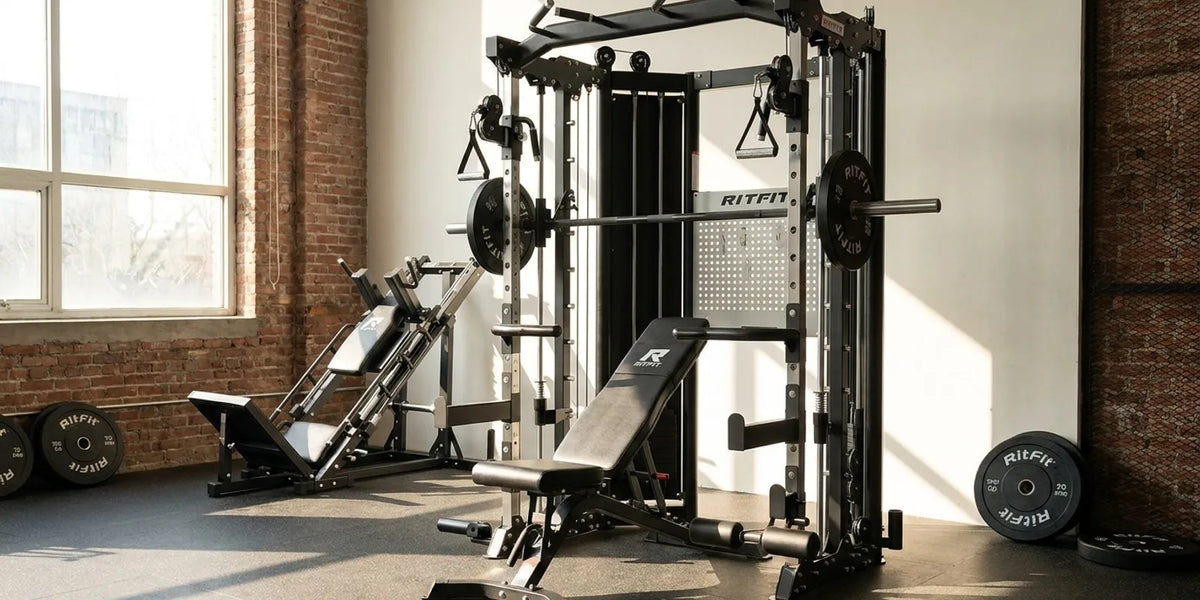
Quick Answer: The best Smith machine shoulder exercises are the seated shoulder press, high incline press, upright row, rear delt row, shrug, cable lateral raise, rear delt fly, face pull, and cable Y raise. Together, they train the front, side, and rear deltoids while also strengthening the trapezius and shoulder blade muscles.
This guide explains exercise setup, target muscles, pain free range, progression, and complete shoulder workouts. Test every movement with light resistance first, because a fixed bar path will not suit every shoulder equally well.
Key Takeaways
- Best exercise combination: Use one pressing movement, one side delt exercise, and one rear delt exercise to create a balanced shoulder workout.
- Bench position matters: Move the bench until the bar remains aligned over your wrists and elbows instead of forcing your shoulders into the machine path.
- Pressing does not cover everything: Shoulder presses emphasize the anterior deltoids, so lateral raises and rear delt movements remain important.
- Cables increase exercise variety: An integrated cable system supports lateral raises, rear delt flies, face pulls, and Y raises.
- Comfort controls progression: Add resistance only when the range, tempo, wrist position, and shoulder comfort remain consistent.
Why Should You Use a Smith Machine for Shoulder Training?
A Smith machine provides a guided bar path that reduces the balance demands of pressing and rowing. This makes exercise setup more repeatable for home gym lifters training without a spotter.
Stable Pressing for Solo Workouts
The guided bar lets you focus on elbow position, pressing effort, and controlled repetitions instead of balancing the bar in several directions.
- Adjustable catches: The rotating hooks provide several reracking positions during a difficult set.
- Safety stops: Properly placed stops can limit how far the bar descends if a repetition cannot be completed.
- Repeatable setup: The same bench position and hook height can be recorded for future sessions.
Useful for Muscle Focused Training
Research comparing machine and free weight resistance training found that both approaches can support muscle growth, while strength improvements tend to be most specific to the equipment used during training.[3]
- Machine advantage: External stability may help some lifters concentrate on the target muscle and approach challenging repetitions safely.
- Free weight advantage: Free weights require greater control of the implement and may transfer better to free weight strength testing.
- Practical decision: Choose the tool that matches your goal, joint comfort, available space, and training experience.
Easy Progress Tracking
A fixed rail makes it easier to standardize the bench angle, grip width, range of motion, load, and safety position from one workout to the next.
- Record bench placement: Mark where the front and rear feet of the bench sit on your gym floor.
- Record hook height: Use the same starting position whenever possible.
- Record the bottom position: Keep the same pain free range before increasing resistance.
Readers who are new to the equipment can begin with this complete guide to what a Smith machine is.
How Do Smith Machine Exercises Train the Shoulder Muscles?
A complete shoulder routine must address the anterior, medial, and posterior deltoids. It should also include muscles that control the shoulder blades, including the trapezius, rhomboids, and serratus anterior.
| Muscle Area | Main Role | Useful Exercises |
|---|---|---|
| Anterior deltoid | Raises the arm forward and assists overhead pressing | Seated shoulder press and high incline press |
| Medial deltoid | Raises the arm away from the torso | Cable lateral raise and upright row |
| Posterior deltoid | Moves the upper arm backward and assists horizontal abduction | Rear delt row, rear delt fly, and face pull |
| Upper trapezius | Elevates and helps rotate the shoulder blades | Shrug, upright row, and face pull |
| Middle and lower trapezius | Retracts, controls, and upwardly rotates the shoulder blades | Rear delt row, face pull, and cable Y raise |
Why One Exercise Is Not Enough
A shoulder press and lateral raise produce strong anterior and medial deltoid excitation, but no single exercise trains every deltoid portion equally.[1]
- Pressing pattern: Prioritizes the anterior deltoids and triceps.
- Abduction pattern: Adds direct work for the medial deltoids to create shoulder width.
- Horizontal pulling pattern: Adds rear delt and upper back work for structural balance.
For a more detailed anatomy explanation, review the shoulder press muscles worked guide.
What Are the 9 Best Smith Machine Shoulder Exercises?
The best routine combines heavy, moderate, and light movements instead of treating every exercise as a maximum strength lift. The first five exercises use the Smith bar, while the remaining four use cables commonly included on all-in-one Smith machines.
| Exercise | Primary Focus | Recommended Range | Equipment |
|---|---|---|---|
| Seated Smith machine shoulder press | Anterior and medial deltoids | 6 to 12 reps | Smith bar and adjustable bench |
| High incline Smith machine press | Anterior deltoids and upper chest | 8 to 12 reps | Smith bar and adjustable bench |
| Smith machine upright row | Medial deltoids and upper traps | 8 to 15 reps | Smith bar |
| Smith machine rear delt row | Posterior deltoids and upper back | 10 to 15 reps | Smith bar |
| Smith machine shrug | Upper trapezius | 8 to 15 reps | Smith bar |
| Single arm cable lateral raise | Medial deltoids | 12 to 20 reps | Low cable pulley |
| Cable rear delt fly | Posterior deltoids | 12 to 20 reps | Dual cable pulleys |
| Cable face pull | Posterior deltoids and middle traps | 12 to 20 reps | High cable pulley and rope |
| Cable Y raise | Lower traps and shoulder blade control | 12 to 20 reps | Dual low cable pulleys |
1. Seated Smith Machine Shoulder Press
The seated Smith machine shoulder press is the primary compound exercise for building pressing strength and anterior delt size. The bench must be positioned carefully to match the fixed rail path.
- Set the bench close to upright and place it directly under the Smith bar.
- Move the bench until your wrists remain aligned above your elbows at the bottom.
- Set the safety stops slightly below your lowest comfortable bar position.
- Grip the bar slightly wider than shoulder width with an overhand grip.
- Keep your elbows angled slightly forward in the scapular plane instead of pointing sideways.
- Press upward smoothly while keeping your core braced and lower back neutral.
- Lower the bar with control toward chin or upper chest height.
- Coach cue: Press through the bar while keeping your wrists firmly stacked over your elbows.
- Best for: Overall shoulder mass, pressing strength, and heavy solo loading.
- Programming: Complete 3 to 4 sets of 6 to 12 repetitions.
Electromyography research comparing front, back, barbell, and machine overhead pressing found that exercise configuration changes muscle excitation, supporting the use of a pressing variation that matches the lifter's goal and comfortable range.[2]
Use the complete Smith machine shoulder press form guide for a more detailed setup sequence.
2. High Incline Smith Machine Press
The high incline press places the torso between an incline bench press and a vertical shoulder press. This angle reduces joint strain for lifters with limited overhead mobility.
- Set the bench between approximately 60 and 75 degrees.
- Position the bench so the bar descends smoothly toward the clavicle and upper chest.
- Keep the forearms vertical at the bottom of each repetition.
- Press upward without lifting your glutes off the bench or overarching your lower back.
- Lower the bar until the shoulders remain stable and comfortable.
- Coach cue: Use a steeper bench angle for more shoulder emphasis and a lower angle for upper chest involvement.
- Best for: Anterior delts, clavicular chest development, and lifters avoiding a strict 90-degree press.
- Programming: Complete 3 sets of 8 to 12 repetitions.
3. Smith Machine Upright Row
The Smith machine upright row trains the side delts and upper traps when performed with a moderate grip width. Maintaining a controlled range allows the shoulders to move without impingement.
- Set the bar around upper thigh height.
- Use an overhand grip at shoulder width or slightly wider to avoid wrist crowding.
- Stand tall with your core braced and shoulders pinned slightly back.
- Pull the bar vertically upward while leading with the elbows.
- Stop when the bar reaches lower or mid chest height.
- Lower the bar smoothly under control without dropping or bouncing it.
- Coach cue: Stop when the deltoids feel fully loaded, not when the elbows reach their highest anatomical limit.
- Best for: Medial delts and upper trapezius thickness.
- Programming: Complete 2 to 3 sets of 8 to 15 repetitions.
Review the Smith machine upright row guide before increasing the load.
4. Smith Machine Rear Delt Row
The rear delt row uses a wider elbow path than a standard lat-focused row. This directs tension toward the posterior deltoids, rhomboids, and middle trapezius.
- Set the bar slightly below knee height.
- Grip the bar with an overhand grip wider than shoulder width.
- Hinge at the hips until your torso is roughly 45 to 60 degrees forward.
- Pull the bar toward your upper abdomen or lower chest.
- Drive the elbows flared outward at roughly a 70 to 80-degree angle from the body.
- Lower until your arms extend fully without losing your hip hinge posture.
- Coach cue: Pull wide with your elbows rather than dragging the bar toward your hips.
- Best for: Rear delts, upper back thickness, and balancing heavy pressing volume.
- Programming: Complete 3 to 4 sets of 10 to 15 repetitions.
5. Smith Machine Shrug
The Smith machine shrug directly trains scapular elevation through a fixed vertical track. This allows the upper trapezius to handle heavy loads with total control.
- Set the bar at mid thigh height.
- Stand close to the bar with an overhand, shoulder-width grip.
- Keep your arms straight and neck in a neutral position.
- Elevate your shoulders straight up toward your ears.
- Pause for a solid one-second contraction at the top.
- Lower the shoulders slowly without rolling them forward or backward.
- Coach cue: Elevate the shoulders straight vertically instead of rolling the joint.
- Best for: Upper trapezius strength and neck-to-shoulder thickness.
- Programming: Complete 3 sets of 8 to 15 repetitions.
See how to perform Smith machine shrugs for setup and progression details.
6. Single Arm Cable Lateral Raise
The cable lateral raise directly isolates the medial deltoid while maintaining constant mechanical tension across the entire range of motion.
- Set one cable handle at the lowest pulley setting on the rack.
- Stand sideways to the pulley and grasp the handle with the far-side hand.
- Maintain a slight bend in your elbow and brace your core.
- Raise your arm out to the side and slightly forward into the scapular plane.
- Pause briefly at shoulder height.
- Lower the cable slowly under continuous muscular control.
- Coach cue: Lead the motion with your elbow and avoid shrugging your shoulder upward.
- Best for: Side delt width and targeted shoulder isolation.
- Programming: Complete 3 to 4 sets of 12 to 20 repetitions per arm.
Read the lateral raise muscles and form guide for additional technique options.
7. Cable Rear Delt Fly
The cable rear delt fly isolates horizontal shoulder abduction with minimal elbow bending. This makes it an effective accessory for complete 3D shoulder aesthetics.
- Set dual cable pulleys at shoulder height without attachments or with single handles.
- Cross your arms to grasp the left cable with your right hand and the right cable with your left hand.
- Step back until the cables are fully tensioned.
- Pull your arms horizontally outward and backward with a soft elbow bend.
- Squeeze the back of your shoulders as your arms align with your torso.
- Return slowly to the crossed starting position without letting the weights clash.
- Coach cue: Drive your hands outward toward opposite walls rather than pulling straight back.
- Best for: Rear deltoid isolation and shoulder joint balance.
- Programming: Complete 3 sets of 12 to 20 repetitions.
8. Cable Face Pull
The cable face pull targets the rear deltoids, rhomboids, and external rotators simultaneously. This exercise strengthens postural stability while building upper back density.
- Attach a triceps rope to a cable pulley positioned at upper chest or eye level.
- Grip the ends of the rope with thumbs pointing backward.
- Step back to tension the cable and establish a solid staggered stance.
- Pull the center of the rope directly toward the bridge of your nose.
- Flare your elbows wide and externally rotate your wrists outward at peak contraction.
- Return slowly under control to full arm extension.
- Coach cue: Pull the rope apart and finish with thumbs pointing behind you.
- Best for: Rear delts, rotator cuff health, and postural integrity.
- Programming: Complete 2 to 4 sets of 12 to 20 repetitions.
Use the Smith machine face pull guide for detailed pulley and rope positioning.
9. Cable Y Raise
The cable Y raise uses light resistance to target the lower trapezius and lateral deltoids. It promotes proper upward scapular rotation during overhead movement.
- Set dual low cable pulleys at the bottom position and cross the handles.
- Stand tall with a slight forward torso lean and neutral spine.
- Raise both arms diagonally upward and outward at approximately a 30-degree angle to form a Y shape.
- Hold the peak contraction for one second at the top.
- Keep your ribs down and avoid overarching your lower back.
- Lower the handles slowly through the eccentric phase.
- Coach cue: Keep resistance light and let your shoulder blades glide upward naturally.
- Best for: Lower trapezius activation, scapular upward rotation, and overhead health.
- Programming: Complete 2 to 3 sets of 12 to 20 repetitions.
How Do You Set Up Smith Machine Shoulder Exercises Safely?
Correct setup matters because the guided bar cannot move freely around an uncomfortable joint position. Adjust the bench, safety catches, grip width, and range of motion before loading plates.
Match the Bench Position to the Rail
Slide the bench forward or backward until the bar remains aligned over your wrists and elbows throughout the pressing range.
- Vertical rail: The bench generally sits directly under the fixed bar path.
- Angled rail: The bench may need to shift several inches forward or backward depending on whether you face inward or outward.
- Body proportions: Individual arm length and ribcage depth determine your ideal bench location.
Test the Empty Bar
Perform several slow repetitions with an unloaded bar to identify joint restrictions, bench sliding, or unsuitable bottom depths.
- Check the wrists: Avoid excessive backward hyperextension under the bar.
- Check the elbows: Keep them stacked under or slightly forward of the bar line.
- Check the shoulders: Stop the descent immediately before any anterior pinching occurs.
Set the Safety Stops
Place the safety stops just below your intended bottom position and test them with the unloaded bar.
- Too low: The bar may descend farther than your comfortable range of motion during fatigue.
- Too high: The stops will prematurely hit the bar and interrupt productive repetitions.
- Correct height: The stops protect the lifter completely while allowing a full, natural stretch.
Use a Pain Free Range
The correct range of motion is the deepest position you can control without sharp joint pain, shoulder impingement, wrist collapse, or spinal rounding.
- Muscle fatigue: Muscular burning and fatigue are normal indicators of high effort.
- Joint warning: Sharp, clicking, or grinding joint discomfort indicates poor setup or an unsuitable exercise variation.
- Alternative exercise: Use dumbbells or independent cable handles if a fixed bar path continues to irritate your shoulders.
Safety note: A Smith machine provides external stability, but it cannot correct poor positioning or an unsuitable movement path. Stop the exercise immediately if joint pain, numbness, or loss of control occurs.
What Are the Best Smith Machine Shoulder Workout Routines?
Most lifters need three to five shoulder exercises in one workout, not every exercise in this guide. Select movements according to training experience, recovery, and the amount of pressing already performed for the chest.
Beginner Smith Machine Shoulder Workout
This routine uses one compound press, one side delt exercise, and one rear delt exercise to create complete coverage without excessive volume.
| Exercise | Sets | Repetitions | Rest |
|---|---|---|---|
| Seated Smith machine shoulder press | 3 | 8 to 12 | 90 to 120 seconds |
| Single arm cable lateral raise | 3 | 12 to 15 per arm | 45 to 75 seconds |
| Cable face pull | 2 | 12 to 20 | 45 to 75 seconds |
- Frequency: Perform this routine once or twice per week.
- Effort: Finish most sets with approximately two controlled repetitions in reserve.
- Progression: Add repetitions before increasing working weight.
Intermediate Smith Machine Shoulder Workout
This routine adds rear delt rowing and trap work while keeping the main press at the beginning of the session.
| Exercise | Sets | Repetitions | Rest |
|---|---|---|---|
| Seated Smith machine shoulder press | 4 | 6 to 10 | 2 minutes |
| Smith machine rear delt row | 3 | 10 to 15 | 75 to 90 seconds |
| Single arm cable lateral raise | 4 | 12 to 20 per arm | 45 to 75 seconds |
| Cable rear delt fly | 3 | 12 to 20 | 45 to 75 seconds |
| Smith machine shrug | 3 | 8 to 15 | 75 to 90 seconds |
Use the guide to how many shoulder exercises to perform per workout when adjusting weekly volume.
How Do You Progress Your Smith Machine Shoulder Workouts?
Progress means increasing the training challenge without sacrificing joint position, range, or control. More weight is useful only when the new load preserves the exercise standard.
Use Double Progression
Select a repetition range, reach the top of that range across every working set, then add the smallest practical increase in resistance.
- Example range: Use 8 to 12 repetitions for the seated shoulder press.
- Progress target: Reach 12 clean repetitions across all planned sets with perfect tempo.
- Next step: Add weight in small increments and begin near the lower end of the rep range again.
Standardize Every Setup
Record your exact bench angle, bench distance, hook height, safety stop setting, grip width, and cable pin position.
- Pressing exercises: Maintain identical bench positions and bottom bar depth.
- Cable exercises: Keep consistent pulley trolley height and standing distance.
- Rows and shrugs: Standardize starting bar height and torso angle.
Progress Isolation Exercises Slowly
Lateral raises, rear delt flies, face pulls, and Y raises respond best to micro-loading and additional controlled repetitions.
- Avoid momentum: Do not swing the torso or bounce out of the bottom position.
- Control the eccentric: Emphasize a smooth 2 to 3-second lowering phase.
- Prioritize delt recruitment: Stop the set when upper traps dominate the movement.
Reduce Training When Recovery Declines
Take a deload week whenever performance stalls, deep joint soreness persists, or recovery drops over consecutive sessions.
- Reduce sets: Drop one to two working sets from each exercise.
- Reduce load: Train with approximately 10 to 20 percent lighter weight.
- Reduce effort: Finish each set 3 to 4 reps shy of muscular failure.
What Are the Most Common Smith Machine Shoulder Mistakes to Avoid?
Most Smith machine shoulder problems stem from poor alignment, excessive overlap, or rushing load progression before mechanics are solid. Correct these errors before increasing training volume.
Using Only Pressing Exercises
Presses heavily recruit the anterior deltoids, which also receive heavy stimulation during flat bench presses, incline presses, and dips.
- Correction: Pair every press with dedicated medial delt and posterior delt movements.
- Volume check: Factor in chest pressing when calculating weekly front delt workload.
Placing the Bench Without Testing Alignment
Centering the bench by eye does not guarantee that the bar will align naturally with your wrists, elbows, and shoulder joints.
- Correction: Test multiple bench positions with the empty bar before loading plates.
- Alignment goal: Keep forearms perpendicular to the bar through the active range.
Lowering the Bar Beyond a Controlled Range
Descending too deep can force the shoulders into internal rotation and excessive extension, causing anterior joint pinching.
- Correction: Stop at the lowest comfortable and repeatable position.
- Safety setup: Set mechanical safety catches directly below that point.
Using Excessive Weight on Lateral Raises
Overly heavy cable lateral raises cause body english and excessive trap recruitment instead of targeted side delt growth.
- Correction: Lighten the weight stack and perform slow, controlled reps.
- Target position: Keep the elbow slightly higher than or level with the wrist.
Pulling Upright Rows Too High
Pulling the bar to neck level can pinch the rotator cuff tendons against the acromion process in sensitive shoulders.
- Correction: Stop the pull around mid-to-upper chest height with elbows leading.
- Alternative: Substitute with cable lateral raises if upright rows cause discomfort.
Assuming the Fixed Path Fits Everyone
A Smith machine provides fixed stability, but individual shoulder anatomy and mobility vary widely across lifters.
- Correction: Experiment with bench angle, seat depth, and grip width.
- Alternative: Use dumbbells or cable pulleys if fixed bar pressing continues to feel restrictive.
How Do You Choose the Best Smith Machine for Home Shoulder Training?
The best Smith machine for shoulder development requires compatible bench space, adjustable safety catches, smooth linear bearings, and versatile cable pulleys. The footprint should also fit comfortably within your workout space.
Check Bench Compatibility
An adjustable bench must fit inside the cage and adjust freely without hitting rear crossbars or pulley systems.
- High incline positions: Confirm the back pad locks securely between 60 and 85 degrees.
- Base clearance: Ensure the bench legs clear low pulley housings and floor bracing.
- Headroom: Ensure adequate overhead clearance when pressing in an upright seated position.
Check Safety Adjustment Positions
Closely spaced laser-cut safety holes let you fine-tune the bottom catch position exactly to your active range of motion.
- Test before loading: Drop the empty bar onto the catches to confirm height.
- Check dual catches: Verify that left and right safety stops are locked at identical levels.
Check Cable Versatility
Dual adjustable cable pulleys turn a basic Smith rack into a full commercial-grade shoulder training station.
- Low pulley: Delivers smooth constant tension for cable lateral raises and Y raises.
- Mid-height pulley: Supports chest-supported rear delt flies and external rotations.
- High pulley: Perfect for overhead cable face pulls and triceps extensions.
- Smith bar exercises: Shoulder presses, high incline presses, upright rows, rear delt rows, and shrugs.
- Cable exercises: Lateral raises, rear delt flies, face pulls, and Y raises.
- Buyer consideration: Confirm ceiling height, bench clearance, plate loading room, and overall footprint before buying.
Explore high-capacity multi-station options like the RitFit M1 Multi-Functional Smith Machine or browse the full RitFit Smith Machine collection to find the ideal setup for your home gym.
Frequently Asked Questions
Find direct answers to common questions about Smith machine shoulder exercises, form adjustments, and hypertrophy below.
What are the best Smith machine shoulder exercises for balanced delts?
The best balanced combination is a seated Smith machine shoulder press, a cable lateral raise, and a rear delt row or fly. This covers the front, side, and rear deltoids without excessive overlap. Add shrugs or face pulls only when they support a clear strength, size, or shoulder control goal.
Can Smith machine shoulder exercises build muscle as well as free weights?
Yes. Smith machine shoulder exercises can build muscle when the working sets are challenging, technique is repeatable, and load or repetitions increase over time. The fixed path changes the stability demand, but it does not prevent hypertrophy. Use the version that lets you train hard while keeping your joints comfortable.
Is the Smith machine shoulder press safe for beginners?
Yes. The guided bar and adjustable catches can make the shoulder press easier to set up for solo training. Beginners should still test the empty bar, set the safety stops, use a comfortable bench position, and finish each set before technique breaks down or shoulder discomfort increases.
How should I position the bench for a Smith machine shoulder press?
Place the bench near upright, then slide it until the bar stays over your wrists and elbows through the full pressing range. The exact position depends on your body proportions and the rail angle. Test several slow repetitions with the empty bar before adding plates.
What causes shoulder pain during a Smith machine shoulder press?
Shoulder pain often comes from poor bench placement, excessive depth, flared elbows, heavy loading, or a fixed path that does not match your anatomy. Reduce the load and change one variable at a time. Stop if pain is sharp, persistent, or paired with weakness, numbness, or reduced movement.
How many Smith machine shoulder exercises should I do per workout?
Most lifters need three or four shoulder exercises in one workout. Start with one press, one side delt movement, and one rear delt movement. Add trap or shoulder blade work only when recovery remains good and the extra volume supports a specific training goal.
Should I include upright rows in a Smith machine shoulder workout?
Yes, when the movement feels smooth and pain free. Use a shoulder width or slightly wider grip, lead with the elbows, and stop near chest height. Replace it with a cable lateral raise when the fixed grip or range produces pinching, clicking, or joint discomfort.
Can I train all three deltoid heads with one Smith machine?
Yes. An all in one Smith machine with adjustable cables can train all three deltoid heads through presses, lateral raises, rear delt flies, face pulls, and rows. A basic Smith bar can still support presses, upright rows, rear delt rows, and shrugs, but offers fewer isolation options.
Conclusion
The best Smith machine shoulder workout combines one stable press with direct medial and posterior delt exercises. Use shrugs, upright rows, face pulls, and Y raises only when they support your specific goals and remain comfortable.
Begin with light resistance, record your setup, and progress only when every repetition stays controlled. Replace any movement that repeatedly causes joint pain or forces your shoulders into an unsuitable fixed path.
Disclaimer
This article provides general fitness education and does not replace medical diagnosis, treatment, or individualized rehabilitation. Stop training and consult a qualified healthcare professional if you experience sharp pain, persistent joint discomfort, numbness, sudden weakness, or reduced shoulder movement.
References
1. Campos YAC, Vianna JM, Guimarães MP, et al. Different shoulder exercises affect the activation of deltoid portions in resistance trained individuals. J Hum Kinet. 2020;75:5-14. PMCID: PMC7706677
2. Coratella G, Tornatore G, Longo S, Esposito F, Cè E. Front versus back and barbell versus machine overhead press, an electromyographic analysis and implications for resistance training. Front Physiol. 2022;13:825880. PMCID: PMC9354811
3. Haugen ME, Vårvik FT, Larsen S, Haugen AS, van den Tillaar R, Bjørnsen T. Effect of free weight versus machine based strength training on maximal strength, hypertrophy and jump performance, a systematic review and meta analysis. BMC Sports Sci Med Rehabil. 2023;15(1):103. PMCID: PMC10426227





