The best thigh exercises target all three major muscle groups in your upper legs: the quadriceps at the front, the hamstrings at the back, and the adductors on the inside. Choosing the right movements and programming them correctly determines how much strength and muscle you actually build.
This guide covers the most effective exercises for each thigh muscle group, with specific sets, reps, frequency recommendations, weight selection guidance, and the most common mistakes to avoid so you can train safely and progressively.
Quick Answer: The best thigh exercises include squats and leg press for the quadriceps, Romanian deadlifts and leg curls for the hamstrings, and sumo squats and lateral lunges for the inner thighs. Beginners should start with 3 sets of 10-15 reps per exercise and train thighs 2-3 times per week, adding weight gradually as form improves.
Key Takeaways
- Balance is essential: Effective thigh training requires both quad-dominant exercises (squats, leg press) and hip-dominant exercises (Romanian deadlifts, leg curls) every training week.
- Volume by experience: Exercise science guidelines suggest beginners start with 6-10 sets per muscle group per week, progressing to 12-16 sets for quads and 10-14 sets for hamstrings at the intermediate level.
- Frequency matters: Training thighs 2-3 times per week across 6-8 hard working sets per session provides an effective stimulus for muscle growth and recovery.
- Inner thighs are often neglected: Dedicated adductor exercises such as sumo squats, lateral lunges, and goblet adductor lunges are needed to fully develop the inside of the thigh.
- Knee safety requires co-activation: Balancing quad and hamstring training keeps the knee joint stable. Single-leg exercises performed through 30-90 degrees of knee flexion support adequate hamstring-to-quad co-activation, which may reduce ACL tensile stress.[2]
Why Your Thighs Need Balanced Training
The thigh is made up of three distinct muscle groups that require different movement patterns to develop fully: the quadriceps (front), the hamstrings (back), and the adductors (inside). Training only squats and leg press builds the quads while leaving the hamstrings and inner thighs underdeveloped, which creates muscle imbalances and increases injury risk.
- Quadriceps: Four muscles at the front of the thigh responsible for knee extension. The rectus femoris, vastus lateralis, vastus medialis, and vastus intermedius all contribute to movements like squats, leg press, and lunges.
- Hamstrings: Three muscles at the back of the thigh (biceps femoris, semimembranosus, semitendinosus) that flex the knee and extend the hip. They require both hip-hinge movements and knee-flexion exercises for complete development.
- Adductors: The inner thigh muscles pull the legs toward the midline. The adductor longus, adductor magnus, and gracilis are commonly undertrained and benefit from specific lateral and wide-stance movements.
- Why balance matters: A well-balanced hamstring-to-quad strength ratio supports knee stability and reduces injury risk during training and everyday movement.
A complete thigh training program selects exercises from all three categories and programs them systematically across the week. Explore our full guide to leg exercises for more lower-body movement options.
What Are the Best Quad Exercises?
The best quad exercises are the barbell back squat, leg press, Bulgarian split squat, hack squat, and leg extension. A study published in the Journal of Human Kinetics found that both squat and deadlift training produced significant lower body strength gains over 6 weeks of consistent training.[1]
Barbell Back Squat
The barbell back squat is the most effective compound movement for building overall quad mass and lower body strength. Squatting below parallel with a controlled descent maximizes quadriceps engagement across a full range of motion.
- Sets and reps: 4 sets of 5-10 reps for strength, or 3 sets of 10-15 reps for hypertrophy
- Key cue: Keep the chest tall, knees tracking over the toes, and descend below parallel
- Replacement: Goblet squat or bodyweight squat for beginners who lack bar control
Leg Press
The leg press is a quad-dominant compound movement that allows high volume loading with less spinal demand than the barbell squat. Foot position adjusts the emphasis: a lower, narrower placement increases quad activation while a higher, wider placement shifts load to the glutes and hamstrings.
- Sets and reps: 3-4 sets of 10-15 reps
- Key cue: Lower the platform until the knees approach 90 degrees, then press through the full range
- Replacement: Hack squat machine when the leg press is unavailable
The RitFit M1 PRO Smith Machine with Leg Press and Hack Squat package allows you to train both movements in a single home gym setup.
Bulgarian Split Squat
The Bulgarian split squat isolates each leg individually, eliminating strength imbalances between sides while loading the quads and glutes through a large range of motion. The rear-foot-elevated position increases the stretch on the hip flexor and quad of the working leg.
- Sets and reps: 3 sets of 10-12 reps per leg
- Key cue: Keep the torso upright to emphasize the quads; lean forward slightly to shift load toward the glutes
- Replacement: Reverse lunge for those who find the rear-elevated position unstable
Hack Squat
The hack squat machine targets the vastus lateralis and overall quad sweep with lower spinal loading than a barbell squat. Full depth on every rep maximizes the quad lengthening stimulus.
- Sets and reps: 3-4 sets of 8-12 reps
- Key cue: Go to full depth and avoid locking out completely at the top to maintain constant quad tension
- Replacement: Leg press with a low, narrow foot position
Leg Extension
The leg extension isolates the quadriceps and is particularly effective for VMO (inner quad) development when performed through full range of motion. It works best as a volume finisher after compound movements rather than as a primary exercise.
- Sets and reps: 3 sets of 12-15 reps with a 1-2 second hold at full extension
- Key cue: Use a controlled tempo, pause at full extension, and lower slowly
- Replacement: Terminal knee extension (TKE) with a band for those with knee sensitivity
"Leg extensions create hypertrophy in the quads and can be overloaded. However, there are some potential safety issues for people with tendonitis or knee issues, as it places a lot of force and tension on the patella. It's a good exercise for some, definitely not all."
Jeff Cavaliere, MSPT, CSCS, ATHLEAN-X
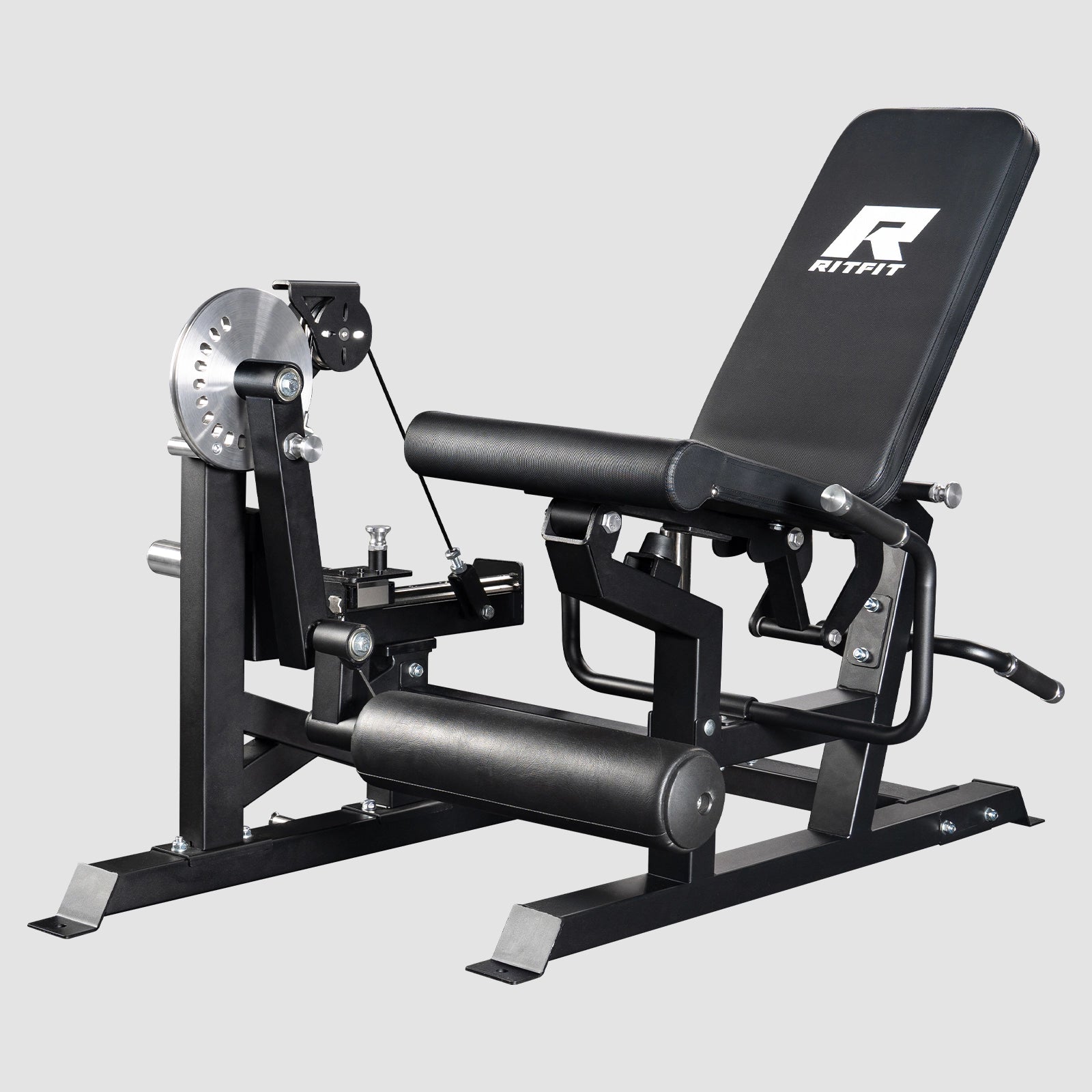
The RitFit leg extension and curl machine covers both quad isolation and hamstring isolation in a single compact unit.
What Are the Best Hamstring Exercises?
The best hamstring exercises are the Romanian deadlift, leg curl, Nordic hamstring curl, and hip thrust. Hamstrings cross both the hip and the knee, so complete development requires both hip-hinge movements that load the hamstring at length and knee-flexion exercises that train it through contraction.
Romanian Deadlift (RDL)
The Romanian deadlift is the most effective single exercise for building hamstring mass because it loads the muscle at its longest position through a controlled hip hinge. A 3-second eccentric on every rep maximizes the lengthening stimulus that drives hypertrophy.
- Sets and reps: 3-4 sets of 6-10 reps
- Key cue: Push the hips back, keep the bar close to the body, and feel a deep hamstring stretch at the bottom before reversing
- Replacement: Single-leg RDL with dumbbells for those who need to address side-to-side imbalances
Lying or Seated Leg Curl
The leg curl isolates the hamstrings through knee flexion, adding targeted volume that the RDL does not fully replicate. The seated leg curl loads the hamstring in a lengthened position and tends to produce higher hypertrophy stimulus than the lying variation.
- Sets and reps: 3 sets of 10-15 reps with a controlled eccentric
- Key cue: Curl through the full range and resist gravity on the way down; avoid letting the hips rise
- Replacement: Nordic hamstring curl using a partner or anchor for those without a machine
Nordic Hamstring Curl
The Nordic hamstring curl is a demanding bodyweight exercise that eccentrically strengthens the hamstrings and is one of the most effective movements for reducing hamstring strain risk in athletes. It requires no equipment beyond an anchor point for the feet.
- Sets and reps: 2-3 sets of 5-8 reps (beginners start with assisted negatives)
- Key cue: Lower under full control as slowly as possible, using a push-up to return to the start position
- Replacement: Stability ball leg curl for beginners who cannot perform the full Nordic
Barbell Hip Thrust
The hip thrust primarily targets the glutes but heavily involves the hamstrings through hip extension, making it a valuable posterior chain complement to the RDL. It is particularly effective for building strength through the full hip extension range.
- Sets and reps: 3-4 sets of 10-15 reps, initiating with the glutes on every rep
- Key cue: Drive through the heels, squeeze the glutes at the top, and hold for 1-2 seconds
- Replacement: Glute bridge on the floor for beginners before loading with a barbell
For a full overview of equipment that supports hamstring and quad training, see our guide to the best gym equipment for thighs.
What Are the Best Inner Thigh Exercises?
The best inner thigh exercises are sumo squats, lateral lunges, and the goblet adductor lunge. A systematic review found that the Copenhagen Adductor Exercise produced the highest adductor longus activation (108% MVIC) among the hip adduction exercises examined, highlighting that eccentric adductor loading drives the strongest muscle stimulus.[3]
Sumo Squat
The sumo squat uses a wide stance and outward-pointing toes to increase adductor activation compared to a standard squat. It also targets the quads and glutes while placing the inner thigh muscles under load across a full range of motion.
- Sets and reps: 3 sets of 12-15 reps
- Key cue: Keep the knees tracking over the toes throughout the descent and drive them out on the way up
- Replacement: Plie squat or wide-stance leg press when a barbell is unavailable
Lateral Lunge
The lateral lunge moves the body in the frontal plane, directly loading the adductors of the working leg as it absorbs the bodyweight shift. It also strengthens hip abductors and improves lateral stability, which carries over to sports performance.
- Sets and reps: 3 sets of 10-12 reps per side
- Key cue: Step wide enough so the working knee tracks over the foot, keep the opposite leg straight, and sit back into the hip
- Replacement: Curtsy lunge for variety or to increase glute involvement
Training the strength exercises for soccer that include lateral movements can reinforce inner thigh function in athletes.
Goblet Adductor Lunge
The goblet adductor lunge combines a dumbbell-loaded side lunge with an active adductor squeeze on the return, making it one of the most targeted inner thigh exercises available without a cable machine or adductor machine.
- Sets and reps: 2-3 sets of 10-12 reps per leg
- Key cue: As you return from the side lunge, actively squeeze the legs together rather than simply stepping back, engaging the adductors concentrically
- Replacement: Side-lying hip adduction or cable hip adduction for those without space for lateral lunges
Use a pair of adjustable dumbbells to progress the goblet adductor lunge, sumo squat, and Bulgarian split squat as your strength improves.
How Many Sets and Reps Should You Do for Thighs?
The right number of sets and reps for thighs depends on your training experience and goal. Exercise science guidelines suggest beginners start with 6-10 sets per muscle group per week, progressing to 12-16 sets for quads and 10-14 sets for hamstrings at the intermediate level.
| Experience Level | Quad Sets/Week | Hamstring Sets/Week | Rep Range |
|---|---|---|---|
| Beginner (0-1 year) | 6-10 sets | 6-10 sets | 10-15 reps |
| Intermediate (1-3 years) | 12-16 sets | 10-14 sets | 8-12 reps (mix heavy and moderate) |
| Advanced (3+ years) | 16-20 sets | 14-18 sets | 5-8 (strength) + 10-15 (hypertrophy) |
Volume guidelines based on practitioner training recommendations. Individual recovery capacity varies.
- Squats and leg press (5-15 reps): Heavier sets of 5-8 reps build a strength base. Sets of 10-15 accumulate the most muscle volume per session relative to recovery cost.
- RDLs (6-10 reps): Control the eccentric completely. Reps above 12 tend to compromise the slow, controlled descent that makes the RDL so effective.
- Leg curls and leg extensions (10-20 reps): Machine isolation exercises respond well to moderate-to-high reps with constant tension and slow eccentrics.
- Bulgarian split squat (8-15 reps): Moderate reps with controlled tempo. The stretch-mediated stimulus is significant even at moderate loads, so heavy loading is not necessary for results.
- Session cap: One training guide recommends 6-8 hard working sets per thigh muscle group per session. Exceeding this without adequate recovery does not accelerate results.
How Often Should You Train Your Thighs?
Training thighs 2-3 times per week produces the best combination of growth stimulus and recovery for most lifters. Spreading the weekly set volume across multiple sessions is more effective than concentrating it in a single long leg day.
- 2x per week (most effective starting point): Session A focuses on quad-dominant movements (squat, leg press, leg extension). Session B focuses on hip-dominant movements (RDL, leg curl, hip thrust).
- 3x per week (intermediate and advanced): Adds a unilateral-focused day (Bulgarian split squat, lateral lunge, single-leg RDL) to address strength imbalances and increase total weekly volume.
- Rest between sessions: Allow at least 48 hours between sessions targeting the same muscle group to ensure recovery before the next training stimulus.
- Signs of insufficient recovery: Persistent soreness, declining performance across sessions, or disrupted sleep. Reduce frequency or volume before adding more training days.
For beginners who are also developing other fitness skills, our guide to aerobic stepper exercises for beginners provides complementary lower-body conditioning work between dedicated thigh training days.
How Do You Choose Your Starting Weight?
Choose a starting weight that you can control for 12-15 reps while maintaining proper form throughout every repetition. If form breaks down before reaching 12 reps, the weight is too heavy. If you can complete 15 reps without much effort, add 5-10 pounds at the next session.
- Squats and leg press: Begin with bodyweight or just the bar. Add 5-10 pounds per session while form remains solid. The priority is technique, not load.
- Romanian deadlift: Start with a weight that allows a full, controlled 3-second eccentric. A common error is loading too heavily before the hinge pattern is established, which turns the RDL into a bent-over row.
- Machine exercises (leg curl, leg extension): Start at a weight you can move smoothly through the full range. Avoid settings where momentum substitutes for muscle control.
- When to increase weight: Add weight when you consistently complete the top end of your rep target (e.g. all 3 sets of 15 reps) with 2-3 reps still in reserve. This is the progressive overload signal.
- Dumbbell exercises: For goblet squats, lateral lunges, and Bulgarian split squats, start 20-30% lighter than you expect. These movements challenge balance and stability in addition to strength.
Explore the full range of dumbbells to find the right starting set for progressive thigh training at home or in the gym.
Common Mistakes and How to Avoid Knee Pain
The most common thigh training mistakes involve poor knee alignment, imbalanced programming, and loading too heavily before movement patterns are established. A systematic review found that single-leg exercises performed through 30-90 degrees of knee flexion produce adequate hamstring-to-quad co-activation, which may reduce tensile stress on the ACL during training.[2]
- Knees caving inward: Valgus collapse during squats and lunges increases medial knee stress. Focus on driving the knees out over the toes on every rep. Hip abductor strengthening with band exercises can correct chronic valgus.
- Skipping hamstring work: A disproportionately strong quad relative to the hamstring puts more tensile load on the knee joint. Pairing every quad session with at least one hip-hinge or leg-curl movement keeps the ratio in a healthier range.
- Cutting depth short: Partial squats reduce quad and hamstring activation. Going below parallel (hip crease below knee level) maximizes muscle development and keeps the movement pattern functional.
- Rushing the eccentric: Dropping quickly through the descent phase on squats, lunges, and RDLs eliminates the lengthening stimulus that drives muscle growth. A 2-3 second lower on every rep produces far better results.
- Too much weight before pattern mastery: Loading the squat or RDL beyond what your mobility and technique can support shifts stress from the muscle to the passive structures (tendons, ligaments, cartilage). Build technique first, load second.
- Ignoring single-leg training: Most people have a dominant side. Single-leg exercises (Bulgarian split squat, single-leg RDL, step-ups) expose and correct strength imbalances that bilateral exercises mask.
- When to stop: Stop any exercise immediately if you experience sharp joint pain, locking, or catching sensations in the knee or hip. Dull muscle soreness during training is normal. Joint pain is not.
For adapted lower-body movements that prioritize joint safety, our guide to exercises for elderly covers low-impact thigh training approaches suitable for those with joint concerns.
Sample Thigh Workouts for Beginners and Intermediate Lifters
These sample workouts apply the exercises, sets, reps, and frequency principles covered above into ready-to-use training sessions. Begin each workout with a 5-minute warm-up such as cycling, walking, or exercise ball exercises to raise muscle temperature before loading.
Beginner Thigh Workout (2x per week)
Perform both sessions each week with at least 48 hours between them. Progress by adding 5 pounds to each exercise when you complete all sets at the top of the rep range.
- Goblet squat or bodyweight squat: 3 sets of 12-15 reps, 2 min rest
- Romanian deadlift (light dumbbells or bar): 3 sets of 10-12 reps, 90 sec rest
- Reverse lunge: 3 sets of 10 reps per leg, 90 sec rest
- Lying leg curl or stability ball curl: 3 sets of 12-15 reps, 60 sec rest
- Sumo squat: 2 sets of 15 reps, 60 sec rest
Intermediate Thigh Workout A (Quad Focus)
Pair this session with Workout B later in the week. Add weight when all sets hit the upper rep target with good form.
- Barbell back squat: 4 sets of 6-10 reps, 3 min rest
- Leg press: 3 sets of 10-15 reps, 2 min rest
- Bulgarian split squat: 3 sets of 10-12 reps per leg, 90 sec rest
- Leg extension: 3 sets of 12-15 reps, 60 sec rest
- Lateral lunge: 2 sets of 12 reps per leg, 60 sec rest
Intermediate Thigh Workout B (Hamstring and Posterior Focus)
Balance the quad-heavy Session A with this hip-dominant session performed 48-72 hours later for full thigh development.
- Romanian deadlift: 4 sets of 6-10 reps, 2 min rest
- Barbell hip thrust: 3 sets of 10-15 reps, 90 sec rest
- Seated leg curl: 3 sets of 10-12 reps, 60 sec rest
- Nordic hamstring curl (assisted) or stability ball curl: 2 sets of 5-8 reps, 90 sec rest
- Goblet adductor lunge: 2 sets of 10-12 reps per leg, 60 sec rest
For athletes who train thighs for sport performance, our strength exercises guide shows how to apply thigh training within a sport-specific context.
FAQs About Best Thigh Exercises
What are the best quad exercises?
The best quad exercises are the barbell back squat, leg press, Bulgarian split squat, hack squat, and leg extension. Squats and leg press build the most overall quad mass through compound movement, while leg extensions isolate the quads for additional volume and definition.
What are the best hamstring exercises?
The best hamstring exercises are the Romanian deadlift, lying or seated leg curl, Nordic hamstring curl, and barbell hip thrust. Romanian deadlifts load the hamstrings at their longest position, producing the greatest hypertrophy stimulus, while leg curls add isolated knee-flexion volume.
What are the best inner thigh exercises?
The best inner thigh exercises are sumo squats, lateral lunges, and goblet adductor lunges. These movements target the adductor muscles along the inside of the thigh. Research suggests eccentric adductor exercises produce high muscle activation and may reduce groin strain risk.
How many sets and reps should I do for thighs?
Beginners should aim for 6-10 sets per thigh muscle group per week using 10-15 reps per set. Intermediate lifters can progress to 12-16 weekly sets for quads and 10-14 for hamstrings, mixing heavier sets of 5-8 reps with moderate sets of 10-15 reps for balanced strength and muscle growth.
How often should I train my thighs?
Train your thighs 2-3 times per week for optimal muscle growth and recovery. Aim for 6-8 hard working sets per muscle group per session. Allow at least 48 hours between sessions targeting the same muscle group to ensure adequate recovery before the next training stimulus.
What weight should I start with for thigh exercises?
Start with a weight you can control for 12-15 reps while maintaining proper form throughout. For squats and leg press, begin with bodyweight or just the bar, then add 5-10 pounds per session as form feels solid. The goal is progressive overload over weeks, not maxing out on day one.
How do I avoid knee pain during thigh exercises?
To avoid knee pain, keep your knees tracking over your toes, avoid letting them cave inward, and control the eccentric phase on every rep. Single-leg exercises performed through 30-90 degrees of knee flexion support balanced quad and hamstring activation. Stop any exercise that causes sharp or joint pain immediately.
Conclusion
The best thigh exercises work all three muscle groups: squats and leg press for the quads, Romanian deadlifts and leg curls for the hamstrings, and lateral lunges and sumo squats for the inner thighs.
Start with the beginner workout in this guide, track your weights each session, and progress to the intermediate split when you can complete all sets comfortably. Browse our guide to best gym equipment for thighs to set up an effective home training environment.
Disclaimer
This article is for general fitness and educational purposes only and does not constitute medical advice, diagnosis, or treatment. Consult a qualified healthcare professional or certified strength and conditioning specialist before beginning any new exercise program, particularly if you have a history of knee, hip, or lower back injury.
Save on your next RitFit order
Tap the button to copy your code, then paste it at checkout.
References
1. Nigro F, Bartolomei S. A comparison between the squat and the deadlift for lower body strength and power training. J Hum Kinet. 2020;73:145-152. doi:10.2478/hukin-2020-0017. PMCID: PMC7386153
2. Dedinsky R, Baker L, Imbus S, Bowman M, Murray L. Exercises that facilitate optimal hamstring and quadriceps co-activation to help decrease ACL injury risk in healthy females: a systematic review of the literature. Int J Sports Phys Ther. 2017;12(1):3-15. PMCID: PMC5294945
3. Schaber M, Guiser Z, Brauer L, et al. The neuromuscular effects of the Copenhagen adductor exercise: a systematic review. Int J Sports Phys Ther. 2021;16(5):1210-1221. doi:10.26603/001c.27975. PMCID: PMC8486394