








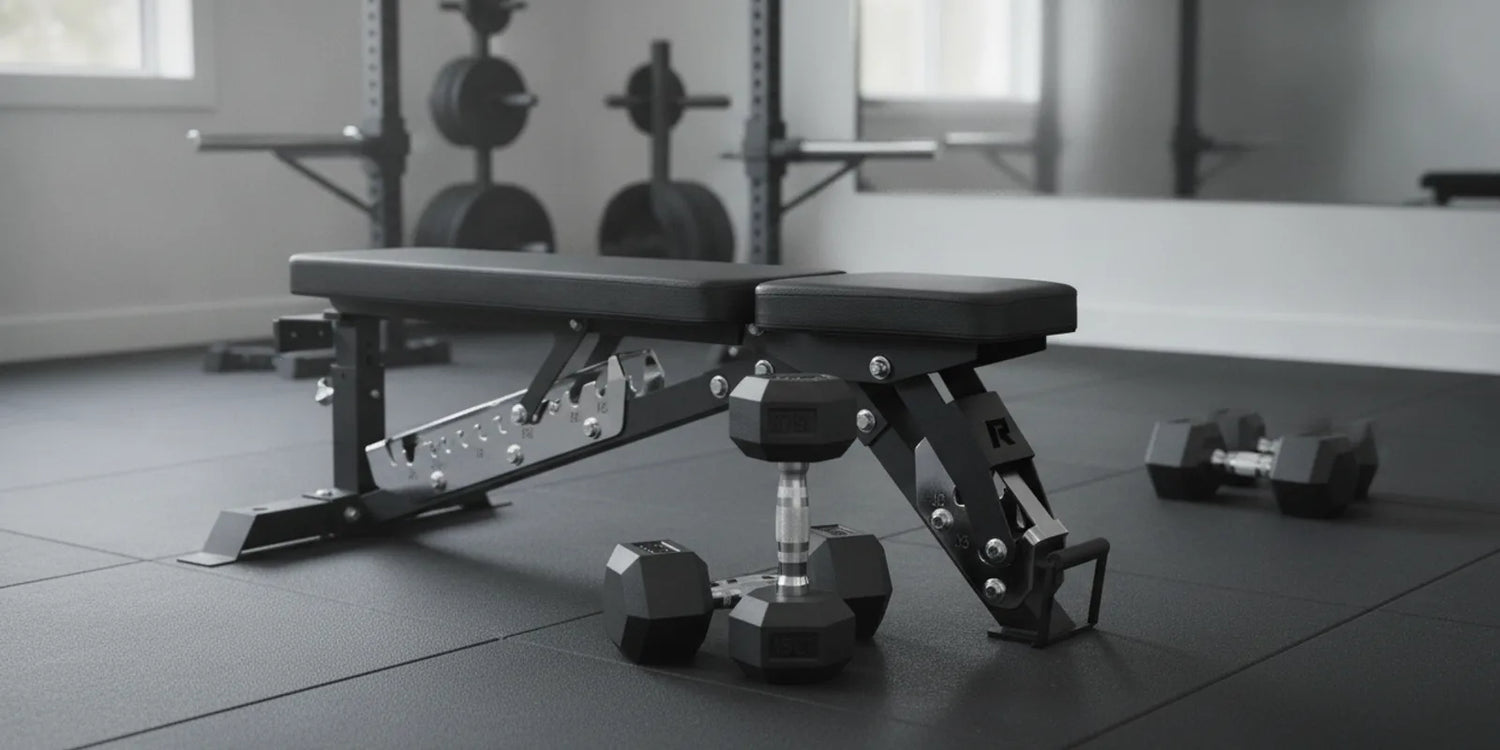
The best way to grow hamstrings and quads at home is simpler than most lifters think: train each muscle twice a week with dumbbell movements that load the stretch, push every set close to failure, and add reps or weight over time. No leg press or cable machine is required.
This guide covers the exact exercises, weekly set targets, a two day training split, and progression rules for a home gym with only dumbbells and a bench. You will also learn when to add weight and which warning signs mean you should back off.
Quick Answer: The best way to grow hamstrings and quads is to train each muscle twice weekly with about ten total sets, using stretch loaded moves like dumbbell Romanian deadlifts for hamstrings and goblet squats or split squats for quads. Take sets close to failure and progress the load gradually.
Key Takeaways
- Effort beats equipment: Muscle size grows similarly with light or heavy loads when sets finish close to failure, so dumbbells are enough for leg growth.
- Ten sets per muscle weekly: Aim for about ten hard sets each for hamstrings and quads, split across two weekly sessions.
- Hinge plus squat: Pair one hip hinge like the Romanian deadlift with one squat pattern like the goblet squat every leg day.
- Progress in small jumps: Add two to five pounds per dumbbell only after you own the top of your rep range for two sessions.
- Respect stop signals: Sharp knee or lower back pain, dizziness, or sudden form breakdown means the set is over.
What Actually Makes Hamstrings and Quads Grow?
Hamstrings and quads grow when they perform enough challenging sets taken close to failure, no matter whether the resistance comes from machines or dumbbells. A network meta-analysis found that loads at or above roughly 60% of one-rep max build more strength, while muscle size increases similarly across a wide load range when effort stays high.[1]
- Effort: Finish most working sets with only one to three good reps left in the tank.
- Stretch: Moves that load the lengthened position, like Romanian deadlifts, give the hamstrings a strong growth signal.
- Range: Use a full, controlled range of motion instead of bouncing through partial reps.
- Consistency: Repeat the same core lifts for at least eight weeks before swapping variations.
For a broader view of complete leg development, see our guide on the best way to build leg muscle. The rest of this article applies these principles to a minimal home setup.
How Many Sets and Sessions Per Week Do Your Legs Need?
Hamstrings and quads each grow best with roughly ten hard sets per week, and you can divide those sets across one or more sessions. In an eight week trial of 22 resistance trained adults, performing the same lower body program in one long session or four shorter sessions produced similar quadriceps thickness gains of 2.3 versus 2.8 millimeters.[2]
Volume is the variable that matters most. An umbrella review of 14 meta-analyses covering 178 primary studies concluded that at least ten weekly sets per muscle group is optimal, that growth rises in a graded dose response with volume, and that repetitions of ten seconds or slower should be avoided.[3]
- Beginners: Start at six to eight weekly sets per muscle and add one set per week.
- Intermediates: Hold ten to fourteen weekly sets as long as recovery stays strong.
- Rest: Take two to three minutes between compound lower body sets.
What Are the Best Hamstring Exercises Without Big Machines?
The dumbbell Romanian deadlift is the single best machine free hamstring builder because it loads the muscle hard in its stretched position. Nordic curls, single leg hip hinges, and slider leg curls complete a home hamstring toolkit.
How Heavy Should You Go?
Pick a dumbbell pair that makes ten to twelve reps feel hard while your back stays flat and your knees stay soft. If you could finish five more reps, the weight is too light, and if your lower back rounds, it is too heavy.
What Are Good Substitutions?
- No heavy dumbbells: Slow the lowering phase to three seconds per rep.
- Limited space: Use single leg Romanian deadlifts holding one dumbbell.
- Extra challenge: Try Nordic curls with your heels anchored under a couch.
If you miss the feel of a lying or seated curl, our guide to leg curl alternatives for stronger hamstrings covers more options. You can also adapt these moves for hamstring workouts with a home workout bench.
What Are the Best Quad Exercises Without Big Machines?
Goblet squats, Bulgarian split squats, and walking lunges are the best quad builders you can do with dumbbells alone. Heels elevated squats and step ups add variety when progress stalls.
How Heavy Should You Go?
For goblet squats, choose a dumbbell that limits you to eight to fifteen controlled reps with your chest tall. Single leg moves like split squats need far less load, so start lighter than your ego suggests.
What Are Good Substitutions?
- Knee friendly: Step ups on a low, stable box.
- Small space: Static split squats instead of walking lunges.
- Extra burn: One and a quarter goblet squats at the end of a workout.
Our library of the best quad exercises for strength and muscle growth goes deeper on form cues. For isolation context, see how the seated leg extension complements compound work.
What Does a Complete Home Leg Week Look Like?
A twice weekly split that pairs one hinge pattern and one squat pattern per session covers the hamstrings and quads with about ten sets each. The plan below fits in a small space with dumbbells, sliders, and a bench.
| Day A | Sets x Reps | Day B | Sets x Reps |
|---|---|---|---|
| Goblet squat | 4 x 8-12 | Bulgarian split squat | 3 x 8-12 each leg |
| Dumbbell Romanian deadlift | 4 x 8-12 | Single leg Romanian deadlift | 3 x 10-12 each leg |
| Step up | 2 x 12-15 each leg | Slider leg curl | 3 x 10-15 |
| Optional finisher: bodyweight squat | 1 x 15-20 | Walking lunge | 2 x 12-16 steps |
Rest two to three minutes between compound sets and sixty to ninety seconds between single leg finishers.
When and How Should You Add Weight?
Add weight when you can finish every set of an exercise with two clean reps left for two sessions in a row. Jump in small steps of two to five pounds per dumbbell so progression never outpaces your technique.
- Double progression: Build to the top of the rep range first, then increase the load and drop back to the bottom.
- Add a set: When recovery is strong and growth slows, add one weekly set per muscle instead of more weight.
- Deload: Every six to eight weeks, cut your sets in half for one week.
- Track it: Log loads and reps in a notebook or app so small jumps stay visible.
A pair of RitFit PVC-coated dumbbells in pairs keeps these small weight jumps practical at home. Buy the next pair before you need it so progression never stalls waiting for equipment.
Which Mistakes Stall Leg Growth and When Should You Stop?
The most common mistakes are skipping hinge work, cutting the range of motion short, and adding sets faster than recovery allows. Sharp joint pain, sudden weakness, or pain that changes your form are clear stop signals.
- Quad dominant programs: Match every squat pattern with a hinge or curl pattern.
- Half reps: Use a full stretch even if it means lighter dumbbells.
- Chasing soreness: Judge progress by load and reps, not by how sore you feel.
- Stop conditions: End the set for sharp knee or lower back pain, dizziness, or visible form breakdown.
To balance your posterior chain further, learn how to hip thrust the right way as a complement to your hinge work. A balanced plan keeps both sides of the thigh growing together.
What Equipment Upgrades Are Worth It Later?
No upgrade is required, but a wider dumbbell range, a sturdy bench, and a compact leg extension and curl unit make progression and isolation easier once the basics feel routine. Buy in the order your program demands, not all at once.
Browsing the RitFit dumbbell collection helps you plan the next weight jumps, and the RitFit PLC01 leg extension curl machine adds direct quad and hamstring isolation in a small footprint. The short video below shows how this style of machine targets both sides of the thigh.
"Many people underestimate the power of at-home workouts, believing that they lack the equipment or space to make meaningful progress."
Jeff Cavaliere, MSPT, CSCS, Physical Therapist and Strength Coach, former Head Physical Therapist for the NY Mets, Athlean-X
FAQs About Growing Hamstrings and Quads
How often should I train hamstrings and quads each week?
Most home lifters grow well training each muscle two times per week, reaching about ten total weekly sets per muscle group. Split the work across two shorter sessions, keep one to three reps in reserve, and add sets gradually only when recovery stays strong.
Can you build big legs with dumbbells only?
Yes. Muscle growth is comparable across light and heavy loads when sets are taken close to failure, so dumbbell goblet squats, split squats, lunges, and Romanian deadlifts can build the quads and hamstrings effectively. Progressive overload and enough weekly volume matter more than the equipment itself.
What is the best hamstring exercise without a machine?
The dumbbell Romanian deadlift is the top machine free choice because it loads the hamstrings in a stretched position through a long range of motion. Nordic curls and single leg hip hinges are strong backups. Choose one hinge pattern, progress the load slowly, and control the lowering phase.
How do I know when to add weight to leg exercises?
Add weight when you finish every set with two or more clean reps left for two sessions in a row. Increase load in small jumps of two to five pounds per dumbbell, or add one set per week instead. Stop progressing if joint pain replaces normal muscle soreness.
Why are my quads growing but my hamstrings lagging?
Lagging hamstrings usually come from too much squat and lunge volume and too little hip hinge work. Add direct hinge and curl movements, train the hamstrings twice weekly, and use a full stretch under load. Balance quad and hamstring weekly sets so both muscles get similar attention.
Conclusion
The best way to grow hamstrings and quads without big machines is consistent effort on a few dumbbell staples, around ten weekly sets per muscle, and patient progression. Start with the two day split above and let small load jumps compound over the coming months.
Ready to equip your home leg days? Explore the latest deals on the RitFit sales page and build your setup one piece at a time.
Disclaimer
This article is for general fitness education and is not medical advice, a diagnosis, or a rehabilitation plan. Consult a qualified health professional before starting a new training program, especially if you have existing pain or a medical condition.
Save on your next RitFit order
Tap the button to copy your code, then paste it at checkout.
References
1. Lopez P, Radaelli R, Taaffe DR, et al. Resistance Training Load Effects on Muscle Hypertrophy and Strength Gain: Systematic Review and Network Meta-analysis. Med Sci Sports Exerc. 2021;53(6):1206-1216. doi:10.1249/MSS.0000000000002585. PMCID: PMC8126497
2. Andersen V, Iversen VM, Vereide PF, et al. High-frequency resistance training improves maximal lower-limb strength more than low frequency. Eur J Sport Sci. 2024;24(5):557-565. doi:10.1002/ejsc.12055. PMCID: PMC11235667
3. Bernárdez-Vázquez R, Raya-González J, Castillo D, Beato M. Resistance Training Variables for Optimization of Muscle Hypertrophy: An Umbrella Review. Front Sports Act Living. 2022;4:949021. doi:10.3389/fspor.2022.949021. PMCID: PMC9302196





