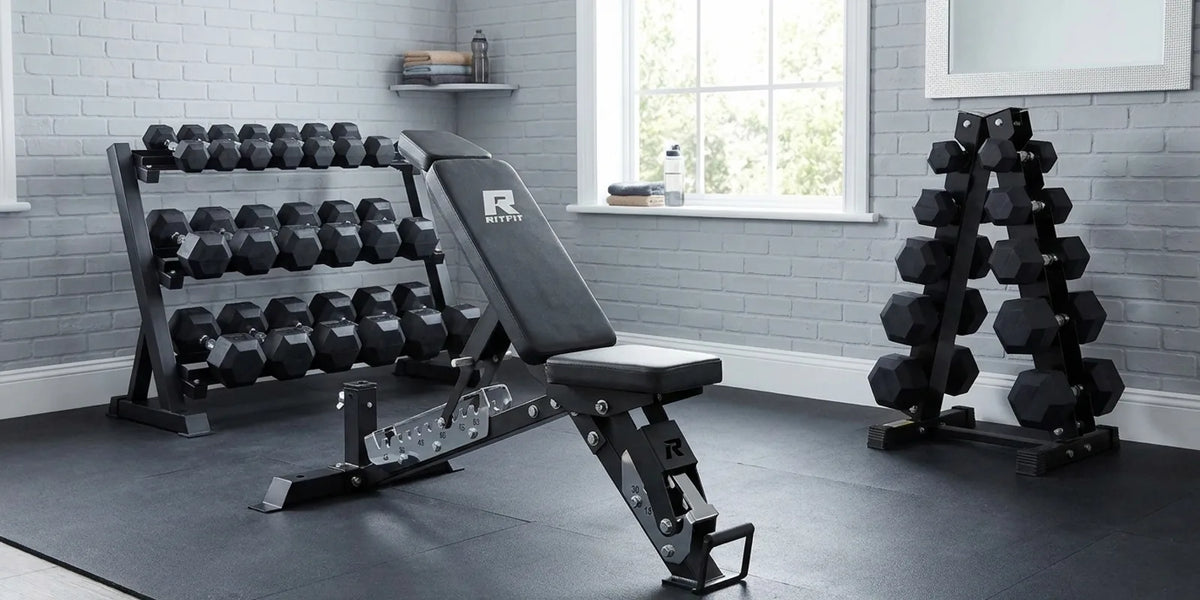
The best weight bench for dumbbell work is the one you can set up under, press from, and bail out of without asking anyone for help, and for most home lifters that bench is the RitFit Gator Adjustable Weight Bench. Its 21 adjustment positions, 11.8 inch pad, and 1,600 lb frame are built for training that runs on dumbbells instead of a barbell.
This guide covers what a dumbbell-only program actually demands, which angles and pad dimensions matter, what the Gator costs, and when a different RitFit bench is the smarter buy.
Quick Answer: The RitFit Gator is the best weight bench for dumbbell work when your pressing runs on dumbbells, because 10 back pad angles, an 11.8 inch pad, a 2 inch seat gap, and a 1,600 lb frame handle heavy sets you set up and finish alone. Barbell-first lifters on a budget can spend less on the RitFit 1300LB BWB01.
Key Takeaways
- Set-up is the real spec: The Gator back pad measures 25.9 by 11.8 inches with a 2 inch gap to the seat pad, so you can sit down, kick heavy dumbbells back, and still land both shoulder blades on the pad.
- Load rating: RitFit rates the frame at a 1,600 lb total load and publishes 14 gauge steel tubing measuring 50 by 70 millimeters, which has to cover your body weight plus the dumbbells.
- Angle range: 10 back pad angles from 0 to 85 degrees plus 3 decline settings cover flat presses, low incline presses, chest-supported rows, and incline curls on one bench.
- Footprint and storage: The Gator is 57.8 inches long and 25.2 inches wide, weighs 109.1 lb, and rolls on transport wheels so one person can stand it upright against a wall.
- Warranty: RitFit's published bench schedule covers the frame for 3 years and the parts and pads for 6 months from the order date.
- Value verdict: At a listed 399.99 dollars the Gator earns its price for dumbbell-first training, while barbell-first lifters on a tighter budget should look at the RitFit 1300LB BWB01 at 269.99 dollars.
How Dumbbell-Only Training Changes the Bench Checklist
A dumbbell-only program asks a bench to do three jobs that a barbell program never tests. You have no rack hooks to hang a bar on and no spotter to hand you the weight, so the bench itself has to make your set-up repeatable.
- You are the rack: Sit on the end of the bench with the dumbbells on your thighs, then kick them back one at a time as you lie down. A seat that sits too high or a seat pad that pushes you forward turns that motion into a wrestling match at 80 lb.
- Load still drives the frame: One trial measuring muscle activity found that chest, front delt, triceps, and lat activity climbs as bench press intensity rises from 70% to 100% of a one-rep max, so the frame has to stay quiet when the weight gets genuinely heavy.[1]
- Bail-out matters more than a spotter: With dumbbells you can bring the weights to your chest and sit up, or set them down beside you. That freedom disappears if the bench slides under the effort.
- Storage is part of the purchase: A dumbbell-only garage gym usually shares its floor with a car, so a bench that rolls and stands upright does more work than one that lives in the middle of the room.
That is why the RitFit Gator Adjustable Weight Bench anchors this guide, because every spec below maps to a problem you hit when you train alone with dumbbells. If the free-weight side of the room is still empty, start with the dumbbell lineup and a pair of RitFit Rubber Hex Dumbbells, then compare adjustable dumbbells if floor space is tight.
"RitFit has Excellent Workout Equipment! I am a repeat RitFit customer! I purchased a bench and dumbbells that arrived in great shape . Great equipment to get me through my workouts in my home gym! Thank you , RitFit!"
Karen B. Verified Buyer, RitFit Rubber Hex Dumbbells Pairs and Sets
Why Bench Height and the Seat Gap Decide Your Set-Up
Bench height and the seat to back pad gap decide whether a heavy press is repeatable when you have to start it alone. You sit down with the dumbbells on your thighs, kick them back one at a time, and settle your shoulder blades before the first rep.
- Height range: The front edge of the Gator adjusts from 14.6 to 24.2 inches, which lets a taller lifter raise the bench instead of over-arching the lower back to reach the floor.
- Seat gap: The published spec is a 2 inch gap between the seat pad and the back pad. That opening is where your tailbone sits, and a wider gap leaves the lower back unsupported once the back pad climbs past 45 degrees.
- Pad real estate: A 25.9 inch back pad gives a 6 foot lifter enough room to keep the head on the pad and the hips off it at the same time, which is the position that protects the spine under load.
- Independent arms: A study of 20 participants found single-dumbbell chest presses allowed more shoulder range of motion than two-dumbbell presses, with no significant difference in activation[2], which is exactly why pad width and set-up height matter more here than they do with a bar.
Dial the height in once and mark it, because a bench that changes every session makes your warm-up sets inconsistent. The dumbbell and barbell pressing compared breakdown explains why those independent arm paths change the demands on your set-up.
Which Back Angles Actually Matter for Pressing
Four back pad angles carry almost all dumbbell work: flat, a low incline near 30 degrees, a steeper incline for shoulder pressing, and a small decline. The Gator covers those positions inside a 10 angle range from 0 to 85 degrees.
- Flat at 0 degrees: Your baseline dumbbell press, and the position that keeps the most load on the sternal portion of the chest.
- Low incline near 30 degrees: A comparison of bench inclinations found that around 30 degrees emphasizes the upper clavicular pectoralis, while steeper inclines shift work toward the anterior deltoid.[3] This is the angle most dumbbell pressing programs are missing.
- Steep incline at 45 to 60 degrees: The slot for seated shoulder pressing, incline curls, and chest-supported rear delt raises.
- Decline at 2.5 to 7 degrees: Three rear settings let you bias the lower chest and lock your hips in place for decline work without sliding.
- 30 to 45 degrees, chest down: Chest-supported rows and prone rear delt work live here, because your chest stays pinned while the arms move.
- Flat, elevated: A seal row needs the bench lifted off the floor, so treat it as a variation you add with a rack rather than something this bench does by itself.
Ten positions matter less than the four you actually rotate through, but the extra stops are what let you nudge the angle instead of jumping 15 degrees at a time. The muscles bench pressing works guide covers how each angle changes what you feel.
"Built with 14-gauge steel, the RitFit Gator Adjustable Weight Bench offers a robust weight capacity of 1,600 pounds. With 10 back pad angles, three seat pad positions, three decline settings, and a five-way adjustable head rest, you have ample options to support your strength and muscle building goals."
Stephen Sheehan, CPT, CNC, Certified Personal Trainer and Nutritionist, Garage Gym Reviews, RitFit Gator Adjustable Weight Bench Review (2026)
How Pad Width and Pad Thickness Affect Shoulder Comfort
A pad that is too wide forces the shoulders to work around it, and a pad that is too narrow leaves the shoulder blades hanging off the edge. The Gator back pad measures 11.8 inches across, which keeps both blades supported without wedging the arms in.
- Scapular retraction needs room: You pull the shoulder blades down and back before every press, and that motion takes width. On a narrow pad the blades slide off the edges and the front of the shoulder starts taking the load.
- Pad thickness of 2.7 inches: The Gator uses 70 millimeter recycled foam under PVC leather, which is firm enough that your hands do not sink below the line of your chest at the bottom of a press.
- Dumbbells versus a bar: A bar fixes your hand spacing for you, so pad width mostly affects comfort. Dumbbells let each arm travel on its own path, so width decides whether those paths stay clear of the pad edges.
- The incline gap test: Set the back pad to 45 degrees, lie back, and check that your lower back has no air under it. If it does, the seat gap is too wide for your torso length, not too narrow.
Comfort is not cosmetic here, because a shoulder that hurts at the bottom of a press changes your depth and your rep quality. If you already manage shoulder irritation, the guide to benching without shoulder pain pairs well with the angle choices above.
What Else This Bench Unlocks Beyond the Press
The Gator pad does more than support a press, because 10 back angles and 3 decline settings turn it into a platform for rows, curls, and rear delt work. That range is what makes one bench enough for a program with no rack, no barbell, and no cable stack.
- Chest-supported row at 30 to 45 degrees: Lying chest down on the incline takes the lower back out of the movement, which matters when you have no rack to row from.
- Incline curl at 45 to 60 degrees: The steeper the pad, the more stretch the biceps reach at the bottom, and the more you can load a curl without swinging.
- Chest-down rear delt raise: A light pair of dumbbells and an incline pad is the most reliable way to hit the rear delts without momentum.
- Bulgarian split squat: A bench handles the rear foot, and a decline setting keeps the front thigh working instead of the hip flexor.
- Dumbbell hip thrust: Your upper back rests on the pad while the hips drive, so the same bench covers glute work without a second purchase.
- Seated shoulder press: A steep back pad supports the torso so the delts take the load instead of the lower back.
That is a full upper body and lower body program off one pad, which is why bench choice matters twice as much in a dumbbell-only room. The shoulder workout with dumbbells and a bench guide and the dumbbell hip thrust setup walkthrough cover two of these positions in detail.
Should You Choose the RitFit Gator for a Press-Focused Home Gym?
The RitFit Gator is worth its listed 399.99 dollars if dumbbells carry your pressing volume, and it is overkill if you only press light dumbbells between barbell sessions. The decision comes down to how much of your training happens on a bench with a dumbbell in each hand.
| Bench | Best for | Load capacity | Listed price |
|---|---|---|---|
| RitFit GATOR 1600LB Adjustable Weight Bench | Pressing heavy dumbbells alone with steep incline and decline work in the same session | 1,600 lb | 399.99 dollars |
| RitFit 1300LB Adjustable Weight Bench BWB01 | Barbell-first lifters who want an adjustable bench at the lowest RitFit price | 1,300 lb | 269.99 dollars |
Load capacities come from the RitFit product listings and prices reflect the RitFit product pages when this guide was written; check the current page before ordering.
- Choose the Gator if: Dumbbells are your main pressing tool, you train alone, and you rotate between flat, low incline, steep incline, and decline in the same block.
- Choose the 1300LB BWB01 if: A barbell does the heavy pressing and dumbbells are accessory work, so a lower load rating and a lower price both make sense.
- Choose the foldable PWB01 if: Your room cannot keep a bench out between sessions, because folding beats rolling when floor space is the real constraint.
- Skip all three if: You already press past 100 lb dumbbells on most sessions and need a bench rated for that ceiling with room to spare.
Browse the full bench lineup if you want to compare those three side by side, including the RitFit 1300LB Adjustable Weight Bench BWB01 and the RitFit PWB01 Adjustable Foldable Weight Bench. Spending more only pays off when the extra adjustment range and load rating match what you actually lift.
"Great quality and heavy duty! Super easy to set up and get rolling. Has so many different adjustments its perfect"
Dylan S. Verified Buyer, RitFit GATOR 1600LB Adjustable Weight Bench
Durability, Warranty, and the Real Cost of Building Around a Bench
The Gator frame is rated for a 1,600 lb total load and RitFit publishes 14 gauge steel, so the structure is the part you are paying for. RitFit's published bench warranty covers the frame for 3 years and the parts and pads for 6 months.
- Frame spec: Reinforced steel tubing measuring 50 by 70 millimeters at 14 gauge, with welded support joints and a widened rear base to resist tipping on a heavy set.
- Safety hardware: Fully enclosed adjustment brackets and a magnetic locking headrest pin reduce the pinching and slippage that show up on cheaper latch designs.
- Weight as a quality signal: At 109.1 lb the bench is heavy enough to stay planted, and the transport wheels are what keep that weight from becoming a problem.
- Warranty terms: RitFit's published bench schedule is 3 years on the frame and 6 months on parts and pads, it applies to the original purchaser, and it does not transfer.
- What extends the cost: The bench is rarely the last purchase in a dumbbell-only gym, so plan for storage such as the RitFit PWR05 3-Tier Dumbbell Rack and for replacing lighter pairs as you outgrow them.
- Assembly and storage: The main frame arrives pre-assembled, most people finish in about 10 minutes, and the bench ships in a single 109.1 lb box.
Buy for the load rating and the adjustment range, because those are the two specs you cannot upgrade later. If you want a third-party look at how RitFit's heavier frames are put together, this review is worth watching.
Common Mistakes That Make Bench Pressing Harder Than It Needs to Be
Most dumbbell pressing problems start with set-up, not with the bench itself. A back pad set too steep, a gap under the lower back, and dumbbells too heavy to kick into place account for most of them.
- Pressing at a steeper incline than the movement needs: If your front delts fail before your chest does, drop from 45 degrees to 30 degrees and let the pad angle do the targeting.
- Leaving air under the lower back: At incline, slide up the pad until your lower back contacts it, then check that your tailbone is not resting on the seat gap.
- Setting the seat too low: If your hips drop and your feet hunt for the floor during a press, raise the front edge of the bench until both feet sit flat.
- Kicking back weights you cannot control: The set-up, not the press, becomes the failure point. Drop one pair size until you can land in position every time.
- Letting the bench drift between sessions: Mark your seat height and back angle so your warm-up sets match your working sets.
- Ignoring slide and wobble: A bench that shifts mid-set costs you force and focus, so check the stabilizers and wheels before you add weight.
None of these fixes requires a new bench, but the last one is worth checking against your gear. The heavy-duty FID bench breakdown shows where a stiffer frame stops being optional.
FAQs About the Best Weight Bench for Dumbbell Work
Is an adjustable weight bench worth it for dumbbell-only training?
Yes. An adjustable weight bench turns one pair of dumbbells into a full training system, because you can press flat, incline and decline, then row and curl from the same pad. The RitFit Gator covers 21 positions, so a single bench handles chest, back, shoulder and arm work without a barbell or a rack.
How much weight can the RitFit Gator bench support?
RitFit lists the Gator at a 1,600 pound total load capacity, which covers your body weight plus the dumbbells in your hands. The main frame uses 50 by 70 millimeter reinforced steel at 14 gauge, so the rating reflects the structure rather than the padding alone.
Can you train your whole body with dumbbells and a bench?
Yes, as long as the bench adjusts far enough. Flat and low incline positions cover pressing, 30 to 45 degrees supports chest-supported rows, and steeper angles open up incline curls and rear delt raises. Decline settings add press variety, and the pad also supports split squats and hip thrusts.
What bench pad width works best for dumbbell pressing?
Look for a pad around 11 to 12 inches wide so both shoulder blades rest fully on it while your hands travel on independent paths. The Gator back pad measures 11.8 inches wide, which keeps the shoulders supported at incline without forcing the arms into a cramped position.
Do you need a spotter to press dumbbells on a bench?
No, and that is one advantage of dumbbell work over a barbell. Instead of being pinned under a loaded bar, you can bring the dumbbells to your chest or set them down beside you. Keep the bench height and the 2 inch seat gap in a range where you can still kick the weights into position.
Is the RitFit Gator good for a small home gym?
Yes. The Gator measures 57.8 inches long, 25.2 inches wide and 14.6 to 51.3 inches tall, and it weighs 109.1 pounds. Built in transport wheels and a knurled handle let one person move it, and it stands upright against a wall when you need the floor space back.
What is the warranty on the RitFit Gator bench?
RitFit's published bench schedule covers the frame for 3 years and the parts and pads for 6 months from the order date. Coverage goes to the original purchaser, is not transferable, and does not apply to products that leave the lower 48 states.
Conclusion
The RitFit Gator is the right bench for a lifter whose program runs on dumbbells, because its 21 positions, 11.8 inch pad, 2 inch seat gap, and 1,600 lb frame solve the problems you hit when nobody is there to hand you the weight. Barbell-first lifters on a budget can put 269.99 dollars into the RitFit 1300LB BWB01 and spend the difference on dumbbells.
Start by measuring your floor space and your dumbbell pairs, then check the RitFit discount guide before you order so the timing works in your favor.
Disclaimer
This article discusses strength equipment and training setup, not medical advice, and you should train within the limits of your experience and equipment ratings. Consult a qualified professional before starting a new program, especially if you have a shoulder, back, or joint concern.
References
1. Krol H, Golas A. Effect of Barbell Weight on the Structure of the Flat Bench Press. J Strength Cond Res. 2017;31(5):1321-1337. PMCID: PMC5400411
2. Patterson JM, Vigotsky AD, Oppenheimer NE, Feser EH. Differences in unilateral chest press muscle activation and kinematics on a stable versus unstable surface while holding one versus two dumbbells. PeerJ. 2015;3:e1365. PMCID: PMC4627906
3. Rodriguez-Ridao D, Antequera-Vique JA, Martin-Fuentes I, Muyor JM. Effect of Five Bench Inclinations on the Electromyographic Activity of the Pectoralis Major, Anterior Deltoid, and Triceps Brachii during the Bench Press Exercise. Int J Environ Res Public Health. 2020. PMCID: PMC7579505
4. Sheehan S. RitFit Gator Adjustable Weight Bench Review. Garage Gym Reviews. 2026. garagegymreviews.com/ritfit-gator-adjustable-weight-bench-review