








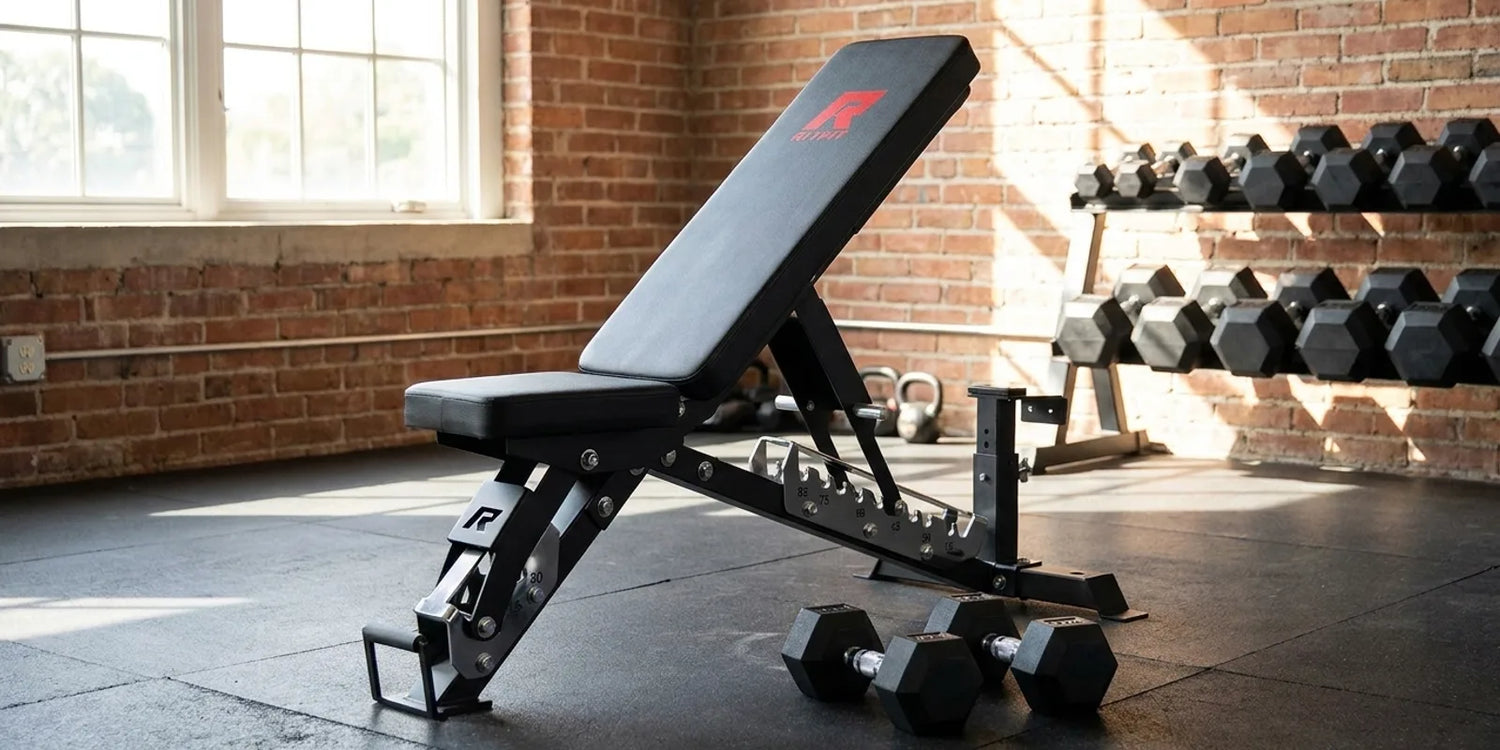
The best FID bench for home gym training is one that covers flat, incline, and decline pressing on a frame rated well above the loads you actually press, and the RitFit Gator 1600LB Adjustable Weight Bench is the reference model for that job in 2026.
This guide breaks down what makes a bench heavy-duty, how frame steel and weight capacity translate into a stable press, and which FID positions belong in your training.
Quick Answer: The best FID bench for home gym setups pairs a frame rated well above your working loads with true flat, incline, and decline positions. The RitFit Gator 1600LB Adjustable Weight Bench covers that range with a 14-gauge steel frame rated to 1,600 pounds, 21 adjustment combinations, a five-position headrest, and removable arm rollers.
Key Takeaways
- Heavy-duty frame: The RitFit Gator uses a 14-gauge reinforced steel frame rated to 1,600 pounds, the spec that separates a heavy-duty FID bench from a starter adjustable bench.
- True FID range: Flat, incline, and decline positions combine into 21 adjustment combinations, so one bench covers every pressing angle you train.
- Extra versatility: A five-position headrest and removable arm rollers add chest-supported rows, overhead work, and preacher curls to the same platform.
- Home gym footprint: At about 109 pounds with transport wheels and 51.3 inches of upright storage height, the Gator tucks against a wall between sessions.
- Warranty and value: RitFit covers the frame for three years and moving parts for one year, with free shipping and a 35-day return policy.
What Makes the Best FID Bench for a Home Gym?
Bench quality in this category comes down to frame steel, weight capacity, and whether the bench covers all three pressing angles. A heavy-duty FID bench uses a reinforced steel frame rated well above the loads a lifter actually presses, so the platform never becomes the weak link in a heavy set. A true FID bench then adds flat, incline, and decline positions so one bench handles every angle you train.
Training loads at or above roughly 60% of your one-rep max drive greater strength gains than lighter loads, which is why the bench under you has to handle real weight.[1]
- Frame steel: A 14-gauge reinforced steel frame resists flex and keeps the pad steady under a heavy bar.
- Weight capacity: A high rating leaves a safety margin so the bench does not become the limiting factor in a heavy press.
- True FID positions: Flat, incline, and decline angles let one bench train the upper, middle, and lower chest.
- Adjustment count: More locked positions let you match the angle to the muscle instead of settling for the nearest setting.
If you are still deciding between bench styles, a workout bench guide maps each type to the training it supports.
RitFit Gator 1600LB Review: What Do You Get for the Money?
The RitFit Gator 1600LB Adjustable Weight Bench is a full FID bench with a 1,600 pound rated 14-gauge steel frame, 21 adjustment combinations, and removable arm rollers. For its list price you get flat, incline, and decline pressing plus chest-supported rows and preacher curls from one platform.
The RitFit Gator 1600LB Adjustable Weight Bench separates itself from a basic flat bench through the number of positions it locks into. The backrest runs through 10 angles, the seat through three positions, and the frame adds three decline settings.
The adjustable headrest and arm rollers are the real differentiators. Fold the headrest down to clear room for overhead work, or raise it to support your chest on rows and rear-delt flies.
- Flat, incline, and decline: One bench covers full chest pressing at every angle.
- Five headrest positions: Support for chest-supported rows and overhead work.
- Removable arm rollers: A preacher curl and isolation station that attaches to the frame.
- 21 adjustment combinations: Ten backrest angles, three seat positions, and three decline settings.
If you want a routine that uses each angle, a bench workout guide walks through the flat, incline, and decline movements this bench supports.
"The gator bench is SOLID! Very sturdy and heavy. You will feel very safe on this bench with any heavy workouts. The wheels make it easy to scoot around the gym when needed. This is money well spent and much better than the basic ritfit bench. Good quality product for the price!"
Christopher O. Verified Buyer, RitFit GATOR 1600LB Adjustable Weight Bench
RitFit Gator Heavy-Duty Specs and Build Quality
Published specs put the Gator at a 14-gauge reinforced steel frame rated to 1,600 pounds, a 109.1 pound total weight, and a 57.8 by 25.2 by 14.6 inch footprint. Those numbers describe a bench that stays planted under heavy pressing rather than flexing with the load.
| Spec | Detail |
|---|---|
| Frame | 14-gauge reinforced steel |
| Weight capacity | 1,600 lb |
| Footprint | 57.8 x 25.2 x 14.6 in |
| Upright storage height | 51.3 in |
| Bench weight | 109.1 lb |
| Backrest angles | 10 positions (0-85 degrees) |
| Seat positions | 3 |
| Decline settings | 3 |
| Headrest positions | 5 |
| Arm rollers | Removable |
Specifications from the RitFit product page and the published Garage Gym Reviews RitFit Gator review.
The two numbers that matter most for a heavy presser are frame gauge and weight capacity. A 14-gauge frame with a 1,600 pound rating means the bar, the plates, and your body weight all sit inside the rated limit, so the bench does not twist or sink when you push a top set.
For a spare room gym, the storage numbers matter just as much. At 51.3 inches upright the bench rolls against a wall on its transport wheels, which keeps the floor clear between sessions.
Built with 14-gauge steel, the RitFit Gator Adjustable Weight Bench offers a robust weight capacity of 1,600 pounds. With 10 back pad angles, three seat pad positions, three decline settings, and a five-way adjustable head rest, you have ample options to support your strength and muscle building goals.
Stephen Sheehan, CPT, CNC, Certified Personal Trainer and Nutritionist, Garage Gym Reviews, RitFit Gator Adjustable Weight Bench Review (2026)
"The bench is awesome! Durable and easy to move. It arrived quickly also."
Verified Buyer, RitFit GATOR 1600LB Adjustable Weight Bench
How Do Flat, Incline, and Decline Angles Change Your Training?
Flat, incline, and decline positions shift the emphasis of the bench press across the chest and shoulders. An incline of roughly 30 degrees targets the upper chest, the flat position spreads work across the whole chest, and a decline angle emphasizes the lower chest.
An EMG comparison of five bench inclinations found that around 30 degrees emphasizes the upper clavicular pectoralis, while steeper angles shift more of the work toward the anterior deltoid.[2] That finding is the practical case for a FID bench, because you pick the angle that matches the muscle you want to train.
- Flat press: The position that lets you handle the most weight for overall chest strength.
- Incline press: Around 30 degrees to emphasize the upper chest without handing the work to the front delts.
- Decline press: A lower angle that shifts emphasis toward the lower chest.
- Seated and shoulder presses: Lock the backrest upright for overhead pressing and shoulder work.
Set the right form for each angle with a bench press form guide before you load the bar.
How Does the Gator Handle 1,600 Pounds Without Wobbling?
The Gator stays stable under heavy loads because its 14-gauge steel frame and 1,600 pound rating leave a wide margin above what you press. That margin matters most on top sets and near-maximal attempts, where any flex in the platform shows up as a shifting bar path.
Muscle activity in the pectoralis major, anterior deltoid, and triceps brachii rises as flat bench press intensity climbs from 70% to 100% of one-rep max.[3] Those are the sets where a bench earns its keep, because the closer you get to a max, the more you need the platform under you to stay still.
A 200 pound lifter pressing 315 pounds asks the bench to support a fraction of the 1,600 pound capacity. That gap is the safety margin, and it is the reason the pad stays level while you grind out a final rep.
Pair the Gator with a rack using this heavy duty Smith machine guide for a complete pressing setup.
"Heavy duty, this one stays pretty stationary, easy to move but it is heavy. Can handle all the weight you can."
Verified Buyer, RitFit GATOR 1600LB Adjustable Weight Bench
How Do the Adjustable Headrest and Arm Rollers Expand Your Workouts?
The five-position headrest and removable arm rollers turn the Gator from a pressing bench into an accessory station. The headrest supports chest-supported rows and rear-delt work, while the arm rollers create a preacher curl platform on the same frame.
Raise the headrest and you can lean your chest into it for supported rows, rear-delt flies, and single-arm dumbbell work. Fold it flat and it disappears, clearing the path for seated overhead presses and overhead triceps extensions.
The arm rollers attach to the frame to form a preacher curl pad. Load a dumbbell or a cable and you get biceps isolation that a flat bench cannot provide.
- Chest-supported rows: The raised headrest locks your torso in place so the back does the work.
- Preacher curls: The arm rollers isolate the biceps through a full range of motion.
- Overhead work: Fold the headrest down to clear the bar path.
- Single-leg and core work: The incline and decline settings support split squats and single-arm movements.
For more ways to use these positions, try bench shoulder exercises and bench workout routines.
FID Bench vs Flat Bench: Which One Fits Your Training?
A flat bench does one job, while a FID bench covers flat, incline, and decline pressing plus supported accessory work on a single frame. The right choice depends on how many pressing angles your program uses and how much floor space you can give up.
Compare the bench types by capability rather than by price alone. If your program never presses above flat and you already own a fixed bench, a FID bench adds range you may not use, while a lifter who rotates incline and decline work can replace two or three single-purpose pieces with one frame.
| Bench type | Positions | Training it covers |
|---|---|---|
| Flat bench | One angle | Flat bench press and basic accessory work |
| Incline-only adjustable | Flat and incline | Flat and incline pressing, with no decline setting |
| Full FID adjustable | Flat, incline, and decline | All three pressing angles plus supported rows and preacher curls |
Bench types compared by capability inside the RitFit lineup only.
Inside the RitFit line, the RitFit 1300lb Adjustable Weight Bench covers flat and incline pressing at a lighter build, the RitFit Gator 1600LB Adjustable Weight Bench is the full FID option, and the RitFit Gator Pink 1600lb bench uses the same frame in a pink colorway.
Browse the full range of RitFit adjustable weight benches if you want to compare them side by side. For layout-specific advice, these guides cover an adjustable bench for a garage gym, a bench for a basement gym, and a bench for heavier lifters.
"Super easy to put together, very sturdy when lifting, and fits me perfectly! I look forward to hitting my fitness goals using this bench!"
Verified Buyer, RitFit GATOR 1600LB Adjustable Weight Bench
Is the RitFit Gator Worth the Price, and What Is the Upgrade Path?
The Gator is worth its list price for a home gym owner who wants one bench to cover pressing, accessory work, and preacher curls. Its three year frame warranty and upright storage make it a long term platform rather than a temporary upgrade.
RitFit covers the frame for three years and moving parts for one year, and the bench ships free with a 35-day return policy. That combination lets you build the bench, press on it, and decide in your own space.
The value argument is straightforward. A separate preacher station and a second bench would take up more floor space and add another purchase to your setup.
The upgrade path is just as simple. Start with the bench, add a rack or a Smith machine next, and the Gator keeps working as your pressing and isolation bench instead of needing a replacement.
"Solid bench, fast delivery. In comparison to the other similar benches within this price bracket, this bench is great."
Verified Buyer, RitFit GATOR 1600LB Adjustable Weight Bench
FAQs About the Heavy Duty FID Bench
How much weight can the RitFit Gator bench hold?
The RitFit Gator Adjustable Weight Bench is rated to 1,600 pounds. Its 14-gauge reinforced steel frame supports heavy flat, incline, and decline pressing with a wide safety margin, so most lifters can press heavy without worrying about the bench flexing or tipping during a max effort set.
Is the RitFit Gator a true FID bench?
Yes. The Gator adjusts through flat, incline, and decline positions, with 10 backrest angles and three decline settings. That full range means you can move from a flat bench press to an incline press and a decline movement without switching benches, which is what makes a bench a true FID bench.
What are the RitFit Gator bench dimensions?
The bench measures 57.8 by 25.2 by 14.6 inches and weighs about 109 pounds. It stands 51.3 inches tall when stored upright, so it takes up a small footprint against a wall and fits neatly into a garage or home gym corner when not in use.
Does the RitFit Gator bench fold for storage?
Yes. The Gator stores upright to save floor space, and it has built-in transport wheels and a handle. That makes it easy to roll the bench out of the way or tuck it against a wall after a workout, even in a smaller garage or spare room gym.
Is the RitFit Gator bench good for incline press?
Yes. Its 10 backrest angles let you dial in roughly 30 degrees to emphasize the upper chest, which a study comparing bench inclinations identifies as an effective position for the clavicular pectoralis. Steeper settings shift more work toward the front delts instead.
What warranty comes with the RitFit Gator bench?
RitFit covers the frame for three years and moving parts for one year. The bench also ships free and comes with a 35-day return policy, so you have time to set it up and test it in your own space before committing.
What is the difference between a FID bench and a flat bench?
A flat bench only supports one pressing angle, while a FID bench adds incline and decline positions. That range lets one bench cover upper chest, mid chest, and lower chest work, plus seated and supported accessory movements, so you do not need to buy a second bench as your training changes.
Can a FID bench replace a preacher curl station?
On the RitFit Gator, the removable arm rollers attach to the frame and create a preacher curl platform for biceps isolation. That means you can train arms on the same bench you press on, which saves floor space and the cost of a separate preacher station.
Does a heavy duty FID bench work in a small home gym?
Yes. The RitFit Gator measures 57.8 by 25.2 by 14.6 inches and stands 51.3 inches tall when stored upright, so it rolls against a wall on its transport wheels. That footprint fits a spare room or apartment corner without giving up the 1,600 pound rated frame.
Conclusion
The RitFit Gator 1600LB Adjustable Weight Bench is built to be the best FID bench for a home gym, combining a 1,600 pound rated 14-gauge steel frame with flat, incline, and decline positions, a five-position headrest, and removable arm rollers.
Start with the bench, then add a rack as your program grows, and check the RitFit discount guide before you order.
Disclaimer
The information in this article is for general educational purposes only and is not a substitute for professional medical or training advice. Consult a qualified coach or healthcare provider before starting a new strength program or lifting near your maximum capacity.
References
1. Lopez P, Radaelli R, Taaffe DR, et al. Resistance Training Load Effects on Muscle Hypertrophy and Strength Gain: Systematic Review and Network Meta-analysis. Med Sci Sports Exerc. 2021;53(6):1206-1216. doi:10.1249/MSS.0000000000002585. PMCID: PMC8126497
2. Rodríguez-Ridao D, Antequera-Vique JA, Martín-Fuentes I, Muyor JM. Effect of Five Bench Inclinations on the Electromyographic Activity of the Pectoralis Major, Anterior Deltoid, and Triceps Brachii during the Bench Press Exercise. Int J Environ Res Public Health. 2020;17(19). doi:10.3390/ijerph17197339. PMCID: PMC7579505
3. Król H, Gołaś A. Effect of Barbell Weight on the Structure of the Flat Bench Press. J Strength Cond Res. 2017;31(5):1321-1337. doi:10.1519/JSC.0000000000001816. PMCID: PMC5400411
4. Sheehan S. RitFit Gator Adjustable Weight Bench Review. Garage Gym Reviews. 2026. garagegymreviews.com/ritfit-gator-adjustable-weight-bench-review





