








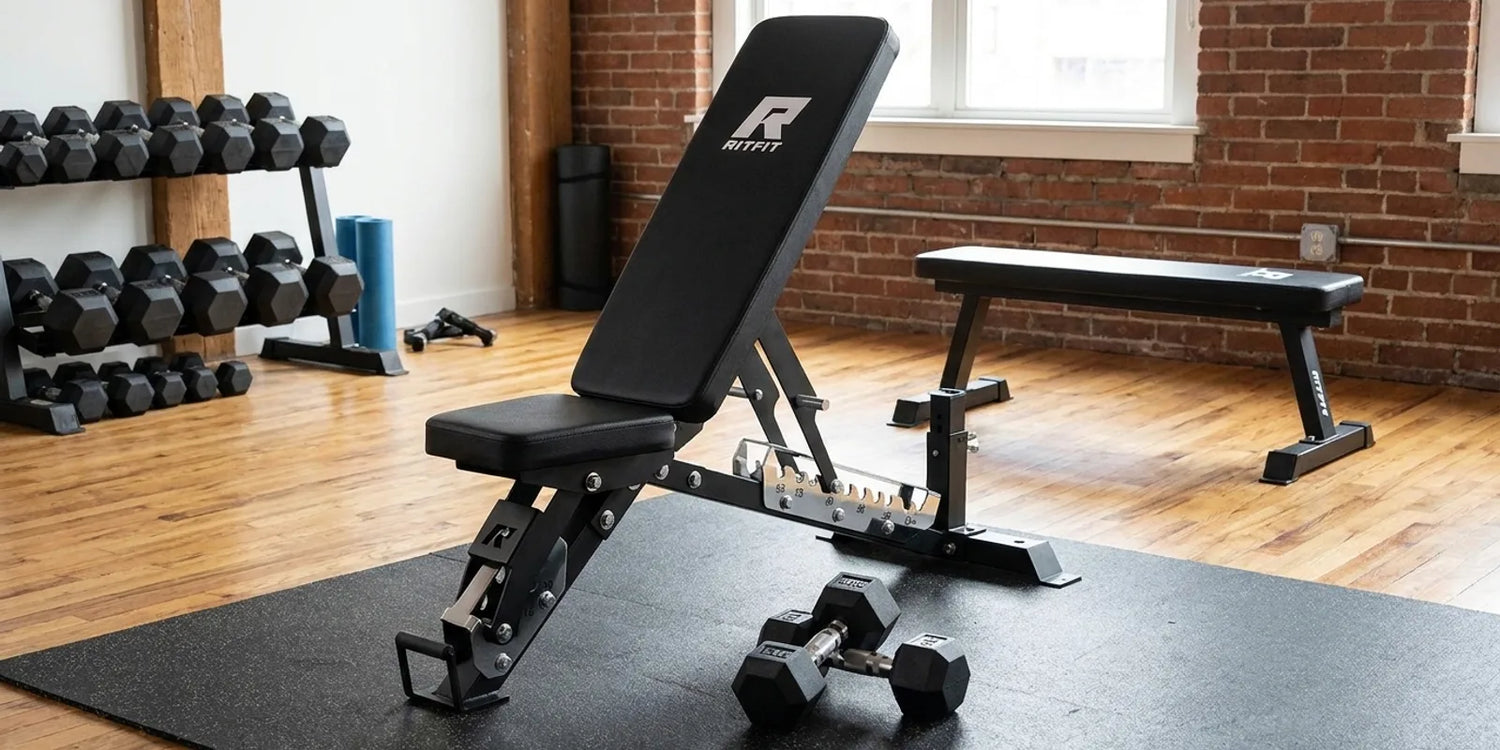
A workout bench is the most versatile piece you can add to a home gym, yet choosing the wrong one wastes money and floor space. This guide walks you through bench types, key specs, stability checks, and sizing.
It is written for home lifters comparing flat, adjustable, and FID benches. You will learn how to match a bench to your training goal, budget, and room.
Quick Answer
The best workout bench for most home gyms is an adjustable or FID bench, because it covers flat, incline, and decline work in one footprint. Choose a flat bench instead if your training is almost entirely heavy barbell pressing and stability is your top priority.
Key Takeaways
- Type drives the decision: Flat benches win on stability and price, while adjustable and FID benches win on exercise variety.
- Pad height matters: A pad around 17 to 17.5 inches lets most lifters plant their feet flat for solid leg drive.
- Stability is non-negotiable: A wobbly bench undermines heavy pressing and can compromise safety.
- Measure before buying: Confirm bench length, pad gap, and rack fit against your actual floor space.
- Buy for your goal: Match the bench to your training plan and budget, not just to a high weight rating.
| Brand | RitFit Sports |
|---|---|
| Featured Products | Browse the RitFit weight benches collection and the RitFit 1300LB Adjustable Weight Bench |
| Key Specs | Pad height around 17 to 17.5 in, flat footprint roughly 110 to 125 cm long, adjustable range 0 to 85 degrees, decline 10 to 30 degrees |
| Best For | Home lifters building a pressing and accessory setup in a garage, spare room, or apartment |
| Not Ideal For | Lifters with zero spare floor space who train only with bodyweight |
What Are the Main Workout Bench Types?
Workout benches come in three main types: flat, adjustable, and FID. A flat bench fixes at horizontal, an adjustable bench moves the backrest through incline angles, and an FID bench adds a decline position.
- Flat bench: A fixed horizontal pad with no moving parts, usually the most stable and affordable, ideal if most of your work is barbell bench press.
- Adjustable bench: A movable backrest that travels from flat to around 85 degrees upright, opening up incline pressing, shoulder work, and rows.
- FID bench: A flat, incline, and decline design that adds a negative angle around 10 to 30 degrees, covering the widest range of exercises in one unit.
For more on programming once you own a bench, see our bench workout guide and these best bench workout routines.
How Do You Choose the Right Bench for Your Training?
You choose a bench by matching it to your dominant lifts and your space, not to the highest weight rating. If most of your training is heavy barbell pressing, prioritize a stable flat bench, and if you want exercise variety, choose adjustable or FID.
RitFit Bench Decision Matrix
Use this matrix to map your priority to the right RitFit bench line before you buy.
| Your priority | Bench type | Why it fits |
|---|---|---|
| Heavy barbell pressing, small footprint | Flat bench | Best value and stability for one job, with the smallest footprint |
| Incline and shoulder variety | Adjustable bench | Multiple backrest angles justify the extra cost for varied training |
| Full exercise library including decline and abs | FID bench | Flat, incline, and decline cover the widest range in one unit |
| Shared home gym, frequent changes | Adjustable or FID | Quick angle changes and pad comfort suit multiple users |
For inspiration on what a versatile bench unlocks, browse our full-body workouts with a home bench.
Is It Worth the Price?
An adjustable or FID bench is usually worth the higher price because it replaces several single-purpose tools in one footprint. A flat bench costs less and stays rock solid, but it limits you to horizontal pressing as your training evolves.
- Versatility value: One adjustable bench supports presses, rows, hip thrusts, and core work, saving money on separate equipment.
- Stability value: A dedicated flat bench delivers a locked-in feel for maximal pressing at a lower price point.
What Are the Long-Term Upgrade Costs?
Long-term costs come from attachments and replacements, so plan for them up front. A bench with attachment ports for leg developers or preacher curl pads can grow with you without a full replacement.
Decline and core training often justify an FID purchase, as shown in our bench ab workouts and leg workouts at home with a bench.
Which Bench Specs Actually Matter?
The specs that actually matter are pad height, pad dimensions, weight capacity, and frame construction. These four determine comfort, stability, and how well the bench fits your body and your lifts.
How Important Are Pad Height and Dimensions?
Pad height and dimensions decide whether you can press with solid leg drive and a planted upper back. A pad height around 17 to 17.5 inches is widely seen as ideal for barbell bench pressing.
- Pad height: Around 17 to 17.5 inches lets most lifters keep feet flat, while taller pads leave shorter lifters reaching.
- Pad width: A wider pad keeps shoulder blades planted during pressing, improving stability.
- Pad gap: A large gap between seat and back pad is annoying for flat work, so look for a tight or minimal gap.
How Much Weight Capacity Do You Need?
You need a capacity that comfortably covers your bodyweight plus the heaviest load you plan to press, with a safety margin. Most home lifters are well served by a bench rated for at least 600 to 1000 pounds total.
Frame construction backs up that rating, so look for thick-gauge steel and a wide, stable base over marketing claims alone.
How Do You Test a Bench for Stability and Safety?
You test a bench for stability by loading it and moving on it the way you actually train, not by sitting still. A wobbly bench undermines heavy pressing, and research on bench press shows muscle activity and movement patterns differ between stable and unstable load conditions[1].
- Metal thickness and frame weight: Heavier frames usually mean more structural steel and a more confident feel under load.
- Adjustment system: If a backrest is awkward to set when empty, it will feel worse under fatigue between sets.
- Base width and anchoring: Wider bases resist tipping, and floor anchoring adds another level of security for heavy lifters.
- Dynamic test: Press, row, and shift your weight on the pad to feel for rock or sway before you commit.
A locked-in platform protects your joints and your barbell path, so treat stability as a safety feature rather than a luxury. You can pair a solid bench with bodyweight moves like our bench dips workout.
How Much Space Does a Workout Bench Need?
A workout bench needs its own footprint plus clear working room on every side for a barbell, dumbbells, and your arms. A flat bench typically sits around 110 to 125 cm long and 28 to 35 cm wide at the pad, while adjustable models add length and bulk.
- Measure the floor: Mark the bench footprint plus at least an arm span of clearance on each side before buying.
- Check rack fit: Confirm the bench slides inside or beside your power rack and lines up under the bar.
- Plan for storage: Folding or wheeled benches reclaim floor space in apartments and shared rooms.
If your bench will live next to a rack, the RitFit Gator Adjustable Weight Bench is a compact option, and you can expand routines with hamstring workouts with a home bench.
What Bench-Buying Mistakes Should You Avoid?
The most common bench-buying mistake is choosing by weight rating alone while ignoring stability, pad fit, and space. Buyers often overpay for a high capacity they never use and underestimate how the bench fits their room and rack.
- Ignoring pad height: A too-tall pad leaves shorter lifters reaching for the floor, weakening leg drive and stability.
- Overlooking the pad gap: A wide seat-to-back gap is uncomfortable for flat work and decline positions.
- Skipping the rack check: A bench that will not fit under your bar forces awkward setups and unsafe lifts.
- Buying spec sheets, not feel: A bench that feels shaky empty will feel worse loaded, so test before you trust the numbers.
Avoid these and most buyers land on the right bench the first time.
What Does the Evidence Say About Bench Angle?
The evidence suggests bench angle changes which muscles do the work, which is the main reason an adjustable bench is so useful. A study using EMG found that a 30 to 45 degree incline produces the greatest upper chest activation, while angles above roughly 56 degrees shift more work to the front shoulder[2].
Setup and range of motion also matter, as muscle excitation varies across different bench press ranges of motion[3]. That is why a bench that adjusts cleanly through angles helps you target different areas over time.
"Set your incline bench between 30 and 45 degrees. Most commercial gym benches have preset angles, use the second or third setting from flat, not the steepest option. If the incline feels entirely like a shoulder press, the bench angle is probably too high."
Brad Schoenfeld, PhD, Exercise Science Researcher, CUNY Lehman College
For most home lifters, a bench that locks securely at a moderate incline covers the bulk of pressing and shoulder needs.
FAQs About Workout Benches
What type of workout bench should a beginner buy?
For most beginners an adjustable or FID bench is the best first purchase because it covers flat, incline, and decline work in one piece of equipment. A flat bench is cheaper and more stable, but it limits you to horizontal pressing, so choose adjustable if you want exercise variety and room to grow over time.
What pad height is best for a bench press?
A pad height of around 17 to 17.5 inches is widely considered ideal for barbell bench pressing because it lets most lifters plant their feet flat for solid leg drive. Taller pads can leave shorter lifters reaching for the floor, which reduces stability and power during heavy pressing sets.
Is a flat bench or an adjustable bench more stable?
A flat bench is usually more stable because it has fewer moving parts and a simpler frame, which makes it a favorite for heavy, pressing-focused training. A quality adjustable bench can still feel rock solid if it uses thick-gauge steel, a wide base, and a tight adjustment mechanism, so build quality matters more than type.
How much weight capacity does a home workout bench need?
Add your bodyweight to the heaviest load you plan to press and leave a generous safety margin. Most home lifters are well served by a bench rated for at least 600 to 1000 pounds total, which comfortably covers bodyweight plus dumbbells or a loaded barbell with room to spare for future strength gains.
How much space does a workout bench take up?
A flat bench is roughly 110 to 125 cm long and 28 to 35 cm wide at the pad, while adjustable benches add some length and bulk. Leave clear space on each side and at the head for a barbell, dumbbells, and your arms, and measure how the bench fits inside or beside your power rack before buying.
Conclusion
Choosing the right workout bench comes down to matching type, specs, and stability to your training goal and space. Pick a flat bench for pressing-focused simplicity, or an adjustable or FID bench for exercise variety.
Measure your room, test for stability, then explore the RitFit Gator 1600LB Adjustable Bench to find the bench that fits your goals.
Disclaimer
This article is for general informational purposes only and does not replace personalized fitness or medical advice. Consult a qualified trainer or healthcare professional before starting a new training program or lifting heavy loads.
References
1. Demirtaş B, Cakir O, Cilli M, Isik O, Cetin O, Beyleroglu M. Investigation of bench press muscle activity and kinematic parameters under stable and unstable load conditions. BMC Sports Sci Med Rehabil. 2025;17(1):231. doi:10.1186/s13102-025-01280-6 https://pmc.ncbi.nlm.nih.gov/articles/PMC12335049/
2. Rodríguez-Ridao D, Antequera-Vique JA, Martín-Fuentes I, Muyor JM. Effect of Five Bench Inclinations on the Electromyographic Activity of the Pectoralis Major, Anterior Deltoid, and Triceps Brachii during the Bench Press Exercise. Int J Environ Res Public Health. 2020;17(19):7339. doi:10.3390/ijerph17197339 https://pmc.ncbi.nlm.nih.gov/articles/PMC7579505/
3. Fischer J, Burger C, Manieu Seguel JA, et al. Acute muscle excitation response across various bench press ranges of motion. Sci Rep. 2025;15(1):14105. doi:10.1038/s41598-025-98354-9 https://pmc.ncbi.nlm.nih.gov/articles/PMC12019332/





