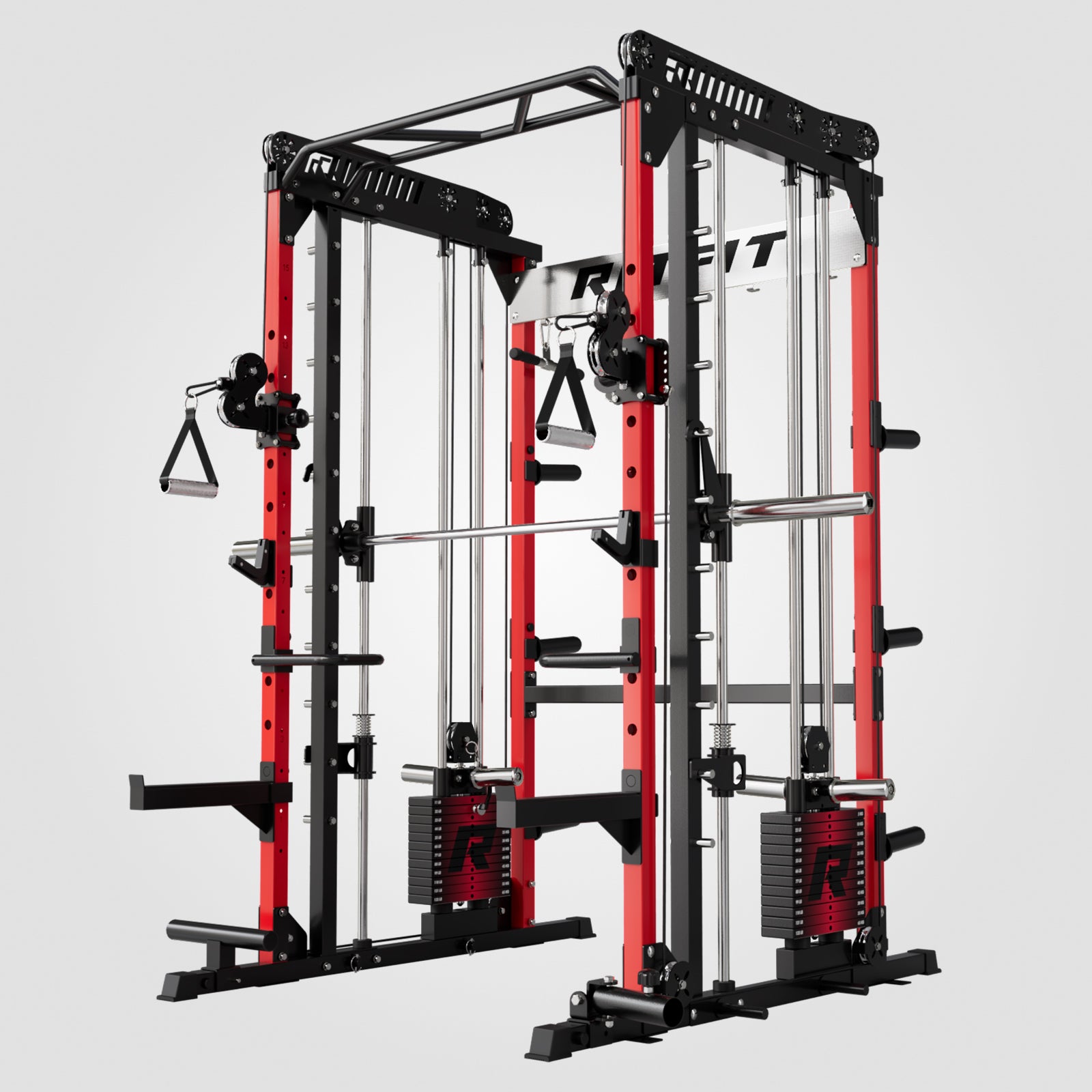
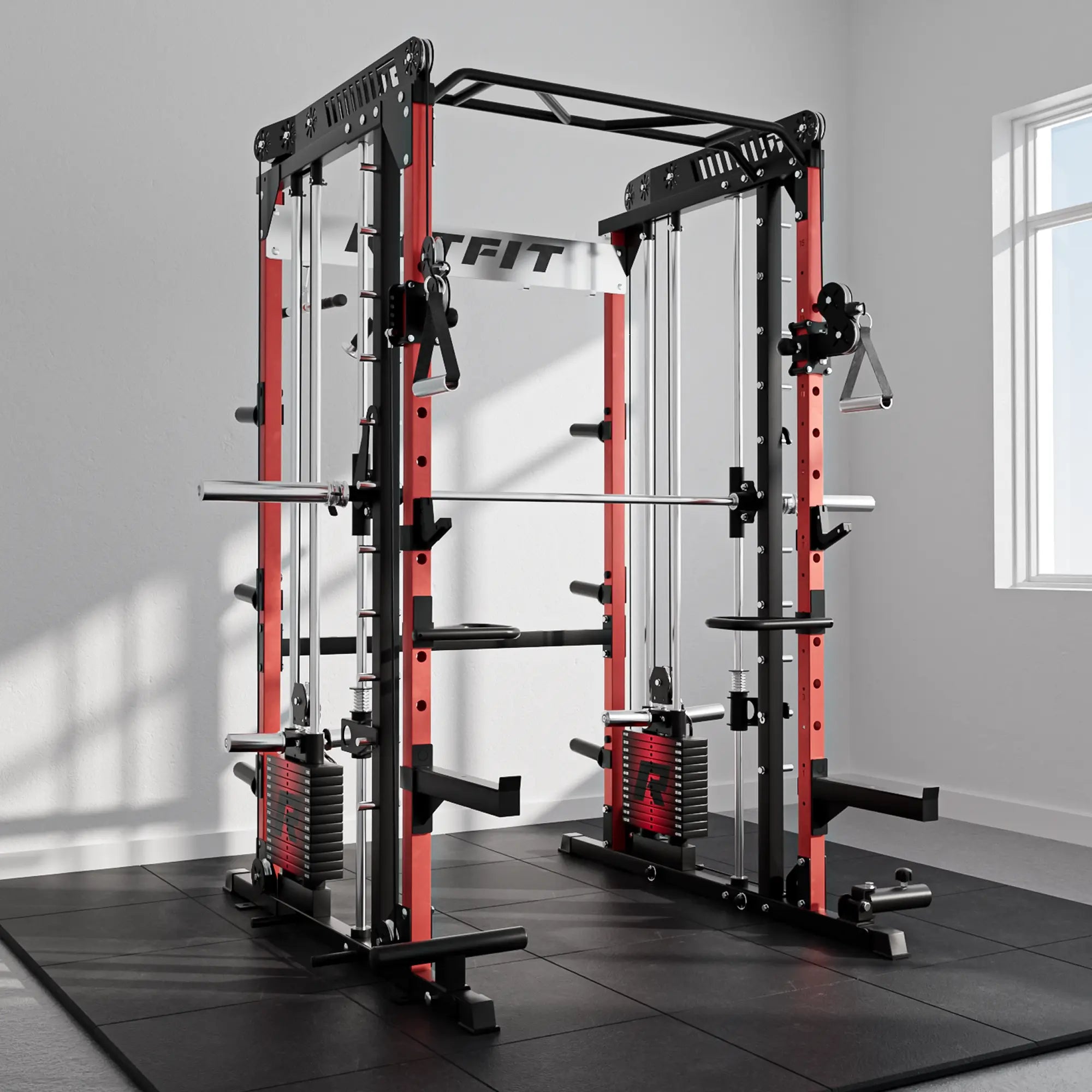

The RitFit BPC06 runs its dual cable system at a 1:1 pulley ratio, which means the number you pin on the stack is close to the load you pull at the handle. That single mechanical fact changes how you read the stack, how small your jumps can get, and how the cable moves through each rep.
This guide covers the mechanism and the practical fallout for owners: effective load, the 10 lb minimum jump, cable travel and speed, the 17 cable height positions, and the honest limits of a 1:1 cable station.
Quick Answer: A 1:1 pulley ratio on the RitFit BPC06 means the load at the cable handle is close to the stack weight you select, so a 100 lb pin setting pulls about 100 lb. It also sets a 10 lb minimum jump, since each plate weighs 10 lb, and it shortens cable travel compared with a 2:1 system.
Key Takeaways
- Pin equals load: At 1:1 the BPC06 cable delivers roughly the selected stack weight at the handle, so the printed number is your working load.
- Smallest step is 10 lb: The stack uses 10 lb plates, so 1:1 gives a 10 lb minimum jump, which is a large step for lateral raises and cable flyes.
- Travel is shorter: A 1:1 system moves the handle and the weight carriage at the same rate, so cable travel is shorter than on a 2:1 machine.
- 17 heights need deliberate use: The BPC06 trolley locks into 17 positions, and matching height to the exercise plane matters more when the load jumps are coarse.
- Not every set belongs here: Heavy pulldowns and rows suit 1:1, while very light isolation work is often easier on a machine with finer increments.
What 1:1 Means for the Load at the BPC06 Handle
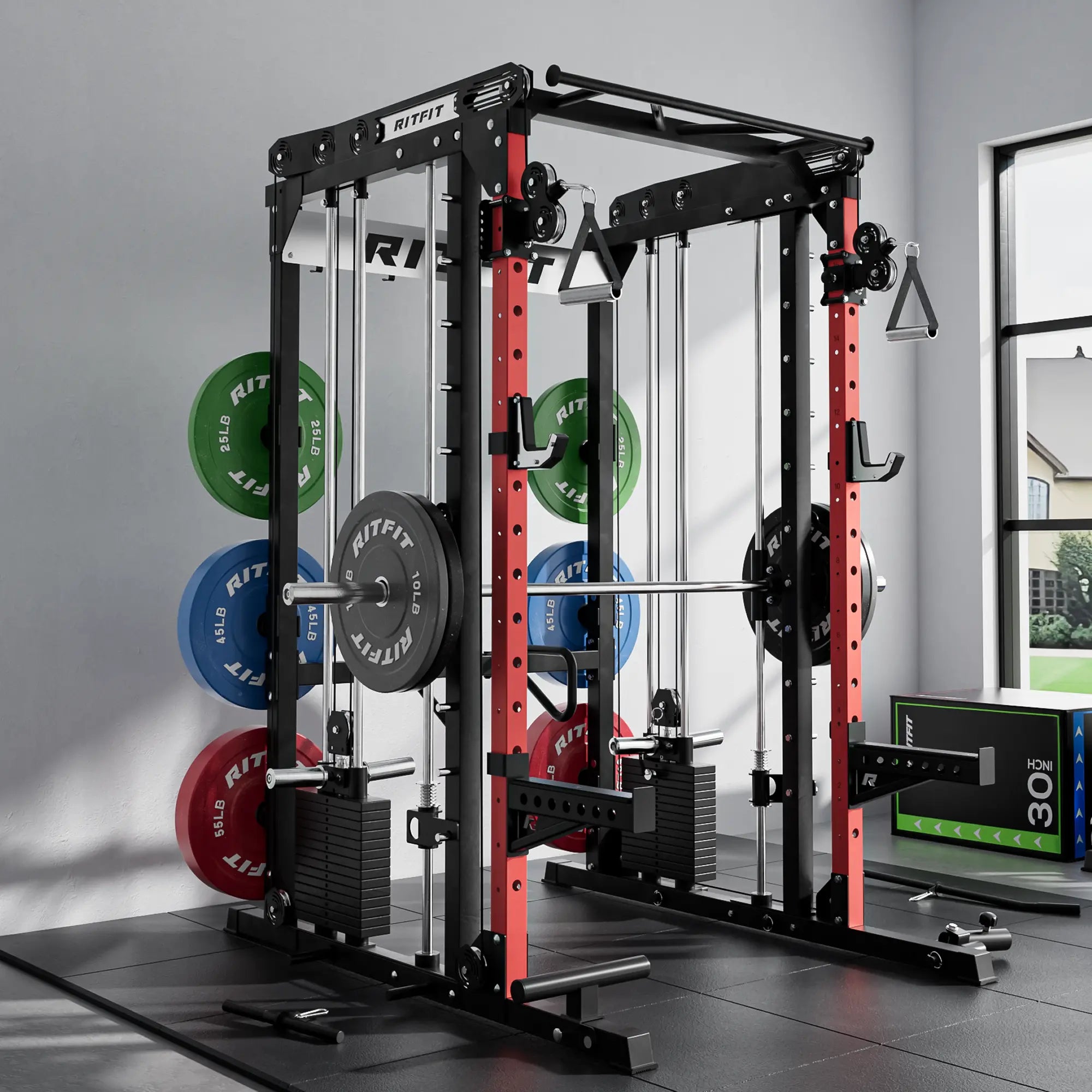
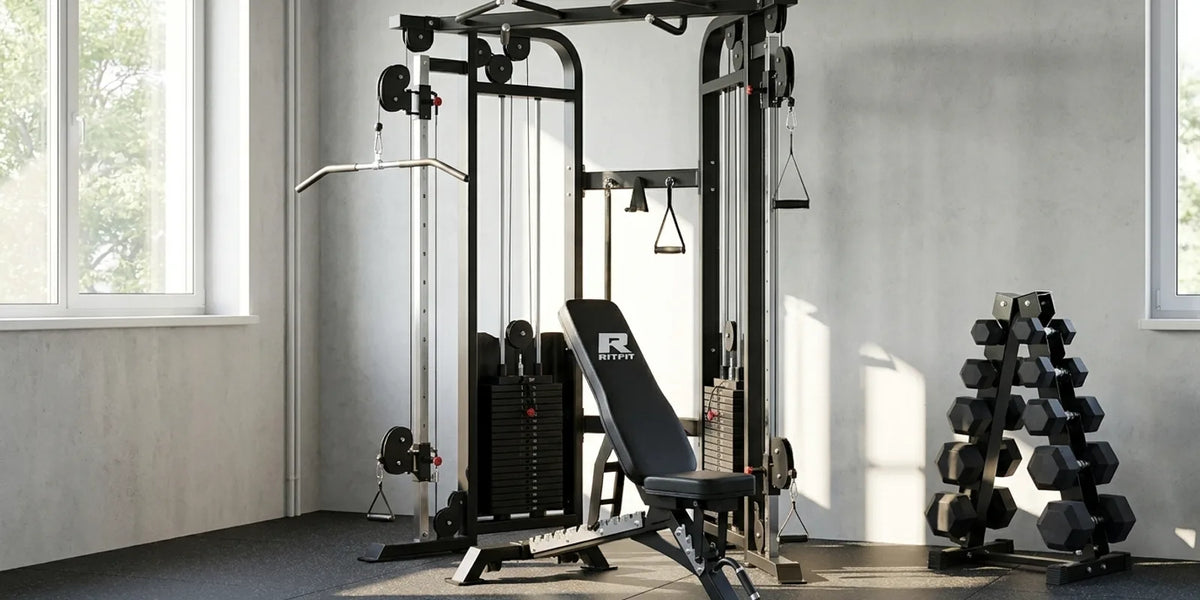
A 1:1 pulley ratio on the BPC06 puts roughly the selected stack weight at the handle. A 100 lb pin setting therefore pulls close to 100 lb rather than 50 lb, and RitFit lists the cable system with a stainless steel guide rail, all-aluminum pulleys, and a steel-core cable with a PU coating. The same spec sheet pairs it with a 260 lb stack split into two sides of 130 lb each, built from 10 lb plates.
A pulley ratio describes mechanical advantage, not build quality. When a cable runs over a single fixed pulley, the load does not change, so the handle sees the full plate weight.
Add a movable pulley that also carries part of the load and the handle sees roughly half of it. That is the whole difference between 1:1 and 2:1, and it is why stack numbers are not comparable across machines.
- Direct load reading: The pin number is close to your working load, so tracking progressive overload needs no conversion.
- Full use of a modest stack: A 130 lb side delivers close to 130 lb at the handle, so heavy lat pulldowns and rows need no stack upgrade.
- Honest friction note: Real machines sit slightly below the ideal number because of pulley friction, cable routing, and attachment weight.
The guided Smith bar on the same frame is a separate system, starting at 26.46 lb with 10 lockout positions, and its load never changes with the cable pin. Full machine details sit on the BPC06 general info and specs page, and the RitFit BPC06 all-in-one Smith machine with 260 lb weight stacks is currently listed at $2,699.99.
"So far love it. Only thing I could see being better is if it was 2:1 on the cables with a 1:1 center pulley. But for the price and what you get it's really hard to beat."
Brandon W. Verified Buyer, RitFit BPC06 All-In-One Smith Machine Home Gym Package
Why a 2:1 System Only Delivers Half of the Stack
A 2:1 cable system uses a movable pulley that shares the load, so the handle sees about half of the selected weight. A 100 lb pin setting pulls close to 50 lb at the handle, and the cable also travels about twice as far as the weight carriage.
Two cable segments support the load in that layout, and each segment carries part of the tension. Sharing the load across two segments halves the tension you feel at the handle while doubling the distance you have to pull.
| Feature | 1:1 pulley | 2:1 pulley |
|---|---|---|
| Handle load at 100 lb selected | About 100 lb | About 50 lb |
| 10 lb stack step at the handle | About 10 lb | About 5 lb |
| Cable travel | Matches carriage travel | About twice the carriage travel |
| Typical fit | Heavy pulldowns, rows, direct load tracking | Flyes, raises, fine progression |
Approximate values that ignore pulley friction, cable routing, and attachment weight.
One industry guide puts the split plainly: 2:1 halves the handle load and doubles the travel. The two ratios trade load for distance rather than making one system stronger.
The guide to what pulley ratio means on a cable machine covers the general principle in more depth, and the cable machine collection shows where each configuration sits in the RitFit line.
The 10 lb Minimum Jump on a 1:1 Stack
The smallest step on the BPC06 cable stack is 10 lb, because every plate weighs 10 lb and the 1:1 ratio passes that step straight to the handle. The same plate on a 2:1 machine would add only about 5 lb at the handle.
That difference sounds minor until you spend a training block on small muscles. Isolation work is where a coarse increment stops being a convenience and starts shaping your programming.
Which movements get hurt by a 10 lb step
Isolation movements with a short lever arm, such as lateral raises, rear delt flyes, and cable flyes, are where the coarse step bites hardest. One plate can be too light for a clean set, and the next plate too heavy for the same rep target.
Four ways to build a smaller effective jump
- Change the attachment lever: Swap a long bar for a single D handle or a rope, which brings the resistance closer to the joint.
- Change the exercise plane: A high crossover loads the same muscles with different leverage than a low pulley flye.
- Adjust position on the trolley: Moving the pulley a few positions changes the starting angle and the hardest point of the rep.
- Use a lighter loading option: Some owners strap a small ankle weight or magnetic plate to the stack to split the step, though that is a workaround rather than a manufacturer feature.
Heavy movements are the ones that gain from a coarse step. Lat pulldowns, seated rows, and cable belt squats want big plates, and a 10 lb jump at 1:1 gives those lifts a usable progression curve without any conversion math.
For the wider accessory picture, the cable machine handles page lists the grip options that change leverage most.
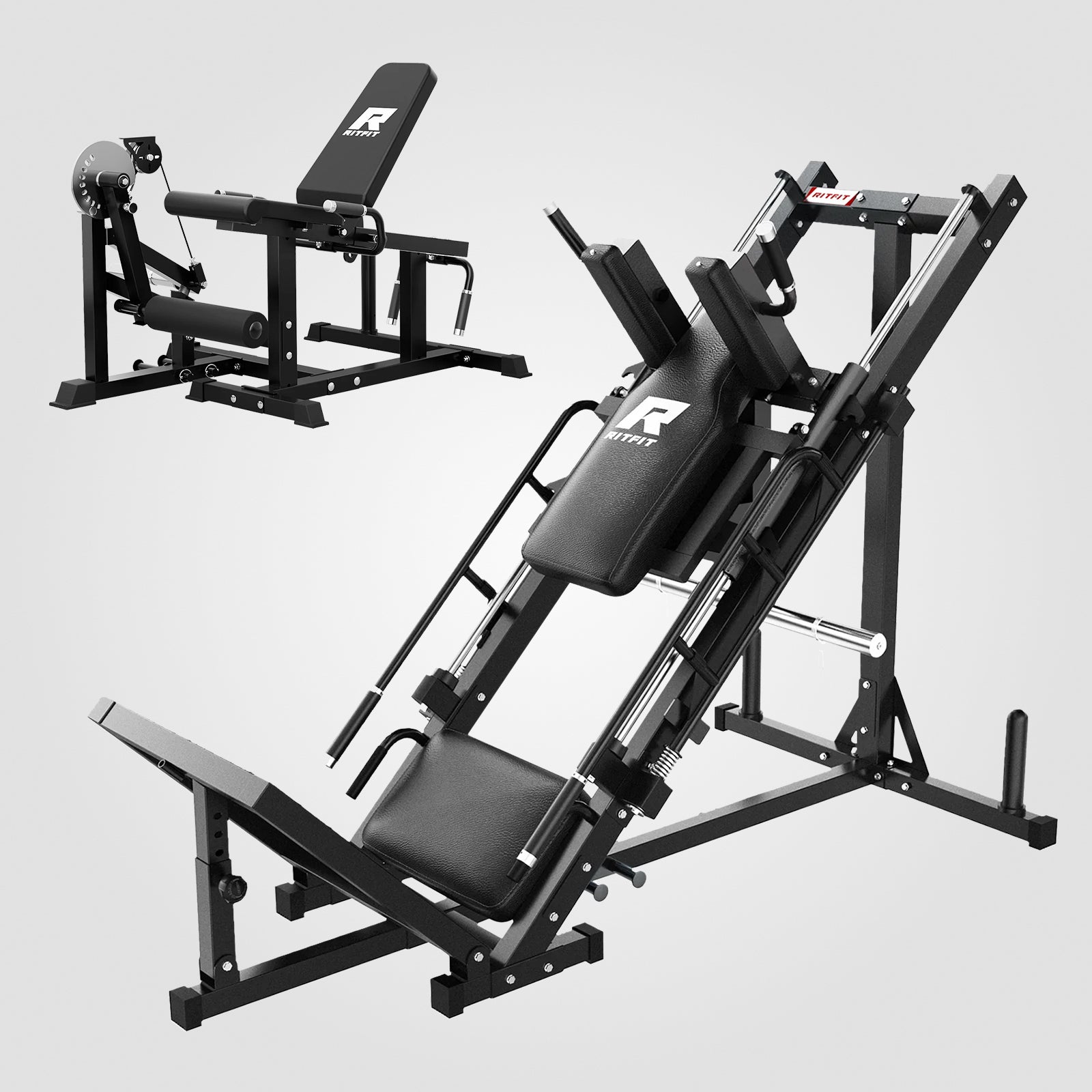
"We bought the BPC06 Package from RitFit in March 2026. I love this machine, I use it every day. First, it is built very well. It is sturdy, operates fantastically, and has nearly everything we need built into a single machine. The pulley system is 1:1, so a little to get used to as I lift the weight printed on the stack. In some cases, that took a minute to get used to (cable flies were a big one). The machine has a nice compact footprint, fit our space nice. I like the leg press attachment - that was a pretty novel way of adding in that exercise. The bench is very sturdy also, and we got the 200# stack of dumbbells with the package, which the entire family uses. The only thing I would recommend upgrading is the Jhooks if you purchase a separate barbell. The ones that it comes with have the leg cushions for stabilizing yourself when doing lat pulldowns and are not really usable for benching since those cushions get in the way. I'd love to see additional attachments for the BPC06 like they do for the M1 and M2, I'd definitely invest in making it a truly all-in-one machine. I definitely recommend though, really great machine."
Theodore N. RitFit BPC06 All-In-One Smith Machine with Weight Stacks
Cable Travel and Speed at 1:1 Versus 2:1
A 1:1 cable system pulls the handle and the weight carriage at the same rate, so cable travel matches stack travel across the whole range. A 2:1 system sends the cable about twice as far as the carriage, which buys a longer stroke at half the load.
The trade is distance against resistance, and it changes how a set feels more than how hard it is. At a given load, the muscle does the same work per rep.
The ratio also does not change the resistance curve inside a rep, because the load stays constant from stretch to lockout. Variable resistance is a different idea, where chains or bands add load as you move, and the research on it does not transfer to pulley ratios.
A 2022 systematic review and meta-analysis of 14 studies found variable-resistance training produced greater maximum-strength gains than constant-resistance training overall, with the advantage in trained lifters appearing at loads of 80% of 1RM and above.[1]
If an exercise needs a long stroke, such as a full-range cable crossover or a high-to-low chop, the shorter 1:1 pull can run out of travel before the set does. That is a fit question rather than a strength question, and it is one of the limits covered next.
How to Match the 17 Cable Heights to Your Exercises
The BPC06 trolley locks into 17 cable height positions, and the right one keeps the cable roughly in line with the joint you are moving. Aligning the pull that way keeps tension on the target muscle instead of turning the movement into a downward press.
Start from the position that matches the exercise plane, then adjust one step at a time until the cable runs straight at the start of the rep.
- Above head: Lat pulldowns, high crossovers, and rope pullovers.
- Chest to shoulder: Cable flyes, face pulls, and standing chest press.
- Hip to waist: Seated rows and cable curls.
- Knee and below: Low-to-high chops, cable belt squats, and low pulley curls.
Common mistakes when setting cable height
- Setting the pulley far above the working joint: This tips the early range into a downward pull and shifts work away from the target.
- Picking a height out of habit: Two exercises can share a height and still need a different angle to feel right.
- Skipping the recheck after moving the trolley: Confirm the cable sits centered on the pulley before loading the set.
Height is also the cheapest way to change difficulty on a coarse stack. Moving the trolley one or two positions shifts the hardest point of the rep, which gives you a second lever beside the 10 lb plate.
"Exercises such as preacher curls and concentration curls (where the upper arm is positioned in front of the torso) work more in the short head, as do exercises such as cross cable curls on a high pulley apparatus."
Brad Schoenfeld, PhD, Exercise Science Researcher specializing in Muscle Hypertrophy, CUNY Lehman College, The Science of Biceps Training
When a Set Is Better Off Without the Cable Station
Cable work is not the best tool for every set on the BPC06. Very heavy bilateral pulls and low-rep maximal work are usually better on the Smith bar or a barbell, and eccentric-focused work runs into equipment limits.
The cable station is strongest for smooth, continuous tension and for angles a straight bar cannot reach. It is weakest when you want a very heavy load on a short, fixed path.
A 2023 review in Sports Medicine notes that delivering eccentric resistance exercise has been challenging because of equipment limitations, which is part of why adaptive machines were developed.[2]
Loading profile also matters less than consistency. A 2020 trial in untrained young women compared chain-loaded variable resistance with constant resistance over 8 weeks and reported comparable strength gains, with no differences between the groups.[3]
Use the cable station where the angle and the tension profile help the exercise, and move the set when they do not. That keeps the RitFit BPC06 home gym package in its lane as one tool inside a setup rather than the whole setup.
How to Verify Your Cable Ratio and Tension
You can confirm the cable ratio on your machine without tools by comparing how far the handle travels against how far the top plate travels. Equal travel means 1:1, while a handle that moves about twice as far as the plate means 2:1.
Run the checks below once the machine is assembled, then again after any long storage or move.
- Count the plates: The stack carries 26 plates at 10 lb each, 13 per side, for 260 lb total, so a mismatched count means the stack was assembled wrong.
- Watch the travel: Mark the handle start and end points on the frame, then repeat with the top plate, because equal distances confirm 1:1.
- Check the pulleys: RitFit lists all-aluminum pulleys, so a magnet should not stick to the pulley body and the sheave should spin without gritty noise.
- Inspect the cable: Run a hand along the PU coated, steel-core cable looking for fraying, flat spots, or an exposed core.
Stop using the cable station and contact RitFit support if the sheath is cut, the core is visible, a pulley wobbles, or the cable jumps the sheave under load. Do not keep loading a damaged cable while you wait for a replacement.
For the full inspection routine, the cable pulley setup and maintenance checklist walks through the same steps. If pulley material is your next question, the plastic versus aluminum pulleys comparison explains what the pulley body has to do under load.
FAQs About the BPC06 1:1 Pulley Ratio
Does the pulley ratio change the weight of the BPC06 Smith bar?
No. The 1:1 pulley ratio describes the dual cable system only. The Smith bar runs on stainless steel guide rails with its own 26.46 lb starting weight and 10 lockout positions. Cable ratio and Smith bar load are independent systems, so pin position never changes how the guided bar feels.
What is the smallest weight jump on the BPC06 cable stack?
Ten pounds. Each plate on the BPC06 stack weighs 10 lb, and the 1:1 ratio delivers that full increment at the handle. Cable flyes, lateral raises, and curl warm-ups that move in 2.5 or 5 lb steps elsewhere will feel coarse here, so plan your progressions around a 10 lb step.
Can you reroute the BPC06 cable to change its ratio?
No. RitFit does not publish an approved rerouting for the BPC06, and changing the cable path can alter travel, capacity, and warranty coverage. If a 1:1 system does not suit an exercise, use a different tool for that set instead of modifying the machine.
Why does 100 lb on a 2:1 machine feel easier than 100 lb on the BPC06?
A 2:1 system halves the resistance at the handle, so a 100 lb pin setting delivers roughly 50 lb. The BPC06 uses a 1:1 ratio, so the same 100 lb setting delivers close to 100 lb. Stack numbers only compare directly when both machines share the same ratio.
Which cable attachments fit the BPC06 pulley system?
The BPC06 cable attachment mount uses a 0.5 inch hole, and the plate sleeves accept 2 inch plates. Most standard lat pulldown bars, rope handles, and single D handles fit that mount. Confirm the attachment pin size before buying, because 1 inch rack attachments will not seat in a 0.5 inch cable hole.
Is a 1:1 pulley ratio harder to control for beginners?
It can feel heavier, not harder to control. Beginners often pull a stack number they recognize from a 2:1 machine and get double the resistance on the BPC06. Start two or three plates below your old setting, hold a two second return on every rep, and add 10 lb only when the final rep stays clean.
Conclusion
The BPC06 cable system is 1:1, so the pin number is your working load, the smallest jump is 10 lb, and the cable travel is shorter than on a 2:1 machine. Treat those three facts as the operating rules for every cable session.
Read the ratio as a tool description rather than a ranking, because heavy pulldowns suit it while light isolation work needs a workaround. Buyers comparing machines should start with the best 1:1 cable ratio Smith machine guide, and anyone tracking price can open the RitFit discount guide.
Disclaimer
This article explains cable machine mechanics and general training considerations for the RitFit BPC06, and it is not medical, physical therapy, or injury advice. Stop training and consult a qualified professional if you feel pain, dizziness, or joint discomfort during any cable exercise.
References
1. Lin Y, Xu Y, Hong F, Li J, Ye W, Korivi M. Effects of Variable-Resistance Training Versus Constant-Resistance Training on Maximum Strength: A Systematic Review and Meta-Analysis. Int J Environ Res Public Health. 2022;19(14). doi:10.3390/ijerph19148559. PMCID: PMC9317775
2. Nuzzo JL, Pinto MD, Nosaka K. Connective Adaptive Resistance Exercise (CARE) Machines for Accentuated Eccentric and Eccentric-Only Exercise: Introduction to an Emerging Concept. Sports Med. 2023;53(7):1287-1300. doi:10.1007/s40279-023-01842-z. PMCID: PMC10127187
3. Arazi H, Salek L, Nikfal E, et al. Comparable endocrine and neuromuscular adaptations to variable vs. constant gravity-dependent resistance training among young women. J Transl Med. 2020;18(1):239. doi:10.1186/s12967-020-02411-y. PMCID: PMC7296723