








Smith machine drag curls are a biceps curl variation where the bar slides up your torso while your elbows travel backward, and the fixed bar path makes that backward elbow motion easier to repeat. The movement shifts emphasis toward the biceps long head, the part of the muscle that shapes the peak of your upper arm.
This guide covers the setup, the grip, the load to choose, and the errors that turn a drag curl back into an ordinary curl. It assumes a Smith machine or all-in-one trainer and no history of elbow or wrist pain.
Quick Answer: Smith machine drag curls work when you keep the bar in contact with your torso and pull your elbows behind you instead of letting them stay at your sides. Set the bar near mid thigh, use a shoulder width palms up grip, and pick a load you can control with the elbows traveling back on every rep.
Key Takeaways
- Definition: A drag curl is a biceps curl where the bar drags up your torso and the elbows travel backward, which holds tension on the biceps long head.
- Machine fit: A Smith machine fixes the bar path, so the bar stays against your torso without the balance work a free barbell asks for.
- Grip: Trained lifters produced more biceps excitation with a palms up grip than with a pronated or neutral grip during curls.
- Main error: Once the elbows drift in front of your torso, the drag curl becomes a standard curl and the long head emphasis fades.
- Dosage: Start lighter than a barbell curl, keep sets around 3, and stop 1 to 3 reps short of failure so the bar keeps contact.
What Is a Drag Curl and How Does It Differ From a Standard Curl?
A drag curl is a biceps curl in which the bar stays in contact with your torso while your elbows travel backward instead of at your sides. That backward elbow path places the upper arm behind the body, which keeps the biceps long head loaded across the range of motion.
The Elbow Path Is the Whole Exercise
In a standard curl the elbows stay under the shoulders and the shoulders flex as the bar rises, so the upper arm travels forward while the forearm bends. In a drag curl the shoulders stay extended and the elbows sweep back, so the bar has to climb the body rather than swing out in front of it.
- Shorter moment arm: Keeping the bar close to your torso reduces the leverage your shoulders can add, so the biceps do more of the lifting.
- Long head position: The long head crosses the shoulder joint, so a slightly extended shoulder position is what separates a drag curl from a preacher curl.
- Contact as feedback: If the bar leaves your torso, you have lost the drag and the rep has turned into a standard curl.
A study of 22 subjects curling a load equal to 40 percent of their isometric maximum found that the incline dumbbell curl, which also places the upper arm behind the body, reached close to 95 percent of maximum biceps activation across the whole elbow range.[1] The preacher curl, which positions the upper arm in front of the body, reached high activation over only a short range of elbow angle.
"Exercises such as preacher curls and concentration curls (where the upper arm is positioned in front of the torso) work more in the short head, as do exercises such as cross cable curls on a high pulley apparatus."
Brad Schoenfeld, PhD, Exercise Science Researcher, CUNY Lehman College, The Science of Biceps Training
If your goal is the opposite side of the muscle, the short head responds to the arm-forward positions listed in this guide to short head biceps exercises.
How to Do Drag Curls on a Smith Machine Step by Step
Set the bar near mid thigh, stand close to the uprights, and drag the bar up your body while your elbows travel backward. Keep your torso still, pause near chest height, and lower the bar along the same path.
Setting the Bar Height and Your Stance
Start with the bar near mid thigh and the J hooks set so you can rack it without shrugging. Stand with your feet about shoulder width apart and your body close to the uprights, because the closer you stand, the shorter the distance the bar can drift away from your torso.
- Step 1: Set the bar height. Park the bar around mid thigh and lock the hooks so the start position puts your elbows just below your ribs.
- Step 2: Take your grip. Use a shoulder width grip with your palms facing up and your wrists neutral rather than curled back.
- Step 3: Brace and drag. Keep your torso upright, then pull the bar up your body by driving the elbows backward instead of thinking about lifting the bar.
- Step 4: Stop at chest height. One guide suggests stopping when the bar reaches nipple height or slightly below, which is where the elbows have traveled as far back as they can go.
- Step 5: Lower under control. Take about the same time to lower the bar as you took to lift it, and keep it touching your torso the whole way down.
Grip matters more than most lifters expect, so a palms up grip is the default choice for a drag curl. A study of 10 competitive bodybuilders curling 6 rep sets at their 8-RM found that biceps excitation during the lifting phase was 19 percent higher with a supinated grip than with a pronated grip and 12 percent higher than with a neutral grip.[2]
Once the straight bar version feels repeatable, compare it with the cable path described in this guide to cable bicep curls on a Smith machine.
Smith Machine Drag Curls vs Free Weight Curls: What Actually Changes
A Smith machine changes the balance demand, not the muscle. The bar travels on a fixed track, so you spend less effort keeping it level and more attention on pulling the elbows backward, while free weights ask your shoulders and wrists to stabilize every rep.
| Factor | Smith machine drag curl | Free weight drag curl |
|---|---|---|
| Bar path | Fixed by the track, so the bar stays close to the torso | You steer the bar, so contact depends on your control |
| Balance demand | Low, which helps beginners learn the elbow path | Higher, because wrists and shoulders stabilize |
| Grip options | Straight bar only unless your machine takes attachments | Straight bar, EZ bar, or a specialty bar |
| Rack and bail out | Hooks and safety stops catch the bar at any point | You need a rack and a plan for a failed rep |
| Best for | Learning the drag path and training close to failure | Training free-weight stabilization with the same path |
Comparison based on how each tool constrains the bar path, not on measured muscle activation.
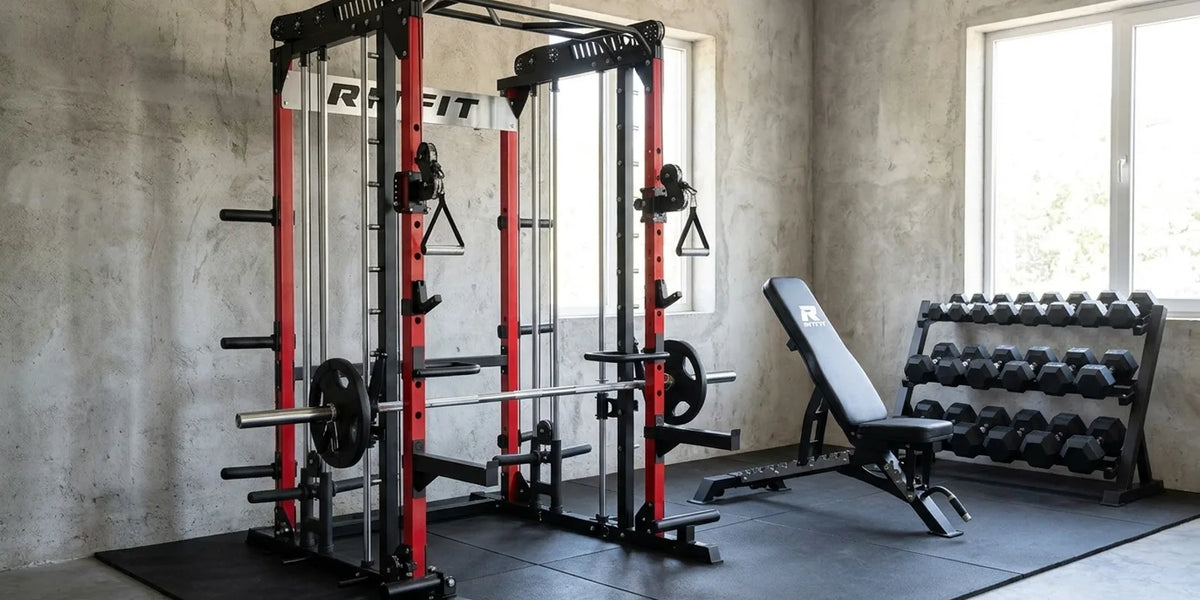
The fixed path is also why so many home lifters start here: a machine from the Smith machine lineup covers pressing, pulling, and arm work on one frame, and the RitFit M1 Smith Machine is the compact entry point for a garage or basement.
Does the RitFit BUFFALO Smith Machine Work for Drag Curls?
Yes, the RitFit BUFFALO Smith Machine works for drag curls because it pairs an adjustable bar on a fixed track with rack hooks you can set at mid thigh. Instead of reaching for a separate barbell and rack, you set the height and drag.
The same frame covers both versions of the movement, because the straight bar handles the drag curl and the lat pull down and cable crossover let you run a rope or handle drag curl without changing machines. That matters on arm day, when switching stations costs more time than the sets themselves.
If you are comparing within the RitFit line, the choice comes down to your space and your goals. The RitFit BUFFALO Multifunctional Smith Machine pairs the Smith track with a cable system so one frame supports curls, rows, and presses.
The RitFit M3 Power Rack Cable Crossover Smith Machine suits a lifter who wants a heavier duty frame, while the RitFit BPC06 All in One Smith Machine package adds weight stacks for a complete home setup.
"The build quality of the RitFit BUFFALO is exceptional. The robust steel construction feels incredibly sturdy and secure, providing the confidence needed for intense workouts. The attention to detail in its design and finish is evident, rivaling the best commercial gym equipment I've ever used."
Tyrone C. Verified Buyer, RitFit BUFFALO Multifunctional Smith Machine with Lat Pull Down and Cable Crossover for Versatile Strength Training
How Much Weight Should You Use for Drag Curls?
Use less weight than you would for a standard barbell curl, because the elbows back position removes some of the leverage your shoulders normally add. One published guide recommends about 3 sets of 4 to 6 or 6 to 8 reps for biceps size and strength, ending each set 1 to 3 reps short of failure.
Pick a load that lets the bar stay glued to your torso for every rep on both the way up and the way down. If the bar breaks contact, if your elbows creep forward, or if your hips start swinging, the weight is heavier than your drag curl can currently handle.
- Start conservative: Begin with a load you could curl for a few extra reps and add weight only after the path stays clean.
- Control the lowering phase: Aim for roughly the same time down as up, which is about one or two seconds in each direction.
- Count contact, not reps: Three clean reps with constant contact beat eight sloppy ones that turn into standard curls.
If you train at home and want a cable version on the same frame, an all-in-one machine can keep the straight bar and the cable path in one footprint. That saves you a second station on arm day and leaves more floor space free.
The Most Common Drag Curl Mistakes to Avoid
The mistakes that cost you results are the ones that quietly remove the drag. The exercise stops being a drag curl the moment the elbows move in front of your torso, so fix the path first and the load second.
Mistake 1: Letting the Elbows Drift Forward
Elbows that drift forward turn the drag curl into a traditional curl, which is not a disaster but does mute the long head emphasis that made you pick the variation. Lower the weight and think about pulling your elbows behind you rather than lifting the bar toward your shoulders.
- Using too much weight: If you cannot keep the bar on your torso, the extra plates are buying momentum instead of muscle.
- Letting the bar drift away: The bar should slide up your body, not float out in front of it, so keep it in contact from start to finish.
- Using momentum: Keep your torso, hips, and knees still, because a hip thrust turns a biceps exercise into a lower back exercise.
- Rushing the lowering phase: One guide notes that controlling the eccentric portion is where a large share of the growth stimulus comes from, so do not drop the bar back to the start.
If you want a wider menu of curl variations to rotate through, these Smith machine biceps exercises cover the other angles of the same machine.
Drag Curl Alternatives and Variations for Bigger Arms
Every good drag curl alternative keeps the upper arm behind the torso while changing the implement, the stability demand, or the resistance curve. Swap variations when your elbows or wrists feel beaten up but you still want to train the same position.
Bar choice changes the stimulus as well as the feel. A 2023 study comparing a straight barbell with an EZ bar during bilateral biceps curls reported distinct biceps brachii and anterior deltoid excitation between the two bar types, so the bar you pick is a real training variable rather than a comfort preference.[3]
| Variation | How it differs | Best for |
|---|---|---|
| Smith machine drag curl | Fixed bar path, constant torso contact | Learning the drag path and training close to failure |
| Dumbbell drag curl | Each arm works alone, so imbalances show up | Fixing a strength difference between sides |
| Cable drag curl | Constant tension through the whole rep | Keeping load on the biceps at the bottom of the rep |
| Bayesian cable curl | Trains the biceps in a stretched position behind the body | Long head work when a straight bar feels awkward |
| Incline dumbbell curl | Arms hang behind the torso with a free weight | Adding shoulder stability work to the same position |
| Preacher curl | Places the upper arm in front of the body | Short head and a strict elbow path |
Variation comparison based on arm position and resistance profile, not on measured muscle activation.
If you want to test the curved bar option on your arm day, these exercises with EZ curl bars cover how the angled grip changes wrist and elbow comfort.
How Often Should You Train Drag Curls?
Two sessions per week is plenty for most lifters, placed after your heavier pulling work so your biceps are not already fatigued when you need the cleanest possible path. Drag curls are a finisher, not a main lift.
Progression follows the reps, not your mood. One guide recommends adding about 10 lb when you reach the top of your rep range, and dropping about 5 lb if you can only manage 3 or fewer reps with the heavier weight, which keeps you inside the range that builds size and strength.
- Keep it short: About 3 working sets is enough volume when the movement is this focused on one position.
- Stop short of failure: Finish each set 1 to 3 reps before you would fail, because the last sloppy rep is usually the one that breaks contact.
- Track the path: Write down the weight and the reps, and add load only when the bar stayed on your torso for every rep.
When Should You Stop a Set of Drag Curls?
Stop the set the moment the bar loses contact with your torso or your elbows drift forward, because past that point you are training a different exercise with extra fatigue. End the set, rest, and drop the weight for the next one.
Stop the exercise entirely if you feel sharp pain rather than muscle fatigue. Discomfort in the front of the elbow, the wrist, or the shoulder that shows up early in a set is a signal to back off the load and the range of motion, not a signal to push through, and pain that persists deserves a professional opinion.
- Muscle burn: Normal, and a reasonable place to finish a set if your form is still holding.
- Joint pinch or sharp pain: Stop immediately, reduce the load, and reduce how far the elbows travel behind you.
- Numbness or tingling: Stop the movement and speak with a healthcare professional before returning to curls.
FAQs About Drag Curls on a Smith Machine
How do drag curls differ from regular bicep curls?
Drag curls keep the bar against your torso while your elbows travel backward, so your shoulders stay extended instead of flexing forward. A regular curl lets the elbows stay at your sides and the shoulders flex as the bar rises. That difference shifts where the biceps work hardest through the range of motion.
Can you do drag curls on a Smith machine?
Yes. A Smith machine fixes the bar path, so the bar stays against your torso as you pull your elbows back, which makes the drag curl easier to learn. Set the bar near mid thigh, stand close to the uprights, and let the fixed track handle the balance so you can focus on the elbow path.
How much weight should you use for drag curls?
Start lighter than you would for a standard barbell curl, because the elbows back position removes some of your usual leverage. One published guide recommends about 3 sets of 4 to 6 or 6 to 8 reps. Choose a load that lets the bar stay in contact with your torso for every rep.
Why do my elbows drift forward during drag curls?
Elbows drift forward when the weight is too heavy or when you rush the rep. Once the elbows travel in front of your torso, the movement becomes a standard curl and the long head emphasis fades. Lower the load and think about pulling your elbows behind you rather than lifting the bar.
Are drag curls good for the long head of the biceps?
Yes. The long head crosses the shoulder joint, so putting your upper arms behind your body keeps it under tension. Drag curls do exactly that, because the elbows travel backward while the bar drags up your torso. One guide notes this arms behind position is what makes drag curls a long head focused variation.
What grip should you use for Smith machine drag curls?
Use a shoulder width, palms up grip. A study of trained bodybuilders found biceps excitation during the lifting phase was 19 percent higher with a supinated grip than with a pronated grip and 12 percent higher than with a neutral grip, so the palms up position keeps the biceps doing most of the work.
How often should you train drag curls?
Two sessions per week is plenty for most lifters, since the biceps recover quickly but still need time between hard sessions. Add drag curls after your heavier pulling work, keep them to about 3 sets, and stop each set 1 to 3 reps short of failure so your form holds.
Conclusion
Drag curls are a positioning exercise, so the elbow path and the bar contact matter more than the number on the pin. A Smith machine gives you a fixed track that keeps the bar against your torso, which makes the backward elbow path repeatable rep after rep.
Set the bar near mid thigh, take a palms up grip, keep your sets around 3, and stop the moment contact breaks. Pick the frame that fits your space, then plan your next arm session around the drag curl instead of another standard set.
Disclaimer
This article is general fitness information and not medical advice, and results with any curl variation vary with training history, technique, and recovery. If you have elbow, wrist, or shoulder pain or a previous injury, consult a qualified healthcare or fitness professional before adding drag curls to your program.
References
1. Oliveira LF, Matta TT, Alves DS, Garcia MA, Vieira TM. Effect of the shoulder position on the biceps brachii emg in different dumbbell curls. J Sports Sci Med. 2009;8(1):24-9. PMCID: PMC3737788
2. Coratella G, Tornatore G, Longo S, et al. Biceps Brachii and Brachioradialis Excitation in Biceps Curl Exercise: Different Handgrips, Different Synergy. Sports (Basel). 2023;11(3). doi:10.3390/sports11030064. PMCID: PMC10054060
3. Coratella G, Tornatore G, Longo S, Esposito F, Ce E. Bilateral Biceps Curl Shows Distinct Biceps Brachii and Anterior Deltoid Excitation Comparing Straight vs. EZ Barbell Coupled with Arms Flexion/No-Flexion. J Funct Morphol Kinesiol. 2023;8(1). doi:10.3390/jfmk8010013. PMCID: PMC9944112





