








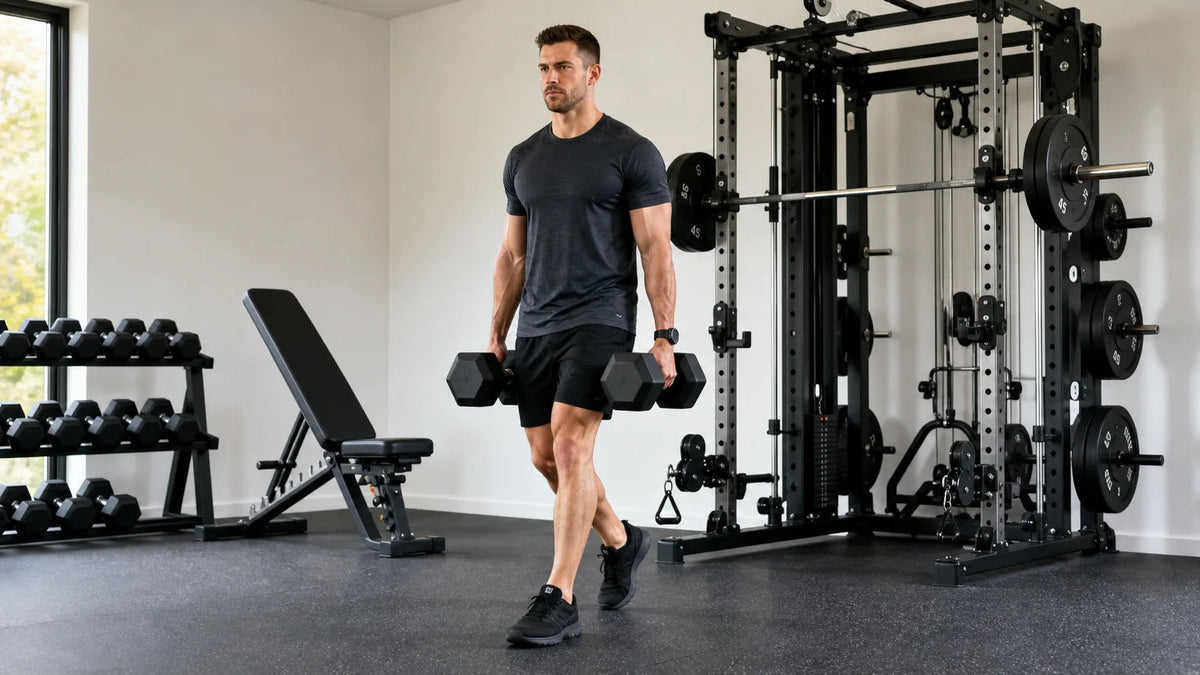
Choosing the right dumbbells for farmers carry can make the difference between a productive training session and a frustrating one. The wrong weight or dumbbell type will break your form within 20 yards, leaving your grip, core, and shoulders undertrained.
This guide covers everything you need to pick the correct dumbbell weight by your bodyweight and experience level, execute proper technique from the pickup to the set-down, and program farmers carry into your workouts for grip strength, core stability, and full-body conditioning.
Quick Answer: Dumbbells are the most accessible tool for farmers carry, and beginners should start with around 25% of their bodyweight per hand using hex rubber dumbbells, which stay stable on the floor between sets. Aim for 3-4 sets of 20-40 meters and build load gradually as your posture and grip improve.
Key Takeaways
- Start light: Beginners typically start with around 25% of bodyweight per hand, building to 50% or more as grip and posture improve.
- Hex dumbbells win: Flat-sided hex or decagon dumbbells are safer for farmers carry because they stay put on the floor between sets, unlike round heads.
- Form over distance: Upright posture, braced core, and a firm grip matter more than how far or fast you walk during every set.
- Program with purpose: Use 20-40 meter sets at heavy load for strength, or 40-60 second timed sets at moderate weight for conditioning.
- Versatile and scalable: Farmers carry with dumbbells builds grip strength, core stability, upper back endurance, and cardiovascular capacity with a single simple movement.
Why Are Dumbbells the Best Starting Tool for Farmers Carry?
Dumbbells are the ideal starting implement for farmers carry because they are available in virtually every gym and home training setup, require no special handles, and allow precise weight increments that make progressive overload manageable from your very first session.
- Availability: Most lifters already own a set, eliminating the need for dedicated farmers carry handles or specialty equipment.
- Fine weight progression: Dumbbell racks typically run in 2-5 lb increments, allowing you to increase load precisely as grip quality improves, rather than making large jumps.
- Bilateral symmetry: Holding equal weight in both hands trains a balanced, upright carry pattern that is ideal for beginners learning the movement.
- Lower technical barrier: The load sits at hip height without requiring any racking or positioning, making the setup simpler than kettlebells or specialty bars.
- HYROX-specific benefit: For competitive athletes, the dumbbell's grip geometry closely replicates HYROX race handles, making dumbbell training the most specific preparation tool available.
Which Dumbbell Type Works Best: Hex, Round, or Adjustable?
Rubber hex dumbbells are the top choice for farmers carry because their six flat sides prevent the dumbbell from rolling when you set it down, reducing the risk of a weight shifting unexpectedly during pickup under fatigue.
- Hex rubber dumbbells: Stable on the floor, excellent grip texture, and durable rubber coating protects floors and reduces noise. The RitFit Hex Rubber Dumbbells are a reliable option with a knurled handle and fully coated head.
- Decagon (10-sided) dumbbells: The ToughFit decagon-shape dumbbells offer similar floor stability with a rounder profile that feels comfortable against the thigh during the walk.
- Round head dumbbells: Effective for the carry itself, but they can roll on the floor, adding an unnecessary hazard during the setup and set-down phases.
- Adjustable dumbbells: Adjustable dumbbells are excellent for progressive overload in small steps, but always confirm the locking collar is fully secured before picking them up for a carry set.
How Much Weight Should You Use for Dumbbell Farmers Carry?
Dumbbell farmers carry weight selection depends on your bodyweight, training experience, and the goal of the session. Use the percentage-of-bodyweight framework below as your starting point, then adjust based on whether you maintain perfect posture for the full carry distance.
| Body Weight | Beginner (around 25% per hand) | Intermediate (around 50% per hand) | Advanced (around 100% per hand) |
|---|---|---|---|
| 130 lb | 30-35 lb per hand | 60-65 lb per hand | 130 lb per hand |
| 150 lb | 35-40 lb per hand | 70-75 lb per hand | 150 lb per hand |
| 170 lb | 40-45 lb per hand | 80-85 lb per hand | 170 lb per hand |
| 200 lb | 50 lb per hand | 100 lb per hand | 200 lb per hand |
Farmers Carry Starting Load by Bodyweight and Experience Level
These are illustration ranges, not statistical averages. One training resource recommends starting at around 25% of bodyweight per hand and working toward 50% (intermediate) or full bodyweight per hand (advanced) as grip and postural endurance develop.
The Posture Test: How Do You Know If the Weight Is Right?
The best weight is the heaviest load you can carry while keeping your chest up, shoulders back and down, core braced, and eyes forward for the entire set distance. If any of those four checkpoints break down before you finish the distance, the weight is too heavy.
- Shoulders rounding forward: A clear sign the load is beyond your current capacity. Reduce weight before proceeding.
- Lateral trunk lean: If your torso tilts toward one side, your core is failing to brace. Drop 5-10 lb and reset.
- Grip slipping: Chalk or wrist straps can help, but grip failure also signals that you have exceeded your current grip strength ceiling. If you consistently lose grip before posture breaks, targeted grip work and a moderate weight reduction will address it.
- Short shuffle steps: Very short steps often indicate the weight is too heavy to manage comfortably. Aim for controlled, natural strides with only a slight reduction from your normal walking stride length.
- Add weight when: You can complete 3 consecutive sets at your target distance with no posture breaks, no grip adjustments, and no deceleration in the final third of the set.
If you are new to loaded carries, one guide recommends starting with around 10-15 lb per hand and 10-20 yards to build endurance before increasing load. The hexagon dumbbell sets available from RitFit give you a full range of weights to work through as you progress.
How Do You Perform Dumbbell Farmers Carry with Correct Technique?
Correct dumbbell farmers carry technique starts with a safe pickup, continues with an upright and controlled walk, and ends with a deliberate set-down that protects your lower back and prevents the dumbbells from rolling.
Step 1: The Setup and Pickup
Place two dumbbells on the floor alongside your feet, parallel to your legs. Hinge at your hips, bend your knees slightly, and grip each handle firmly with a neutral grip (palms facing your thighs).
- Foot position: Stand with feet about hip-width apart, one dumbbell on each side.
- Grip: Wrap all four fingers and thumb firmly around the handle before you initiate the lift.
- Lift like a deadlift: Drive through your heels, extend hips and knees simultaneously, and keep your back flat throughout the pickup. Do not round your lower back to reach the handles.
- Top position: Once standing, arms should hang straight at your sides, shoulders pulled back and down, chest tall. Take one breath and brace your core before taking the first step.
Step 2: The Walk
Walk forward with short, controlled steps at an even pace, keeping your gaze straight ahead and your torso as upright as if you were balancing something on top of your head.
- Step length: Slightly shorter than your natural stride. Overly long steps shift your center of mass and cause lateral sway.
- Arm position: Dumbbells stay close to your sides and should not swing forward or backward as you walk.
- Breathing: Take short controlled breaths without fully releasing core tension. Do not hold your breath for the entire set.
- Turnaround: Slow down before the turn, come to a stop, pivot your whole body, then resume walking. Do not twist at the waist while the dumbbells are loaded.
Watch this video from CrossFit for a clear visual demonstration of proper dumbbell farmers carry form:
Step 3: Setting Down Safely
At the end of each set, do not drop the dumbbells. Slow your pace, brace your core, hinge at your hips, and lower the dumbbells with control to the floor, keeping a flat back throughout.
- Why it matters: The set-down phase is when back injuries most often occur because fatigue is highest and attention drops.
- Floor placement: Use hex or decagon dumbbells from the RitFit dumbbells collection to ensure the weights stay in place after you set them down, ready for your next set.
What Muscles Does Farmers Carry Work and What Are the Key Benefits?
The dumbbell farmers carry is a full-body compound movement that activates muscles across the grip, forearms, shoulders, upper back, core, glutes, quads, hamstrings, and calves simultaneously, making it one of the most efficient exercises available for functional strength and conditioning.
- Grip and forearms: Your finger flexors and forearms are under sustained high-tension output for the entire set. This produces the kind of functional grip durability that transfers directly to deadlifts, rows, and real-world activities like carrying groceries or luggage.
- Trapezius and upper back: Your traps and rhomboids work under sustained tension to hold your shoulder girdle in a packed, stable position throughout the walk, training them in a way that rows and shrugs alone cannot fully replicate.
- Core (anti-lateral flexion): Your abs and obliques brace constantly to resist the load pulling you sideways, building what is sometimes called anti-lateral flexion strength. This type of core stability is highly relevant to real-world function and athletic performance.
- Glutes, quads, hamstrings, and calves: The legs drive each step under a weighted load, training lower body muscular endurance and hip extensor stability in a way that static exercises cannot match.
- Cardiovascular endurance: Carrying heavy dumbbells for 30-60 seconds elevates heart rate significantly, making farmers carry a practical conditioning tool for home gym setups where dedicated cardio equipment may not be available.
A 2019 systematic review in Sports Medicine Open found that loaded carries are high-intensity full-body exercises with documented applications for both athletic performance and general conditioning.[1] A 2024 study published in the International Journal of Exercise Science measured muscle activation during loaded carry movement patterns, confirming broad recruitment across trunk and lower body muscles.[2]
"One of the two things that I would recommend just about everyone do is some sort of loaded carry. One of the main things so many older adults complain about is getting groceries out of their car and into their house, and I think that loaded carries are going to directly transfer to that."
Greg Nuckols, MA, Strength Researcher and Coach, Stronger By Science
How Should You Program Farmers Carry for Strength and Conditioning?
Dumbbell farmers carry programming depends on whether your primary goal is building strength and grip capacity or developing conditioning and work capacity. The two goals call for different loading and distance strategies.
For Strength: Short Distance, Heavy Load
Strength-focused farmers carry uses heavier dumbbells for shorter distances, with sufficient rest between sets to allow near-full recovery before the next effort.
- Sets and distance: 3-4 sets of 20-40 meters with a challenging load. One training resource recommends this range for lifters prioritizing grip strength and postural endurance development.
- Rest: 90 seconds to 2 minutes between sets.
- Load target: Heavy enough that your grip is challenged within the set, but not so heavy that posture fails immediately.
- Overload ceiling: Working to 110-120% of your target distance weight at reduced distances (20-30 meters) raises your force capacity ceiling so that your standard weight feels manageable on most training days.
- Placement in session: Program strength carries as a main accessory movement after your primary strength work, not as a warm-up where grip fatigue would affect your compound lifts.
For Conditioning: Longer Sets, Moderate Weight
Conditioning-focused carries use moderate weight for longer timed sets, keeping heart rate elevated and training muscular endurance alongside cardiovascular capacity.
- Sets and duration: 3-4 sets of 40-60 seconds with a moderate load and 60 seconds rest between sets.
- Load target: A weight you can maintain for the full duration without posture breakdown. One training resource notes that carries at roughly 70-75% of 1RM show only mild soreness and minimal performance decreases in the days following the session.
- Placement in session: Use as a conditioning finisher at the end of a strength session, after your main lifts. Farmers carry as a finisher taxes your grip without compromising the primary movements earlier in the workout.
- Frequency: 2-3 sessions per week for general fitness, with at least one rest day between sessions to allow grip and lower back recovery.
Store your dumbbell set on a dumbbell storage rack to keep multiple weight options accessible for quick set-up between sets.
What Are the Most Common Farmers Carry Mistakes to Avoid?
Common farmers carry mistakes almost always trace back to using too much weight, walking too fast, or neglecting posture cues. Correcting these early will keep your joints safe and maximize the training benefit of every set.
- Choosing weight that is too heavy: If your shoulders round forward, your trunk tilts sideways, or your grip fails within 10 meters, the weight is too heavy. Start lighter and build over weeks rather than sessions.
- Rushing the carry: Walking too fast forces momentum to do the work that your muscles should be doing. Keep a steady, controlled pace to maintain time under tension.
- Letting the dumbbells drift forward: Dumbbells should hang at your sides, close to your thighs. If they drift in front of your body, your shoulder internal rotators are overworking and your posture has already broken.
- Shrugging the shoulders: Your shoulder blades should be pulled back and down, not elevated toward your ears. Constant shrugging leads to trap strain and reduces the stability benefit of the carry.
- Dropping the dumbbells at the end of the set: Always set down with control. Fatigue is highest at the end of the carry, which is exactly when a careless set-down risks injury.
- Skipping the core brace: Your abs and obliques should be lightly braced for the entire duration. Letting the core relax mid-set transfers excessive load to the lower back and removes most of the anti-lateral flexion benefit.
- Not using chalk or appropriate grip support: If your hands are sweating or grip is limiting your set well before your core and legs tire, chalk is a legitimate and effective tool for farmers carry. The dumbbells and rack package pairs well with a chalk bowl nearby for heavy carry training at home.
Which Farmers Carry Variations Should You Try Next?
Once bilateral dumbbell farmers carry feels stable and progressive, these variations add new demands to keep your training challenging and address specific weaknesses.
Single-Arm (Suitcase) Carry
The suitcase carry holds one dumbbell in a single hand, dramatically increasing the anti-lateral flexion demand on your core because the load now pulls you sideways with no counterbalance. A 2021 study in the Journal of Applied Biomechanics found that walking with unilateral weight significantly increases hip and trunk muscle activity compared to unloaded walking.[3]
- How to do it: Hold one dumbbell at your side and walk the same distance as your bilateral set. Switch hands at the halfway point or on the next set.
- Best for: Lifters with lateral core asymmetries, anyone training for real-world one-handed carries, and those who want an advanced core challenge without adding bilateral load.
- Dumbbell choice: Use the same PVC coated dumbbells or hex rubber options as for bilateral carries, but start slightly lighter on each hand until your core adapts to the single-sided demand.
Front Rack Carry
The front rack carry holds the dumbbells at shoulder height, shifting demand to your upper back, core breathing muscles, and shoulder stability. This variation is more technical and should only be attempted once bilateral farmers carry is well established.
- Breathing challenge: The front rack position compresses your thoracic cavity slightly, making breathing harder and training your respiratory muscles alongside your postural muscles.
- Upper back emphasis: Your traps, rhomboids, and rear deltoids work much harder to hold the racked position than in the standard carry. This pairs well with back exercises such as those covered in the best back exercises with dumbbells guide.
For a complete range of dumbbell options to support these carry variations and progressive loading, see the best entry-level dumbbells for beginners guide to find the right starting set.
When Should You Stop or Scale Back During Farmers Carry?
Farmers carry is a low-injury-risk exercise when performed with appropriate weight and correct technique, but there are clear signals that tell you to stop a set, reduce the load, or skip the movement for a session.
- Sharp pain in your lower back, wrists, or shoulders: Stop the set immediately. Dull fatigue in your grip or upper traps is normal. Sharp, localized pain is not.
- Grip fails before 50% of your target distance: This is a clear indicator that the weight is above your current grip capacity. Set down safely and reduce load by 10-20% for the remaining sets.
- Trunk swaying uncontrollably: If your body sways side to side with each step and you cannot correct it with a conscious cue, the weight is too heavy for your current core endurance. Finish the set safely, then reduce load.
- Following a heavy lower back session: If your erectors and lower back are already fatigued from deadlifts or barbell rows, either skip heavy farmers carry or reduce the load significantly to avoid cumulative fatigue that increases injury risk.
- Any existing wrist or shoulder injury: Consult with a healthcare provider before loading the farmers carry pattern if you have an existing diagnosis. The neutral grip is generally less aggravating than pronated or supinated positions, but individual tolerance varies.
The dumbbell exercises guide covers additional upper body movements that can complement your carry training when you need to reduce direct grip load on a given training day.
FAQs About Dumbbells for Farmers Carry
What weight dumbbells should I use for farmers carry?
A practical starting point is around 25% of your bodyweight per hand. For a 150 lb person, that means roughly 35-40 lb dumbbells. Once you can walk 20-30 meters with solid posture and a firm grip, add 5 lb and repeat the process. Intermediate lifters often work up to 50% of bodyweight per hand over time.
Are hex dumbbells better than round dumbbells for farmers carry?
Yes. Hex dumbbells are generally preferred for farmers carry because their flat sides prevent rolling when you set them down between sets, making the exercise safer and easier to manage. Round dumbbells can shift unexpectedly on the floor, which adds a small but unnecessary risk when picking them up under fatigue.
How far should you walk during a farmers carry?
Beginners typically start with 10-20 yards and build from there. For strength-focused training, 20-40 meters per set with heavier weight works well. If you are training for conditioning or endurance, you can extend sets to 40-60 seconds of continuous walking. Always prioritize upright posture over distance during every set.
How often should you do farmers carry in your workout routine?
Most training programs recommend 2-3 farmers carry sessions per week for general fitness, added as a finisher to your main strength session. Because the exercise taxes your grip, core, and lower back, give yourself at least one rest day between sessions. Start with 2-3 sets and build to 4 sets as your endurance improves.
Can you do farmers carry with adjustable dumbbells?
Yes, adjustable dumbbells work well for farmers carry and offer a significant advantage. You can make small weight increases of 2.5-5 lb rather than jumping between fixed dumbbell increments, making progressive overload more precise. Just ensure the locking mechanism is fully secured before picking up the weight, and avoid dropping adjustable dumbbells during the set-down.
Conclusion
Dumbbell farmers carry is one of the most efficient exercises for building grip strength, core stability, and upper back endurance with minimal equipment.
Start with around 25% of your bodyweight per hand, use hex dumbbells for safe floor placement, and add load only when your posture holds clean. Commit to progressive overload and you will see the carry's benefits transfer across every lift.
Disclaimer
The information in this article is intended for general educational purposes and does not constitute medical or professional fitness advice. Consult a qualified healthcare provider or certified strength coach before beginning any new exercise program, especially if you have existing injuries or health conditions.
Save on your next RitFit order
Tap the button to copy your code, then paste it at checkout.
References
1. Hindle BR, Lorimer A, Winwood P, Keogh JWL. The Biomechanics and Applications of Strongman Exercises: a Systematic Review. Sports Med Open. 2019;5(1):49. doi:10.1186/s40798-019-0222-z
2. Ellestad SH, Holcomb TP, Swiergol AM, Holmstrup ME, Dicus JR. The Quantification of Muscle Activation During the Loaded Carry Movement Pattern. Int J Exerc Sci. 2024;17(1):480-490. doi:10.70252/NWUE9985
3. Graber KA, Loverro KL, Baldwin M, Nelson-Wong E, Tanor J, Lewis CL. Hip and Trunk Muscle Activity and Mechanics During Walking With and Without Unilateral Weight. J Appl Biomech. 2021;37(4):351-358. doi:10.1123/jab.2020-0273





