








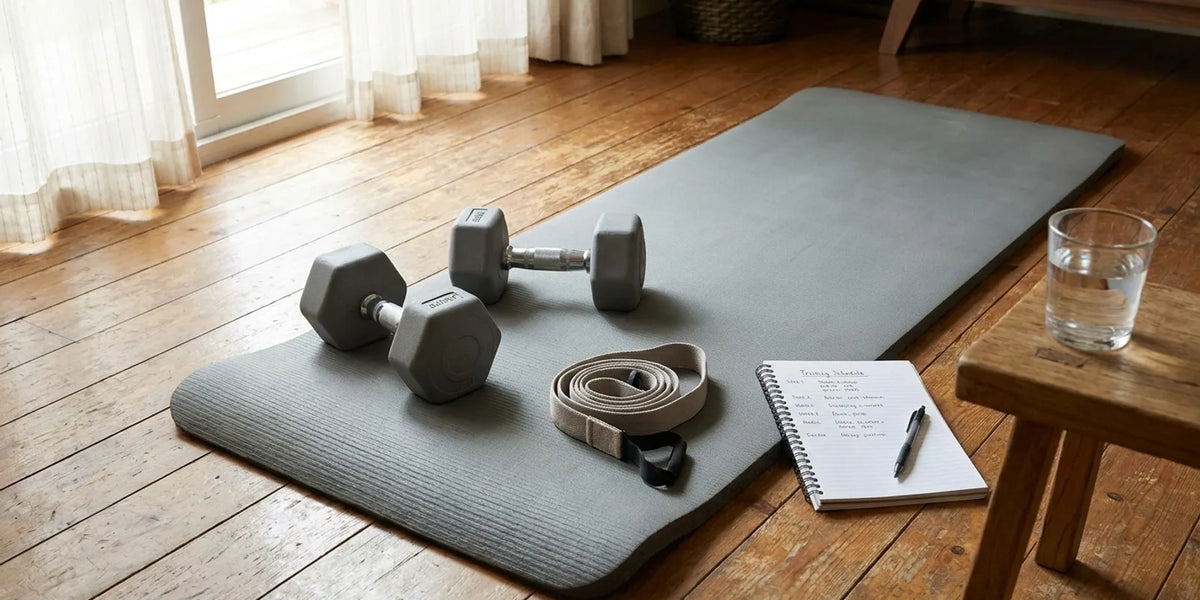
A fitness plan for muscle gain is a weekly schedule built on progressive overload, compound free-weight lifts, and enough recovery to let muscle repair and grow. This 4-day upper/lower split gives intermediate home lifters a complete roadmap they can run with dumbbells, a bench, and a pull-up bar.
It covers day-by-day workouts with sets, reps, and rest, how to pick starting weights, when to add load, exercise swaps for limited gear, and clear safety stop conditions. If you have outgrown a beginner routine and want serious home hypertrophy, start here.
Quick Answer: A fitness plan for muscle gain should hit every major muscle group twice per week with enough volume to grow. This 4-day upper/lower split, built on compound free-weight lifts, trains the upper body twice and the lower body twice, using 8-12 rep sets, 60-120 second rests, and a simple rule for adding weight over time.
Key Takeaways
- Training frequency: Train every major muscle group twice per week with an upper/lower split for efficient hypertrophy.
- Rep and volume range: Keep most sets in the 6-12 rep range and stop each set one to three reps short of failure.
- Progression rule: Add one rep per set each session, then increase weight when you hit the top of your rep range.
- Minimal equipment: Adjustable dumbbells, a bench, and a pull-up bar cover nearly every exercise in the plan.
- Recovery: Space four sessions across the week and keep seven to nine hours of sleep nightly.
What Does a 4-Day Muscle Building Plan Look Like?
A 4-day muscle building plan pairs an upper/lower split with compound free-weight lifts so every major muscle group trains twice per week, twice for the upper body and twice for the lower body. Each session pairs one heavy compound lift with focused accessory work and a short core block.
- Day 1 Upper A (Push): Bench press, shoulder press, triceps, and front delts, plus core.
- Day 2 Lower A (Quad): Squat pattern, split squat, quads, calves, and core.
- Day 3 Upper B (Pull): Pull-ups, rows, rear delts, and biceps, plus core.
- Day 4 Lower B (Posterior chain): Hip hinge, single-leg work, hamstrings, glutes, and core.
You can run the four sessions as Monday, Tuesday, Thursday, and Friday, which gives you a rest day between each lift and a two-day recovery block on the weekend. The plan assumes you have at least adjustable dumbbells, a bench, and a pull-up bar, and it stays flexible when you have less.
What Actually Drives Muscle Growth?
Muscle growth happens when a muscle is placed under enough mechanical tension, pushed with progressive overload, and then given time to recover and adapt. No single exercise or split produces gains on its own; the load, the volume, and the recovery around it do the work.
- Mechanical tension: Loads that are challenging for the target rep range create the signal to build new muscle tissue.
- Progressive overload: The muscle only grows when the stimulus slowly increases over time through more weight, reps, or sets.
- Recovery: Growth happens between sessions, so sleep, protein, and rest days are as important as the training itself.
- Full range of motion: Working through a complete range, especially the stretched part of a lift, adds tension where muscle is most sensitive to growth.
"Training muscles in a lengthened position, where the muscle is under load at its greatest stretch, produces superior hypertrophic gains compared to training in a shortened range. This is why exercises that achieve deep knee flexion under load are particularly effective for quad development."
Brad Schoenfeld, PhD, Exercise Science Researcher specializing in Muscle Hypertrophy, CUNY Lehman College, Brad Schoenfeld on Lengthened Partials
This is why the plan favors full-range compound lifts over partial-range machine work. If you want to understand the training styles behind these choices, our guide to types of weight lifting explained for strength, muscle, and fitness walks through the options.
Why Use an Upper/Lower Split for Muscle Gain?
An upper/lower split is one of the most efficient structures for a fitness plan for muscle gain because it trains each muscle twice per week while leaving room for volume. The four days alternate between upper-body and lower-body sessions so no muscle group trains on consecutive days.
| Day | Session | Focus | Main Lifts |
|---|---|---|---|
| Day 1 | Upper A | Push emphasis | Dumbbell bench press, shoulder press, triceps |
| Day 2 | Lower A | Quad emphasis | Goblet squat, split squat, calves |
| Day 3 | Upper B | Pull emphasis | Pull-ups, rows, biceps |
| Day 4 | Lower B | Posterior chain emphasis | Romanian deadlift, hip thrust, hamstrings |
Rest days fall between each session and after Day 4, so every muscle gets at least 48 hours to recover before its next stimulus.
If you are newer to structured training, a 3-day full-body version of this plan is a gentler on-ramp before you add the fourth day. The same progression rules in this article apply either way.
What Are the Day-by-Day Workouts?
Each session lists the exercise, sets, reps, and rest. Compound lifts come first, accessories follow, and a short core block closes every workout.
Day 1: Upper Body A (Push)
| Exercise | Sets | Reps | Rest |
|---|---|---|---|
| Dumbbell Bench Press | 4 | 8-10 | 90 sec |
| Incline Dumbbell Press | 3 | 8-10 | 90 sec |
| Dumbbell Shoulder Press | 3 | 8-12 | 90 sec |
| Dumbbell Lateral Raise | 3 | 12-15 | 60 sec |
| Overhead Tricep Extension | 3 | 10-12 | 60 sec |
| Plank | 3 | 30-45 sec | 60 sec |
Day 2: Lower Body A (Quad emphasis)
| Exercise | Sets | Reps | Rest |
|---|---|---|---|
| Goblet Squat | 4 | 8-10 | 120 sec |
| Bulgarian Split Squat | 3 | 8-10 per leg | 90 sec |
| Dumbbell Step-Up | 3 | 10 per leg | 90 sec |
| Romanian Deadlift | 3 | 8-10 | 90 sec |
| Standing Calf Raise | 4 | 15-20 | 60 sec |
| Hanging Knee Raise | 3 | 10-15 | 60 sec |
Day 3: Upper Body B (Pull emphasis)
| Exercise | Sets | Reps | Rest |
|---|---|---|---|
| Pull-Up | 4 | 6-10 | 90 sec |
| One-Arm Dumbbell Row | 4 | 8-10 per side | 90 sec |
| Chest-Supported Row | 3 | 10-12 | 90 sec |
| Band Face Pull | 3 | 15-20 | 60 sec |
| Dumbbell Curl | 3 | 10-12 | 60 sec |
| Hammer Curl | 3 | 10-12 | 60 sec |
Day 4: Lower Body B (Posterior chain emphasis)
| Exercise | Sets | Reps | Rest |
|---|---|---|---|
| Romanian Deadlift | 4 | 8-10 | 120 sec |
| Single-Leg Romanian Deadlift | 3 | 8 per leg | 90 sec |
| Dumbbell Hip Thrust | 4 | 12-15 | 90 sec |
| Reverse Lunge | 3 | 10 per leg | 90 sec |
| Standing Calf Raise | 4 | 15-20 | 60 sec |
| Pallof Press | 3 | 10 per side | 60 sec |
Two patterns explain why this plan looks the way it does. First, [1] research on resistance-based core training found that adding adjustable resistance increases abdominal muscle activity.
That is why the core blocks move from planks to resisted planks over time. Second, [2] EMG data indicate that free-weight squat variations activate the quadriceps and posterior chain more than machine-based isolation substitutes, which is why the lower days lead with goblet squats and Romanian deadlifts.
What Equipment Do You Need?
Three pieces of gear cover nearly every exercise in this fitness plan for muscle gain: adjustable dumbbells, a bench, and a pull-up bar. Optional extras add variety and load range as you progress.
- Adjustable dumbbells: The backbone of the plan, covering presses, rows, squats, and curls with one compact pair. Browse adjustable dumbbells to see the options.
- A bench: Needed for bench presses, chest-supported rows, and hip thrusts. Any bench that adjusts between flat and incline works.
- A pull-up bar: The main vertical pulling movement for the lats and biceps.
- Optional rack or smith machine: Adds barbell squats and presses and a spot for heavier lower-body work. See smith machine options if you want a guided barbell path.
- A floor mat and resistance bands: Protect the floor, add resistance to core and mobility work, and extend your load options.
If you prefer an all-in-one setup, the RitFit M2 Multi Functional Modular Home Gym Smith Machine combines a rack, bar, and cable tower in one footprint for a serious garage gym.
How to Choose Your Starting Weights
Pick a weight that lets you finish every prescribed rep with good form while the last two reps feel hard. The goal is a load where you could do two or three more reps but choose not to.
- Start light, then test: Begin each new exercise with a weight you can lift for all sets, then add load in the second session if it felt easy.
- Use the last set as the guide: If the final set of reps is easy across all sets, the weight is too light; if form breaks on the first set, it is too heavy.
- Write everything down: Record the weight and reps for every exercise so you know exactly what to beat next session.
- Leave a rep in reserve: Stop each set one to three reps short of failure on working sets, and only reach failure on the last set of an exercise.
When you cannot tell if a weight is right, choose the lighter option for the first week. You can always add weight, but a too-heavy start forces bad form that slows progress.
How Do You Add Weight With Progressive Overload?
Progressive overload is the single most important rule in a fitness plan for muscle gain: every session, you make the work slightly harder than before. The simplest system is double progression.
- Add reps first: Stay on the same weight and add one rep to each set until you hit the top of the rep range across all sets.
- Then add weight: When you hit the top of the range on every set, increase the load by the smallest increment available and drop back to the bottom of the range.
- Example: From 3 sets of 8 on a lift, progress to 3 sets of 9, then 10, then increase the weight and start again at 8.
- Add sets or slow the tempo: When small plates are not available, add a set or slow the lowering phase to create more tension.
- Deload after a hard block: Every 6 to 8 weeks, take one week at roughly half your normal working weight to recover before the next push.
The idea is simple, but the execution is where people stall. If you want a deeper look at why this principle matters, read our breakdown of what is overload in fitness.
What Substitutes Work When You Lack Equipment?
If you are missing a piece of gear, swap in a close relative rather than skipping the movement pattern. Each substitute below keeps the same muscles working with what you already own.
| Missing Item | Substitute | Muscles Covered |
|---|---|---|
| Pull-up bar | Banded pull-aparts, inverted rows, or resistance band rows | Lats, biceps, rear delts |
| Bench | Floor press, dumbbell pullover, hip thrust on the floor | Chest, triceps, glutes |
| Heavy dumbbells | Single-leg squats, split squats, step-ups | Quads, glutes |
| Smith machine or rack | Goblet squats, dumbbell Romanian deadlifts | Legs, posterior chain |
Each swap keeps the same movement pattern so the target muscle still gets trained, even when the absolute load is lower.
Bands are a reliable fallback for pulling work when you train at home. Learn whether you can gain muscle with resistance bands and how to use bands for big time muscle and strength gains to judge how far they can take you.
How Much Recovery Do You Need Between Sessions?
Four sessions per week is a strong frequency for a fitness plan for muscle gain because it trains each muscle twice while leaving three recovery days. More training days do not automatically mean more muscle, and extra sessions just add fatigue.
- Rest between sessions: Put at least one rest day between upper and lower sessions so no muscle group trains on back-to-back days.
- Sleep: Aim for seven to nine hours a night, since most muscle repair happens while you sleep.
- Protein and calories: Eat a small calorie surplus with enough protein, around 0.7 to 1 gram per pound of body weight, to support growth.
- Active recovery: Walk, stretch, or do light mobility on rest days, but avoid hard training of the same muscles.
Nutrition and recovery are the other half of a gain cycle. If you are deciding between adding muscle or losing fat first, compare what is bulking in fitness and what is cutting in fitness.
When to Stop: Pain vs Normal Muscle Discomfort
Muscle soreness after a workout is normal, but sharp or joint pain during an exercise is a signal to stop. Learn the difference so you can train hard without training through an injury.
- Normal soreness: Dull muscle soreness one to two days after training is expected and safe to work around.
- Stop immediately: Sharp pain, joint pain, clicking with pain, or pain that limits your range of motion means end the set and switch to a safer movement.
- Do not grind: If form breaks down on a heavy set, lower the weight or stop the set; grinding through poor form invites injury.
- See a professional: Pain that lasts more than a few days or that limits daily activity deserves a doctor or physical therapist, not more reps.
This plan is a general training guide, not medical advice. When in doubt about an ache or pain, take the extra rest day; missing one session costs far less than a layoff from injury.
What Mistakes Slow Down Muscle Growth?
Most stalled plans fail for the same handful of reasons. Fix these and your fitness plan for muscle gain will keep producing progress.
- Training the same weight forever: Without progressive overload, the stimulus never increases and growth plateaus.
- Skipping legs: Lower-body compound lifts drive the most overall growth, so skipping them slows progress everywhere.
- Program hopping: Switching plans every few weeks never gives a routine enough time to produce a result; run this plan for at least 8 to 12 weeks.
- Training to failure on every set: Excessive failure adds fatigue without extra muscle, cutting the volume you can complete in the week.
- Ignoring recovery: Short sleep, low protein, and missed rest days undo the training stimulus no matter how hard you lift.
When progress stalls anyway, it is rarely the plan; it is usually a variable you stopped tracking. Our guide to what is a fitness plateau walks through the most common causes.
FAQs About a Fitness Plan for Muscle Gain
How many days a week should I train to build muscle at home?
For most home lifters, four days per week with an upper/lower split is the sweet spot for muscle gain.
It trains every major muscle group twice weekly, gives you enough volume to grow, and leaves three recovery days.
Beginners can start with three full-body days, while more advanced lifters can add a fifth day.
How long does it take to see muscle gain results?
With a consistent plan, most people notice visible changes in eight to twelve weeks, though early strength gains often appear in the first month.
Muscle growth is gradual, so track your weights and measurements rather than daily scale readings.
Stay consistent with progressive overload and adequate protein for the best results.
What is progressive overload and how do I apply it?
Progressive overload means gradually making your workouts harder over time so your muscles keep adapting.
The simplest method is adding one rep per set each session until you reach the top of your rep range, then increasing the weight.
You can also add sets, slow the tempo, or reduce rest between sets.
Can I build muscle with just dumbbells at home?
Yes.
Adjustable dumbbells provide enough load and mechanical tension to build muscle for most home lifters.
Pair them with a bench and a pull-up bar, and you can train every major muscle group.
Focus on progressive overload and challenging rep ranges, and you will keep growing before you outgrow the dumbbells.
Should I train to failure on every set?
No.
Training to failure on every set adds fatigue without extra muscle gain.
Save failure for the final set of an exercise, and stop one to three reps short on earlier sets.
You will accumulate more total volume across the week, which supports better growth, while staying recovered enough for your next session.
Conclusion
A fitness plan for muscle gain does not need to be complicated. Run this 4-day upper/lower split with compound free-weight lifts, add weight or reps each week through progressive overload, and protect your recovery with sleep, protein, and rest days.
Start lighter than you think, write down every session, and give the plan a full 8 to 12 weeks before judging results. When you are ready to outfit the space, check the current deals at RitFit sales to build your home gym without overspending.
Disclaimer
This article provides general training information and is not medical, nutrition, or injury advice. Consult a qualified physician or fitness professional before starting a new program, especially if you have an existing condition, injury, or concern about joint pain.
References
1. Kim HJ, Sung JH, Ryu JK, Jung HC, Wang J. Effect of Reformer Spring Resistance Modifications on Core Muscle Activity During Basic Core Muscle Exercises. Healthcare (Basel). 2024;12(23). PMCID: PMC11641042
2. Bautista D, Durke D, Cotter JA, Escobar KA, Schick EE. A Comparison of Muscle Activation Among the Front Squat, Overhead Squat, Back Extension and Plank. Int J Exerc Sci. 2020;13(1):714-722. doi:10.70252/BTUH3630. PMCID: PMC7241624





