








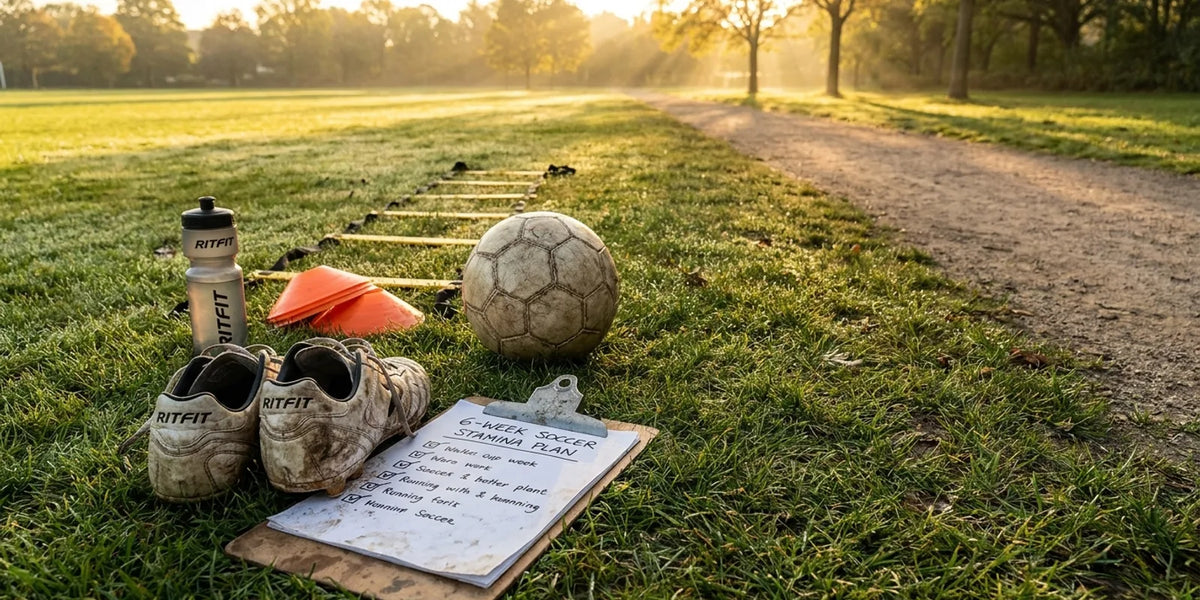
Soccer stamina is the ability to repeat fast runs, recover between intense efforts, and maintain technical quality across a full 90 minute match. Building it requires more than long distance running because aerobic fitness, sprint quality, and speed endurance each solve a different match demand.
This guide explains those three layers and provides a six week structure for the 2026 soccer season. Adjust the plan around team sessions, matches, training history, and recovery needs, and stop if you develop pain, dizziness, chest discomfort, or unusual shortness of breath.
Published: June 15, 2026
Last Updated: June 15, 2026
Author: RitFit Editorial Team
Content Review: Training recommendations were checked against the peer reviewed studies listed in the references.
Independence Statement: This is an independent soccer training resource. RitFit is not affiliated with, sponsored by, or endorsed by any tournament organizer, governing body, broadcaster, team, or athlete. Third party names and marks belong to their respective owners.
Table of Contents
Key Takeaways
- Train Three Layers: Soccer stamina combines an aerobic base, high quality sprint work, and speed endurance. Relying on only steady running or only hard intervals leaves important match demands undertrained.
- Protect Sprint Quality: Sprint interval sessions should use near maximal efforts with enough recovery to preserve speed and mechanics. Turning every repetition into a fatigued grind changes the purpose of the session.
- Easy Running Has a Role: Low intensity aerobic work can improve recovery capacity and general endurance, but the research protocol used individualized threshold testing and should not be copied blindly.
- Speed Endurance Can Work Quickly: In one four week trial, two additional weekly speed endurance sessions improved high intensity performance in competitive male players, although the small sample limits broad conclusions.
- Expect Gradual Progress: Measurable changes can appear within four to nine weeks, but results depend on training status, team workload, sleep, nutrition, injury history, and session consistency.
What Soccer Stamina Actually Requires
Soccer alternates walking, jogging, accelerations, decelerations, high speed running, and technical actions. The energy systems overlap, so effective conditioning must prepare you to sustain movement while still producing sharp efforts late in the match.
- Aerobic base: Supports continuous movement and helps restore energy between harder actions.
- Sprint capacity: Supports short accelerations, breakaways, recovery runs, and explosive changes of pace.
- Speed endurance: Helps maintain hard running when recovery between efforts is incomplete.
- Technical endurance: Helps preserve passing, first touch, scanning, and decision quality under fatigue.
Positional demands also matter. The guide to soccer positions explained can help you decide whether your plan should emphasize wider running volume, repeated accelerations, or recovery between short intense actions.
Sprint Interval Training for Soccer Fitness
Sprint interval training uses brief near maximal efforts with generous recovery. The main goal is to repeat fast, technically sound sprints rather than accumulate the greatest possible fatigue.
What the Six Week Trial Found
A randomized trial of 30 male soccer players compared six weeks of sprint interval training, plyometric training, and active control training. Sprint interval and plyometric groups produced similar improvements in aerobic measures, while plyometric training produced larger gains in several power, jumping, speed, and change of direction outcomes.1
The practical lesson is not that one method replaces the other. Sprint work develops acceleration exposure and running mechanics, while plyometrics can add braking, stiffness, and explosive force qualities when athletes already have sound landing control.
Practical Sprint Session
- Warm up for 10 to 15 minutes with easy movement, mobility, skips, and progressive accelerations.
- Perform 4 to 6 repetitions of 20 meters at about 90 to 95 percent effort.
- Walk back and rest until breathing settles and sprint mechanics feel ready, usually 90 seconds to 3 minutes.
- Stop the set when speed clearly drops or posture, foot strike, and control deteriorate.
This research podcast discusses short sprint interval frequency and performance. It reinforces a useful programming principle, sprint sessions should preserve speed quality and allow enough recovery for each repetition to remain purposeful.
Building the Aerobic Base for 90 Minute Matches
The aerobic base helps you keep moving, restore energy between intense actions, and maintain better output late in training or competition. Easy aerobic sessions should feel controlled enough that you can speak in short sentences.
What the Nine Week Study Actually Tested
A study of 24 professional male players used 27 individualized one hour jogging sessions over nine weeks. The jogging speed was set at 72 percent of the first lactate threshold, and the intervention improved several measures related to energy recovery and general endurance.2
This was a laboratory guided professional protocol, not a universal prescription. Recreational players should begin with 20 to 40 minutes at an easy conversational effort once or twice per week, then adjust volume around team practices and matches.
Simple Aerobic Progression
- Weeks 1 and 2: Complete 20 to 25 minutes at an easy, steady effort.
- Weeks 3 and 4: Progress to 25 to 35 minutes if recovery remains good.
- Weeks 5 and 6: Maintain 30 to 40 minutes or reduce volume when match load rises.
Do not turn every easy run into a threshold session. The value comes from accumulating aerobic work without creating enough fatigue to reduce sprint, strength, or technical quality later in the week.
Speed Endurance for Repeated High Intensity Efforts
Speed endurance training uses hard running efforts with controlled recovery to improve fatigue resistance during intense intermittent work. It is more demanding than an easy run and should not be placed immediately before a match.
What the Four Week Trial Found
In a randomized trial of 18 competitive male players, two additional weekly sessions were completed for four weeks. The speed endurance production group improved Yo Yo intermittent recovery level 2 performance by 50 percent and repeated sprint performance by 2.1 percent, with larger gains than the maintenance group.3
The result is notable, but the sample was small and the participants began below elite levels on the recovery test. Treat the percentage as a study specific outcome rather than a promise that every player will improve by the same amount.
Practical Speed Endurance Session
- Warm up thoroughly and complete two progressive runs before the work set.
- Perform 4 repetitions of 20 seconds of hard shuttle running with controlled turns.
- Rest for about 2 minutes between efforts.
- Progress toward 6 repetitions only when speed, turning control, and next day recovery remain acceptable.
Beginners should first develop movement control through soccer conditioning drills for beginners. Hard shuttle work increases braking stress, so sharp changes of direction should be added gradually.
A Weekly Soccer Stamina Training Structure
This sample week separates the three conditioning layers so each session has a clear purpose. Team practices, matches, and strength sessions count toward total workload and may require you to remove, not add, extra conditioning.
| Day | Session | Main Purpose | Load Guidance |
|---|---|---|---|
| Monday | Sprint intervals | Acceleration and sprint quality | 4 to 6 runs of 20 meters with full recovery |
| Tuesday | Easy aerobic run | Aerobic base and recovery capacity | 20 to 40 minutes at conversational effort |
| Wednesday | Strength exercises for soccer and mobility | Force production and tissue capacity | Moderate volume, avoid repeated maximal efforts |
| Thursday | Speed endurance | Fatigue resistance during hard running | 4 to 6 efforts of 20 seconds with about 2 minutes rest |
| Friday | Easy technical work or rest | Freshness and ball control | Keep effort low and finish feeling better than you started |
| Saturday | Match, small sided game, or beginner soccer drills | Soccer specific integration | Count this as a hard day when intensity is high |
| Sunday | Full rest | Physical and mental recovery | Prioritize sleep, food, hydration, and normal walking |
Progress one variable at a time. Add one repetition, extend the easy run slightly, or improve movement quality, but do not increase sprint volume, speed endurance volume, and strength load during the same week.
How Long It Takes to Improve Soccer Stamina
Research in the three cited studies measured meaningful changes after four, six, and nine weeks. Most players should look for gradual improvements in repeated effort quality, recovery between drills, and technical consistency rather than expecting a single dramatic breakthrough.
What to Track Each Week
- Sprint quality: Record whether times or perceived speed remain stable across repetitions.
- Recovery: Note how quickly breathing settles before the next drill.
- Technical control: Track passing accuracy and first touch quality late in practice.
- Session effort: Rate the session from 1 to 10 and watch for unexplained increases.
- Readiness: Monitor sleep, soreness, motivation, and leg heaviness before hard days.
Use your late session soccer passing accuracy as one practical indicator. If conditioning improves while technique stays controlled under fatigue, the plan is transferring toward match performance.
When to Reduce Training
Reduce volume when sprint speed falls for several sessions, soreness changes your running mechanics, sleep quality declines, or team practices become more intense. Adding work is not progress when it prevents you from completing the most important sessions with quality.
FAQs About Building Soccer Stamina
How long does it take to build soccer stamina?
Many players can notice better recovery and steadier late session performance within four to six weeks. Larger changes may take eight to twelve weeks or longer. Progress depends on starting fitness, team workload, sleep, nutrition, injury history, and whether sprint, aerobic, and speed endurance sessions are completed consistently.
What is the best workout for soccer stamina?
The best approach combines three session types, easy aerobic running, high quality sprint intervals, and speed endurance work. Each develops a different part of match fitness. A balanced week usually works better than repeating one exhausting workout, because it improves capacity while protecting speed, movement quality, and recovery.
Can you build soccer stamina without a team or full field?
Yes. You can improve soccer stamina with short sprints, controlled shuttle runs, easy aerobic sessions, strength training, and ball drills in a park or modest training area. Use safe turning distances, choose a level surface, and reduce speed when limited space prevents smooth acceleration and deceleration.
How many stamina sessions should soccer players do each week?
Most recreational players need one to three dedicated conditioning sessions each week, depending on team practices and matches. Count hard team sessions as conditioning. Start with one sprint day and one aerobic day, then add speed endurance only when recovery, sleep, soreness, and movement quality remain stable.
Does strength training improve soccer stamina?
Yes. Strength training can support running economy, acceleration, braking control, and resilience, which may help players maintain movement quality under fatigue. It does not replace aerobic or sprint conditioning. Use one or two weekly strength sessions, and place demanding lower body work away from matches and maximal sprint days.
Conclusion
Build soccer stamina by training the aerobic base, sprint quality, and speed endurance as separate but connected abilities. Use the weekly structure as a starting point, then adjust the number of sessions around practices, matches, strength work, and recovery.
Progress only one variable at a time and track late session technique, repeated sprint quality, and readiness. Consistent training for six weeks can create noticeable change, while continued development usually requires a longer cycle.
Disclaimer
This article is for educational purposes and does not replace individualized medical advice, rehabilitation, or professional coaching. Consult a qualified clinician or certified coach before beginning high intensity training, especially if you have cardiovascular concerns, a current injury, a recent illness, or a history of exercise related symptoms.
References
- Yang G, Chen W, Qi D, Zhang J, Men Z. The effects of a 6 week plyometric and sprint interval training intervention on soccer player physical performance. J Sports Sci Med. 2024;23(3):526 to 536. Read the full study.
- Hwang J, Moon NR, Heine O, Yang WH. The ability of energy recovery in professional soccer players is increased by individualized low intensity exercise. PLoS One. 2022;17(6):e0270484. Read the full study.
- Mohr M, Krustrup P. Comparison between two types of anaerobic speed endurance training in competitive soccer players. J Hum Kinet. 2016;51:183 to 192. Read the full study.





