








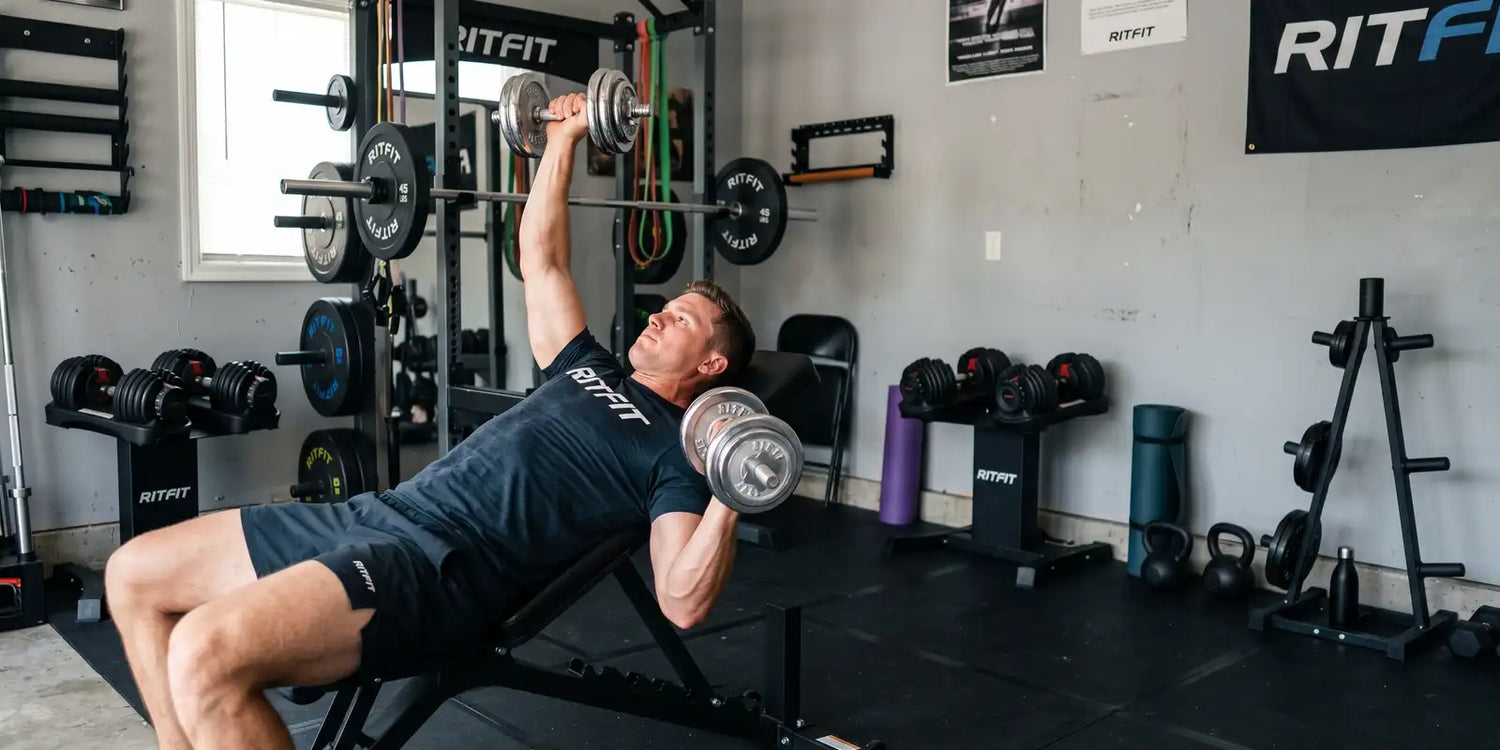
Learning how to bulk up comes down to two levers: a controlled calorie surplus that feeds muscle growth and progressive overload training that forces your body to use it. For most beginners, that combination, not a bigger appetite, is what turns extra food into visible muscle.
This guide covers the full beginner process: calories, daily protein, a home training split built on progressive overload, bulk duration, and recovery. If your main obstacle is simply eating enough, there is a dedicated strategy for that below as well.
Quick Answer: To bulk up, eat 10-20% above maintenance calories, hit 1.6-2.2 g of protein per kg of body weight daily, and train each muscle group two to three times a week with progressive overload. Most beginners should aim to gain 0.25-0.5% of body weight per week over a 12-16 week phase.
Key Takeaways
- Calorie Surplus: Aim for 10-20% above your maintenance calories, targeting roughly 0.25-0.5% of body weight gained per week.
- Protein Target: Research-informed guidelines suggest 1.6-2.2 g of protein per kg of body weight daily is the effective range for muscle building.
- Volume Drives Growth: An umbrella review of 44 systematic reviews found that training volume, meaning the number of sets you perform, is the primary driver of muscle hypertrophy.
- Bulk Duration: Most coaches recommend a 12-16 week bulk phase, stopping when you can no longer add weight or reps week over week.
- Recovery Matters: Fitness coaches consistently recommend 7-9 hours of sleep per night during a bulk for optimal muscle-building results.
How to Bulk Up Without Adding Fat
Bulking up without adding fat means eating in a controlled calorie surplus while training with progressive resistance, so the extra energy is used to build muscle instead of stored as fat. The difference between a lean bulk and a fat gain phase is how large that surplus is and how consistently you train.
How to Bulk Up: Four Repeatable Steps
Bulking up follows four repeatable steps: set a modest calorie surplus, lock in daily protein, apply progressive overload, and protect sleep for recovery. Skipping any one step slows muscle gain even when the other three are dialed in.
- Step 1, set the surplus: Add 300-500 calories above maintenance instead of eating unlimited amounts.
- Step 2, anchor protein: Spread 1.6-2.2 g per kg of body weight across three to five meals each day.
- Step 3, overload the training: Add weight, reps, or sets to your main lifts over time so the surplus has a reason to become muscle.
- Step 4, recover: Sleep 7-9 hours per night and keep at least one full rest day per week.
Clean Bulk vs. Dirty Bulk
A clean bulk means eating a modest calorie surplus of nutrient-dense whole foods, while a dirty bulk relies on high-calorie junk food to hit calorie targets quickly. A clean bulk generally produces less fat gain and better long-term body composition, which is why most coaches recommend it over the dirty approach.
- Clean bulk: 10-20% calorie surplus, whole foods, controlled fat gain.
- Dirty bulk: Large, uncontrolled surplus, leads to excess fat accumulation and harder cutting phases.
- Best choice for beginners: A clean bulk gives you the best muscle-to-fat ratio over a 12-16 week phase.
If you want to understand the full scope of the 7 major muscle groups you are targeting during a bulk, reviewing the anatomy context will help you train each one with intention. If eating enough is your specific obstacle, the dedicated guide on how to bulk up for skinny guys goes deeper into that supply problem and how to solve it.
How Many Calories Should You Eat to Bulk Up?
Nutrition experts recommend a 10-20% calorie surplus above your daily maintenance level, which translates to roughly 300-500 extra calories per day for most people. Targeting a gain rate of 0.25-0.5% of your body weight per week keeps muscle gain high and fat gain controlled.
Calculating Your Calorie Surplus
Start by estimating your Total Daily Energy Expenditure using a TDEE calculator, then add 10-20% to that number to find your bulking calorie target. For example, a person maintaining weight at 2,500 calories would target around 2,750-3,000 calories per day on a bulk.
- Beginner or hardgainer: Start at the higher end, around 400-500 extra calories, since your body responds more aggressively to a new training stimulus.
- Intermediate lifter: Stick to 200-300 extra calories since your body adapts more slowly and a large surplus mostly becomes fat.
- Track your weight weekly: If you are gaining faster than roughly 1% of body weight per month, reduce calories by 100-200 to keep fat gain in check.
Macronutrient Breakdown for Bulking
Protein builds muscle, carbohydrates fuel your training sessions and replenish glycogen, and dietary fat supports hormonal function. A practical split for most bulkers is roughly 35-40% protein, 40-45% carbohydrates, and 20-25% fat, adjusted to hit your protein minimum first.
- Protein-rich carb sources: Rice, oats, sweet potatoes, and whole grain bread.
- Quality fat sources: Olive oil, avocado, nuts, and fatty fish.
- Limit: Alcohol, fried foods, and high-sugar processed snacks that add calories without muscle-building nutrients.
How to Tell If Your Surplus Is Working
You are eating the right amount if you gain roughly 0.25-0.5% of your body weight per week while your main lifts keep climbing. Judge the trend from weekly averages rather than any single day, because daily weight swings are mostly water and food volume.
- Weight flat for two straight weeks: Add roughly 100-200 calories per day, then re-check the following week.
- Gaining faster than target: Trim 100-200 calories per day so the extra weight does not become mostly fat.
- Scale rising but lifts stalling: The surplus is outrunning your training stimulus, so increase weekly sets before adding more food.
- Waist measurement: Pair the scale with a waist measurement, since a stable waist alongside rising body weight points to lean gain.
Hit Your Protein Target Every Day
Protein provides the amino acids that your body uses to repair and build muscle fibers after resistance training, making it the single most important macronutrient for a successful bulk. Without adequate protein, a calorie surplus mostly adds fat rather than muscle.
Daily Protein Targets
Guidelines suggest 1.6-2.2 g of protein per kg of body weight per day is the effective range for maximizing muscle protein synthesis during a bulk. Spreading that intake across three to five meals helps maintain elevated amino acid availability throughout the day.
- Per-meal target: Aim for around 0.3 g of protein per kg of body weight per meal to optimize the muscle protein synthesis response.
- Timing: A protein-rich meal or shake within two hours of training supports recovery during the post-workout window.
- Consistency: Hitting your daily protein target matters more than precise timing, so prioritize total daily intake first.
For an 80 kg (176 lb) lifter, that range works out to roughly 128-176 g of protein per day.
Best Protein-Rich Foods for Bulking
Whole food protein sources provide amino acids alongside micronutrients that support recovery, making them preferable to protein supplements for the majority of your intake.
- Animal sources: Chicken breast, lean beef, eggs, Greek yogurt, salmon, and cottage cheese.
- Plant sources: Edamame, lentils, tempeh, and tofu combined to cover all essential amino acids.
- Convenient options: Protein shakes or Greek yogurt work well as snacks when whole-food meals are not practical.
If you are building your home gym to support this training phase, the best dumbbells for beginners to build muscle is a practical starting point for equipment decisions. For those wondering whether a minimal setup is enough, can you build muscle with just dumbbells answers that question directly.
Lift With Progressive Overload at Home
Resistance training is the non-negotiable trigger for muscle growth during a bulk: without a consistent training stimulus, extra calories largely become body fat rather than muscle. An umbrella review of 44 systematic reviews confirmed that training volume, specifically the number of sets you perform per week, is the primary variable driving muscle hypertrophy.[1]
Progressive Overload
Progressive overload means systematically increasing the demands placed on your muscles over time, whether by adding weight, adding reps, or adding sets. A narrative review on resistance training variables found that progressively increasing training volume is essential for reaching optimal hypertrophic adaptations.[2]
- Add weight: Increase load by the smallest available increment once you complete all target reps with good form.
- Add reps: If you cannot add load yet, perform one to two additional reps per set before progressing to heavier weight.
- Add sets: Adding one working set per exercise every two to three weeks is one of the most reliable ways to apply progressive overload.
- Track everything: Logging sets, reps, and load each session is the only way to confirm consistent overload is actually happening.
Recommended Beginner Training Splits
A systematic review on maximizing muscle hypertrophy recommends 3-6 sets of 6-12 repetitions per exercise at 60-80% of your one-rep max, with around 60 seconds of rest between sets and a total training volume of 12-28 sets per muscle group per week.[3]
| Split | Days Per Week | Best For |
|---|---|---|
| Full Body | 3 | Complete beginners with limited equipment |
| Upper / Lower | 4 | Beginners ready for more weekly volume |
| Push / Pull / Legs | 6 | Intermediate lifters with solid form base |
Best Compound Exercises for Bulking
Compound movements recruit the most muscle mass per exercise, produce the strongest training stimulus, and allow you to load progressively over months and years. Focus on these foundational lifts before adding isolation work.
- Squat: Builds quads, glutes, and hamstrings simultaneously with high loading potential.
- Bench Press: Targets the chest, anterior deltoids, and triceps as the primary horizontal push movement.
- Deadlift: A full posterior chain builder covering hamstrings, glutes, erectors, and traps.
- Overhead Press: Builds shoulder width and pressing strength while engaging the upper back as a stabilizer.
- Barbell or Dumbbell Row: The primary horizontal pull for back thickness, also training the biceps as a secondary mover.
- Pull-Up or Lat Pulldown: Builds the lats for a wider back and strong vertical pulling strength.
For the vertical pull specifically, how to do the chin up breaks down the technique so you can load the movement progressively.
For a Smith machine variation of these compound movements, the guide on best Smith machine exercises for muscle building covers how to adapt each lift for a home gym. For those exploring minimal setups, can you gain muscle with resistance bands provides a useful alternative perspective.
Watch this science-based breakdown of how to structure your bulk nutrition and training for maximum results:
"The two largest reasons why people don't get results with their fitness training protocol is number one, adherence, and then number two, some sort of progressive overload."
Andy Galpin, PhD, Professor of Exercise Science and Human Performance, Parker University, Dr. Andy Galpin: Optimize Your Training Program for Fitness and Longevity
How Long Should You Bulk?
Coaches recommend a bulk phase of 12-16 weeks for most people, providing enough time to accumulate meaningful muscle without training fatigue overwhelming progress. The practical signal to end a bulk is when you can no longer add weight or reps week over week, which indicates the body has reached its adaptive capacity in a surplus.
- Beginners: Coaches estimate beginners can gain approximately 1-2 lbs of actual muscle per month, so a 12-16 week phase can yield 3-8 lbs of lean mass.
- Intermediate lifters: Muscle gain rate slows with experience, making patient, consistent training and nutrition more important than an aggressive surplus.
- After the bulk: Transition to a maintenance phase for two to three weeks before cutting to allow accumulated fatigue to dissipate before entering a calorie deficit.
Tracking body weight weekly at the same time and under the same conditions, alongside strength in key compound lifts, gives you the clearest signal of whether your bulk is producing muscle, fat, or both.
Shorter blocks work as well: a 10 week bulk or 12 week bulk is a common first cycle, after which you reassess body composition before deciding whether to run another block. A 30-day window is too short to judge progress, because visible composition changes typically appear only after six to eight weeks.
Recover Well and Avoid Common Bulking Mistakes
Recovery is where muscle growth actually occurs: training creates the signal, but sleep and rest days provide the environment for your body to build new tissue. Fitness coaches consistently recommend 7-9 hours of sleep per night during a bulk, as growth hormone secretion, which plays a role in muscle repair, is primarily concentrated during deep sleep.
Common Bulking Mistakes to Avoid
Most failed bulk attempts trace back to a handful of consistent errors rather than complex nutritional miscalculations.
- Eating too large a surplus: A surplus beyond 20% above maintenance mostly adds fat, especially for intermediate lifters past their beginner adaptation phase.
- Skipping progressive overload: Adding calories without consistently increasing training demands produces fat gain, not muscle gain.
- Inconsistent protein intake: Missing the 1.6-2.2 g/kg protein range while hitting calorie targets leaves muscle protein synthesis chronically under-supported.
- Dirty bulking: Using junk food to hit calorie targets leads to excess fat accumulation that requires a prolonged, difficult cut to reverse.
- Bulking too long: Once body fat rises significantly and training stalls, continuing in a surplus adds mostly fat and makes the eventual cut much harder.
- Neglecting rest days: Training without adequate rest prevents muscle repair, increases injury risk, and reduces the quality of every subsequent training session.
For long-term context on how bulking fits into physique development, the guide on building a natural physique covers the full bulk-to-cut cycle. If you are in the early stages of setting up your training environment, these home gym setup tips will help you build the right foundation for consistent long-term progress.
How many calories should I eat to bulk up?
Eat 10-20% above your daily maintenance calories to bulk up effectively. For most people, this means adding 300-500 calories per day. Aim to gain roughly 0.25-0.5% of your body weight per week, and adjust intake up or down based on your actual weekly weigh-in results.
How much protein do I need when bulking?
Guidelines suggest 1.6-2.2 g of protein per kg of body weight per day is the effective range for maximizing muscle protein synthesis during a bulk. Spread that intake across three to five meals to maintain consistent amino acid availability throughout the day for optimal muscle repair and growth.
How long does it take to bulk up and see results?
Most coaches recommend a 12-16 week bulk phase for meaningful results. Coaches estimate beginners can gain around 1-2 lbs of actual muscle per month, so visible body composition changes typically become noticeable after six to eight weeks of consistent training and eating in a controlled calorie surplus.
What is the difference between a clean bulk and a dirty bulk?
A clean bulk uses a modest 10-20% calorie surplus from nutrient-dense whole foods to gain muscle with minimal fat. A dirty bulk uses unrestricted high-calorie foods to quickly hit a large surplus, which tends to add significantly more fat alongside muscle and requires a longer, harder cutting phase afterward.
Can you bulk up without weights using only resistance bands?
Yes. Resistance bands can produce meaningful muscle growth when used with progressive overload principles, though they offer less loading range than free weights for more advanced stages. Bands work well for beginners or as a complement to barbell and dumbbell compound training in a home gym setup.
How many days a week should I train when bulking?
Three to four training days per week is effective for most beginners bulking, using a full-body or upper-lower split to hit each muscle group two to three times weekly. More advanced lifters may train five to six days, but adequate rest between sessions is essential for muscle repair and consistent long-term progress.
Should I do cardio while bulking?
Yes, moderate cardio during a bulk supports cardiovascular health and helps manage fat gain, but high-volume cardio can compete with the recovery resources needed for muscle growth. Two to three low-to-moderate intensity sessions per week at 20-30 minutes each is a practical balance for most home gym trainees during a bulk.
Conclusion
Bulking up successfully comes down to four compounding habits: a controlled 10-20% calorie surplus, consistent protein intake at 1.6-2.2 g per kg, progressive resistance training that adds volume over time, and 7-9 hours of sleep per night for recovery. Run a 12-16 week phase, track your lifts and body weight weekly, and adjust calories when your rate of gain drifts outside the target range.
Start with the right equipment, commit to one of the beginner splits covered in this guide, and let consistency over 12-16 weeks do the work that complexity never will.
Disclaimer
This article is for general informational purposes only and does not constitute medical, nutritional, or personal training advice. Consult a qualified healthcare or fitness professional before starting a new diet or exercise program, especially if you have an existing health condition.
References
1. Plotkin DL, Roberts MD, Haun CT, Schoenfeld BJ. The influence of resistance exercise training prescription variables on skeletal muscle mass, strength, and physical function in healthy adults: an umbrella review. Sports Med. 2024. PMCID: PMC10818109
2. Baz-Valle E, Balsalobre-Fernandez C, Alix-Fages C, Santos-Concejero J. Manipulating resistance training variables to induce muscle strength and hypertrophy: a brief narrative review. J Hum Kinet. 2022;80:141-152. PMCID: PMC9458289
3. Krzysztofik M, Wilk M, Wojdala G, Golas A. Maximizing muscle hypertrophy: a systematic review of advanced resistance training techniques. Int J Environ Res Public Health. 2019;16(24):4897. PMCID: PMC6950543





