The one arm row on smith machine bars gives you unilateral back training with a fixed path and built-in safety stops. This guide covers the side-on stance, the exact step-by-step form, the muscles involved, and how to load it without twisting your torso.
It suits home gym lifters training back on an all-in-one smith machine, from first-year trainees to intermediates. By the end you will know the setup, the loading logic, the best alternatives, and the warning signs that end a set.
Quick Answer: The one arm row on a smith machine is a side-on unilateral row performed with the bar set at hip height. You stand sideways, grip the center of the bar with one hand, hinge to about torso parallel, and pull the bar toward your lower ribs while keeping your shoulders square.
Key Takeaways
- Setup: The fixed bar path and adjustable safety stops of a smith machine make single-arm rowing easier to control and safer to bail from.
- Muscles: The working side hits the latissimus dorsi, middle trapezius, and rhomboids while your core fights rotation the whole set.
- Loading: Expect to use less than your two-arm row at first, often about half per side, and add weight only when your shoulders stay square.
- Programming: Rotate single-arm and two-arm rowing across the week instead of treating one as the only answer.
- Safety: End the set when your torso twists, your shoulder shrugs early, or pain replaces muscular effort.
What Is the One-Arm Row on a Smith Machine?
The one arm row on a smith machine is a unilateral horizontal row done standing side-on to the bar. One hand grips the center of the bar while the free hand braces, so each side of your back works on its own.
- Unilateral training: One-side-at-a-time work exposes left to right strength gaps that two-arm rows can hide.
- Fixed bar path: The bar travels on rails, so you spend less effort on balance and more on scapular control.
- Free-hand brace: Your off hand rests on the frame or a bench, which steadies your torso under load.
The pattern mirrors the single-arm dumbbell row, but the rail takes the stabilization burden off your shoulder. That makes the smith version a friendly place to learn unilateral rowing.
How to Set Up the One-Arm Row on a Smith Machine
Setup starts with bar height and your stance. Set the bar at roughly hip height, unlock it, and stand sideways to the machine with your working arm closest to the bar.
- Bar height: Hip height lets you hinge without the bar hitting your thighs or floating too high to reach.
- Stance: Step your outside foot back a short stride so your torso can hinge clear of the bar path.
- Grip: Take an overhand or neutral grip at the center of the bar with your working hand.
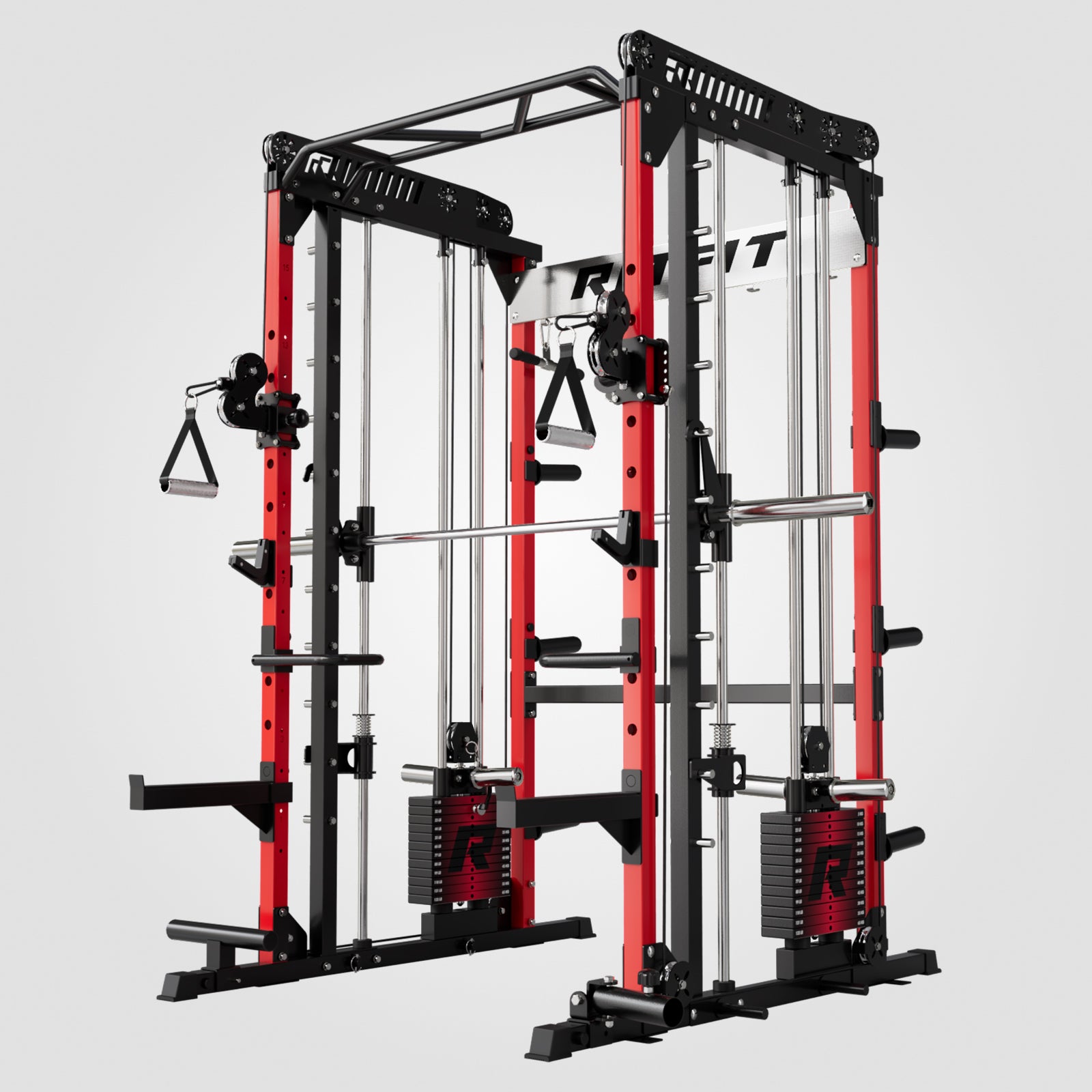
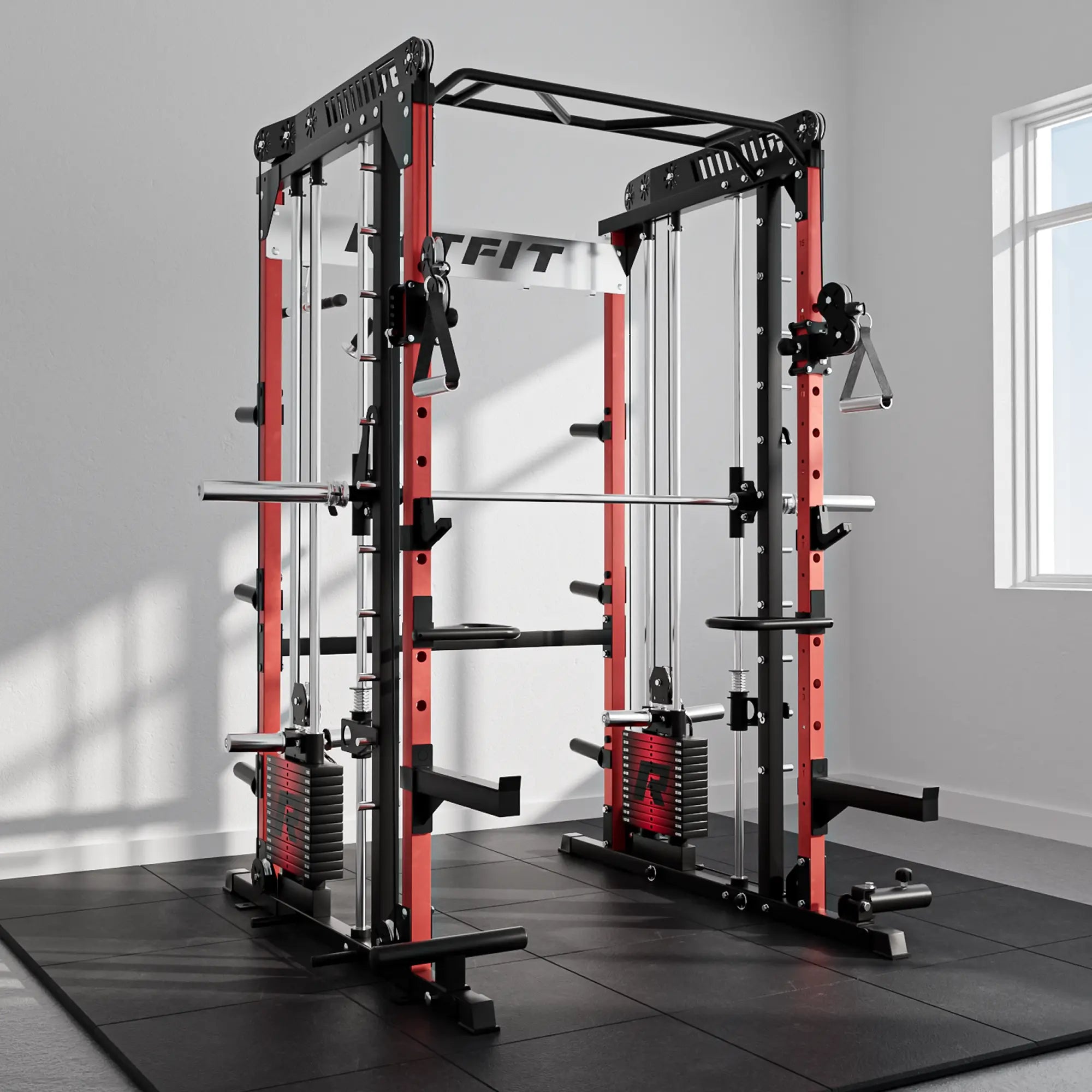
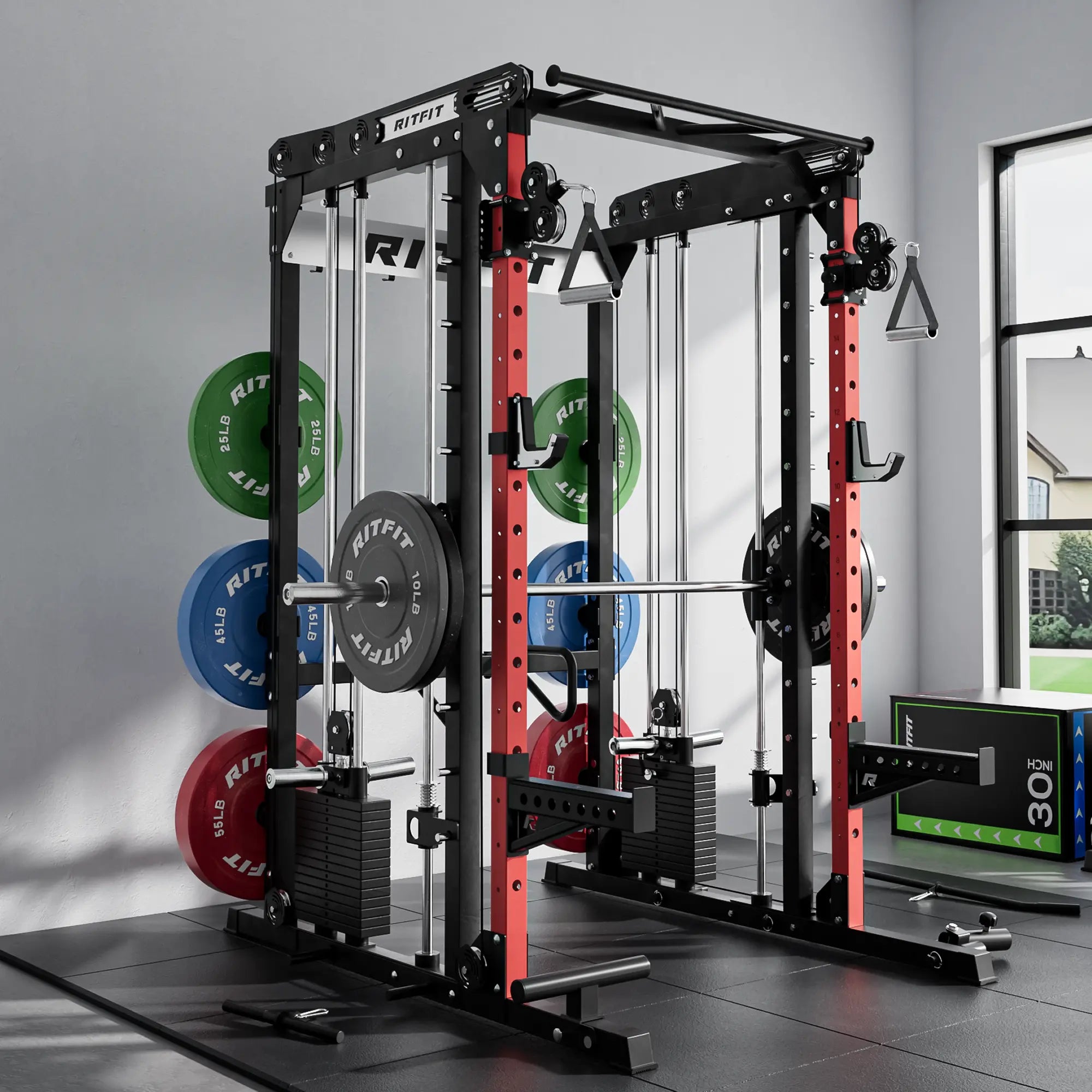
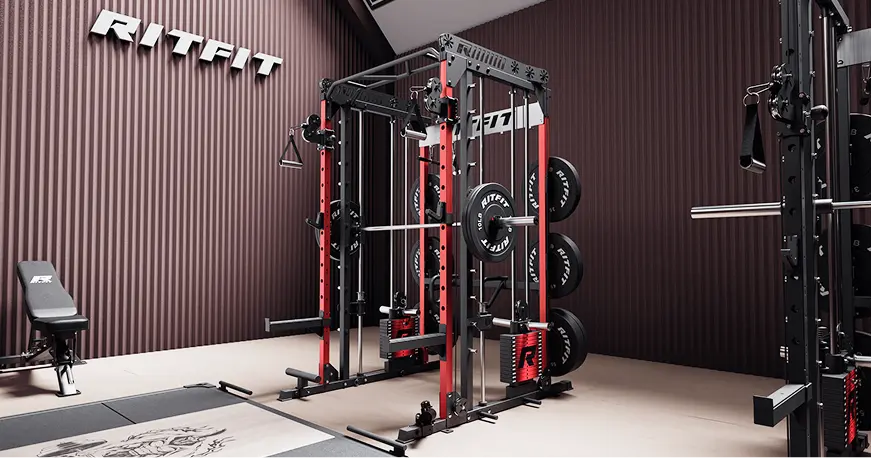
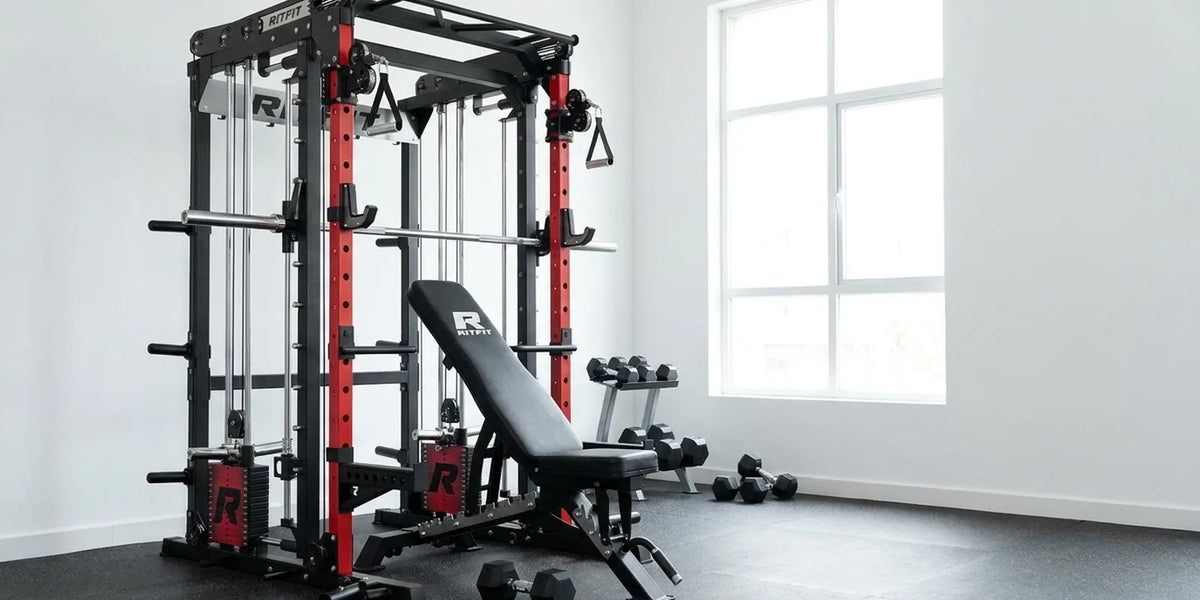
- Safety stops: The smith machine provides a fixed bar path with adjustable safety stops, so a failed rep ends safely instead of in a scramble. You can see that layout on the Multifunctional Smith Machine.
Brace your free hand on the frame or uprights before the first rep. Once your feet are set, nothing about the setup should change mid-set.
How to Perform the One-Arm Row on a Smith Machine: Step-by-Step Form
The rep itself comes down to a hinge, a brace, and a controlled pull toward your lower ribs. Run the six steps below for every set.
- Step 1: Stand side-on and grip the center of the bar with one hand.
- Step 2: Step your outside foot back and soften both knees.
- Step 3: Hinge forward to about torso parallel, keeping your back flat and your neck neutral.
- Step 4: Brace your core and set your free hand on the frame for support.
- Step 5: Row the bar toward your lower ribs, driving your elbow back and finishing with scapular retraction.
- Step 6: Lower the bar under control to a full stretch, then complete your reps before switching sides.
Keep your shoulders square to the floor from the first rep to the last. If your chest starts rotating toward the ceiling, the set is over.
Muscles Worked by the One-Arm Smith Machine Row
The working side targets the latissimus dorsi, middle trapezius, and rhomboids, while the rear delts and biceps assist the pull. Your core works the entire set as well, bracing against the twist that single-arm loading creates.
- Middle trapezius: Cited EMG work recorded the one-arm row activating the middle trapezius to 79% of its maximum.[1] That measurement came from a free-weight protocol, so treat it as a marker for the rowing pattern rather than a smith-specific figure.
- Rhomboids: In the same EMG work, rowing tasks ranked highest for middle trapezius and rhomboid activity among the lat exercises tested.[1] Scapular retraction did not change that middle trapezius and rhomboid activity.
- Lats: The latissimus dorsi drives the elbow down and back, so it shares the load on every rep.
- Rear delts and biceps: Both assist through the top half of the pull without needing deliberate focus.
- Core anti-rotation: Single-arm loading tries to spin your torso, and your obliques resist it for the whole set.
That anti-rotation demand is the quiet bonus of unilateral rowing. You train your back and your trunk stability in the same movement.
One-Arm Row vs Two-Arm Row on a Smith Machine
Neither version is universally better, and the right pick depends on your goal. One-arm rows balance the sides and free a hand for support, while two-arm rows let you move more total weight.
| Feature | One-Arm Row | Two-Arm Row |
|---|---|---|
| Load | Lighter, often about half per side at first | Heavier total load on the bar |
| Balance demand | Low, free hand can brace on the frame | Moderate, you control the full load |
| Imbalance check | Exposes and fixes side to side gaps | Can hide a weaker side |
| Core demand | High anti-rotation work | Lower rotational demand |
| Best use | Fixing weak points, learning the pattern | Building maximal pulling strength |
Compare the two against your current goal rather than treating either as the default back day row.
Scapular behavior matters in both versions. In one seated-row trial of 14 resistance-trained men rowing at 8RM, a fixed scapular position raised eccentric latissimus dorsi excitation (ES 0.85) and middle trapezius excitation (ES 0.67), and the researchers concluded that both fixed and free scapular rowing are effective.[2]
You can run the two-arm version as the classic smith machine row or as the bent-over smith row. Many lifters keep both styles in the same weekly plan.
"He used the Smith machine a lot, he used a lot of machines a lot. He still did some free weight stuff as well too and that should help lend this idea that there's not one that is definitively better than the other."
Joe Bennett, Hypertrophy Coach, Independent, Hypertrophy Coach Jay Cutler Quad Training
How to Choose Your Weight
Start with less weight than your two-arm row, often about half per side. The bar path is fixed, but your core still has to win the anti-rotation fight on every rep.
- First session: Pick a load you can control through a full range without your torso twisting.
- Progress trigger: Add weight only when every rep finishes with square shoulders and full lockout.
- Bar weight: Most smith bars are counterbalanced, so the starting resistance is lighter than the plates suggest. Check the marking on your own machine before you load.
- Rep quality: A slower, smoother bar beats a heavier one that needs body english to finish.
If the bar slows mid-rep or your shoulder shrugs early, the load has outrun your technique. Strip a plate off and rebuild the rep quality first.
Sets, Reps, and Progression
Treat the one-arm row as a main rowing slot, not an afterthought. Start with about 3 sets of 8 to 12 reps per side.
- Weekly frequency: Slot it into one or two back sessions per week.
- Progression: Add reps before adding weight, then return to the bottom of the range as the load climbs.
- Balance work: Start each set with your weaker side so it sets the rep target for both arms.
- Pairing: Follow it with a vertical pull or a chest-supported row for complete back coverage.
The full range of frames that host this movement lives in the Smith Machine collection. Watch the fixed rail path and cable work in action below.
One-Arm Smith Machine Row Alternatives
Several stand-ins keep the one-sided pulling pattern alive when the machine is busy or you want a different stimulus. Pick based on the equipment you have and the fatigue you want to avoid.
A narrative review of EMG work found lat activation differs across common pulling exercises, which is a good reason to rotate alternatives deliberately.[3]
- Single-arm dumbbell row: The free-weight cousin from earlier, with more balance demand and a freer bar path.
- Seal rows: Chest-supported seal rows take your lower back out of the equation entirely.
- Meadows row: A landmine single-arm row with a long stretch at the bottom of the rep.
- Two-arm smith row: The bilateral option when total load is the priority for the day.
Rotate one alternative per training block rather than stacking all of them into a single back day. That keeps progress measurable on each variation.
Common Mistakes in the One-Arm Smith Row
Most form problems show up as rotation, shrugging, or a shortened range. Catch them early and the row stays productive.
- Torso twist: Rotating your chest toward the ceiling turns a back exercise into a body english contest.
- Scapular collapse: Letting the shoulder blade drift forward at the bottom cuts the work the row exists for.
- Biceps takeover: A curled wrist and a leading elbow turn the rep into an arm exercise.
- Half reps: Skipping the full stretch removes the range your lats and mid-back need.
- Rushed tempo: Dropping the bar fast erases the controlled lowering half of every rep.
Film a set from the side once in a while. The camera catches twists and short ranges that feel invisible under load.
When to Stop: Pain Signals and Safety Limits
Muscle burn is normal training effort, and joint or spine pain is not. Stop the set when sharp pain, numbness, or dizziness replaces normal effort.
- Sharp pain: Any sudden shoulder, elbow, or low back pain ends the set immediately.
- Numbness or tingling: Sensations radiating down the arm are a signal to stop and reassess your setup.
- Form breakdown: When your torso twists rep after rep despite your cues, the load or the session has outrun you.
- Safety limits: The adjustable safety stops let you bail by twisting the bar back onto the rails, which is one reason single-arm work suits a smith machine.
Pain that persists after the session belongs with a qualified professional, not with more reps. Nothing in your program is worth training through a real injury signal.
Can You Do One-Arm Rows on the RitFit M2
The RitFit M2 handles one-arm rowing comfortably. Its smith bar runs on a fixed rail path, and the adjustable catches give you a safe bail-out position on every set.
The modular frame means the same machine hosts your rows, presses, squats, and cable work. That makes it a practical home for unilateral back training in a garage gym.
If you want built-in weight stacks out of the box, the BPC06 All-In-One Smith Machine pairs a smith bar with selectorized stacks. The RitFit M1 Smith Machine covers a smaller footprint at a friendlier entry point.
"Set it up by myself, not ideal, but definitely doable! Just used it for the first time and it is incredible. One stop shop piece of equipment"
Taylor C. Verified Buyer, RitFit M2 Multi-Functional Modular Home Gym Smith Machine Tailored to All Fitness Levels
FAQs About the One Arm Row on the Smith Machine
Is a one arm row better than a two arm row?
Neither is universally better. One-arm rows let each side work independently, expose left to right imbalances, and free a hand for support. Two-arm rows let you load heavier. Many lifters rotate both, using single-arm work to fix weak points and bilateral work for strength.
What muscles does the one arm smith machine row work?
The working side targets the latissimus dorsi, middle trapezius, and rhomboids, while the rear delt and biceps assist the pull. Your core also works hard anti-rotation, bracing against the twist that single-arm loading creates. That trunk stability demand is a quiet bonus of unilateral rowing.
How do you set up a one arm row on a smith machine?
Set the bar at roughly hip height, stand sideways to the machine, and grip the center of the bar with one hand. Step your outside foot back, hinge to about torso-parallel, brace, and row the bar toward your lower ribs, keeping shoulders square.
Can beginners do the one arm smith machine row?
Yes, and the smith machine is a friendly place to learn it. The fixed bar path removes balance demands, so beginners can focus on scapular control and a full range of motion. Start with very light weight and master the hinge before adding load.
How heavy should a one arm row be?
Expect to use less weight than your two-arm row, often about half per side at first. Unilateral work is about quality, so pick a load you can control without torso twist. Add weight only when every rep finishes with square shoulders and full lockout.
Conclusion
The one-arm smith machine row earns its slot by balancing your sides and adding an anti-rotation challenge to back day. Set the bar at hip height, stay side-on, and keep your shoulders square from the first rep to the last.
Start with about half your two-arm row load, progress with reps before plates, and end any set that turns painful. For more home gym savings, see the RitFit discount guide.
Disclaimer
This article is for general fitness education and does not replace medical advice. Check with a qualified health professional before starting a new training program, especially after an injury or with a medical condition.
References
1. Lehman GJ, Buchan DD, Lundy A, Myers N, Nalborczyk A. Variations in muscle activation levels during traditional latissimus dorsi weight training exercises: An experimental study. Dyn Med. 2004;3(1):4. doi:10.1186/1476-5918-3-4. PMCID: PMC449729
2. Padovan R, Cè E, Longo S, Tornatore G, Esposito F, Coratella G. High-Density Surface Electromyography Excitation of Prime Movers Across Scapular Positions in the Seated Row. J Funct Morphol Kinesiol. 2025;11(1). doi:10.3390/jfmk11010006. PMCID: PMC12821611
3. Di Fonza D, Di Claudio G, Colantuono G, et al. Electromyographic Analysis of Latissimus Dorsi Activation During Common Resistance Training Exercises: A Narrative Review. J Funct Morphol Kinesiol. 2026;11(3). doi:10.3390/jfmk11030315. PMCID: PMC13510307