
The reverse plank on a weight bench is a bodyweight isometric hold that trains the whole posterior chain with your hands on the bench edge behind you and your feet on the floor. This guide covers exact hand placement, honest hold times, single-leg progressions, and the form faults to fix.
The bench version is also the friendlier entry than the floor version for a first serious training year, and it needs nothing more than a stable bench and clear floor space. Anyone with shoulder or wrist concerns should get personalized advice from a qualified professional before training.
Quick Answer: To do a reverse plank on a weight bench, sit in front of the bench, place both palms flat on its rear edge just outside your hips with fingers pointing toward you, then lift your hips until your body forms one straight line from shoulders to heels and hold.
Key Takeaways
- Setup: Both palms sit flat on the rear edge of the bench just outside your hips, with fingers pointing toward your body and elbows straight but not locked.
- Why the bench helps: The raised hand position shortens the leverage on the shoulders and hips, which makes the bench reverse plank easier to own than the floor version.
- Muscles worked: One clean hold trains the glutes, hamstrings, and erector spinae, with the abdominals bracing to keep the hips lifted.
- Programming: Hold times grow from roughly ten to twenty seconds per set toward a coaching template of four sets of 15 to 30 seconds for beginners, two to three sessions per week.
- Progression and stop rule: Single-leg holds and hip lifts come after clean 45 to 60 second holds, and every set ends the moment the hips sag.
Train the Whole Posterior Chain in One Static Hold
The reverse plank on a weight bench trains the back of your body in a single isometric hold, mainly the glutes, hamstrings, and erector spinae of the lower back. The abdominals work at the same time to keep the hips lifted, so one clean hold hits the whole posterior chain at once.
- Gluteus maximus and hamstrings: These two muscle groups extend the hips and hold them there, which is the work that keeps your body line straight off the bench.
- Erector spinae: The lower back muscles hold the torso steady, and in a peer-reviewed EMG comparison of core exercises the reverse plank produced the highest activation of the lumbosacral and upper lumbar erector spinae among the exercises tested on 9 recreationally trained young adults holding for 30 seconds.[1]
- Abdominals: The abs brace the front of the hips so the glutes do not have to work alone, which is why sagging hips usually mean the abs let go first.
Fitness guides describe the working muscles as the lower back, glutes, hamstrings, and abdominals, and the bench version trains the same muscles as the floor version with lighter leverage. That makes the bench reverse plank the rare weight bench core exercise that loads the back of the body instead of the front.
A 2022 study measured short-term changes after 5 sets of 30-second reverse plank holds in adults with forward shoulder posture, including a reduced forward shoulder angle.[2] The changes were immediate rather than lasting, and the study did not examine injury outcomes.
Do the Reverse Plank on a Weight Bench Instead of the Floor
The bench reverse plank is easier than the floor version for most beginners because the raised hand position shortens the moment arm acting on the shoulders and hips. Your body slopes toward your feet instead of lying flat, so the hold demands less strength at the top.
- Shorter lever: With your hands on the bench edge behind you, gravity pulls against a shorter moment arm, so your glutes and shoulders carry less load than in a flat floor hold.
- Lower entry point: The bench version lets first-year lifters own clean 30-second holds long before the floor version feels manageable.
- Clear progression path: Add time on the bench first, then move the same hold to the floor once your hips stay level for a full minute.
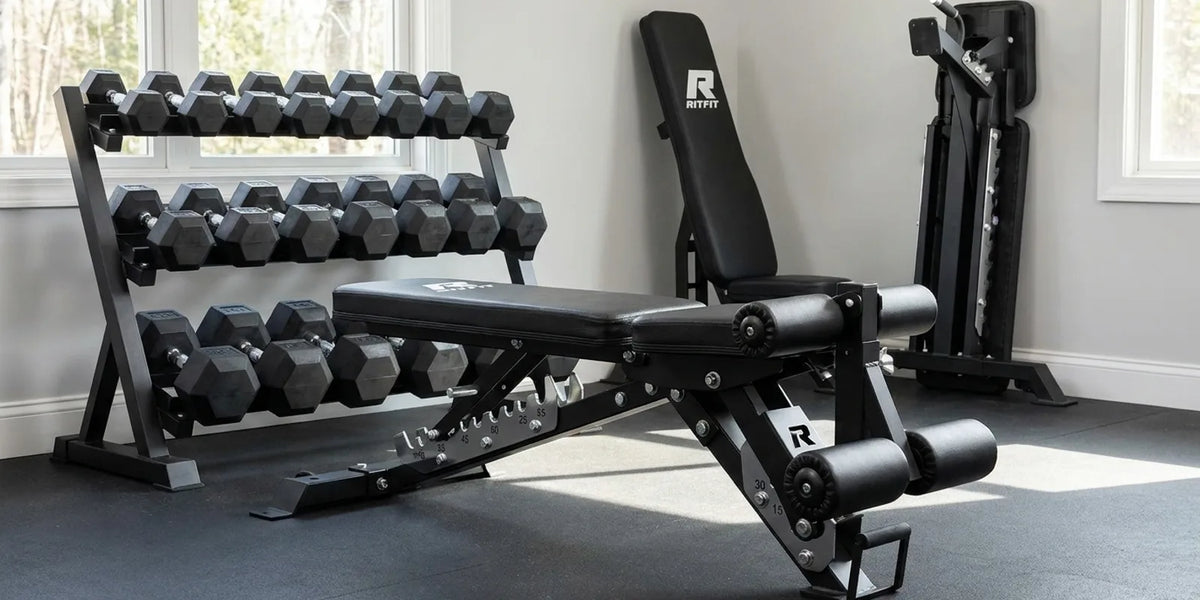
Any flat, stable bench works, and the RitFit 1300LB adjustable weight bench is a lower-cost platform that handles bodyweight holds easily. If you are still choosing hardware, the weight bench lineup covers every frame style, and the priority is a bench that does not rock or slide.
"They're good for everything from chest presses, dumbbell bench presses, incline bench supersets, skull crushers, glute bridges, incline rows to hit your back, ab moves, quad and leg moves like split squats, and more biceps moves than you can imagine."
Ebenezer Samuel, C.S.C.S. Fitness Director at Men's Health, on The Best Weight Benches of 2026
"Wow! This is not my first weight bench, but I am confident it will be my last. The ease of use and ability to move around the cable machine from one exercise to the next is awesome. Regardless of the exercise I am performing I feel secure and stable. It is an awesome product."
Richard R. Verified Buyer, RitFit GATOR 1600LB Adjustable Weight Bench
Set Your Hands on the Bench and Find Your Line
Hand placement decides the bench reverse plank, so set both palms flat on the rear edge of the bench just outside your hips with your fingers pointing toward your body. Keep your elbows straight but not locked, and turn your fingers outward if the standard position feels tight through the shoulders.
- Bench check: Place the bench on flat ground and push it once with both hands, because a bench that slides during the hold turns the exercise into a balance test.
- Palm position: Grip the rear edge with palms flat and fingers pointing toward your body, with the hands just outside hip width so the arms stay vertical.
- Shoulder position: Draw the shoulder blades back with a light scapular retraction so the chest stays open instead of letting the shoulders hunch forward.
- Body line: Aim for a neutral spine and one straight line from shoulders to heels, with the hips level between the shoulders and knees.
The bench itself must sit flat and stay put while you hold. RitFit lists the RitFit GATOR adjustable weight bench at a total load capacity of 1600 lbs including body weight and added weights, with a product weight of 109.1 lbs and a product height from 14.6 to 51.3 inches, and the GATOR Pink edition carries the same specification in another colorway.
Lift Into the Hold Step by Step
The lift into a bench reverse plank runs in one slow motion from a seated start to a straight-line hold. Set your hands first, drive the hips up second, and lock the line from shoulders to heels last.
- Step 1: Sit and set the hands. Sit on the floor with your back to the bench and both palms on the rear edge just outside your hips.
- Step 2: Walk the feet out. Extend your legs until your heels rest on the floor and the legs are nearly straight.
- Step 3: Drive the hips up. Push through the heels and palms to lift the hips until shoulders, hips, and knees form one straight line.
- Step 4: Brace and hold. Tighten the abdominals, keep breathing evenly, and hold the line for the planned time before lowering the hips back to the floor.
One EMG study found that adding an abdominal hollowing action to prone plank holds raised oblique and lumbar erector spinae activation compared with the standard plank in 20 participants.[3] That comparison tested the prone plank position rather than the reverse plank, so use the draw-in as a bracing cue and nothing more.
Pick Your Hold Time, Sets, and Frequency
Hold time for the bench reverse plank starts at roughly ten to twenty seconds per set and grows only while the straight line stays clean. One coaching guide programs the move by level, and two to three sessions per week with a rest day between them is a practical starting point for home gym trainees.
| Level | Sets | Hold Time per Set | Weekly Frequency |
|---|---|---|---|
| Beginner | 4 | 15-30 seconds | 2-3 sessions |
| Intermediate | 4 | 45-60 seconds | 2-3 sessions |
| Advanced | 2-3 | 90-120 seconds | 2-3 sessions |
Set and hold-time ranges are one coaching guide's template, not a clinical prescription. Adjust to your own form quality.
- End the set early: Stop the moment the hips sag or the shoulders roll forward, because extra seconds with broken form do not build the hold.
- Rest between sets: Rest until the straight line feels easy to rebuild, then start the next set with the same clean setup.
- Keep weekly volume modest: Two to three sessions per week leaves recovery days between holds while the shoulders and wrists adapt to the position.
Progress to Single-Leg Holds and Hip Lifts
Single-leg holds and hip lifts are the two natural reverse plank progressions once a two-leg bench hold feels easy for 45 to 60 seconds. Both progressions load the same posterior chain harder without changing your hand position on the bench edge.
- Single-leg reverse plank: Lift one foot a few inches off the floor while the hips stay level, hold for half the set, then switch sides.
- Reverse plank hip lift: Lower the hips toward the floor under control, then drive them back up to the straight line for slow repetitions.
- Bent-knee reverse table top: The regression for tired shoulders, with the knees bent and the feet flat so the legs carry more of the load.
- Glute bridge alternative: When the shoulders need a full break, the glute bridge trains the same hip extension pattern lying on the floor.
When to Move Up
Move up one level only when the current hold stays clean for the full planned time on both sides. If the hips sag at the end of a set, add time at the current level before touching the progressions.
"Very functional and sturdy. The back is adjustable and so is the seat. Also has wheels"
Khristian P. Verified Buyer, RitFit 1300LB Adjustable Weight Bench BWB01
Fix the Common Mistakes
Sagging hips are the most common fault in the bench reverse plank, and coaching guides flag the same short list of form errors in their tutorials. Every fault on the list has a simple fix you can apply on the very next hold.
- Sagging hips: The hips drop below the line when the glutes let go, so end the set or shorten the hold until the hips stay level again.
- Hunched shoulders: Shoulders rolling forward collapse the chest, and a light scapular retraction keeps the upper back engaged through the hold.
- Locked elbows and knees: Hyperextending the joints shifts work away from the muscles, so keep a soft bend at the elbows and knees.
- Tilted head: Dropping or craning the head breaks the neck line, so look straight up at the ceiling with the chin neutral.
- Arched lower back: An overarched lower back usually means the abs let go, so brace the abdominals and keep a neutral spine through the whole hold.
One form guide notes that the textbook hand position is fingers pointing toward your body, and turning the fingers outward can help tight shoulders. Match the hand rotation to your own mobility before blaming the hold.
Know When to Stop the Set
A bench reverse plank set ends the moment your hips begin to sag or your shoulders roll forward, because the posterior chain work stops once the straight line breaks. End the set, rest, and start again only with a clean line.
- Form breakdown: Sagging hips or hunched shoulders mean the hold is done, not that you should grind out more seconds.
- Joint discomfort: Wrist or shoulder discomfort is a signal to stop and check your setup with a qualified professional rather than pushing through the set.
- Unstable bench: Skip the exercise entirely on any bench that slides, rocks, or sits on an uneven surface.
FAQs About Reverse Planks on a Weight Bench
Is a reverse plank on a weight bench easier than the floor version?
Yes, the bench version is easier for most people. With your hands raised on the bench your body slopes toward your feet, which shortens the leverage acting on your shoulders and hips compared with a flat floor hold. Start on the bench, then move to the floor as your holds get longer.
How long should I hold a bench reverse plank?
Hold the position only as long as your form stays clean. New lifters often start with sets of ten to twenty seconds, while a common coaching template builds toward four sets of forty-five to sixty seconds at the intermediate level. End any set the moment your hips begin to sag.
What muscles does the bench reverse plank work?
The bench reverse plank trains the back side of your body, mainly the glutes, hamstrings, and erector spinae of the lower back, with the abdominals working to keep your hips lifted. An EMG comparison found the reverse plank was the strongest activator of the dorsal core muscles tested.
Where should my hands go on the bench?
Place both palms flat on the rear edge of the bench just outside your hips, with your fingers pointing toward your body. If that angle feels tight through the shoulders, turn your fingers outward instead. Keep your elbows straight but not locked, on a bench edge that will not slip.
How much weight does the RitFit Gator bench hold?
The RitFit GATOR 1600LB Adjustable Weight Bench is rated for a total load of 1600 lbs, a figure that includes your body weight together with any added weights. That total-load rating comes from the official RitFit product specifications and should not be rounded up.
How heavy is the RitFit Gator bench?
The RitFit GATOR bench weighs 109.1 lbs according to the official specification table. Its listed footprint is 57.8 inches long and 25.2 inches wide, and the product height ranges from a minimum of 14.6 inches to a maximum of 51.3 inches.
Can beginners start with the bench reverse plank?
Yes, the raised hand position makes the bench version the friendly entry point, and beginners can train it well before the floor version. Start with short holds of five to twenty seconds, rest between sets, and only add time when your hips and shoulders stay in one clean line.
How often should I do reverse planks each week?
Two to three sessions per week is a practical starting point for most home gym trainees, with a rest day between sessions. Treat the reverse plank as accessory work at the end of a lower body or back session, and keep total hold time modest while your shoulders adapt.
Conclusion
The reverse plank on a weight bench is the beginner-friendly entry to posterior chain work, and the path is simple: set the hands, hold a clean line, and add time before adding difficulty.
Pair the hold with the bench ab workout for midline work or dragon flags on a weight bench for a harder challenge, use the weight bench guide to plan your bench training, and check the weights and plates once bodyweight holds get easy. The RitFit discount guide is worth a look before any upgrade.
Disclaimer
This article is general fitness information and is not medical, physical therapy, or rehabilitation advice. Consult a qualified healthcare professional before starting this or any exercise program, especially if you have shoulder or wrist concerns.
References
1. Zahiri A, Alizadeh S, Daneshjoo A, Pike N, Konrad A, Behm DG. Core Muscle Activation With Foam Rolling and Static Planks. Front Physiol. 2022;13:852094. doi:10.3389/fphys.2022.852094. PMCID: PMC8964357
2. Koo DK, Nam SM, Kwon JW. Immediate Effects of the Reverse Plank Exercise on Muscle Thickness and Postural Angle in Individuals with the Forward Shoulder Posture. J Funct Morphol Kinesiol. 2022;7(4). doi:10.3390/jfmk7040082. PMCID: PMC9624361
3. García-Jaén M, Cortell-Tormo JM, Hernández-Sánchez S, Tortosa-Martínez J. Influence of Abdominal Hollowing Maneuver on the Core Musculature Activation during the Prone Plank Exercise. Int J Environ Res Public Health. 2020;17(20). doi:10.3390/ijerph17207410. PMCID: PMC7600276