








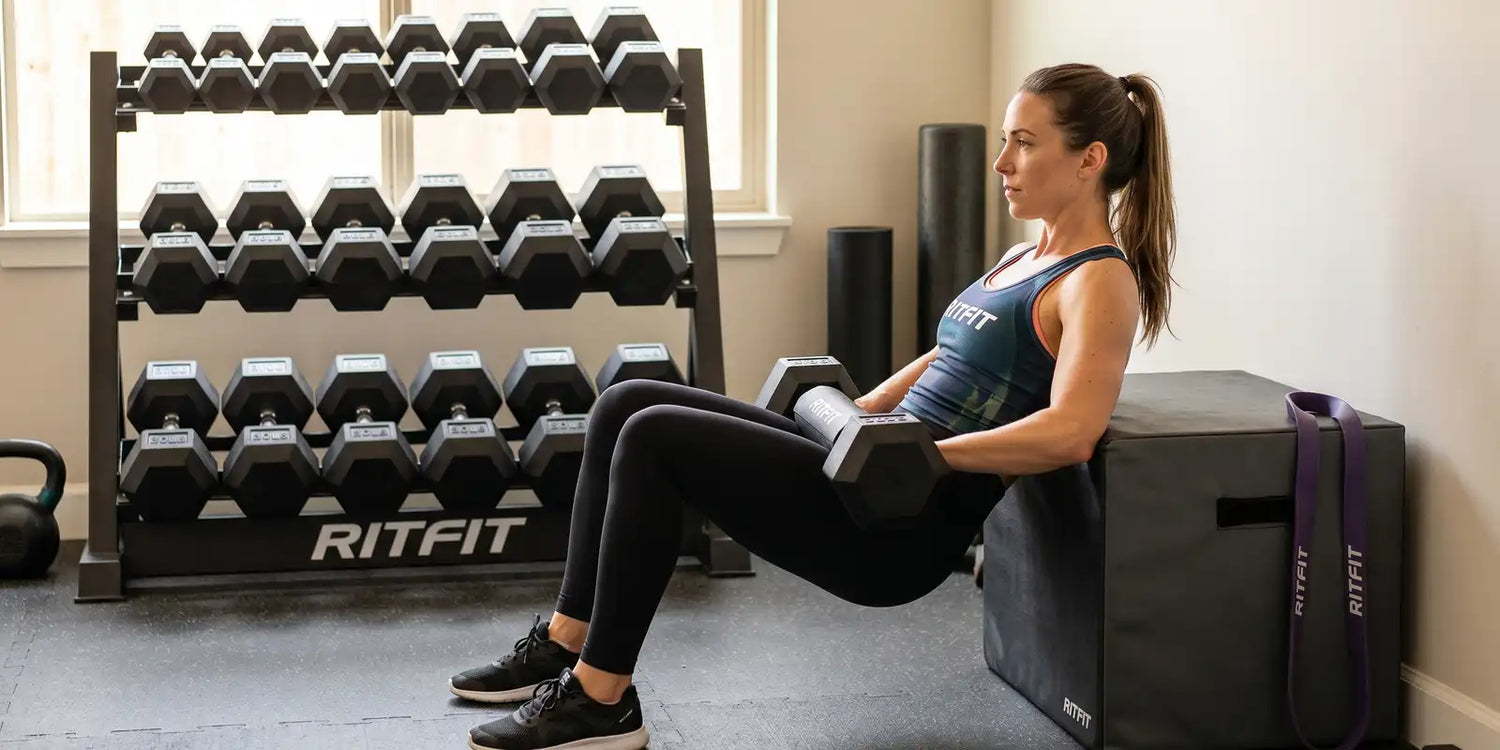
Strong hips are the foundation of nearly every movement you make, from walking upstairs to lifting a barbell. When the hip muscles are underdeveloped, the knees, lower back, and ankles are forced to compensate, which is often where pain begins.
This guide covers the anatomy of the hip complex, clear signs of weakness, and a progressive exercise plan from beginner bodyweight drills through resistance band and weighted movements.
Table of Contents
Key Takeaways
- The hip complex includes the gluteus maximus, medius, and minimus, plus the hip flexors and deep rotators, all of which need targeted training.
- Weak hips are associated with knee pain, lower back discomfort, and reduced balance during single-leg activities.
- Bodyweight exercises like hip bridges and side-lying abduction build an effective foundation before adding resistance.
- Resistance band walks in a semi-squat posture produce moderate to high gluteus medius activation with minimal compensation from the tensor fasciae latae.
- Two to three dedicated hip-strengthening sessions per week is sufficient for most people to build meaningful strength and stability.
Why Hip Strength Matters
The hips are the body's primary power-transfer joint, connecting the lower limbs to the trunk for every push, pull, and pivot. Insufficient hip strength forces surrounding joints, especially the knees and lumbar spine, to absorb loads they were not designed to handle independently.
Stronger hips improve athletic performance, reduce injury risk, and make everyday tasks like climbing stairs, carrying groceries, or standing from a chair noticeably easier. They also play a direct role in maintaining balance during the single-leg stance phases of walking and running.
Key Muscles of the Hip Complex
The hip complex spans six movement planes, and training only one or two planes leaves functional gaps in stability and strength. The table below outlines the primary muscles and their roles.
| Muscle | Primary Action | Why It Matters |
|---|---|---|
| Gluteus maximus | Hip extension | Powers squats, deadlifts, running, and stair climbing |
| Gluteus medius | Hip abduction, pelvic stability | Keeps the pelvis level during single-leg stance; weakness is associated with knee pain and IT band syndrome[2] |
| Gluteus minimus | Hip abduction, internal rotation | Assists medius in frontal plane control |
| Hip flexors (iliopsoas) | Hip flexion | Critical for stepping, running cadence, and core stability |
| Piriformis and deep rotators | External rotation | Stabilize the hip joint; tightness restricts movement and loads the lower back |
| Hip adductors | Hip adduction | Control medial knee alignment; important in lateral and rotational movements |
Fitness guides and coaches emphasize training hips in all six movement planes, including extension, flexion, abduction, adduction, and both rotational directions, for complete functional hip strength. Focusing only on extension (squats and deadlifts) leaves the stabilizing muscles undertrained.
Signs Your Hips May Be Weak
Hip weakness is often felt in adjacent areas before the hips themselves become symptomatic. Common indicators include recurring knee pain on the inner or outer side, a tendency for the knee to cave inward during a squat or lunge, and low back fatigue after moderate activity.
Other signs include difficulty balancing on one leg, a visible drop of one hip during walking (contralateral pelvic drop), and chronic hip flexor tightness from prolonged sitting.
Addressing these signs early with targeted strengthening typically resolves the compensatory patterns before they progress to overuse injuries.
Bodyweight Hip Strengthening Exercises
Bodyweight exercises establish the neuromuscular patterns needed before adding external load. Start here if you are new to structured hip training or returning from a period of inactivity.
Hip Bridge
Lie on your back with knees bent and feet flat on the floor, hip-width apart. Drive through your heels to lift your hips until your body forms a straight line from shoulders to knees, hold for two seconds, then lower slowly.
Side-Lying Hip Abduction (Clamshell)
Lie on your side with hips stacked and knees bent to about 45 degrees. Keeping your feet together, rotate the top knee upward like an opening clamshell, pause at the top, then lower with control.
Research shows that performing this exercise with a slight forward (anterior) roll of the trunk raises gluteus medius and gluteus maximus activation to nearly the threshold associated with meaningful strength gains.[1]
Single-Leg Glute Bridge
From the same starting position as the standard bridge, extend one leg straight and drive your hips up using only the planted foot. This variation increases the demand on the stance-side gluteus medius and maximus significantly compared to the bilateral version.
Donkey Kick
Start on all fours with hands under shoulders and knees under hips. Keeping the knee bent to 90 degrees, drive one heel toward the ceiling until the thigh is parallel to the floor, then lower without letting the knee touch the ground.
Pair these foundational movements with the best hip exercises at home for glutes and mobility for a complete home session.
Resistance Band Progressions
Resistance bands add progressive overload to hip abductor and rotator exercises while allowing controlled movement in functional positions. A review of 13 studies found that lateral band walks performed in a semi-squat posture (approximately 30 degrees of hip and knee flexion) produce moderate to high activation of the gluteus medius and maximus, while minimizing compensation from the tensor fasciae latae.[2]
Lateral Band Walk
Place a loop band just above the knees and lower into a quarter-squat position with feet hip-width apart. Step sideways with consistent band tension, keeping the torso upright and avoiding lateral trunk sway.
Maintain the semi-squat depth throughout the entire set for maximum gluteal recruitment.
Monster Walk
With the band in the same position, step forward and diagonally outward, alternating feet to create a wide, waddling pattern. This variation combines hip flexion with abduction, training the glutes in a more functional, gait-like pattern than pure lateral stepping.
Banded Clamshell
Add a light resistance band just above the knees to the standard clamshell exercise for additional abductor loading. Progress by moving the band lower toward the ankles as strength improves, which increases the lever arm and the demand on the hip muscles.
Once you are comfortable with banded movements, the banded hip thrust is a natural next step that loads the gluteus maximus through a full range of hip extension.
Weighted Hip Exercises
Adding load through dumbbells, barbells, or cable resistance allows the hip muscles to be trained with enough stimulus for hypertrophy and maximum-strength development. Begin with loads that allow full range of motion and controlled tempo before increasing weight.
Single-Leg Squat (Pistol Variation)
Research found that the single-leg squat produced the highest integrated activation of the gluteus maximus and gluteus medius compared to the double-leg squat and front step-up.[3] Use a box or TRX for assistance when learning the movement pattern.
Sumo Deadlift
Set your feet wider than shoulder-width with toes angled out, then push your hips back to grip a dumbbell or barbell between your legs. The wide stance shifts emphasis to the hip adductors and glutes compared to a conventional stance, providing broader hip complex development.
Dumbbell Hip Thrust
Rest your upper back on a bench with a dumbbell across your hips, then drive through your heels to extend the hips to full lockout while squeezing the glutes. The dumbbell hip thrust is an accessible starting point before progressing to the barbell hip thrust for heavier loading.
Lateral Step-Up
Stand beside a box or step and drive the lead leg to step up laterally, fully extending the hip at the top before stepping back down. This movement trains hip abduction under load in a functional, single-leg weight-bearing position that translates directly to stairs and uneven terrain.
For additional lower-body compound movements that complement hip training, explore compound leg exercises for programming ideas.
How to Structure Your Hip Training
According to Houston Methodist, two to three focused hip-strengthening sessions per week provides enough frequency to build strength without overtaxing the smaller stabilizing muscles. Allow at least one rest day between sessions targeting the same muscle groups.
A well-rounded session follows this progression: start with bodyweight activations (bridges, clamshells) for 2 sets of 10 to 15 reps, then move to banded exercises (lateral walks, monster walks) for 2 to 3 sets of 15 to 20 steps per direction. Finish with weighted movements (single-leg squats, hip thrusts) for 3 sets of 8 to 12 reps.
Pair hip strengthening with balance and stability exercises to accelerate functional gains.
FAQs About How to Strengthen Hips
What are the best exercises to strengthen weak hips?
Yes, there is a clear starting point. Hip bridges and side-lying hip abduction are the most recommended entry-level exercises for the gluteus medius and maximus.
Once those feel easy, lateral band walks in a semi-squat position and single-leg squats provide progressively greater challenge for both stabilizing and prime-mover hip muscles.
How often should I do hip strengthening exercises?
No, daily sessions are not necessary. Two to three focused sessions per week is sufficient to build hip strength while allowing the stabilizing muscles adequate recovery time.
Spreading sessions across the week, rather than doing them back-to-back, produces more consistent gains than cramming volume into fewer days.
Can strengthening hips reduce knee pain?
Yes, it often can. Gluteus medius weakness is associated with dynamic knee valgus, the inward collapse of the knee during weight-bearing movement, which is a common contributor to patellofemoral and IT band discomfort.
Strengthening the hip abductors helps restore frontal-plane alignment, reducing stress on the inner and outer knee structures during walking and exercise.
Do I need equipment to strengthen my hips?
No. Bodyweight exercises including hip bridges, clamshells, donkey kicks, and single-leg glute bridges effectively target the hip complex with no equipment. A light resistance loop band costs very little and substantially increases the difficulty of these exercises, making it the single most cost-effective upgrade for home hip training.
How long before I notice stronger hips?
Results vary. Most people notice improved balance and reduced compensatory discomfort within two to four weeks of consistent training.
Measurable strength gains in the hip abductors and extensors typically become apparent after six to eight weeks, depending on starting fitness level and training frequency.
What causes weak hips in the first place?
Prolonged sitting is the most common cause. When the hips remain flexed for long periods, the hip flexors shorten and the gluteal muscles become less responsive, a pattern sometimes called gluteal amnesia.
Sedentary lifestyle, imbalanced training programs that overemphasize anterior chain exercises, and previous lower-limb injuries can all contribute to reduced hip strength over time.
Is hip strengthening safe for older adults?
Yes. Hip strengthening is especially beneficial for adults over 50, as muscle loss in the hip region accelerates with age and directly contributes to fall risk and reduced mobility.
Starting with bodyweight exercises in a supported, floor-based position is safe for most healthy older adults. Consulting a physician is recommended for those with existing hip or joint conditions.
Conclusion
Building stronger hips does not require complex equipment or long workouts. Consistent work across the full range of hip movements, from bodyweight bridges and clamshells to banded lateral walks and loaded single-leg squats, progressively develops the stability and strength that protect your joints and improve every movement you perform.
Start with two sessions per week, master the bodyweight foundations, then layer in band and dumbbell variations as your strength grows. For more structured lower-body training, explore compound leg exercises to build a complete program around your hip work.
Disclaimer
This article is for general informational and educational purposes only and does not constitute medical advice, diagnosis, or treatment. If you have a pre-existing hip condition, joint pain, or any musculoskeletal injury, consult a qualified healthcare professional before beginning a new exercise program.
References
- Baik SM, Cynn HS, Shim JH, et al. Effects of Log-Rolling Position on Hip-Abductor Muscle Activation During Side-Lying Hip-Abduction Exercise in Participants With Gluteus Medius Weakness. J Athl Train. 2021;56(9):945-951. https://pmc.ncbi.nlm.nih.gov/articles/PMC8448474/
- González-de-la-Flor Á. Optimizing Hip Abductor Strengthening for Lower Extremity Rehabilitation: A Narrative Review on the Role of Monster Walk and Lateral Band Walk. J Funct Morphol Kinesiol. 2025;10(3). https://pmc.ncbi.nlm.nih.gov/articles/PMC12372021/
- Lubahn AJ, Kernozek TW, Tyson TL, et al. Hip muscle activation and knee frontal plane motion during weight bearing therapeutic exercises. Int J Sports Phys Ther. 2011;6(2):92-103. https://pmc.ncbi.nlm.nih.gov/articles/PMC3109897/





