








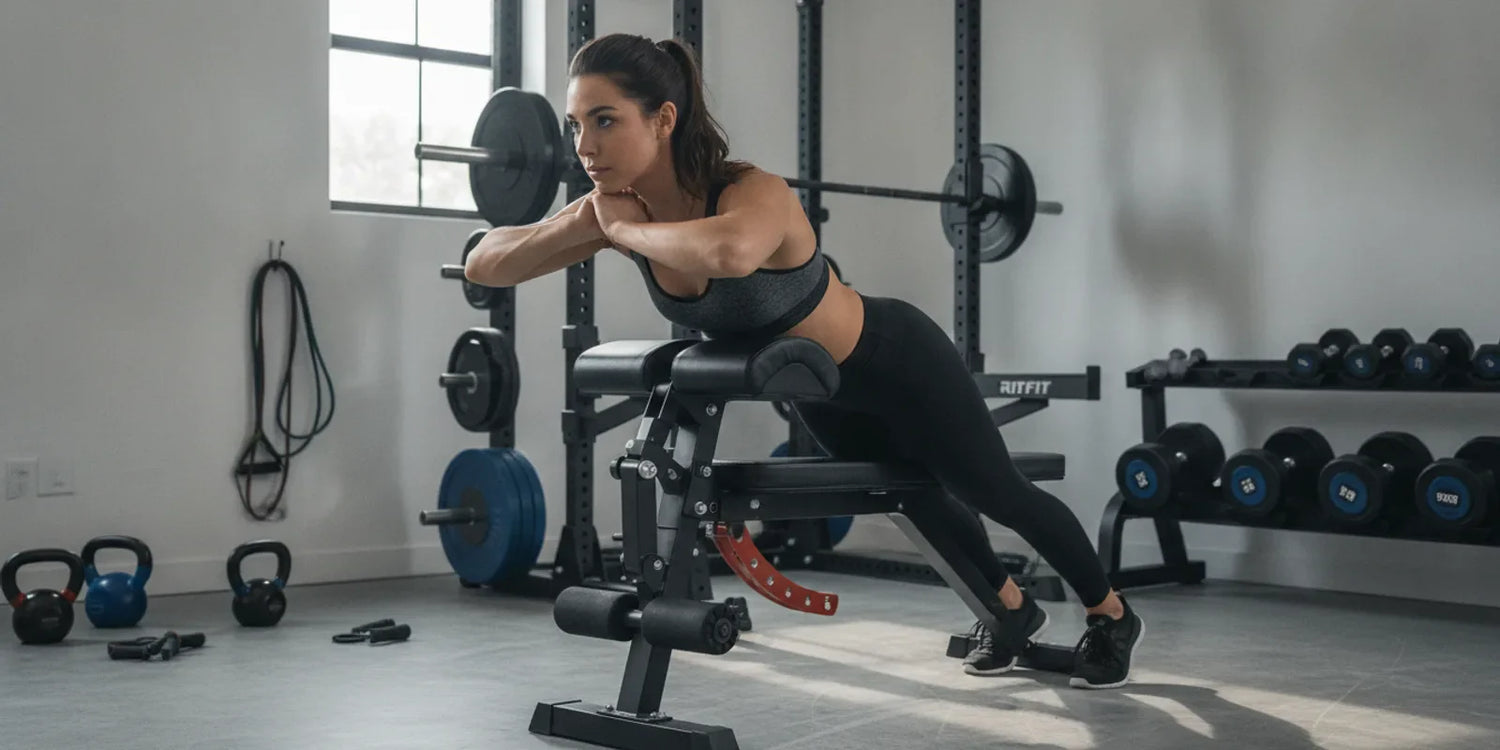
Hyperextensions for glutes build the gluteus maximus when you hinge at the hips and squeeze instead of arching your lower back. This guide shows you how to make the movement glute dominant rather than a lower back exercise, from pad height and body position to rep ranges, common mistakes, and home substitutes.
You will also see how to load and program the movement and what to look for in a home back extension machine. Stop if you feel sharp pain, and ease in if hip hinging is new to you.
Quick Answer: The single change that makes hyperextensions a glute exercise is hinging at the hips with a slight posterior pelvic tilt and stopping at a straight line. Set the top pad two to three inches below your hip crease, drive up with a glute squeeze, and train three to four sets of fifteen to twenty reps.
Key Takeaways
- Intent decides the muscle: Hyperextensions become a glute builder only when you hinge at the hip and squeeze the glutes, not when you arch your spine.
- Pad height is the setup lever: Place the top pad about two to three inches below your hip crease so your hips can fold freely.
- Cue the tuck: A slight posterior pelvic tilt with a softly rounded upper back takes the lower back out and loads the glutes.
- Stop at a straight line: Rising past horizontal shifts work back to the spine, so finish level and squeeze.
- No bench needed: Glute bridges, hip thrusts, and bird dogs train the same hip extension pattern at home.
What Are Hyperextensions and Which Muscles Do They Target?
Hyperextensions are a hip hinge exercise performed on a 45 degree or horizontal bench that trains the posterior chain. Which muscle dominates depends on how you move, not on the machine itself.
- Glutes: The gluteus maximus extends the hip and becomes the target when you keep the spine neutral and hinge.
- Hamstrings: They assist hip extension and stabilize you through the bottom stretch.
- Erector spinae: These take over when you arch and extend through your spine instead of your hips.
An observational study of posterior chain activity confirms that the gluteus maximus is recruited alongside the hamstrings and erectors during extension exercises[1]. For a wider view of equipment, see our guide to the best gym machines for glutes.
How Do You Make Hyperextensions Glute Dominant Instead of Lower Back Dominant?
Hyperextensions become glute dominant when you hinge from the hips with a posterior pelvic tilt instead of extending through your lumbar spine. That shift takes the workload off your erectors and puts it on your glutes and hamstrings.
In one EMG trial, researchers reported that hip extension produced a higher lumbar multifidus to erector spinae activation ratio than trunk extension, and that glute contraction generated a posterior pelvic tilt torque that helped stabilize the pelvis[2]. Trunk extension, by contrast, loaded the erectors most.
If you feel back extensions only in your lower back, this is almost always the fix. Pairing them with a Smith machine glute bridge reinforces the same hip extension pattern.
"By rounding the spine and posteriorly tilting the pelvis, you take the erectors out of play so that the glutes and hamstrings perform the movement. You want pure hip extension with some posterior pelvic tilt when you do back extensions, NOT anterior pelvic tilt."
Bret Contreras, PhD, Sports Scientist, Contreras Strength Institute
How Do You Set Up the 45 Degree Bench for Glutes?
Set the top of the hip pad about two to three inches below your hip crease so your pelvis can hinge freely over the edge. A pad set too high near your stomach blocks the hinge and forces a spinal movement instead.
Pad Height and Foot Position
Work through each checkpoint below before you add any load, because a sloppy setup is what turns the movement into a lower back exercise.
- Pad height: The top edge sits just below the hip crease, leaving your hips free to fold.
- Feet and ankles: Lock your heels firmly against the back plate and let your inner thighs rest on the pads.
- Foot angle: Turn your toes slightly outward to encourage hip external rotation and stronger glute recruitment.
- Knees: Keep a soft bend rather than locking out, which keeps the glutes involved.
A stable RitFit bench can stand in for the hip hinge pattern when a dedicated unit is unavailable.
How Do You Perform Glute Focused Hyperextensions Step by Step?
To perform glute focused hyperextensions, hinge down at the hips until you feel a stretch, then drive your hips into the pad and squeeze the glutes to rise. Keep the spine neutral or slightly rounded throughout.
- Descend: Push your hips back and lower until you feel a glute and hamstring stretch.
- Rise: Think of a hip thrust into the pad, driving up with the glutes rather than pulling with your back.
- Finish: Stop at a straight line and add a firm posterior pelvic tilt and glute squeeze.
For a no machine version of this hinge pattern, explore the best hip exercises at home for glutes.
How Many Sets and Reps Should You Do, and When Do You Add Weight?
Train hyperextensions in higher rep ranges for glute development because the bodyweight load is light. A practical starting point is three to four sets of fifteen to twenty reps with a strong glute squeeze on every rep.
- Bodyweight focus: One guide suggests sets of twenty to thirty reps as an end of workout finisher for a deep glute burn.
- Tempo: Try three seconds down, a one second squeeze at the top, and one second back down.
- When to add weight: Hold a plate to your chest only after your glute contraction and neutral spine stay consistent across full sets.
Keep the plate close to your body to hold tension on the glutes. A body bar for lower body glute work offers another way to add light, controlled load.
What Are the Most Common Mistakes and When Should You Stop?
The most common mistake is hyperextending the spine at the top instead of stopping at a straight line, which moves work from your glutes to your lower back. Stop the set immediately if you feel a sharp twinge in your lower back.
- Arching at the top: Finish level with your body, not in a banana shaped back position.
- Pad too high: If the pad sits at your stomach, lower it to the hip crease so you can hinge.
- Pulling with the back: Drive up with the glutes, not by yanking your torso up with your upper back.
Going higher does not mean better glute work, and one study found that gluteus maximus activity did not differ significantly across different ranges of extension[3]. The hip abduction machine for glutes is a low strain option on recovery days.
What Can You Do Instead if You Have No Hyperextension Bench?
If you have no hyperextension bench, glute bridges, hip thrusts, single leg hip thrusts, and bird dogs train the same hip extension pattern with a glute focus. They keep the lower back neutral while loading the posterior chain.
- Glute bridges and hip thrusts: Direct hip extension you can load with a barbell or band.
- Single leg variations: Build balance and address side to side strength gaps.
- Bird dogs and Romanian deadlifts: Reinforce a neutral spine and a clean hip hinge.
A RitFit 2 in 1 hip thrust attachment makes loaded hip extension simple at home, and you can compare more options in our roundup of the best Smith machine exercises for glutes.
How Do You Program Hyperextensions in Your Routine?
Program hyperextensions two to three times per week, usually as an accessory or finisher after your main lower body lifts. They pair well with squats and deadlifts because they strengthen end range hip extension without heavy spinal loading.
- Placement: Use them late in a leg or glute session when heavy compound work is done.
- Frequency: Two to three light sessions per week build the mind muscle connection.
- Progression: Add reps first, then light external load once form holds.
Build your full setup around a versatile rack with our power rack packages, or add a RitFit 1300LB Adjustable Weight Bench for loaded hip extension substitutes.
Should You Buy a RitFit BE01 Back Extension Machine for Your Home Gym?
The RitFit BE01 Adjustable Back Extension Machine is a compact posterior chain station for hyperextensions, GHD style sit ups, and band resisted work. Its 660 lb static load rating and 36 month frame warranty suit a home lifter who plans to add load over time.
Durability comes from a 2 x 3 in (50 x 75 mm) steel frame with a 1.5 mm wall, and the wide set base keeps the unit planted during heavy extension work.
The adjustability is the real argument for this machine in a garage gym, because one footprint covers several posterior chain movements.
- Versatility: 12 positions combine five pad angles from -7 to 25 degrees, three roller spacings, and four slider settings, which fits users from 4 ft 7 in to 6 ft 3 in.
- Padding and support: The 4.3 in curved split pad supports the spine, and the 17.3 x 13.4 in footplate locks the heels in place under load.
- Warranty: RitFit covers the main frame for 36 months and parts for 12 months.
- Add on resistance: Built in band pegs let you add resistance without extra equipment.
| Specification | RitFit BE01 |
|---|---|
| Frame | 2 x 3 in steel tubing (50 x 75 mm), 1.5 mm wall |
| Static load rating | 660 lb (300 kg) |
| Footprint | 32.3 x 44.8 in |
| Overall height | 35.7 in |
| Back pad | 4.3 in thick, 18.5 in long |
| Adjustment system | 12 positions: 5 pad angles, 3 roller spacings, 4 slider positions |
| User height range | 4 ft 7 in to 6 ft 3 in |
| Unit weight | 116 lb, two shipping boxes |
Specifications from the RitFit BE01 product page, checked September 2026.
Verified buyers describe the BE01 as a tank that will not budge, and one reviewer at 6 ft 3 in and 198 lb reported no movement during heavy back extensions and curls.
At $439.99, the BE01 covers posterior chain, core, and upper back work from a 32.3 x 44.8 in footprint with transport wheels for storage. Skip it if you need a true 45 degree angled extension, because the pad angle tops out at 25 degrees.
"The machine feels extremely solid and stable, even under heavy loading. The 660lbs weight capacity feels very realistic, if not conservative."
Alec Enkiri, Equipment Reviewer, Enkiri Elite Fitness
"Super great quality i love my new back extension machine."
Alexis B. Verified Buyer, RitFit BE01 Adjustable Back Extension Machine for Home and Gym
FAQs About Hyperextensions for Glutes
Do hyperextensions actually build glutes?
Yes, when you perform them as a hip hinge with a posterior pelvic tilt rather than arching your spine. By keeping the lumbar spine neutral, rounding the upper back slightly, and driving up with a hard glute squeeze, you shift most of the work from your lower back onto your glutes and hamstrings, making it an effective glute builder.
Where should the pad sit for glute focused hyperextensions?
Position the top of the pad about two to three inches below your hip crease so your hips can hinge freely. If the pad sits too high near your stomach, your range of motion shrinks and the movement turns into a lower back exercise. The correct height lets you fold deeply at the hip.
How many reps of hyperextensions should I do for glutes?
For glute development, higher reps work well because the exercise is light. A common approach is three to four sets of fifteen to twenty bodyweight reps, focusing on a strong glute squeeze at the top. Some coaches push sets of twenty to thirty reps as a finisher. Add weight only once your form and glute contraction stay consistent.
Why do I only feel hyperextensions in my lower back?
Feeling it in your lower back usually means you are extending through your spine instead of your hips. Fix it by tucking your pelvis under, rounding your upper back slightly, stopping when your body reaches a straight line, and squeezing your glutes to drive up. Rotating your feet outward also helps recruit the glutes.
What can I do instead of hyperextensions if I have no bench?
If you lack a hyperextension bench, glute bridges, hip thrusts, single leg hip thrusts, and bird dogs all train hip extension with a similar glute focus. Romanian deadlifts and back extensions performed over a sturdy padded bench also work. These substitutes let you target the posterior chain at home while keeping the lower back in a safe, neutral position.
What should I look for in a home back extension machine?
Look for a pad that adjusts below your hip crease, a frame rated well above your body weight, and a footplate that locks your heels in place. Multiple pad angles let you shift between flat and angled hyperextensions. Compact footprints under 45 inches deep suit most garage gyms, and transport wheels make storage easier.
Conclusion
Hyperextensions become a genuine glute builder the moment you hinge at the hips, tuck the pelvis, and stop at a straight line with a hard squeeze. Set the pad below your hip crease and let your glutes drive every rep.
Start with bodyweight sets of fifteen to twenty reps, add light load only when your form holds, and use glute bridges or hip thrusts as easy home substitutes. Check the RitFit discount guide before you build out the rest of your setup.
Disclaimer
This article is for general educational purposes only and does not replace professional medical or fitness advice. Consult a qualified trainer or healthcare provider before starting new exercises, especially if you have back pain or an existing injury.
References
1. De Ridder EM, Van Oosterwijck JO, Vleeming A, Vanderstraeten GG, Danneels LA. Posterior muscle chain activity during various extension exercises: an observational study. BMC Musculoskelet Disord. 2013;14:204. doi:10.1186/1471-2474-14-204. PMCID: PMC3716991
2. Kim JS, Kang MH, Kim JW, Lee DK, Yoon TH, Oh JS. Selective Activation of Lumbar Paraspinal Muscles during Various Exercises in the Prone Position as Measured by EMG. J Phys Ther Sci. 2014;26(8):1223-4. doi:10.1589/jpts.26.1223. PMCID: PMC4155224
3. Kim SM, Yoo WG. Comparison of trunk and hip muscle activity during different degrees of lumbar and hip extension. J Phys Ther Sci. 2015;27(9):2717-8. doi:10.1589/jpts.27.2717. PMCID: PMC4616077





