








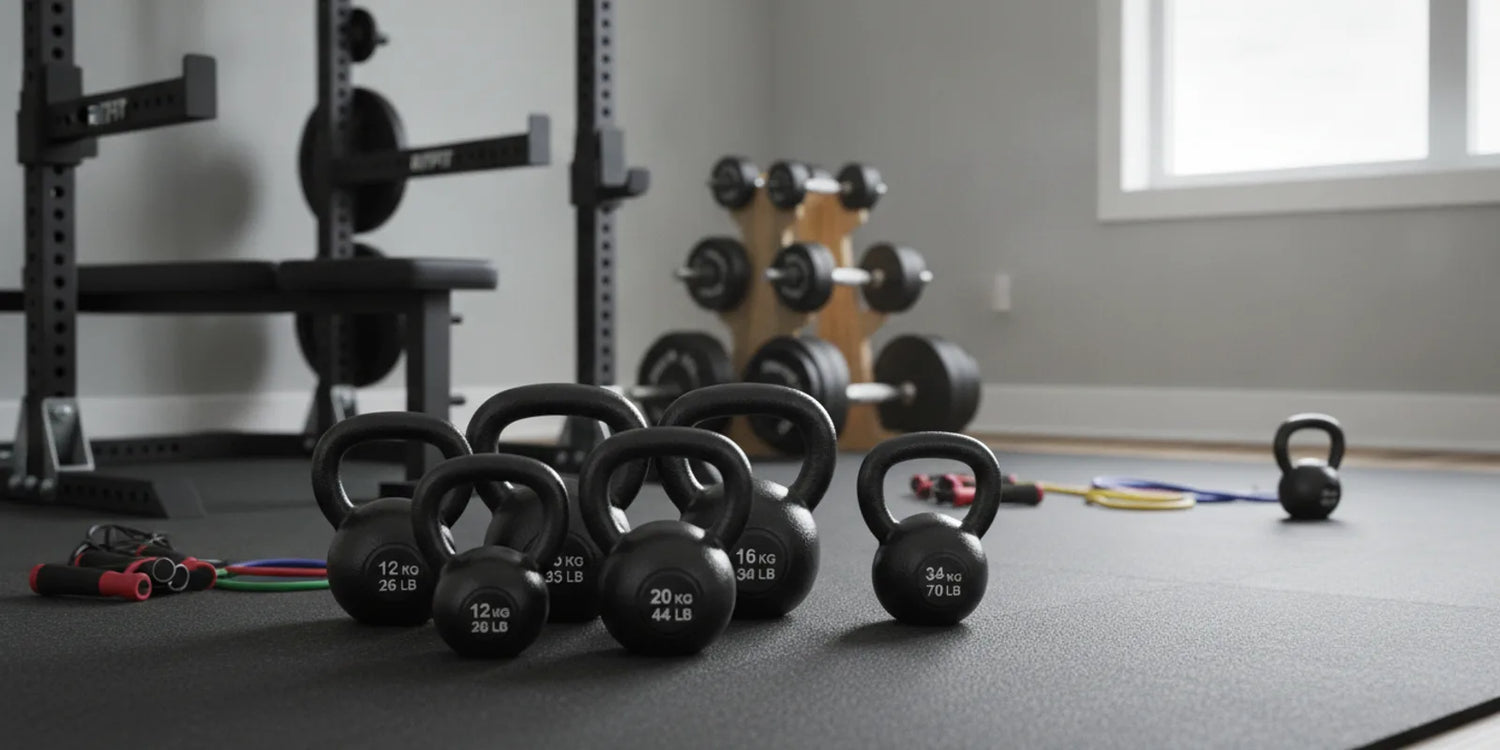
Shopping for a kettlebells set for sale online means deciding weight, material and how many bells you truly need before you click buy. This guide walks through each choice so you start with a set you will actually use, not one that gathers dust.
The honest answer for most home trainers is cast iron, a modest two-bell start and room to grow. We cover cast iron, competition and adjustable options, a weight guide by goal, and the specific cases where a 28 kg bell makes sense.
Quick Answer: The right kettlebell set for sale for most home gyms is two cast iron bells, one around 16 kg for swings and one lighter for presses, with competition or adjustable options reserved for consistent technique. A 28 kg bell belongs to experienced lifters, so start modest and grow the set.
Key Takeaways
- Start small: Two cast iron bells, roughly 16 kg and 8 kg, cover most home workouts before any full set.
- Material matters: Cast iron suits most home users, while competition and adjustable bells serve specific needs.
- Match weight to goal: Use a lighter bell for presses and get-ups, a heavier one for swings and hinges.
- Heavy is advanced: A 28 kg kettlebell fits trained lifters doing two-hand swings and squats, not beginners.
- Buy what you use: A 4-5 bell cast iron set under $200 is enough if you actually train with every weight.
How Many Bells Do You Actually Need?
Most home trainers need only two kettlebells, a moderate bell for swings and hinge work plus a lighter bell for presses and get-ups. A full set purchased before you know your go-to weights usually leaves most of it unused.
- Efficient conditioning: A 2024 review of kettlebell training noted that 12 minutes of continuous kettlebell swings produced a metabolic challenge around 87% of maximal heart rate and 65% of maximal oxygen consumption.[1]
- One moderate, one light: Use the moderate bell for swings, squats and carries, then the lighter bell for presses and get-ups.
- Grow later: Add a heavier bell only when your current weight stops challenging your hinge work.
For hinge patterns such as how to do kettlebell deadlifts, a single moderate bell is usually enough to build the movement. If you are new to the exercise, how a simple kettlebell can change your life is a good first read.
Cast Iron vs Competition vs Adjustable: Which Style Fits?
Cast iron kettlebells fit most home users because they are affordable and durable, while competition bells keep one uniform size across all weights. Adjustable bells replace several fixed weights in a single compact object, which suits small apartments.
- Cast iron: Most home gym buying guides agree that cast iron suits most home users, though the shell grows as the weight climbs.
- Competition: The same dimensions and handle size across every weight let technique transfer cleanly, which matters most for snatch practice.
- Adjustable: One bell covers a wide range and saves floor space, but internal mechanisms can wear under heavy ballistic use.
An adjustable model replaces several fixed bells, and this video shows the practical trade-offs to weigh before you buy.
How Do I Choose the Right Kettlebell Weight?
Most guides recommend that men start near 16 kg for swings and women near 8 kg, then choose a lighter bell for presses and get-ups. Start light enough to keep clean form, since the hips and legs dominate the movement.
- Swings and hinges: A 16 kg bell is the common male start, while 8 kg is the common female start for swings.
- Presses and get-ups: Drop one step lighter, since the shoulders carry less load than the hips.
- Progression: Move up only after your current bell feels easy for full sets of clean swings.
| Weight | Best For |
|---|---|
| 8 kg | Swings start for many women, presses and get-ups for beginners |
| 16 kg | Common male start for swings and hinge work |
| 24 kg | Next step once 16 kg feels easy for full reps |
| 28 kg | Experienced lifters doing two-hand swings and carries |
Weight recommendations are general guidance for home trainees, not a one-size-fits-all rule.
For a structured start, the ultimate beginner kettlebell workout guide builds the fundamentals in small steps. Once swings feel natural, how to do the kettlebell snatch explains the next skill to learn.
What to Look For: Handle, Coating and Stability?
Most guides recommend a 32-35 mm handle as the universal sweet spot for swings, cleans and presses, since it fits most palm sizes. A quality coating and a flat, stable base matter just as much for grip and floor safety.
- Handle diameter: A 32-35 mm handle suits most hands and transfers well across swings, cleans and presses.
- Coating: A smooth, non-slip finish protects floors and grips better than a glossy, slippery vinyl coat.
- Base stability: A flat bottom keeps the bell stable during rack holds and floor rests.
RitFit presents its kettlebells as a neoprene-coated series, with full details in the Neoprene Kettlebell Technical Specification. General sizing and care guidance sits on the Kettlebell General Info page.
When Does a 28 kg Kettlebell Make Sense?
A 28 kg kettlebell fits experienced lifters who already control a 20-24 kg bell through clean swing reps, and it works best for two-hand swings, squats and carries. Beginners should start near 8-16 kg and progress only when their current weight feels easy.
- Who it fits: Lifters with a solid base in hinge movements who find their current bell too light.
- What it does well: Two-hand swings, goblet squats and farmer carries, not overhead pressing.
- What it does not: Not a first purchase and rarely a daily press weight for most trainees.
If you already handle a heavy bell for full reps, is a 32 kg kettlebell right for you explains the next step up.
What Should a Good Kettlebell Set Cost?
One buying guide notes that adjustable kettlebells usually run about $100-$300, while a basic 4-5 bell cast iron set can come in under $200. Real costs depend on the brand, shipping and whether you buy singles first.
- Singles first: Buying one or two bells is cheaper than a full set and avoids unused weights.
- Set value: A modest 4-5 bell cast iron set offers clean progression across strength, conditioning and press work.
- Adjustable trade-off: An adjustable bell near $100-$300 replaces several fixed bells, which suits tight spaces.
For a different load tool at a similar price, the best dumbbell sets for home gym article compares the alternatives.
How Do You Build Your Set Over Time?
Build the set in steps, buy your two go-to weights first, train for several weeks, then add a heavier bell only when the moderate weight stops challenging you. Most buyers regret full sets they only touch half of, so grow deliberately.
- Step 1: Start with two cast iron bells, one moderate and one light.
- Step 2: Add a heavier bell for swings and hinge work once the moderate one feels easy.
- Step 3: Fill gaps for presses, carries or heavier conditioning only if you train them weekly.
If your home setup already uses a rack with a weight stack, the RitFit WSM1 weight stack set for M1 is a complementary load tool for plate-free progression.
What Buying Mistakes Should You Avoid?
The biggest buying mistakes are starting too heavy, choosing slippery handles and buying weights you never use. Each one is avoidable with a modest two-bell start and a clear goal.
- Starting too heavy: A bell that is too heavy ruins form and drains motivation, so err light.
- Slippery handles: Glossy vinyl coatings lose grip with sweat, so check the finish before you buy.
- Unused weights: Full sets often include bells you never touch, so buy the weights you use weekly.
Choose the weight that serves your goal, the material that fits your space and the number of bells you will actually rotate.
"Start with the kettlebell. It's the best entry point."
Pavel Tsatsouline, Founder of StrongFirst, credited with popularizing kettlebells in the West, StrongFirst
FAQs About Kettlebell Sets
What weight kettlebell should a beginner start with?
Most home gym guides recommend men start with a 16 kg bell for swings and women with an 8 kg bell, then add a lighter bell for presses and get-ups. Start slightly light because swings load the hips, glutes and hamstrings, which are far stronger than your arms suggest, so form comes first.
Is a kettlebell set worth buying instead of single bells?
A set makes sense when multiple people train together or you want clean progression across strength, conditioning and press work. If you train alone and know your go-to weights, one or two singles are cheaper and avoid the unused bells that many buyers regret.
Are adjustable kettlebells as good as fixed cast iron bells?
Adjustable kettlebells cost around 100 to 300 dollars and replace four to six fixed bells, which suits small spaces. Their weight distribution differs and internal mechanisms can wear under heavy ballistic use, so most home gyms do fine with three or four cast iron bells.
Who should buy a 28 kg kettlebell?
A 28 kg bell, about 62 pounds, suits experienced lifters who already control a 20 to 24 kg bell through clean swing reps, and it fits two-hand swings, squats and carries rather than overhead pressing. Beginners should start near 8 to 16 kg and progress only when their current weight feels easy.
What is the difference between cast iron and competition kettlebells?
Cast iron kettlebells are affordable, durable and the practical choice for most home users, though their size grows with weight. Competition bells keep the same dimensions and handle size across weights, so technique transfers cleanly, which matters most for snatches.
How many kettlebells do I need for a home gym?
Most beginners need two kettlebells, one moderate bell for swings, squats and hinges and one lighter bell for presses and get-ups. Add a third only after you outgrow the moderate bell for hinge work, usually after several weeks of consistent training.
Conclusion
A kettlebell set for sale only helps when you actually use it, so buy two cast iron bells at a comfortable weight and grow the collection over time. Match the material to your space, keep handles around 32-35 mm and skip the heavy bell until your current weight feels easy.
Browse the RitFit Kettlebell collection to compare the neoprene options, then start with the weight that fits your goal.
Disclaimer
Kettlebell training carries a risk of injury, and the guidance here is general advice rather than personalized programming. Consult a qualified coach or healthcare professional before starting a new exercise routine, especially if you have prior injuries or medical conditions.
References
1. Jaiswal PR, Ramteke SU, Shedge S. Enhancing Athletic Performance: A Comprehensive Review on Kettlebell Training. Cureus. 2024;16(2):e53497. doi:10.7759/cureus.53497 PMCID: PMC10910645





