Proper leg extension form is decided before you touch the weight stack. Line your knee up with the machine's pivot, set the shin pad just above the ankle, and the quadriceps carries the load instead of the joint structures around it.
This guide covers every adjustment on the machine, from seat angle to foot position, then walks through execution tempo, load selection, the mistakes that cause knee strain, and the alternatives that keep quad volume high when a machine is not available.
Quick Answer: Proper leg extension form requires four setup checks before you load the machine: align your knee with the pivot, place the shin pad just above the ankle, lean the seat back to about 40 degrees of hip flexion, and grip the handles. Lift over 2 seconds and lower over 2 to 3 seconds for 10 to 12 controlled reps.
Key Takeaways
- Pivot alignment is non-negotiable: Your knee joint must line up with the machine's axis of rotation before every set, or joint stress rises no matter how light the load feels.
- Shin pad position matters: The pad belongs just above the ankle, not mid-shin, because a higher pad shortens the lever arm and puts pressure on the knee instead of the quad.
- Lean back for more rectus femoris growth: A reclined seat near 40 degrees of hip flexion rather than 90 degrees produces greater rectus femoris activation, according to E3 Rehab's reading of work by Larsen and colleagues.
- Controlled tempo protects the joint: Slow 2-to-3-second eccentrics hold tension through the lengthened range, which is where the vastus intermedius and the other quad heads contribute most.
- Start light and progress deliberately: Leg extensions isolate the quad, so clean reps at a moderate load build more muscle than heavy reps that rely on momentum and hip lift.
What Muscles Do Leg Extensions Work?
Leg extensions train all four heads of the quadriceps femoris: the rectus femoris, the vastus lateralis, the vastus medialis, and the deep vastus intermedius. Unlike squats or the leg press, this is a strict isolation movement, so the hamstrings and glutes contribute almost nothing to the lift.
- Rectus femoris: The only quad head that crosses the hip joint. Its activation increases when you lean back and reduce hip flexion angle, which makes seat position especially important for this muscle.
- Vastus lateralis: The large outer quad head. Activation stays relatively consistent across different knee angles during the movement.
- Vastus medialis: The teardrop-shaped inner quad. It works hardest near full extension, which is why a controlled lockout matters for complete VMO development.
- Vastus intermedius: The deep quad head sitting beneath the rectus femoris. A 2023 study in Scientific Reports found that the vastus intermedius is most active in the flexed, stretched position of the knee extension movement, which makes a deep starting position important for complete quad recruitment.[1]
Because leg extensions isolate the quads so completely, they pair well with compound movements like squats and lunges. Check out the top leg extension benefits to see where this exercise fits into a broader leg training program.
How Do You Set Up a Leg Extension Machine for Proper Form?
Correct leg extension machine setup comes down to four adjustments you make before adding any load: seat back angle, knee to pivot alignment, shin pad height, and foot position. Getting these four right is what keeps the resistance on the quadriceps and off the knee joint.
Step 1: Seat Back Position and Hip Angle
Slide the seat back far enough that you are leaning back rather than sitting bolt upright. E3 Rehab notes that a reclined position near 40 degrees of hip flexion, instead of 90 degrees, produces greater rectus femoris growth based on work by Larsen and colleagues.
Step 2: Knee-to-Pivot Alignment
Sit down and locate the axis of rotation marker on the side of the machine, usually a small red dot or bolt. Your knee joint has to align directly with this pivot point, so slide the seat forward or back until the alignment is exact.
Step 3: Shin Pad Placement Just Above the Ankle
Adjust the shin pad so it rests just above the ankle joint, not mid-shin. If the pad feels uncomfortable, fold a small towel under it without raising the contact point above the ankle.
Step 4: Foot Position and Grip
Point your feet straight forward and grip the side handles firmly. Rotating your toes inward or outward does not meaningfully change which quad heads are targeted, so keep a neutral foot position.
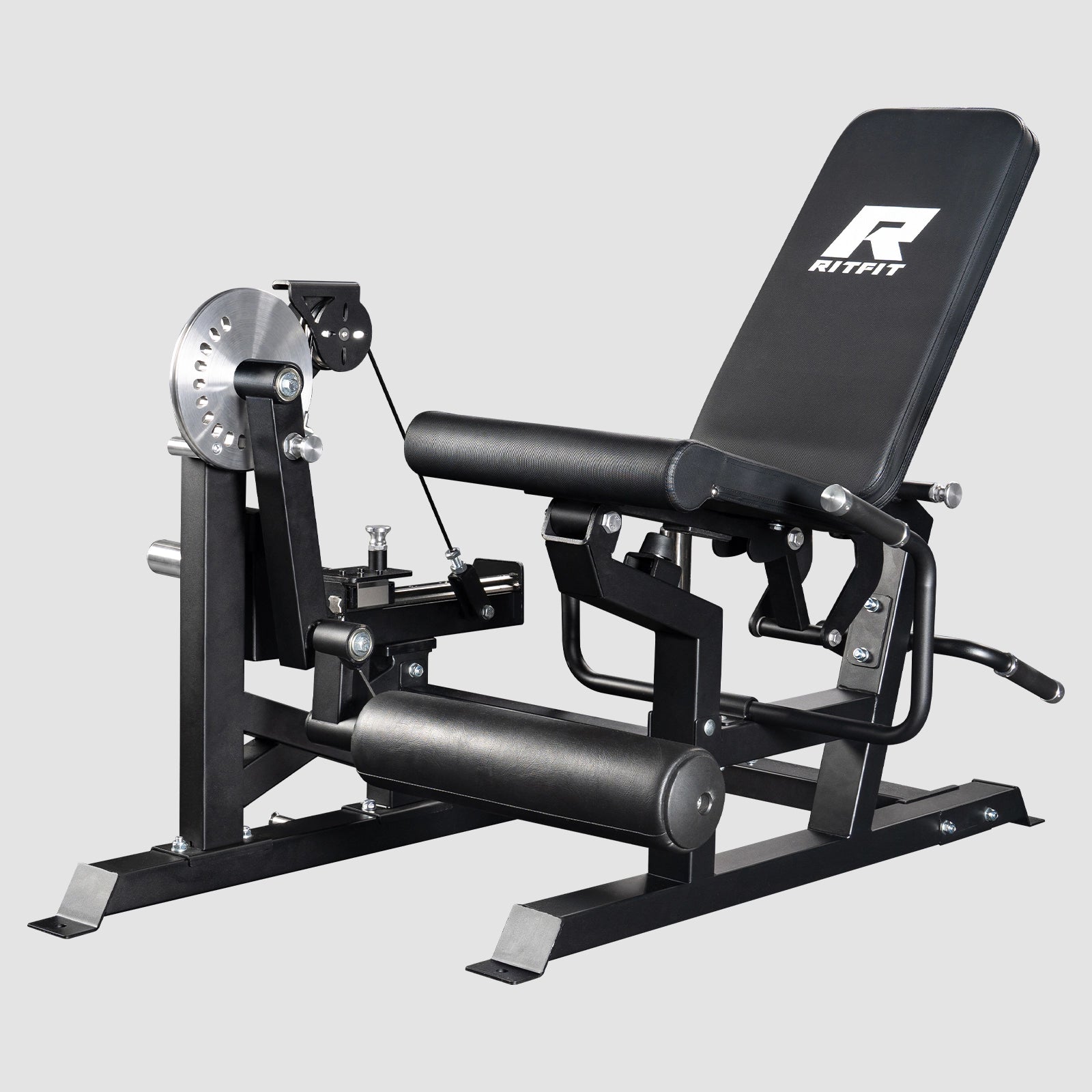
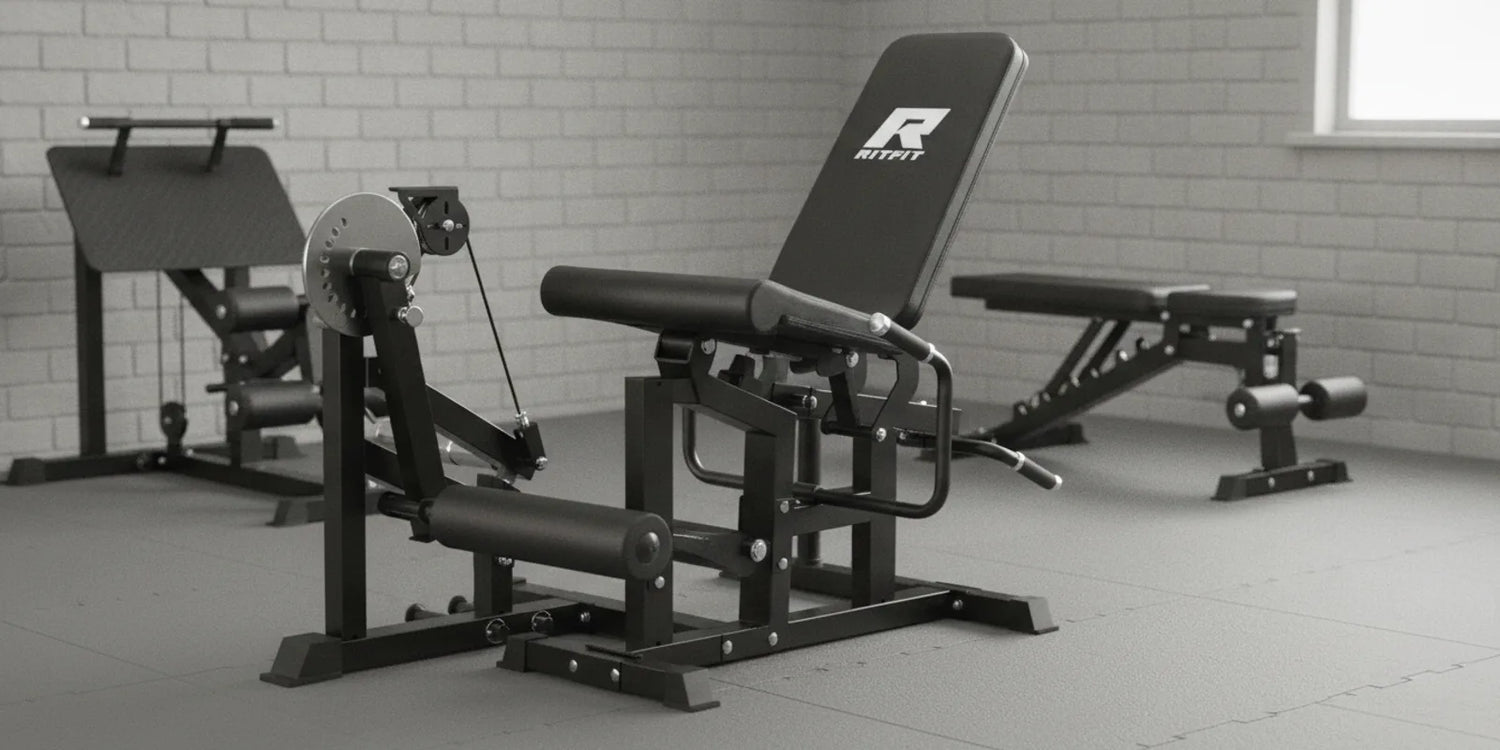
If you train at home without a dedicated machine, the RitFit PLC01 Leg Extension Curl Machine carries independent seat and shin pad adjustments on one frame, so a garage setup can hit all four of these positions without a second machine. The RitFit LEM2 Leg Extension Rack Attachment is the space-saving route when you already train on an M2 rack, because it adds the extension movement to the rack you own instead of adding another footprint to the floor.
How Do You Perform a Leg Extension with Correct Technique?
Correct leg extension execution keeps the torso still and moves only the lower leg, with the quadriceps doing all of the work through a full range of motion. Two tempo rules govern the rep: about 2 seconds to lift, then 2 to 3 seconds to lower under control.
Concentric Phase and the Lift
Exhale and extend your legs in a smooth arc over about 2 seconds, squeezing the quads as your legs approach full extension. Keep your back pressed against the pad and your glutes in contact with the seat throughout the lift.
Eccentric Phase and Tempo Control
Lower the weight back to the starting position over 2 to 3 seconds, resisting gravity rather than letting the stack drop. Never let the weight plates slam together at the bottom, because that removes tension from the quad at the most productive part of the rep.
- Tempo guideline: 2 seconds up, a brief pause at the top, then 2 to 3 seconds down.
- Range of motion: Start with your knees bent as far as the machine allows and extend to just short of full lockout if you feel any discomfort at terminal extension.
- Repetition count: 10 to 15 reps at a moderate load is a reliable starting range for beginners. Experienced lifters can work in the 8 to 12 rep range with heavier loads.
- Unilateral option: Single-leg extensions let you identify and address quad strength imbalances between legs. Perform your weaker leg first, then match the rep count on the stronger side.
For a companion exercise on the same machine, see how to do prone leg curls on a leg extension machine to train the hamstrings as a counterbalance.
How Heavy Should You Go on Leg Extensions?
The right leg extension weight lets you complete 10 to 12 reps with perfect form, a controlled eccentric, and no hip lift off the seat. Leg extensions are an isolation exercise, so the quad carries the entire load without help from larger compound muscles, which means even moderate loads feel challenging when executed correctly.
- Beginners: Start with a load you can handle for 15 reps with full control. This lets you reinforce proper form before adding resistance.
- Intermediate lifters: Work in the 8 to 12 rep range across 3 sets. Rest 60 to 90 seconds between sets to keep metabolic tension high on the quad.
- Progressive overload cue: Add a small increment once you can complete 3 sets of 12 reps with controlled tempo and no form breakdown on the final rep.
- Load ceiling: Strength coaches note that leg extensions should generally not be taken to extremely heavy single-rep efforts, since the absence of hamstring co-contraction at maximal loads increases shear stress at the knee. A published study using a modified leg extension machine confirmed that joint torque and angular velocity measurements are most reliable when eccentric loading is controlled rather than allowed to free-fall.[2]
For a deeper breakdown of how weight increments affect progression on leg extension equipment, see the ultimate guide to leg extension machine weight increments.
What Are the Most Common Leg Extension Mistakes?
Four errors account for most leg extension problems: pivot misalignment, a shin pad that sits too high, momentum on the lift, and hips that come off the seat. Each one shifts load away from the quad and places it on the knee or the hip instead.
Knee Shooting Past the Pivot Point
When the seat sits too far back or too far forward, the knee joint no longer tracks over the machine's axis of rotation. The result is a shearing force on the patellar tendon and the anterior knee during each rep, so verify pivot alignment before you add weight.
Using Momentum or Swinging the Weight
Kicking the weight up with a swinging motion removes tension from the quad at the bottom of the rep, exactly where the vastus intermedius and the other quad heads produce the most force. Use a smooth, deliberate lift and never let the weight stack crash down at the bottom.
Pad Resting on Mid-Shin Instead of the Ankle
Placing the shin pad too high reduces the moment arm of the weight relative to the knee, which makes the load feel lighter while actually increasing pressure on the knee joint itself. Keep the pad low, just above the ankle, on every single set.
Lifting Hips Off the Seat
Hip lift is the most obvious sign of excessive load. Drop the weight until you can complete every rep with your glutes flat against the seat throughout.
"The key to the leg extension is making sure the axis of rotation of the machine matches your knee joint. If they're misaligned, you're going to get shearing forces in the knee that can cause pain and injury over time."
Jeff Cavaliere, MSPT, CSCS, Physical Therapist and Strength Coach, Athlean-X
"The Mustang pro is a great add to any gym. It does everything you need plus more, might be the best bang for your buck piece of equipment for your home gym. Don't hesitate to buy this, worth every penny. Only thing I'd complain about is they didn't offer a black and red combo."
MARK S. Verified Buyer, RitFit Mustang PRO Leg Extension Curl Machine
Are Leg Extensions Safe for Your Knees?
Leg extensions are safe for most healthy adults when the setup is correct and the load is appropriate. Sports rehab clinicians note that leg extensions cause no more patellofemoral stress than squats at comparable relative loads, and the exercise is used in ACL rehabilitation protocols at most post-surgery time points.
- Patellofemoral pain: If you feel anterior knee pain during the exercise, reduce the range of motion at the end range of extension rather than stopping the exercise entirely. A shorter range reduces peak stress on the patella while keeping quad activation.
- Full lockout discomfort: Terminal knee extension creates the highest patellofemoral contact pressure. Stopping a few degrees short of full extension is a practical modification if lockout causes discomfort.
- Load management: The most common cause of knee discomfort on this machine is not the exercise itself but excessive load with poor setup. Verify pivot alignment and shin pad position before you increase weight.
- When to stop: Sharp, localized knee pain during the exercise is a signal to reduce load or range of motion. Persistent pain that continues after the workout warrants evaluation from a qualified professional.
The seated leg extension benefits article covers the full case for including this exercise in your training, including the research on quad development and functional strength.
What Are the Best Leg Extension Alternatives?
Several exercises can replicate the quad isolation of leg extensions when a machine is unavailable or you need to reduce joint load during a deload week. A 2012 study in the International Journal of Sports Physical Therapy found that knee extensions performed with elastic tubing produced similar concentric quadriceps activation above 70% normalized EMG to machine-based leg extensions, though eccentric activation was slightly lower.[3]
- Banded knee extensions: Anchor a resistance band low behind you, loop it around your ankle, and extend the knee from a seated position. The resistance profile is not identical to a weight-stack machine, but concentric quad activation is comparable according to the 2012 study above.
- Terminal knee extensions: Stand facing a band attached behind you, loop it behind the knee, and practice controlled extension from around 30 degrees of flexion to full extension. This range has low ACL strain and strong VMO activation.
- Wall sits: An isometric alternative that loads the quad in the lengthened position without any machine. Hold for 30 to 60 seconds for endurance work, or use short holds at 90 degrees for strength emphasis.
- Leg press: While not a true isolation exercise, the leg press loads the quadriceps heavily through a similar range of motion with less single-joint shear force. Explore the leg press machine collection if you are building out a home gym leg program.
- Bulgarian split squat: A unilateral compound movement with a strong quad bias when the torso stays upright. It also challenges hip stability and balance, which makes it a well-rounded complement to machine isolation work.
If you are setting up a home gym and want dedicated leg extension hardware, the best leg extension machine for home gyms review compares key features across different form factors. Browse the full leg machine collection to find the right fit for your space and budget.
The Mustang Pro Leg Extension Curl Machine is a top option for a heavy-duty standalone unit that stays in one place, while the RitFit PLC01 Pink Leg Extension Curl Machine offers the same adjustability in a colorway built for a pink-themed home gym. If your leg day also includes press work, the RitFit BLP01 leg press and PLC01 leg extension set combines both movements in a single package.
FAQs About Proper Leg Extension Form
How do I know if my seat is in the right position on a leg extension machine?
Your knees should align with the machine's pivot point when seated. Sit down without weight and look at the side panel, where the axis marker, often a red dot, should line up with your knee joint. Proper alignment prevents shearing forces on the knee.
How heavy should I go on leg extensions?
Start with a load you can handle for 10 to 12 controlled reps without any hip lift or momentum. Once you can complete 3 sets of 12 with a controlled 2-second lower and clean form, add a small weight increment on your next session.
Are leg extensions safe for your knees?
Yes. With correct setup and appropriate load, leg extensions are safe for most healthy adults, and sports rehab clinicians use them in ACL rehabilitation. Aligning the knee with the machine pivot and placing the shin pad just above the ankle are the two key safety factors.
What is the correct shin pad position for leg extensions?
The shin pad should rest just above the ankle, not mid-shin or on top of your foot, because placing it too high shifts the lever arm and increases pressure on the knee joint. If the pad digs into your shin, place a folded towel under it without raising the contact point above the ankle.
What tempo should I use for leg extensions to build muscle?
Use a 2-second lift and a 2-to-3-second lower on every rep, and avoid bouncing or letting the stack crash down. Slow eccentrics keep tension on the quad through the bottom range of motion and reduce cumulative stress on the knee over a full training session.
What muscles do leg extensions work?
Leg extensions target all four quadriceps heads: the rectus femoris, vastus lateralis, vastus medialis, and vastus intermedius. This strict isolation movement has almost no hamstring or glute contribution, making it valuable for correcting quad-specific strength imbalances between your left and right legs.
Conclusion
Proper leg extension form comes down to setup: knee on the pivot, pad just above the ankle, seat angled back, and a controlled 2-to-3-second lower on every rep. Get those four details right and the quadriceps takes the load instead of the joint.
Start with a weight you can control for 10 to 15 reps, and add resistance only after the last rep looks like the first. Explore leg extension machines for beginners to pick the right unit for your space, then check the RitFit discount guide before you order.
Disclaimer
The information in this article is for general educational purposes only and does not constitute medical advice, diagnosis, or treatment. Consult a qualified healthcare professional or certified strength and conditioning specialist before beginning any new exercise program, especially if you have a history of knee, hip, or lower back injury.
References
1. Akima H, Maeda K, Shima N. Neuromuscular activation of the quadriceps femoris, including the vastus intermedius, during isokinetic knee extensions. Sci Rep. 2023;13(1):7674. doi:10.1038/s41598-023-34532-x PMCID: PMC10175244
2. Kanada Y, Sakurai H, Sugiura Y, Arai T, Koyama S, Tanabe S. Evaluation of the relationship between joint torque and angular velocity using a modified leg extension machine. Fujita Med J. 2019;5(4):85-91. doi:10.20407/fmj.2018-018 PMCID: PMC8766240
3. Jakobsen MD, Sundstrup E, Andersen CH, et al. Muscle activity during knee-extension strengthening exercise performed with elastic tubing and isotonic resistance. Int J Sports Phys Ther. 2012;7(6):606-16. PMCID: PMC3537465