Smith machine reverse curls are one of the strictest ways to build the brachioradialis, forearm extensors, and grip strength with the equipment already standing in your home gym. The overhand grip shifts the work away from the biceps and onto the front of the forearm, and the guided bar keeps every rep on the same path.
This guide covers how to set the bar, where to put your hands and elbows, how much weight to load, and the mistakes that turn the movement into a swing. It also separates reverse curls from wrist curls so you train the right muscles.
Quick Answer: Smith machine reverse curls work well because the guided bar keeps your hands on a fixed path that matches the natural curl line from thighs to shoulder height. Stand in front of the bar, take a shoulder-width overhand grip, pin your elbows to your sides, and curl with about half your usual curl weight.
Key Takeaways
- Overhand Grip Shifts the Work: A pronated grip removes the biceps supination advantage, so the brachioradialis and forearm extensors lead the movement.
- The Fixed Path Fits the Curl: The bar travels close to your body from thighs to shoulder height, so the Smith machine rails match the movement naturally.
- Start at Half Weight: Load about half of your standard biceps curl weight and aim for three sets of 8 to 12 strict reps.
- Elbows Stay Pinned: Keeping your elbows at your sides stops the shoulders and momentum from taking over.
- Elbows vs Wrists: Reverse curls bend the elbow to train the brachioradialis and forearm extensors, while wrist curls bend only the wrist to train the wrist flexors.
Can You Do Reverse Curls on a Smith Machine?
The Smith machine works for reverse curls because the guided bar follows the same straight vertical line the exercise already travels. You stand in front of the bar with a knuckles-up overhand grip, pin your elbows to your sides, and curl the bar close to your body to shoulder height.
- Overhand, Knuckles-Up Grip: Take a pronated grip so your knuckles face up and your palms face down, with your hands roughly shoulder width.
- Elbows Glued to Your Sides: Your upper arms stay still and only the elbow joint bends, which keeps the load on the elbow flexors instead of the shoulders.
- The Bar Stays Close: The bar should graze your body as it rises from thigh height to shoulder height, exactly the line the rails already provide.
- Momentum Is Off the Table: The guided bar cannot swing forward or drift back, so every rep is honest from the first inch to the last.
The movement is a documented curl variation rather than a gym hack, exercise databases list the Smith machine reverse curl with the same setup cues used for any strict curl. If you are still choosing a platform, the Smith machine collection shows every guided-bar setup RitFit makes.
What Muscles Do Smith Machine Reverse Curls Work?
Smith machine reverse curls train the brachioradialis and forearm extensors hardest, with the brachialis and biceps assisting elbow flexion. A 2023 EMG study of biceps curls found biceps brachii excitation was about 19% greater with a supinated than a pronated grip in the lifting phase, while the brachioradialis differed by only about 5%[1]. The overhand grip therefore shifts the balance of the curl toward the front of the forearm.
- Brachioradialis: This thick muscle runs along the top of the forearm and is the main reason to train the reverse curl.
- Forearm Extensors: The muscles on the back of the forearm that straighten the wrist and fingers work hard to hold the wrist neutral under the pronated grip.
- Brachialis: The elbow flexor sitting underneath the biceps assists every rep regardless of forearm position.
- Biceps Brachii: The biceps still helps bend the elbow, and coaching guidance from Men's Health notes that because the forearm never rotates, the biceps loses its supination role and emphasis shifts to the brachioradialis.
Two follow-ups fit here, the full list of Smith machine forearm exercises and a closer look at hand grip and forearm size.
Reverse Curl vs Wrist Curl: Elbow Flexion or Wrist Flexion
The difference between a reverse curl and a wrist curl is the joint doing the work. A reverse curl bends the elbow to train the brachioradialis, forearm extensors, and biceps, while a wrist curl bends only the wrist to train the wrist flexors on the underside of the forearm.
| Movement | Joint That Moves | Primary Muscles | Best For |
|---|---|---|---|
| Reverse curl | Elbow | Brachioradialis, forearm extensors, brachialis | Top of the forearm and grip strength |
| Wrist curl | Wrist | Wrist flexors | Underside of the forearm |
Both movements belong in a complete forearm program, the reverse curl loads elbow flexion and the wrist curl isolates wrist flexion.
If your goal is the top of the forearm and a stronger grip, the reverse curl is the movement to prioritize. Save wrist curls for the end of the session when you want to finish the underside of the forearm.
How to Do Reverse Curls on a Smith Machine
To do reverse curls on a Smith machine, set the bar to thigh height, take a shoulder-width overhand grip, pin your elbows, and curl the bar to shoulder height. The four steps below cover the full setup and execution.
Step 1: Set the Bar at Thigh Height
Unload the safety tabs and lower the bar until it rests around thigh height. This is where every rep starts and finishes.
Step 2: Take a Shoulder-Width Overhand Grip
Stand close to the bar and grip it with your knuckles facing up, hands about shoulder width. If the straight bar feels restrictive on your wrists, move your hands slightly wider until the wrists stay neutral.
Step 3: Pin Your Elbows to Your Sides
Tuck your elbows against your ribs and keep them locked in place for the whole set. The bar should graze your body as it travels up, which keeps the movement in the elbow joint.
Step 4: Curl to Shoulder Height and Lower Slowly
Curl the bar up to shoulder height, pause briefly, then lower it under control while keeping tension in the forearms. Exhale on the way up and inhale on the way down.
The same setup works on any guided-bar platform, including the multifunctional Smith machine, so the technique transfers between machines without changing a single cue.
How to Keep Your Wrists and Elbows Strict
Strict reverse curl form keeps the wrists neutral and the elbows pinned to your sides from the first rep to the last. Small position changes decide which muscles join the lift, so the cues below keep the work on the forearms.
- Keep the Wrists Neutral: Do not flip the wrists upward to start the rep, hold a strong straight wrist and move only at the elbow joint.
- Pick Bar Comfort Over Bar Type: An EMG comparison of straight barbell, EZ bar, and dumbbell curls found only small differences in biceps brachii and brachioradialis activity, and the authors describe the choice as a matter of subjective handgrip comfort[2]. If the straight Smith bar bothers your wrists, widen your grip before blaming the exercise.
- Keep the Upper Arms Still: One EMG study measured about 17.7% greater biceps brachii excitation in the lifting phase when the arms were flexed forward, along with greater anterior deltoid involvement[3]. For reverse curls, pinned elbows keep the shoulders out of the rep.
"When I do a standard bicep curl or even a hammer curl, to some extent, I can cradle with my grip. I don't need to actively squeeze the bar as tightly as possible. But once I have that bar flipped over and I'm doing the reverse curl, whether it's a barbell or dumbbell or anything, if I loosen my grip, the bar is simply going to fall to the ground. That means I need to keep a tighter grip the entire time when I'm curling, so my grip strength is going to get a very good time under tension and constant tension test."
Ebenezer Samuel, C.S.C.S. Fitness Director, Men's Health. How to Do Reverse Curls to Build More Forearm Muscle
How Much Weight Should You Use for Smith Machine Reverse Curls?
Start Smith machine reverse curls with about half the weight you use for a standard biceps curl, because the pronated grip is weaker and grip fatigue arrives early. One coaching guide recommends three sets of 8 to 12 reps as a starting point and treats the reverse curl as a finisher rather than a main lift.
- Starting Load: Half of your usual curl weight is the standard recommendation, and the empty bar or a plate per side is enough for most first sessions.
- Rep Range: Three sets of 8 to 12 reps, with a brief pause at the top of every rep.
- When to Add Weight: Add the smallest increment available only after every rep in the last set stays strict, with no swinging and no elbow drift.
- When to Stop the Set: Sharp wrist or elbow pain is a stop signal, while normal muscular fatigue is not.
- If Grip Fails First: Grip fatigue is expected on this movement, and dedicated work with hand grip strengtheners builds the endurance to hold the bar longer.
Common Smith Machine Reverse Curl Mistakes to Avoid
The most common reverse curl mistake is turning the movement into a swing, because momentum steals work from the brachioradialis and the forearms. The fixes below keep every rep strict.
- Swinging the Bar: Avoid the urge to swing when the forearms fatigue, staying tight, curling, pausing, and lowering is all each rep should be.
- Letting the Elbows Drift: Keep the elbows pinned at your sides and never shift them forward to cheat. This is also what separates the reverse curl from a drag curl, where the elbows travel behind the body instead of staying at your sides.
- Flipping the Wrists: Extending the wrists upward to start the move shifts stress away from the target muscles and toward the wrist joint.
- Going Too Heavy: The pronated grip is weaker than the supinated one, so an overloaded bar turns a strict curl into a body-rocking pull.
- Curling Out in Front: Letting the bar drift away from your body breaks the fixed path and adds strain to the shoulders.
How to Program Smith Machine Reverse Curls Into Your Arm Training
Program Smith machine reverse curls two to three times per week near the end of an arm or pull workout, for two to four sets. The exercise works best as a finisher after heavy biceps and back work, because grip fatigue accumulates fast.
- Frequency: Two to three sessions per week with at least one rest day between forearm focused days gives the area room to recover.
- Placement: Save reverse curls for the end of the session so grip fatigue never limits rows, pull-ups, or deadlifts.
- Swap Options: On days your forearms are fried, swap in cable bicep curls on a Smith machine or any move from the Smith machine biceps exercises list.
- Progression: Track reps before load, and only add weight once every rep in the final set stays strict.
The same setup holds in a garage gym on the M1 multi-functional home gym Smith machine, and the M3 power rack with cable crossover opens up cable variations when your grip needs a break.
Does the RitFit BUFFALO Smith Machine Work for Reverse Curls?
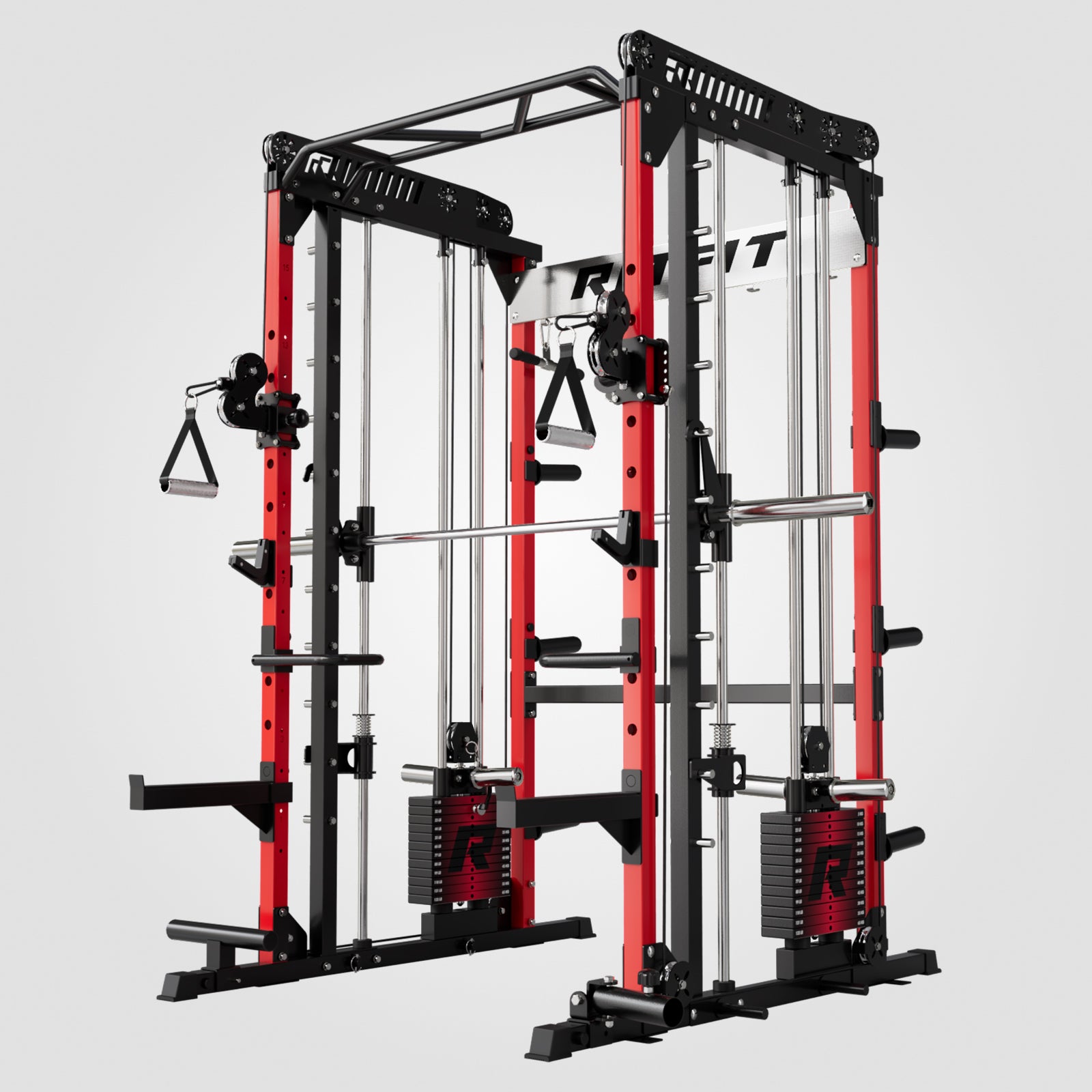
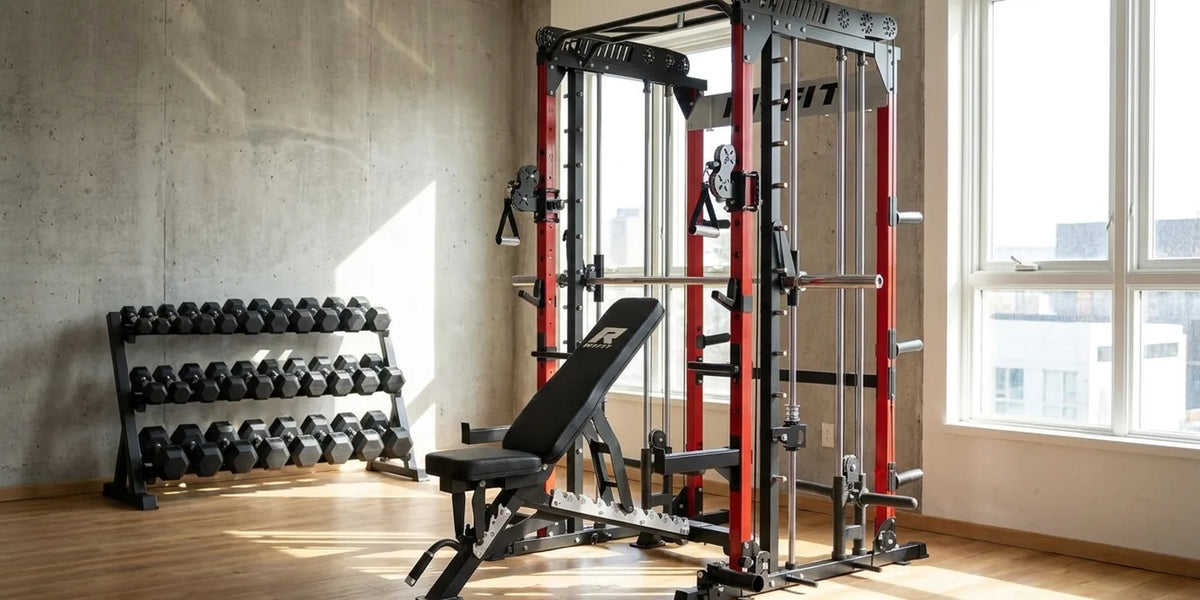
The RitFit BUFFALO Smith Machine works for reverse curls because its guided bar, adjustable height settings, and stable frame support strict elbow-pinned curls. The machine pairs the fixed Smith bar with lat pull-down and cable crossover stations, so one platform covers your whole arm day.
- Guided Bar for Strict Reps: The BUFFALO bar travels the fixed vertical path the movement needs, from thigh height to shoulder height with your elbows pinned.
- Full Arm Day Coverage: Lat pull-down and cable crossover stations cover rows, pull-downs, and cable curl variations between sets of reverse curls.
- Built for Shared Home Gyms: Verified buyers describe a sturdy, stable platform that holds up during intense workouts.
If you want plates included from day one, the platform also ships as a Buffalo Smith machine home gym package with weight stack.
"The build quality of the RitFit BUFFALO is exceptional. The robust steel construction feels incredibly sturdy and secure, providing the confidence needed for intense workouts. The attention to detail in its design and finish is evident, rivaling the best commercial gym equipment I've ever used."
Tyrone C. Verified Buyer, RitFit BUFFALO Multifunctional Smith Machine with Lat Pull Down and Cable Crossover for Versatile Strength Training
FAQs About Smith Machine Reverse Curls
Can you do reverse curls on a Smith machine?
Yes. Set the bar to thigh height, stand close with a shoulder-width overhand grip, pin your elbows to your sides, and curl the bar up your body to shoulder height. The fixed rail path matches the natural curl line, so the machine supports strict reps.
What muscles do Smith machine reverse curls work?
Smith machine reverse curls train the brachioradialis and forearm extensors hardest, with the brachialis and biceps assisting elbow flexion. The pronated grip removes the biceps supination advantage, so the front of the forearm does more of the work than in a standard supinated curl.
How much weight should you use for Smith machine reverse curls?
Start with about half the weight you curl with a standard supinated biceps curl, since the pronated grip is weaker and grip fatigue sets in early. A good starting prescription is three sets of 8 to 12 reps, adding weight only when all reps stay strict.
What is the difference between reverse curls and wrist curls?
Reverse curls are an elbow flexion movement, the elbows bend and the brachioradialis, forearm extensors, and biceps lift the load. Wrist curls are a wrist flexion movement that trains the wrist flexors on the underside of the forearm. One bends the elbow, the other bends only the wrist.
How often should you do Smith machine reverse curls?
Two to three sessions per week works for most lifters, with at least one rest day between forearm focused sessions. Program reverse curls near the end of an arm or pull workout for two to four sets, and track reps before adding load.
Why do my wrists hurt during reverse curls on a Smith machine?
Wrist pain usually means the wrists are extended upward or the load is too heavy for the pronated grip. Keep your wrists straight and neutral, lower the weight to half your supinated curl load, and stop the set if sharp pain appears rather than normal muscular fatigue.
Can beginners do reverse curls on a Smith machine?
Yes. The guided bar removes the balance demand of free weights, so beginners can learn an overhand curl with strict form. Start with an empty bar or very light plates for three sets of 10 to 12 reps, master the elbow-pinned technique, then progress gradually.
Conclusion
Smith machine reverse curls deliver strict, repeatable reps for the brachioradialis, forearm extensors, and grip, and the fixed bar path makes the Smith machine a natural home for the movement.
Start with half your usual curl weight, keep your elbows pinned, and progress slowly. If you are still building out your setup, check the RitFit discount guide before adding plates or attachments.
Disclaimer
This article is for general fitness information and is not medical advice. Stop any exercise that causes sharp pain and consult a qualified healthcare professional before starting a new training program.
References
1. Coratella G, Tornatore G, Longo S, et al. Biceps Brachii and Brachioradialis Excitation in Biceps Curl Exercise: Different Handgrips, Different Synergy. Sports (Basel). 2023;11(3). doi:10.3390/sports11030064. PMCID: PMC10054060
2. Marcolin G, Panizzolo FA, Petrone N, et al. Differences in electromyographic activity of biceps brachii and brachioradialis while performing three variants of curl. PeerJ. 2018;6:e5165. doi:10.7717/peerj.5165. PMCID: PMC6047503
3. Coratella G, Tornatore G, Longo S, Esposito F, Cè E. Bilateral Biceps Curl Shows Distinct Biceps Brachii and Anterior Deltoid Excitation Comparing Straight vs. EZ Barbell Coupled with Arms Flexion/No-Flexion. J Funct Morphol Kinesiol. 2023;8(1). doi:10.3390/jfmk8010013. PMCID: PMC9944112