








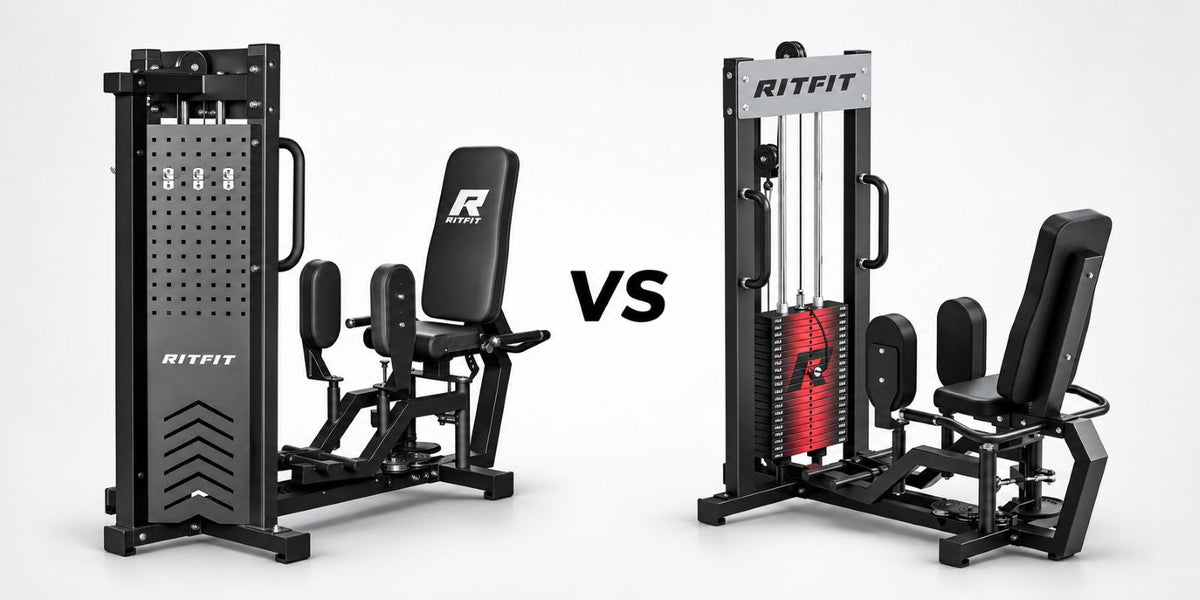
Panther Pro vs Panther is a decision about adjustment hardware rather than resistance, because both RitFit hip machines share the same 209 lb weight stack, the same range of motion, and the same frame. The Pro lists at $1,379.99 and adds a four-position backrest, two knee pad heights, an eight-position angle dial, side handles, a storage panel, and aluminum pulleys.
The standard Panther lists at $1,299.99 with a fixed, slightly angled backrest. This comparison separates the shared specifications from the Pro-only parts so the $80 difference is easy to judge for your own home gym.
Quick Answer: The RitFit Panther Pro is the better pick for a shared home gym at $1,379.99, while the standard Panther at $1,299.99 suits one lifter who stays on one setting. Panther Pro vs Panther comes down to $80 for a four-position backrest, two knee pad heights, an eight-position angle dial, side handles, a storage panel, and aluminum pulleys, since the resistance and range are identical.
Key Takeaways
- Same drivetrain: Both machines use a 209 lb stack with 19 plates, 70 degrees of abduction per side, and 96 degrees of adduction per side.
- Pro-only hardware: The Panther Pro adds a four-position backrest, two knee pad heights, an eight-position angle dial, side handles, a perforated steel storage panel, and aluminum pulleys.
- Price gap: The Panther Pro lists at $1,379.99 and the Panther at $1,299.99, an $80 difference that buys adjustment range instead of more weight.
- Best fit: Choose the Pro for two or more users with different heights, and the standard Panther for one lifter who keeps a fixed setting.
RitFit Panther Pro vs Panther: Full Specifications Compared
The RitFit Panther Pro and the standard Panther differ in adjustment hardware, not in resistance or range. Both machines carry a 209 lb weight stack with 19 plates, 70 degrees of abduction per side, 96 degrees of adduction per side, and the same 12.7 square foot footprint. The table below lines up every published specification so the rows that separate the two models are easy to spot.
| Specification | RitFit Panther Pro | RitFit Panther |
|---|---|---|
| Price | $1,379.99 | $1,299.99 |
| Weight stack | 209 lb, 19 plates | 209 lb, 19 plates |
| Resistance selection | Pin selector | Pin selector |
| Hip abduction range | 70 degrees per side | 70 degrees per side |
| Hip adduction range | 96 degrees per side | 96 degrees per side |
| Abduction resistance ratio | 0.88:1 | 0.88:1 |
| Adduction resistance ratio | 0.66:1 | 0.66:1 |
| Dimensions (L x W x H) | 60.2 x 30.3 x 63.7 in | 60.2 x 30.3 x 63.7 in |
| Footprint | 12.7 sq ft | 12.7 sq ft |
| Frame steel | Q235 steel, 2 x 2.8 in main tube | Q235 steel, 2 x 2.8 in main tube |
| Uprights | 50 x 70 mm | 50 x 70 mm |
| Back pad | 2.4 in (60 mm), 21.9 x 11.2 in | 2.4 in (60 mm), 21.9 x 11.2 in |
| Seat pad | 2.4 in | 2.4 in |
| Backrest adjustment | Four positions | Fixed, slightly angled |
| Knee pads | 360 degree rotation, two height settings | 360 degree rotation |
| Angle dial | Eight positions with locking pin | Not listed on product page |
| Side handles | Secure side handles at the seat | Not listed on product page |
| Storage | Perforated steel panel | Not listed on product page |
| Pulleys | Aluminum | Not listed on product page |
| Colors | Black, Pink | Black, Pink |
| User height | 155-190 cm | 155-190 cm |
| Shipping | Not itemized on product page | Four boxes, free shipping in the continental US, in-stock orders leave in 2-3 business days |
Specifications and prices reflect the RitFit product pages as displayed on November 6, 2026. Prices can change, so confirm the current listing before ordering.
RitFit Panther Pro and Panther: Each Machine on Its Own
The table above compares the two models row by row. This section covers each machine on its own, so you can read the one you are leaning toward without scanning past the other machine's specifications.
RitFit Panther Pro Hip Abductor and Adductor Machine
The Panther Pro is the adjustable model at $1,379.99, listed in Black and Pink. It uses the same 209 lb stack with 19 plates, the same 70 degree abduction and 96 degree adduction range per side, the same 0.88:1 and 0.66:1 resistance ratios, and the same 60.2 x 30.3 x 63.7 in frame as the standard Panther. What the extra money buys is adjustment and convenience hardware: a four-position backrest, a second knee pad height on top of 360 degree rotation, an eight-position angle dial with a locking pin, handles on both sides of the seat, a perforated steel storage panel, and aluminum pulleys.
That hardware lets the machine be reset for a 155 cm lifter and then for a 190 cm lifter without either one sitting in a compromise position, and the dial lets the same lifter repeat a start angle exactly when they switch between abduction and adduction. The Pro does not add resistance, so it earns its place on setup range rather than on a heavier stack.
RitFit Panther Home Hip Abductor and Adductor Machine
The standard Panther is the fixed-setup model at $1,299.99, also listed in Black and Pink. It shares the 209 lb stack, the 70 and 96 degree ranges, the resistance ratios, and the 12.7 sq ft footprint, and it keeps the 360 degree rotating knee pads that set pad angle to the leg. Its backrest stays at a fixed, slightly angled position, and it does not list the second knee pad height, the angle dial, the seat handles, the storage panel, or the aluminum pulleys.
For one lifter who trains both directions on a single setting, that covers the whole machine: set the seat once, pin the load, and rotate the pads. The $80 saved goes further on plates, flooring, or a bench than on adjustments nobody will move.
"This is a great piece of equipment especially for the price. The range of motion on it is just right. Sturdy and reliable."
Taylor H. Verified Buyer, RitFit Panther Home Hip Abductor and Adductor Machine
Where the Panther Pro Actually Improves on the Panther
The Panther Pro improves fit rather than load, because the extra hardware changes where your hips, knees, and hands sit during a set. Each upgrade below solves an alignment problem that appears when a machine is shared or when one lifter changes stance between sets.
A Four-Position Backrest Changes Torso Angle
The standard Panther uses a fixed, slightly angled backrest, while the Pro lets a lifter choose among four backrest positions. A taller lifter can sit more upright so the knee pads stay on the thighs, and a shorter lifter can recline a little so the pads do not ride toward the knee.
Two Knee Pad Heights on Top of 360 Degree Rotation
Both machines rotate the knee pads 360 degrees, but only the Pro lists two height settings. That second axis matters when two users have different femur lengths, because rotation fixes the pad angle while the height setting fixes where the pad meets the leg.
An Eight-Position Angle Dial With a Locking Pin
The dial sets the start angle of the movement, so abduction can begin with the legs wider or narrower inside the published 70 degree range. A locking pin holds the chosen position, which helps when a second user has to return the machine to your setting.
Side Handles, a Storage Panel, and Aluminum Pulleys
The Pro adds handles on both sides of the seat, a perforated steel panel for pins and small items, and aluminum pulleys. Handles give your arms a defined place to rest during a set, and the storage panel keeps the selector pin and accessories off the floor.
None of these parts change the resistance curve. They change how repeatable the setup is, which is the part a second user disrupts most often.
What the Panther and Panther Pro Share
The Panther and Panther Pro share their entire resistance system, so neither machine offers more weight, a longer stroke, or a different resistance curve. That shared hardware is the most important fact in this comparison, because the higher price can look like a stronger machine.
- Weight stack: 209 lb across 19 plates with pin selection on both models.
- Range of motion: 70 degrees of abduction and 96 degrees of adduction per side.
- Resistance ratios: 0.88:1 for abduction and 0.66:1 for adduction on both.
- Footprint: 60.2 x 30.3 x 63.7 in and 12.7 sq ft on both models.
- Frame and pads: Q235 steel with a 2 x 2.8 in main tube, 50 x 70 mm uprights, and 2.4 in back and seat pads.
- User height: 155-190 cm on both, with 360 degree rotating knee pads on both.
The practical result is that a stronger lifter gains nothing from the Pro beyond the same 209 lb stack, and a buyer who only needs one setting pays $80 for hardware that never moves. Read the best hip abductor and adductor machine for a home gym guide if you are still comparing this category as a whole.
Hip Abduction vs Hip Adduction: What Each Setting Trains
Hip abduction moves the thigh away from the midline and trains the upper glutes, while hip adduction pulls the thigh inward and trains the inner thigh adductors. Both Panther models run 70 degrees of abduction and 96 degrees of adduction per side, so the movement pair is identical on either machine.
- Abduction setting: 70 degrees per side at a 0.88:1 ratio, the higher of the two ratios on the machine.
- Adduction setting: 96 degrees per side at a 0.66:1 ratio, so the same plate load feels lighter in this direction.
- Switching between them: the Pro angle dial changes the start position, while the standard machine relies on the seated position you set.
If your goal is glute work rather than inner thigh work, pair this machine with the gym machines that build glutes and the equipment for inner and outer thighs so the rest of the lower body gets covered too.
"Hip abduction movements – from side lying abduction, to band standing abduction, to band seated abduction, to band walk variations, to abductor machines – these target the upper glutes."
Bret Contreras, PhD, Strength researcher and author of Glute Lab, Growing Glutes Without Growing the Legs
Who Should Buy the RitFit Panther Pro?
The RitFit Panther Pro suits a shared home gym where two or more lifters differ in height or hip structure. Each person can reset the backrest, knee pad height, and angle dial in seconds, then leave those settings repeatable for the next session.
- Couples and training partners: one machine covers a 155 cm lifter and a 190 cm lifter without either one compromising on pad placement.
- Lifters between sizes: the four backrest positions and two knee pad heights cover bodies that sit between the fixed settings of a single-position machine.
- Alternating abduction and adduction: the eight-position dial makes the start angle repeatable when you switch direction mid-session.
- Order and storage: the steel storage panel and side handles matter in a garage gym where the selector pin otherwise ends up on the floor.
For this buyer the $80 difference is spread across every session, and the machine stays correctly set up for two body types instead of one.
Who Should Buy the Standard Panther?
The standard Panther suits one lifter who trains abduction and adduction on a single setting and would rather put the $80 toward plates, flooring, or a bench. Its fixed, slightly angled backrest and 360 degree rotating knee pads still deliver the same 209 lb stack and the same 70 and 96 degree ranges.
- Solo lifters in the middle of the height range: the fixed backrest angle already places most users of average height in a workable position.
- One movement, one setting: if you never change your start angle, an eight-position dial adds parts you will not adjust.
- Tight budgets: the $80 saved covers a set of resistance bands or part of a flooring order for the same corner of the room.
- First machine purchase: the lower entry price shortens the step from bodyweight hip work to loaded abduction and adduction.
If you are not ready to commit floor space, start with the hip exercises at home and revisit the machine once the habit is established.
Price and Long Term Value: Is the Panther Pro Worth 80 Dollars More?
The $80 gap is small next to the machine price, and it buys adjustment range that either fits your household or does not. The standard Panther is not a lesser machine in resistance terms, since both models share the same stack, ratios, and range.
Divided across the years you keep the equipment, the difference works out to a modest amount per year, and the useful question is how often those settings will change. RitFit warranty terms are set by the current policy page for each model, so confirm coverage for the version you choose before ordering.
Buyers who want the Pro to feel worth the money should count users, not features. Two people adjusting the machine weekly will use every part of the $80, while one person on one setting will not.
How to Choose in 60 Seconds
A quick decision table is enough for most households, because the two machines separate on adjustability alone. Match your situation to the row that sounds like your gym and skip the rest of the comparison.
| Your situation | Pick | Reason |
|---|---|---|
| Two or more lifters share the machine | Panther Pro | Backrest, knee pad height, and angle dial reset per person |
| One lifter, one setting | Standard Panther | Same stack and range for $80 less |
| Lifters far apart in height | Panther Pro | Four backrest positions and two knee pad heights |
| You switch between abduction and adduction often | Panther Pro | Eight-position dial with locking pin |
| Budget capped near $1,300 | Standard Panther | Identical 209 lb stack, ratios, and footprint |
Both models list Black and Pink colorways at the same price, so color does not affect the decision.
Whichever row fits, browse the full RitFit leg machines lineup for the matching leg extension or leg press, and use the lower body machine workout guide to place hip work inside a full leg day.
FAQs About the Panther Pro vs Panther
What is the difference between the RitFit Panther and the Panther Pro?
Both machines use the same 60.2 by 30.3 inch frame, the same 209 pound weight stack with 19 plates, and the same 70 degree abduction and 96 degree adduction range. The Panther Pro adds a four position backrest, two knee pad height settings, an eight position angle dial, side handles, a storage panel, and aluminum pulleys for 80 dollars more.
Is the Panther Pro worth the extra 80 dollars?
The extra 80 dollars buys adjustment range rather than more resistance, so it pays off when more than one person uses the machine or when hips need a wider or narrower start position. A single lifter who stays on one setting can put that money toward plates or flooring instead.
Does the Panther Pro fit a small home gym?
Yes, both models share a 12.7 square foot footprint and stand 63.7 inches tall, so the Pro takes the same floor space as the standard Panther. Leave clearance around the moving knee pads and enough room to pull the pin and change plates while standing beside the machine.
Can two people of different heights share the Panther Pro?
The four position backrest and two knee pad heights are the reason sharing works, because a shorter and a taller lifter can each set their own start position. Both models list a 155 to 190 centimeter user height range, so the Pro mainly adds repeatable settings rather than extra size.
Which machine is better for inner thigh training?
Both machines train hip adduction with the same 96 degree per side range and the same 0.66 to 1 resistance ratio, so inner thigh resistance is identical. The Pro difference is comfort and alignment, not a stronger adduction load or a longer squeeze at the end of the range.
How many boxes arrive and how long does assembly take?
The Panther ships in four boxes with free shipping inside the continental United States, and in stock orders usually leave the warehouse within two to three business days. Assembly needs two people and the included tools, so plan for a clear floor area before the boxes arrive.
Conclusion
Panther Pro vs Panther comes down to whether the settings will actually change, because the resistance, range, and footprint are identical on both machines. Buy the Panther Pro for a shared gym and the standard Panther for one lifter on one setting.
Check the current listing for both models, then confirm the colorway and delivery window before you order. The RitFit discount guide explains how the store structures its seasonal offers.
Disclaimer
This article compares specifications published on the RitFit product pages and does not replace medical or training advice. Confirm current pricing, shipping, and warranty terms on the product page before ordering, and consult a qualified professional before starting a new training program.





