








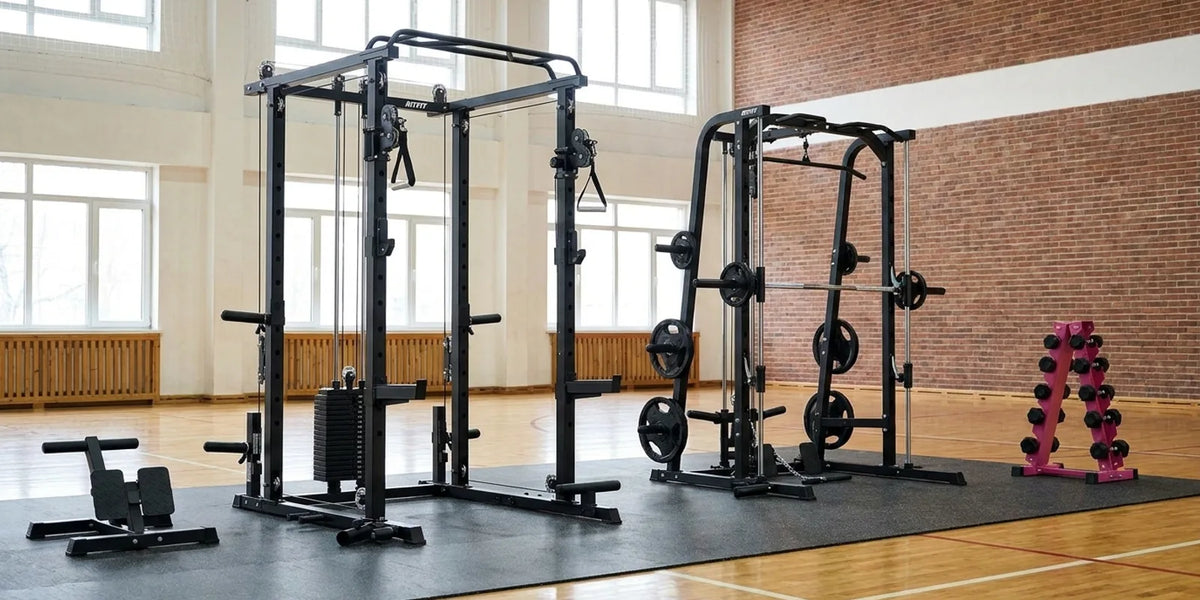
School gym equipment procurement follows a defined sequence: confirm the need, build the budget, line up the funding, choose a purchase path, then order, receive, install, and tag the equipment.
This guide walks that sequence for a school or district buyer, from the first needs assessment to the last asset tag, and notes the compliance rules that change the answer. Thresholds, grant eligibility, and budget rules vary by state and district, so treat every figure as a framework to confirm with your own purchasing office.
Quick Answer: School gym equipment procurement moves through a needs assessment, a budget line, a funding source, then either a competitive solicitation or a cooperative purchasing contract, followed by delivery, installation, inspection, and asset tagging. Budget rules, purchase thresholds, and grant eligibility vary by state and district, so confirm the process with your own purchasing and finance office.
Key Takeaways
- Follow the sequence: A school purchase moves through needs assessment, budget, funding, purchase path, order, delivery, acceptance, and asset tagging in that order.
- Budget the whole install: Equipment, freight, installation, flooring, spares, and a maintenance reserve belong in one capital request.
- Match funding to rules: District capital, bonds, grants, and donated funds each carry different eligibility and documentation requirements.
- Choose the right path: A district solicitation and a cooperative purchasing contract are both valid, and state thresholds decide which you may use.
- Plan the lifecycle: Tag every item, register the warranty, schedule preventive maintenance, and fund replacement before equipment fails.
What Does School Gym Equipment Procurement Involve?
School gym equipment procurement involves a chain of decisions that runs from a written needs assessment to an asset record in the district fixed asset register. Each stage produces a document, and a missing document usually stalls the next stage.
- Needs assessment: user groups, room size, activities, and access confirmed with coaches and facilities staff.
- Budget line: equipment, freight, installation, flooring, spares, and a replacement reserve grouped into one request.
- Funding source: district capital funds, a bond, a grant, or donated money matched to the purchase.
- Purchase path: a district solicitation or a cooperative purchasing contract, chosen against state thresholds.
- Award and order: board approval, a purchase order, and a delivery window agreed with the supplier.
- Acceptance and record: inspection against the purchase order, installation sign off, and asset tagging.
The people involved matter as much as the steps, because the athletic director usually defines the need while the business office controls the money and the solicitation. For a closer look at what belongs in the room itself, see this guide to equipment for sports facilities.
How Do You Build the Budget for School Fitness Equipment?
A school fitness equipment budget covers the equipment plus everything required to make it usable. Freight, installation, flooring, spares, and a maintenance reserve belong in the same request. A budget that covers only the sticker price usually returns to the board for a second appropriation.
| Budget line | What it covers |
|---|---|
| Equipment | Racks, cages, benches, dumbbells, plates, and functional items |
| Freight and delivery | Shipping, liftgate access, and inside delivery to the room |
| Installation and rigging | Assembly, anchoring to the slab, and any utility tie in |
| Flooring and site work | Rubber flooring, wall protection, and lighting or ventilation fixes |
| Spares and warranty | Replacement cables, pulleys, upholstery, and warranty registration |
| Maintenance reserve | Annual inspection, repair, and replacement funding |
| Contingency | An allowance for price movement and site surprises |
Planning categories only. Confirm every line with the district business office before submission.
Flooring is the line buyers most often underestimate, because coverage depends on the room footprint rather than on the number of stations. A rubber gym flooring collection and an example of interlocking rubber floor tiles show the two common formats to price.
Where Do Schools Get Funding for Gym Equipment?
Schools fund gym equipment from district capital or facilities budgets, voter approved bonds, grant programs, and donated money raised by booster clubs, alumni, or sponsors. Each source carries its own eligibility rules, so confirm them before you commit to a purchase.
- District capital or facilities budget: the most common route, funded through the annual capital plan.
- School bond: voter approved borrowing for construction and major facilities work, with ballot language that defines what is covered.
- Grants: state and federal programs are typically competitive, and eligibility varies by state and by program.
- Booster club and alumni donations: often raised by a tax exempt group that gifts the funds to the district.
- Naming rights and sponsorship: recognition tied to a facility or zone, subject to district policy.
- In kind goods and services: donated labor or materials, which still follow district procurement rules.
An NFHS Title IX compliance guide notes that the OCR and federal courts have ruled that the source of outside funding, whether a booster club, a donor, or a corporate sponsor, does not excuse a district from its obligation to remedy inequities. Protective equipment, locker rooms, practice and competition facilities, and access to weight training facilities are among the areas reviewed.
A documented project at Durango High School in Colorado, reported by the Durango Herald, shows how a mixed funding stack looks in practice. The room cost about $136,000, the booster club raised about $66,000 from 85 donors, a regional nonprofit added a $50,000 matching grant, and a statewide giving day contributed about $61,000.
Keep the paperwork for each source together, because auditors and grant administrators ask for the same trail of approval, receipt, and asset record. Discuss the funding mix with the district business office before a solicitation goes out.
Do Purchase Thresholds Decide Between a Public Bid and a Cooperative Contract?
A school may run its own competitive solicitation or buy through a cooperative purchasing contract that another public agency already awarded, and state law decides which routes are open. Neither path is automatically cheaper, and the thresholds that govern them differ by state.
Thresholds set the point where a district must move from informal quotations to a formal process. NASPO publishes a state by state threshold table, and its tiers vary widely.
Alabama, for example, lists small purchase thresholds at $5,000 and $25,000 with competitive sealed bidding above $25,000, while Louisiana raised its micro purchase threshold from $5,000 to $10,000 and its intermediate tier from $15,000 to $20,000. Confirm your own state rule before you decide which route to use.
Cooperative purchasing is the alternative route. Sourcewell cites the American Bar Association Model Procurement Code, which defines cooperative purchasing as procurement conducted by or on behalf of one or more public procurement units.
Sourcewell lets any government or education entity register for free, with no fees, no commitment, and no obligation to purchase, and it states that businesses are not eligible. Its procurement team develops the requests for proposal behind the contracts, advertises the notice, and runs the public opening.
OMNIA Partners describes its K-12 program in similar terms, with free membership, no minimums, and contracts that a lead public agency competitively solicited and publicly awarded. The shared idea is fewer district run solicitations and pricing aggregated across many districts.
Before you use a cooperative contract, confirm four things: that your state authorizes the specific contract, that your entity is eligible, that the contract is still active, and that its scope covers the equipment you need. Many states also restrict proprietary specifications, so a specification written around a single product can be challenged.
What Does the Procurement Timeline Look Like?
A school gym equipment procurement usually runs several months from the first needs assessment to final acceptance. Board calendars, supplier lead times, and freight booking drive the schedule more than the equipment does.
- Planning: needs assessment, site check, and a budget figure submitted into the district capital cycle.
- Funding: the source confirmed and any grant application window met.
- Purchase path: a solicitation drafted or a cooperative contract identified, then reviewed for compliance.
- Award: board approval, purchase order issued, and the supplier schedule confirmed.
- Production and freight: lead time for racks, flooring, and freight booking, which is often the longest stretch.
- Delivery and installation: often scheduled for a school break so the room can be taken offline.
- Acceptance: inspection, punch list, warranty registration, asset tagging, and final payment.
Build the schedule backwards from the date the room must open, then add slack for freight and inspection. If the project depends on a grant, treat the award date as a constraint rather than an estimate.
How Do You Plan and Lay Out a School Strength Room?
Planning a school strength room starts with how many students must train at once and which movements they need, then works back to layout, circulation, and equipment count. A room that also serves physical education classes needs a layout one teacher can supervise.
Count the users first. A room that must hold a full team at one time needs a station for each athlete, while a class based room can rotate smaller groups through fewer stations.
Then map the floor. Cardio, racks, platforms, and open turf zones each need their own footprint, and circulation paths have to stay clear when a class changes over.
Storage and sightlines come next, because equipment left on the floor becomes a hazard once the room is busy. Plan equipment storage racks and wall storage as part of the layout rather than as an afterthought.
Visiting peer programs before you write a specification is the cheapest research available. One physical education teacher who served on a school weight room design team described what those visits actually delivered.
"One of my biggest takeaways coming back here was the level of knowledge and expertise that those coaches had and seeing how it translated to the organization of space and efficiency of their programming. The kids were bought in to that program. These kids know exactly what they're doing and they're working hard. There are definitely different styles throughout all of the schools, but the big common theme was that they all had very efficiently run programs and spaces with kids who were bought into that."
Bethany Gleason, Physical Education Teacher, Durango High School, Durango Herald
Which Power Rack or Cage Should a School Buy?
A school should buy a power rack or cage on load rating, steel gauge, upright size, and warranty terms rather than on a marketing name. Those four fields are what a purchase order should pin down, because they decide how the frame holds up under shared daily use.
| Room scale | What the room needs | Example in the RitFit line |
|---|---|---|
| Small shared or auxiliary room | One light rack or cage, one adjustable bench, dumbbell pairs, one flooring zone | RitFit P3 power cage with an adjustable bench |
| Standard varsity room | Several racks or cages, benches, a full dumbbell set, plate sets, full flooring | RitFit rack and dumbbell collections with plate sets |
| Large team or multi sport room | A rack and cage line, functional stations, storage, and a lifting platform zone | RitFit strength machines with storage and flooring |
Planning guidance only, matched to the RitFit product line. Confirm sizes and load ratings on the current product listing before writing a specification.
Start the list with the rack or cage, then add the free weight stations around it. A power racks and cages collection and a dumbbell sets collection cover the two lines that carry most of a school order.
RitFit publishes spec detail on its own listings, and the RitFit P3 power cage is listed at a 1200 lb capacity with a smooth cable system. A fixed hex rubber dumbbell set is the usual pick for a shared floor, because there are no loose parts to lose.
Write the specification around the job the room does rather than around one brand. Set the load rating and steel gauge you actually need, state the warranty length you will accept, and let suppliers propose against it.
A single rack or cage band is best for a school running one shared room, while a multi rack line fits a team room that trains several squads at once. If the room also hosts physical education classes, size the rack count for a class rather than for a team.
"Definitely worth the price for what you get. Assembly was easy. I did it by myself. Took around 2 1/2 hours. Will definitely be ordering more equipment from RitFit!"
Darwin, Verified Buyer, RitFit P3 Power Cage 1200lbs with Smooth Cable System & Aluminum Pulleys
How Do You Handle Delivery, Installation, and Acceptance?
Delivery, installation, and acceptance turn a purchase order into a working room, and each stage needs its own document: a freight receipt, an installation sign off, and a written acceptance. Inspect before you sign, because that is when the supplier is still responsible for shortages and damage.
Start with the freight terms. Confirm whether the quote includes inside delivery to the room or stops at the loading dock, and whether a liftgate is needed at the door.
Then walk the path the equipment will travel. Door widths, stair turns, and elevator capacity decide whether a rack can reach the room without being taken apart.
Installation covers assembly and anchoring. Racks and cages should be anchored to the slab, and anything that ties into the structure should be signed off by facilities staff.
Acceptance is a line by line check. Count and inspect against the purchase order, record serial numbers, and list every defect on a punch list.
Hold final payment until the punch list is closed. The same discipline an owner uses for assembly, maintenance, and warranty applies to a room with forty users.
How Do You Track Assets, Maintenance, and Replacement?
Tracking starts with an asset tag and a record for every item, then a preventive maintenance schedule and a funded replacement reserve. Districts that skip the record discover the gap when a warranty claim or a fixed asset audit asks for proof of purchase.
The record should hold the asset tag, model, serial number, purchase date, warranty term, and location. Attach the acceptance document and the invoice to it.
Preventive maintenance is mostly inspection and wear replacement. Cables, pulleys, upholstery, and fasteners are the parts that fail first on a shared floor.
A written schedule keeps those parts from failing mid season. A cleaning and maintenance routine is a reasonable starting point for the checklist.
Replacement is a budget question rather than a repair question. Track the purchase year of each major item and set an annual reserve, so worn equipment is funded before it fails instead of after.
What Are the Most Common School Procurement Mistakes?
The most common mistakes are buying on price, writing a specification so narrow that only one supplier can meet it, and forgetting freight, installation, and spare parts until after award. Each one is avoidable with a short review before the solicitation goes out.
- Budgeting the sticker price only: freight, installation, flooring, and spares then arrive as a surprise later.
- Writing a proprietary specification: naming one product can lock out competition and be challenged in many states.
- Skipping the peer visit: a room can be built and still be unworkable for how classes actually run.
- No acceptance inspection: signing for delivery without a line by line check closes the door on shortages and damage.
- No asset record: unregistered warranties and untagged equipment are hard to insure, repair, or replace.
- No replacement reserve: equipment that was never funded for replacement gets patched together until it fails.
Run the checklist against your own state rules and district policy before you commit, because the framework here is general while the requirements are local.
FAQs About School Gym Equipment Procurement
How long does school gym equipment procurement take
Plan on several months rather than weeks. A typical sequence is needs assessment, a budget request in the district capital cycle, a solicitation or cooperative contract look-up, board approval, then supplier production and freight lead time, delivery, installation, and a formal inspection. Long lead times on racks, flooring, and freight scheduling usually drive the back half, so start early in the budget year.
Do schools have to accept the lowest bid
Not always, and the rule is set by state statute and district policy rather than by the buyer. Many states require competitive sealed bidding above a small purchase threshold, but award language often allows the lowest responsible and responsive bid, or best value against stated criteria. Confirm your own threshold and award standard with the district purchasing office before you write a specification.
What is a cooperative purchasing contract for schools
It is a contract that a lead public agency already put out for competitive solicitation, which other public entities can then use instead of running their own request for proposal. Sourcewell cites the American Bar Association Model Procurement Code definition of cooperative purchasing as procurement conducted by or on behalf of public procurement units. Membership is typically free, but confirm your state authorizes the specific contract.
Can a booster club buy equipment for a public school gym
Booster clubs and donors often fund equipment, usually through a tax exempt organization that gifts the funds or the goods to the district. Two cautions apply: the purchase still has to follow district and state procurement rules, and an NFHS compliance guide notes that the outside source of funding does not excuse a district from Title IX equity obligations, so loop in your athletic administrator and Title IX coordinator.
What should a school check before accepting a gym equipment delivery
Inspect against the purchase order line by line before signing. Confirm quantities, model numbers, and that the listed spec matches what arrived, look for freight damage on multi-box shipments, verify that anchoring and assembly are complete, and record serial numbers for warranty registration. Then close out the punch list in writing and keep the acceptance document with the asset records and the invoice.
How should a school plan for gym equipment replacement
Treat equipment as a lifecycle rather than a one-time buy. Record an asset tag, purchase date, model, and warranty term for every item, run preventive maintenance on a written schedule, keep a small spare-parts stock for cables, pulleys, and upholstery, and set an annual replacement reserve so worn items are funded before they fail. Most districts find a rolling reserve easier to defend than a single large request.
Conclusion
School gym equipment procurement rewards preparation more than speed. Confirm the need, build a budget that covers freight, installation, flooring, and spares, match the funding to its rules, and pick a purchase path your state actually allows.
Then plan the room before the order, inspect before you sign, and tag everything you receive. For the room itself, browse the RitFit power rack packages line and confirm current specifications on each product page.
Disclaimer
This article is a general framework for school gym equipment procurement and is not legal, financial, or procurement advice. Budget rules, grant eligibility, purchase thresholds, and Title IX obligations vary by state and district, so confirm every requirement with your own purchasing, finance, and athletic administrators before you solicit, award, or sign.
References
1. Cooperative Purchasing: How It Works. Sourcewell. sourcewell-mn.gov. Accessed October 2026.
2. Cooperative Purchasing for K-12 Schools. OMNIA Partners. omniapartners.com. Accessed October 2026.
3. Competitive Thresholds, Research and Innovation. National Association of State Procurement Officials. naspo.org. Accessed October 2026.
4. Title IX Compliance, Part II: The Eleven Areas of Other Athletics Benefits. National Federation of State High School Associations. nfhs.org. Accessed October 2026.
5. Non-traditional funding alternatives for public athletic facility projects. SportsField Management. sportsfieldmanagementonline.com. Accessed October 2026.
6. Durango High School unveils new weight room. Durango Herald. durangoherald.com. Accessed October 2026.
7. RitFit P3 Power Cage 1200lbs with Smooth Cable System and Aluminum Pulleys product listing. ritfitsports.com. Accessed October 2026.





