








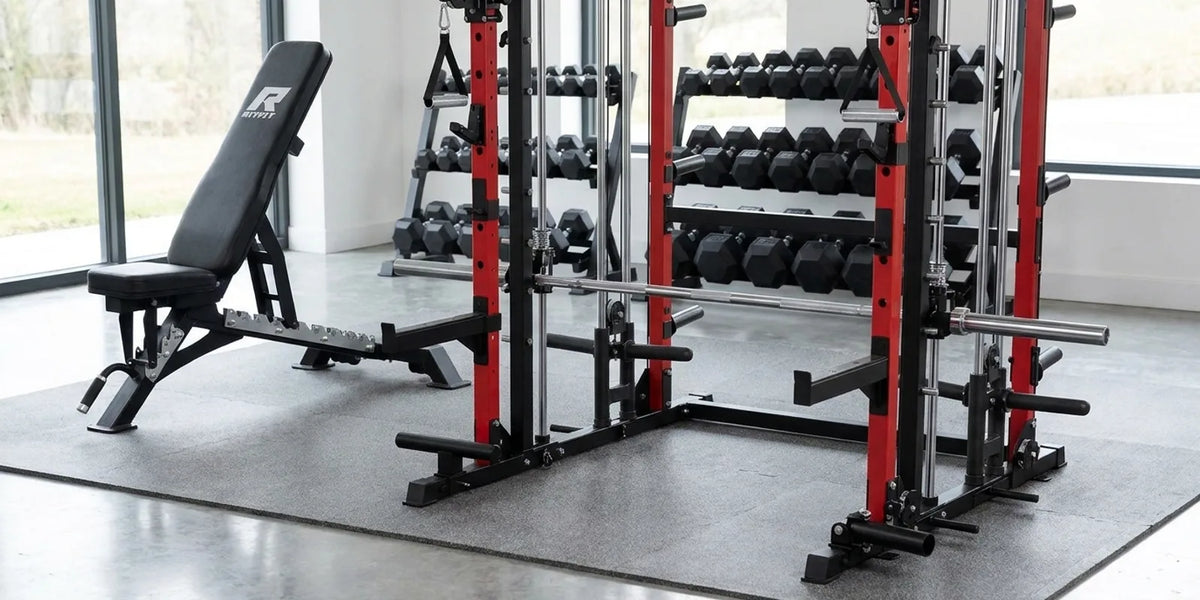
Stiff-leg deadlifts on a Smith machine are a smart way to load the hamstrings when you train alone. The guided bar keeps the load against your legs while you hinge at the hips, so you get a deep hamstring stretch without chasing a free bar around your shins.
This guide covers the setup and form cues that make the lift work, how the move differs from the Romanian deadlift, and the lower-back safety rules that keep it productive. You will get simple programming for leg day and a look at what a home Smith machine needs.
Quick Answer: Yes, stiff-leg deadlifts on a Smith machine work well because the guided bar slides straight down the legs, the knees stay nearly straight, and the safety hooks let solo lifters train hard. Set the bar at mid-thigh, hinge the hips back, and pull the bar up along the legs on every rep.
Key Takeaways
- Machine fit: The Smith machine suits the stiff-leg deadlift because the guided bar tracks the legs and the safety hooks give solo lifters a bailout point.
- Form: Keep a soft knee bend, push the hips back, and lower the bar toward mid-shin while the lumbar spine stays neutral.
- Difference from the RDL: The stiff-leg deadlift travels deeper with straighter knees, while the Romanian deadlift stops just below the knees.
- Muscles: The hamstrings and gluteus maximus lead the lift, and a training study reported greater gluteus maximus excitation in the stiff-leg deadlift than in the Romanian deadlift.
- Programming: Two to four sets of six to ten reps once or twice a week, adding load only when every rep stays controlled.
Can You Do Stiff-Leg Deadlifts on a Smith Machine?
Stiff-leg deadlifts on a Smith machine work because the guided bar tracks straight down the legs while the hips hinge back. The safety hooks replace the need for a spotter, so solo lifters can push hard sets in a home gym. The knees stay nearly straight with only a slight bend, and the hamstrings control the load through a long range of motion.
The rail system fixes the bar path in a vertical line, which keeps the weight glued to your thighs and shins. On a free bar the load drifts forward when the hamstrings tighten, and the rep falls apart.
Start height matters more here than on the floor. You unrack from around mid-thigh, so every rep begins at the top of the hinge and the bar never has to clear the knees from the ground.
- Guided path: The bar slides in one vertical line, so it stays against the legs from top to bottom.
- No spotter needed: The hooks give you a fixed start and a clear place to end the set, which keeps solo garage training safe.
- Stable bar-to-leg distance: The bar cannot swing away from you, so the hamstring stretch stays consistent rep after rep.
- Easy depth control: The safety pins can act as a floor and let you reset every rep at the bottom.
- Faster learning curve: The machine removes the balance problem, so new lifters can feel the hip hinge sooner.
Experienced lifters lean on the machine for the same reason anywhere in the gym, and Jeff Nippard pushes his Smith machine sets hard because the bar path removes the failure risk.
"Next, I do Smith machine squats for the quads and glutes. Here I get as deep as I can and explode out of the hole. Doing these on the Smith allows me to push my last set to failure without worrying about dumping the bar."
Jeff Nippard, Science-Based Natural Bodybuilder and Powerlifter, JeffNippard.com, Jeff Nippard's Science-Backed Leg Workout for Massive Quads (Men's Health UK)
Muscles Worked by Smith Machine Stiff-Leg Deadlifts
The hamstrings and gluteus maximus do most of the work in the Smith machine stiff-leg deadlift. The erector spinae and the deep core muscles hold the lumbar spine neutral while the posterior chain extends the hips.
A systematic review of electromyographic studies on the deadlift and its variants pooled original research from four electronic databases with a search running through March 2019 in the exercise-science literature. That review reports semitendinosus activation predominating over biceps femoris within the hamstring complex during deadlift variations.[1]
In a study of ten competitive bodybuilders working at 80% 1-RM, the stiff-leg deadlift excited the gluteus maximus more than the Romanian deadlift with an effect size 0.99 in its favor.[2] The semitendinosus showed the opposite pattern, favoring the Romanian deadlift with an effect size 1.38 in that comparison.
- Hamstrings: The hip extensors work hardest at the stretched bottom position, which is why the near-straight knee matters.
- Gluteus maximus: The glutes finish the lift as the hips drive forward to standing.
- Erector spinae: The spinal erectors hold the back flat instead of rounding under the load.
- Grip and forearms: The hands only hook the bar, but the forearms still hold tension through the set.
The hamstrings cross the hip and knee in every rep, so a small change in knee angle shifts the work between muscles. For more hamstring work outside this lift, see our hamstring workouts with a workout bench.
How to Do Stiff-Leg Deadlifts on a Smith Machine
A correct Smith machine stiff-leg deadlift starts with the bar at about mid-thigh height and a soft knee bend. You unlock the bar, push the hips back, and let the bar slide down the front of the legs toward mid-shin.
The hamstrings cross both the hip and knee joints, so keeping the knees nearly straight lengthens them further as the hips travel back.[3] The same review links impaired hamstring capacity with low back pain, which is why the range of motion stays within your control.
- Step 1: Set the bar height: Position the hooks around mid-thigh, stand close to the bar, and place the feet hip-width with the toes forward or slightly out.
- Step 2: Unrack and brace: Stand up to unrack, roll the hooks back, and brace the trunk before the first rep begins.
- Step 3: Hinge the hips back: Push the hips toward the wall behind you while the knees keep their small fixed bend.
- Step 4: Find your depth: Lower the bar past the knees toward mid-shin, and stop at the deepest point you can hold with a flat back.
- Step 5: Stand tall: Drive the hips forward and squeeze the glutes, letting the bar drag up the legs on the same path.
Two form cues keep the set honest. Keep the bar in light contact with the legs the whole way down, and control the eccentric while you reset each rep at the top instead of bouncing the bottom.
If the hip hinge feels new, practice the pattern with our deadlift instructions first, and add load only after the bar path feels repeatable.
Stiff-Leg Deadlift vs Romanian Deadlift on the Smith Machine
The stiff-leg deadlift keeps the knees nearly straight and lowers the bar toward mid-shin, while the Romanian deadlift keeps a visible knee bend and stops just below the knees. These are two different movements, and the knee angle is what separates them.
The stiff-leg deadlift lets the bar travel deeper, so the hamstrings stretch further and the lifter can reset at the bottom of every rep. The Romanian deadlift shortens the range slightly and turns the hip hinge into a sharper tool for heavy loading.
| Movement | Knee position | Bar depth | Main stretch | Best for |
|---|---|---|---|---|
| Stiff-leg deadlift | Nearly straight, soft bend | Past the knees toward mid-shin | Hamstrings at long length | Stretch-focused hamstring work |
| Romanian deadlift | Bend around 15 to 20 degrees | Just below the knees | Hamstrings and glutes under hinge control | Heavy hinge strength |
| Conventional Smith deadlift | Bent knees, hips start lower | From the pins near the floor | Quads, glutes, and upper back | Full pulling strength |
Depth ranges describe typical coached form, and individual hamstring mobility sets the final range.
The conventional version bends the knees more and shifts part of the work toward the quads and upper back. For that pull, use our ultimate guide to Smith machine deadlifts, and for the hinge sibling of this lift follow our Smith machine Romanian deadlift walkthrough.
Common Mistakes and Lower-Back Safety
Rounding the lumbar spine under load is the main risk in the stiff-leg deadlift, so end the descent the moment the lower back starts to flex. Depth without a neutral spine adds little for the hamstrings and a lot of stress to the back.
- Chasing depth with a round back: Stop at the point where the pelvis starts to tilt and the spine follows.
- Drifting into a squat: If the knees bend deeper each rep, the lift turns into a conventional pull and the hamstring stretch disappears.
- Letting the bar float: Keep light contact with the thighs and shins so the load never pulls the torso forward.
- Loading too fast: Ego weight forces the back to work harder than the hamstrings, which is the wrong trade.
- Bouncing the bottom: The stretch position is where the hamstrings work hardest, so control it instead of rebounding.
Lifters with tight hamstrings should build depth gradually and may prefer the Romanian deadlift first. Sharp pain, tingling in the legs, or a form breakdown means the set ends, and persistent discomfort is a reason to talk with a qualified professional.
Brace before every rep, and if the lower back starts to take over the lift, drop the weight or shorten the range of motion before progressing again.
Why Choose the RitFit M2 Smith Machine for Stiff-Leg Deadlifts?
The RitFit M2 Smith Machine fits stiff-leg deadlifts well because its guided bar keeps the load against the legs and its safety hooks give solo lifters a dependable bailout. The machine turns a garage corner into a posterior-chain station without asking for a spotter.
For a home gym where one machine covers leg day and upper-body work, the M2 pairs the Smith station with cable training and add-on options. You run the stiff-leg deadlift first, then move to rows or leg curls without leaving the platform.
- Space fit: The M2 suits a garage or basement where a full rack and a separate cable tower would not fit together.
- Training flow: The guided bar handles the hinge work, and the cable station covers the hamstring and back accessories that follow.
- Family use: Fixed hooks and a predictable bar path make the machine easier for multiple lifters in one household to share.
Shoppers comparing the line should match the machine to the room. The M1 Multi Functional Home Gym Smith Machine keeps the footprint small for starter setups.
The M3 Power Rack Cable Crossover Smith Machine fits lifters who want a full rack and a wider cable station. Browse the Smith machine collection to compare current options.
"We love our 3d smith machine. It took me and my wife a few hours to put it together. Pretty straight forward. Great machine and products."
EVAN E. Verified Buyer, RitFit M2 Multi-Functional Modular Home Gym Smith Machine Tailored to All Fitness Levels
How to Program Smith Machine Stiff-Leg Deadlifts
Two to four sets of six to ten reps, once or twice a week, is a solid default for lifters building hamstrings with the stiff-leg deadlift. The lift responds to control and stretch, so keep two clean reps in reserve on most sets.
- Starting weight: Begin with the empty bar and add load only when ten controlled reps feel crisp and repeatable.
- Weekly frequency: One to two sessions per week works for most home lifters, with at least forty-eight hours between hamstring-focused days.
- Progression: Add about five pounds when every rep of the last set stays clean with the same depth and tempo.
- When to add load: Move the weight up only after two sessions at the same load with no form breakdown.
- Rest periods: Rest two to three minutes between sets so the hamstrings and the back both recover before the next effort.
Substitutions and Complementary Hamstring Moves
The stiff-leg deadlift is one tool in a hamstring plan, and swapping it keeps progress moving when the movement stalls.
- Romanian deadlift: Shifts the range shorter and suits heavier hinge strength blocks.
- Leg curl variations: Train knee flexion directly and round out the hamstring work, see leg curl alternatives for stronger hamstrings.
- Single-leg Romanian deadlift: Adds balance and unilateral volume on lighter days.
- Accessory machines: Dedicated leg machines keep the hamstrings and quads growing on days when the hinge is off the menu.
FAQs About Smith Machine Stiff-Leg Deadlifts
Can You Do Stiff-Leg Deadlifts on a Smith Machine?
Yes. The Smith machine works well for stiff-leg deadlifts because the guided bar travels straight down your shins, the safety hooks give you a bailout point, and you can train hard without a spotter. Set the bar around mid-thigh height and push your hips back while keeping your knees nearly straight.
What Is the Difference Between a Stiff-Leg Deadlift and a Romanian Deadlift on the Smith Machine?
The stiff-leg deadlift keeps the knees nearly straight and lets the bar travel past the knees to mid-shin, so the hamstrings stretch further. The Romanian deadlift keeps a visible knee bend of about 15 to 20 degrees and usually stops the bar just below the knees with the hips acting as the main hinge.
How Low Should the Bar Go on a Smith Machine Stiff-Leg Deadlift?
Lower the bar until it reaches about mid-shin level or until your lower back starts to lose its neutral position, whichever comes first. Most lifters feel a strong hamstring stretch just past the knees. Stop there if your hamstrings or lower back tighten up, since depth without control adds little benefit.
Are Smith Machine Stiff-Leg Deadlifts Safe for the Lower Back?
Smith machine stiff-leg deadlifts are safe when you keep the lumbar spine neutral, brace before every rep, and stop the descent the moment your back rounds. The guided bar path helps you keep the load close to the legs. Lifters with limited hamstring mobility should master the Romanian deadlift first and build depth gradually.
What Weight Should I Start With for Smith Machine Stiff-Leg Deadlifts?
Start with an empty bar or light plates and add load only after ten controlled reps feel crisp. Because the hamstrings work at a long muscle length, most lifters need less weight than on conventional deadlifts. A useful rule is to choose a load that leaves two clean reps in reserve.
How Often Should I Do Stiff-Leg Deadlifts on a Smith Machine?
One to two sessions per week fits most training plans, with two to four sets of six to ten reps each. Leave at least forty-eight hours between hamstring-focused sessions. Add weight in small jumps, such as five pounds, only when every rep stays controlled with a neutral spine.
Can Stiff-Leg Deadlifts Replace Leg Curls for Hamstring Training?
Stiff-leg deadlifts train the hamstrings through hip extension while leg curls train knee flexion, so the two movements complement each other rather than replace each other. Use the stiff-leg deadlift as your main hamstring builder and keep a leg curl variation if knee flexion strength matters to your goals.
Conclusion
Yes, stiff-leg deadlifts on a Smith machine work, and the guided path makes the hip hinge easier to learn than the free-bar version. Keep the knees nearly straight, push the hips back, and build the hamstrings rep by rep.
Start light, log your reps, and progress on feel. When you want the full home setup, check the RitFit discount guide for current offers on Smith machines and leg equipment.
Disclaimer
This article is general fitness information and is not medical advice or a treatment plan. Consult a qualified professional before starting a new training program, especially with a history of lower-back or hamstring issues.
References
1. Martín-Fuentes I, Oliva-Lozano JM, Muyor JM. Electromyographic activity in deadlift exercise and its variants. A systematic review. PLoS One. 2020;15(2):e0229507. doi:10.1371/journal.pone.0229507. PMCID: PMC7046193
2. Coratella G, Tornatore G, Longo S, Esposito F, Cè E. An Electromyographic Analysis of Romanian, Step-Romanian, and Stiff-Leg Deadlift: Implication for Resistance Training. Int J Environ Res Public Health. 2022;19(3). doi:10.3390/ijerph19031903. PMCID: PMC8835508
3. Kellis E, Blazevich AJ. Hamstrings force-length relationships and their implications for angle-specific joint torques: a narrative review. BMC Sports Sci Med Rehabil. 2022;14(1):166. doi:10.1186/s13102-022-00555-6. PMCID: PMC9446565





