








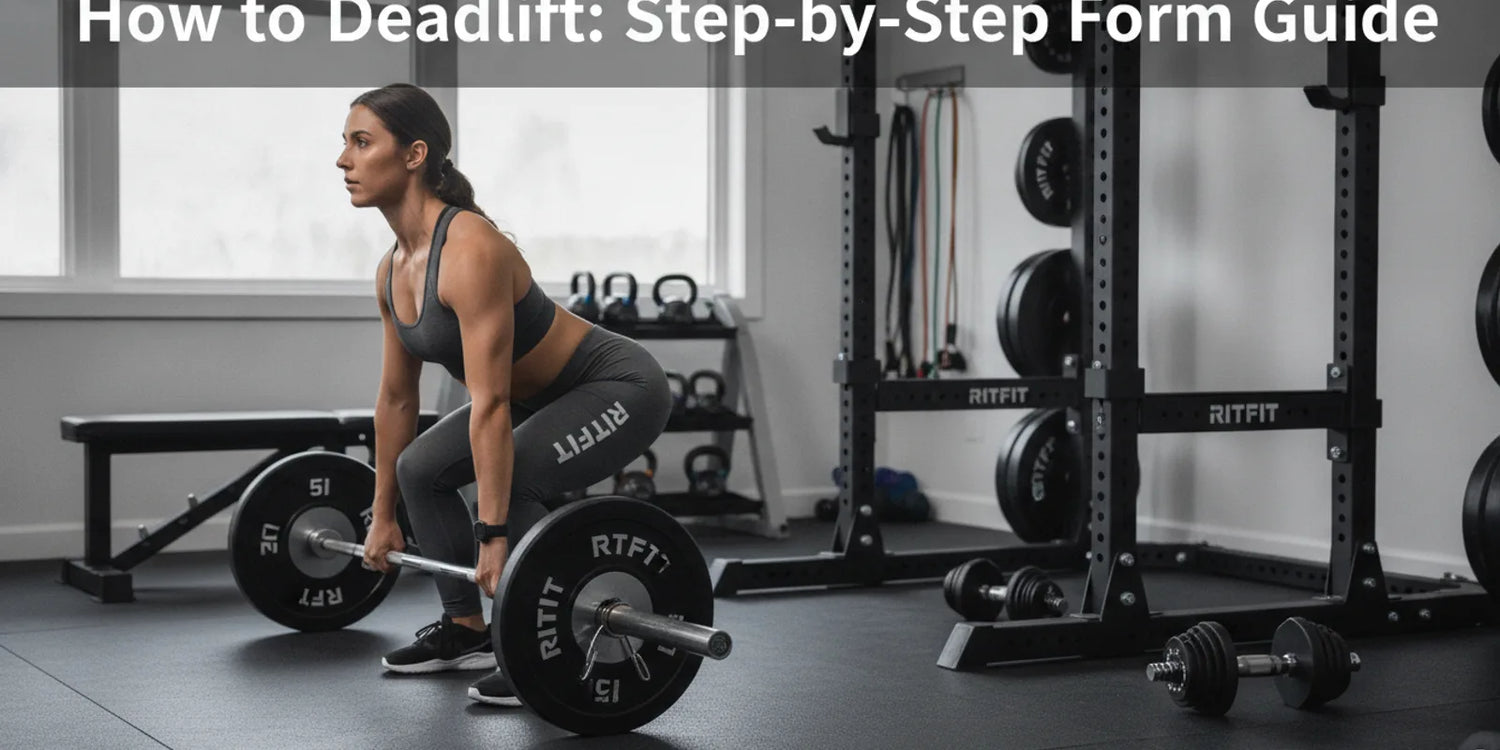
The deadlift is a full-body strength exercise where you lift a loaded barbell from the floor to a standing position using a hip hinge. This guide walks you through the conventional barbell deadlift step by step, from setup to lockout.
It is written for beginners and early-intermediate lifters who want clean, safe form. You will learn the exact stance, grip, brace, common mistakes to avoid, and how to choose a starting weight.
Table of Contents
- What Is a Deadlift and Why Does It Matter?
- Which Muscles Does the Conventional Deadlift Work?
- What Equipment and Bar Setup Do You Need?
- How Do You Deadlift in 5 Steps?
- How Do You Lower the Bar and Reset Each Rep?
- What Are the Most Common Deadlift Mistakes?
- What Weight Should You Start With and How Do You Progress?
- Which Deadlift Variations Should You Try Next?
Key Takeaways
- Master the hinge first: The deadlift is a hip hinge, not a squat, so push your hips back and keep the bar close to your body.
- Neutral spine is non-negotiable: Keep your back flat and braced throughout to protect your lower back and lift efficiently.
- Follow a 5-step setup: Stance, grip, knees, back, then pull, in that exact order every single rep.
- Start light and progress slowly: Begin with an empty or lightly loaded bar so technique stays solid as the weight climbs.
- Stop on form breakdown: End the set the moment your back rounds or you feel sharp pain, not when you hit a number.
What Is a Deadlift and Why Does It Matter?
A deadlift is a strength exercise in which you lift a barbell from the floor to a standing position by extending your hips and knees together. It is one of the "big three" powerlifting movements alongside the squat and bench press.
- Movement pattern: It trains the hip hinge, a foundational pattern you use every time you pick something up off the ground.
- Dead weight: Each rep starts from a dead stop on the floor, so there is no bouncing or momentum to help you.
Because it loads nearly every muscle in the posterior chain, the deadlift builds practical, transferable strength. To understand whether it counts as a pull or a press, read our breakdown of is the deadlift a push or pull.
Which Muscles Does the Conventional Deadlift Work?
The conventional deadlift trains the entire posterior chain, including the hamstrings, glutes, erector spinae, and quadriceps, working as a coordinated unit. A systematic review of EMG studies found that the erector spinae and quadriceps showed greater activation than the gluteus maximus and biceps femoris during the deadlift and its variants.[1]
- Posterior chain: Hamstrings and glutes drive hip extension as you stand the weight up.
- Trunk and back: The erector spinae keeps your spine neutral and resists rounding under load.
- Grip and lats: Your forearms hold the bar while your lats keep it pinned to your body.
This whole-body demand is why the deadlift is so effective, but also why technique matters. Build it with quality barbells and weight plates suited to progressive loading.
What Equipment and Bar Setup Do You Need?
You need a standard barbell, weight plates, and enough floor space to pull safely, ideally on a platform or mat. Set the bar so it sits about mid-shin height, which is the standard starting position created by full-size plates.
- Bar height: Standard plates raise the bar to roughly mid-shin, the ideal pull height for beginners.
- Loading help: A barbell jack makes adding and removing plates safer and faster between sets.
- Footwear: Use flat, stable shoes or train barefoot so you can drive through your whole foot.
If you are lifting lighter loads, learn how to load plates on a barbell at the correct height, or use a RitFit deadlift jack barbell stand for easier setup.
How Do You Deadlift in 5 Steps?
You deadlift in five ordered steps: set your stance, grip the bar, bend your knees, set your back, then pull. Following the same sequence every rep keeps your position consistent and your spine safe.
"To maximize both performance and safety in the deadlift, it's of utmost importance to pay appropriate attention to your deadlift setup and technique."
Greg Nuckols, MA, Strength Researcher and Coach, Stronger By Science
Step 1: Set your stance and bar position
Stand with your feet about hip-width apart, heels around 4-6 inches apart, with your toes turned out around 15 degrees and the bar over your mid-foot.
Step 2: Grip the bar
Bend at the hips and grip the bar just outside your shins with a double overhand grip, keeping your arms vertical.
Step 3: Bend your knees and set your shins
Drop your hips by bending your knees until your shins lightly touch the bar, without pushing the bar forward.
Step 4: Set your back and brace
Lift your chest to flatten your back into a neutral spine, then take a deep breath and brace your core hard. Research on the lift-off position found it relies heavily on the rectus femoris and erector spinae, so a braced trunk is essential here.[2]
Step 5: Pull and lock out
Drive through your whole foot, keep the bar against your legs, and stand tall with hips and knees locking out together.
Watch the full setup and pull demonstrated in this tutorial before your first session.
How Do You Lower the Bar and Reset Each Rep?
You lower the bar by reversing the pull: push your hips back first, then bend your knees once the bar passes your kneecaps. Keep the bar against your legs and your spine neutral the whole way down.
- Hips first: Unlock your hips and knees, then hinge back rather than squatting the weight down.
- Reset fully: Let the bar settle on the floor, take a fresh breath, and rebrace before the next rep.
Every rep starts from a dead stop, so avoid bouncing the plates off the floor to cheat the next pull.
What Are the Most Common Deadlift Mistakes?
The most common deadlift mistakes are rounding the lower back, letting the bar drift away from the shins, and raising the hips too early. Each one reduces efficiency and increases strain on your spine.
- Rounded back: Reset your chest up and brace harder, and lower the weight until your spine stays neutral.
- Bar drifting forward: Engage your lats to pull the bar into your legs and keep weight over your mid-foot.
- Hips shooting up: Drive with your legs and hips together so your shoulders and hips rise at the same rate.
- Jerking the bar: Build tension before you pull instead of yanking the weight off the floor.
If form keeps breaking down, drop the weight and rehearse the pattern with a lighter variation like the kettlebell deadlift.
What Weight Should You Start With and How Do You Progress?
You should start with an empty or lightly loaded barbell so you can rehearse the full setup and pull with clean form. Add weight only when every rep stays neutral and controlled.
How to choose your starting weight
Begin with a load you can lift for 3 sets of 5 reps while keeping perfect technique, even if that is just the bar.
When to add weight
Add a small increment, around 5-10 lb, once you complete all your reps with a flat back and smooth lockout for two sessions in a row.
When to stop a set due to form breakdown or pain
Stop immediately if your lower back rounds, your bar path drifts, or you feel any sharp or pinching pain.
- Frequency: Deadlift once or twice per week with at least one recovery day between sessions.
- Quality over numbers: End a set on form breakdown, not when you hit a target rep count.
Which Deadlift Variations Should You Try Next?
Once your conventional deadlift is solid, you can branch into variations that shift emphasis or lower the technical barrier. Each one trains the hip hinge slightly differently.
- Trap bar deadlift: A beginner-friendly option that places less stress on the lower back; see how to do a trap bar deadlift.
- Suitcase deadlift: A unilateral pull that challenges your core and grip; learn the suitcase deadlift.
- Single-leg Romanian deadlift: An accessory move for balance and hamstrings; try the single-leg Romanian deadlift.
- Guided bar option: Nervous beginners can rehearse the pattern with Smith machine deadlifts.
One study comparing the conventional and Romanian deadlift found the conventional version produced greater overall lower-extremity activation, including the rectus femoris and gluteus maximus.[3]
FAQs About How to Deadlift
Is the deadlift bad for your lower back?
No. The deadlift is not inherently bad for your back when performed with a neutral spine and an appropriate load. Problems usually come from rounding the lower back under heavy weight or progressing too quickly. Brace your core, keep the bar close, and start light so your technique stays solid as the weight climbs over time.
Should beginners use a mixed grip or double overhand grip?
Beginners should start with a double overhand grip because it builds grip strength evenly and keeps the shoulders balanced. Switch to a mixed grip or add straps only once the bar starts slipping at heavier loads. Chalk also helps. The goal early on is to let your grip develop naturally alongside your pulling strength.
How often should I deadlift each week?
Most beginners do well deadlifting once or twice per week, leaving at least one or two days of recovery between sessions. The deadlift is demanding on the whole posterior chain and central nervous system, so quality reps matter more than frequency. Focus on consistent technique and small weekly load increases rather than maxing out often.
What weight should I start deadlifting with?
Start with an empty or lightly loaded barbell so you can rehearse the full setup and pull with clean form. Add weight gradually, only when you can complete every rep with a neutral spine and controlled lockout. Many beginners progress for several weeks before the bar feels heavy, which is exactly what you want for safe long-term gains.
Why does the bar drift away from my shins?
The bar drifts forward when your hips rise too early or your weight shifts toward your toes. Keep the bar over your mid-foot, engage your lats to pull it into your legs, and drive through your whole foot. Resetting your stance and starting lighter usually fixes the bar path quickly within a few sessions.
Conclusion
The conventional deadlift is a foundational lift that rewards patient, precise technique over rushing to heavy weight. Master the five-step setup, keep a neutral spine, and let the bar stay close throughout.
Start light, add weight only when form holds, and stop any set the moment your back rounds. Once your pull feels solid, branch into variations to keep building total-body strength.
Disclaimer
This article is for general educational purposes only and does not replace professional fitness or medical advice. Consult a qualified coach or healthcare provider before starting a new resistance training program, especially if you have any existing injury or health condition.
References
1. Martin-Fuentes I, Oliva-Lozano JM, Muyor JM. Electromyographic activity in deadlift exercise and its variants. A systematic review. PLoS One. 2020;15(2):e0229507. https://pmc.ncbi.nlm.nih.gov/articles/PMC7046193/
2. de Lima LCR, Mortatti AL, de Souza TMF, et al. Analysis of muscle strength and electromyographic activity during different deadlift positions. Muscles. 2023;2(2):218-227. https://pmc.ncbi.nlm.nih.gov/articles/PMC12225233/
3. Lee S, Schultz J, Timgren J, Staelgraeve K, Miller M, Liu Y. An electromyographic and kinetic comparison of conventional and Romanian deadlifts. J Exerc Sci Fit. 2018;16(3):87-93. https://pmc.ncbi.nlm.nih.gov/articles/PMC6323186/





