Stretch band exercises for legs let you train your quads, hamstrings, glutes, and calves at home using a single elastic band, no rack or heavy plates required. This guide shows you which moves hit each muscle, exactly where to place the band, and how to pick the right tension.
It is written for home and travel exercisers who want a joint friendly lower body routine. Always work within a pain free range and stop any move that causes sharp discomfort.
Quick Answer: Stretch band exercises for legs effectively build the quads, hamstrings, glutes, and calves at home using one elastic band. Compound moves like squats and Romanian deadlifts need heavier tension, while mini band hip drills use lighter resistance, and band placement controls which muscle leads.
Key Takeaways
- One band, four muscle groups: A single loop or tube band can train quads, hamstrings, glutes, and calves in a complete home session.
- Placement decides the target: Looping the band lower, near the feet or ankles, tends to drive more glute activity than placing it above the knees.
- Match tension to the move: Use heavier bands for squats and deadlifts, medium for curls and extensions, lighter for mini band hip work.
- Bands are joint friendly: Tension builds gradually through the range of motion, which suits beginners, travelers, and older trainees.
- Progress simply: Add reps, slow the lowering phase, or step up band stiffness once a move feels controlled.
Why train your legs with a stretch band?
Stretch bands let you train the lower body anywhere because they pack into a bag, cost little, and apply accommodating resistance that increases as you stretch them. That rising tension feels easy at the bottom of a move and hardest where your muscles are strongest, which is gentle on the joints.
- Portability: A band travels in a carry on and replaces a rack of fixed weights.
- Joint friendly load: Resistance climbs gradually rather than crashing onto the knee or hip.
- Variable strength curve: You can shift the hardest point of an exercise by changing band length and placement.
Browse a full range of resistance bands if you want to assemble a set with several tension levels.
What band do you need and how do tension levels work?
For a complete leg workout you mainly need one large loop band plus an optional tube band with handles, and ideally a small mini band for hip work. Large loop bands suit big movements like squats, while mini bands create close tension for small range glute drills.
- Large loop band: Best for squats, hip thrusts, and standing on the band for overhead loading.
- Tube band with handles: Good for Romanian deadlifts, calf raises, and pressing style moves.
- Mini band: Ideal for lateral walks, clamshells, and fire hydrants where range is short.
Tension scales two ways, by choosing a stiffer band and by stretching the same band further, so a single band can cover several effort levels. New trainees should start light and confirm form before stepping up.
See our guide to resistance band exercises you can do literally anywhere for travel friendly ideas.
How does band placement change which muscles work?
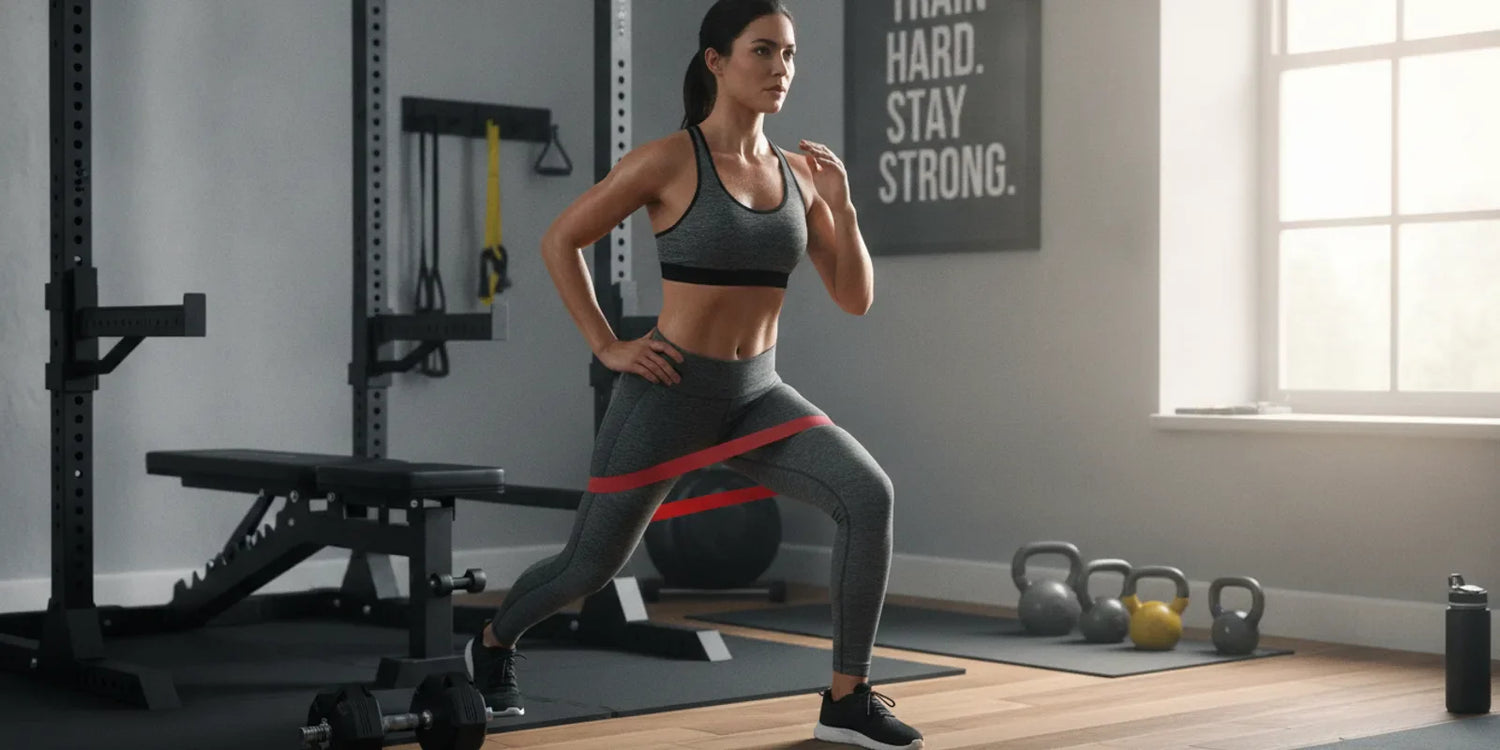
Where you loop the band strongly changes which muscles do the most work, and lower placements often recruit more glute activity than placements above the knee. This means the same exercise can be retargeted simply by moving the band up or down your legs.
One trial measuring muscle activity during squats found the greatest hip muscle activity when the stiffest band sat around the forefeet, with increases of about 83 percent for the gluteus medius and 68 percent for the gluteus maximus compared with squatting without a band.[1] More distal placement increased hip activity rather than reducing it.
- Above the knees: Gentle starting point that teaches you to push the knees out.
- Around the ankles: Raises demand on the hips during walks and kickbacks.
- Around the forefeet: Drives the highest glute and hip activity during squats.
Beginners should still start with above knee placement to groove the movement before moving the band lower for more challenge.
Which stretch band exercises build the quads?
The best banded quad exercises are the banded squat, the banded reverse lunge, and the banded leg extension or Spanish squat, because each loads the front of the thigh through knee extension. These moves let you overload the quads at home without a leg press.
One study comparing knee extensions with elastic tubing against a machine found the band produced similar high quadriceps muscle activity during the lifting phase, though slightly lower during the lowering phase.[2] That makes bands a credible at home stand in for machine knee extensions.
- Banded squat: Stand on the band, loop it over your shoulders, and squat to hip width depth.
- Banded reverse lunge: Step back against the band so the quad works hardest returning to the top.
- Spanish squat: Anchor a band behind your knees and sit back to resist knee extension in a closed chain.
The video below from Athlean-X demonstrates several banded leg moves and the small stabilizing muscles they target.
For a loaded progression once bands feel easy, see how to build leg muscle.
Which stretch band exercises build the hamstrings?
The most effective banded hamstring moves are the banded Romanian deadlift, the standing banded leg curl, and the banded bridge and curl, because each loads hip extension or knee flexion against the band. Together they cover both jobs the hamstrings perform.
- Banded Romanian deadlift: Stand on the band, hinge at the hips with a soft knee, and drive your hips forward to stand tall.
- Standing banded leg curl: Anchor the band low, then curl one heel toward your glute against the tension.
- Banded bridge and curl: Wrap the band around your ankles, bridge your hips, and pull your heels in toward your seat.
Keep the lowering phase slow on each rep, since controlled eccentrics are where the hamstrings work hardest. For more options, see these leg curl alternatives for stronger hamstrings.
Which stretch band exercises build the glutes?
The best banded glute exercises are the banded hip thrust, the lateral band walk, the fire hydrant, and the glute kickback, because they combine hip extension with the hip abduction that targets the side glutes. Band placement matters most here.
In one trial of resisted side stepping, placing the band around the feet elicited more gluteal activity than placing it around the ankles, without increasing tensor fascia latae activity, and activity rose as the band moved from the knees to the ankles to the feet.[3] Lower placement gives the side glutes more to do.
- Banded hip thrust: Loop the band above your knees, push your knees out, and drive your hips up.
- Lateral band walk: Keep tension in the band and step sideways without letting the knees cave in.
- Fire hydrant: On all fours, lift one knee out to the side against the band to hit the gluteus medius.
This banded hip work pairs well with seated leg training on a leg machine once you are ready to add fixed load.
Which stretch band exercises build the calves?
The two key banded calf moves are the standing banded calf raise for the gastrocnemius and the seated banded calf raise for the soleus, because bending the knee shifts the work to the deeper calf muscle. Both add resistance to a movement most people only do with body weight.
- Standing banded calf raise: Stand on the band, hold the ends near your shoulders, and rise onto your toes with a slow lower.
- Seated banded calf raise: Loop the band under the balls of your feet, hold the ends across your knees, and push through your toes.
Focus on a full squeeze at the top and a controlled descent, since the lowering phase builds calf strength most effectively. The RitFit Ultimate Leg Day Duo is a handy companion when you want a dedicated lower body set up.
What is a simple weekly band leg routine?
A practical band leg routine runs two to three sessions per week with at least one rest day between leg days. Aim for two or three sets of 10 to 15 reps per exercise, picking one move from each muscle group.
- Quads: Banded squat, 3 sets of 12 to 15 reps.
- Hamstrings: Banded Romanian deadlift, 3 sets of 10 to 12 reps.
- Glutes: Banded hip thrust plus lateral walks, 3 sets of 15 reps.
- Calves: Standing banded calf raise, 3 sets of 15 to 20 reps.
Progress when you can finish the top of your rep range with control, by adding reps, slowing the lowering phase, or moving to a stiffer band. For broader variety, browse our 9 resistance band exercises you can do at home and general leg exercises.
What mistakes should you avoid and when should you stop?
The most common band mistakes are letting the knees cave inward, using too little tension, and rushing the lowering phase. Fixing these protects your joints and makes every rep count.
- Knee valgus: Keep the knees tracking over the toes during squats and lunges instead of letting them collapse inward.
- Too little tension: A band that barely stretches will not challenge the muscle, so step up once a set feels easy.
- Rushed eccentrics: Control the return so the band does not snap you back to the start.
Stop any movement that causes sharp or pinching joint pain, reduce the tension or range, and reassess your form before trying again. If you are an older trainee, our guide to leg strengthening exercises for seniors offers gentler progressions, and the best leg day workout covers loaded next steps.
"We can take exercises that you're already doing right now, utilize bands and improve the ability of that exercise to stimulate muscle growth because we're introducing new stress at different points in the range of motion as we manipulate the strength curves."
Jeff Cavaliere, MSPT, CSCS, Athlean-X, Men's Health
FAQs About Stretch Band Exercises for Legs
Can stretch band exercises really build leg strength?
Yes, for beginners and intermediates bands provide enough progressive tension to build noticeable leg strength at home.
Research comparing banded knee extensions with machine work found similar quadriceps activity during the lifting phase.
Bands shine for travel and joint friendly training, though very advanced lifters chasing maximum size will eventually want heavier loaded options too.
Where should I place the band for leg exercises?
Placement decides which muscles work hardest.
For glute and hip work, looping the band lower down, around the feet or ankles rather than above the knees, tends to increase gluteal activity.
For squats, a stiffer band near the forefeet has been shown to boost hip muscle activation.
Above knee placement is gentler and good for beginners.
What band tension should I start with for legs?
Match tension to the exercise type.
Use a medium heavy band for compound moves like squats and Romanian deadlifts where big muscles drive the work.
Choose a medium band for isolation moves such as leg curls and extensions.
Start lighter for lateral hip work with mini bands, since the smaller hip abductors fatigue faster than most people expect.
How often should I do a band leg workout?
Two to three sessions per week is a practical starting point for most home exercisers, leaving at least a day between leg sessions for recovery.
Aim for 10 to 15 reps per exercise across two or three sets.
Progress by adding reps or moving to a stiffer band once the top of your rep range feels controlled.
Are bands safe for my knees?
For most people bands are joint friendly because tension builds gradually rather than crashing onto the joint.
Keep your knees tracking over your toes and avoid letting them cave inward during squats and lunges.
Stop any movement that causes sharp or pinching knee pain, and reduce band tension or range of motion before trying again.
Conclusion
A single stretch band can train every major leg muscle when you match the move to the muscle, place the band thoughtfully, and pick a tension that challenges you. Start above the knee, then lower the band as you grow stronger.
Beginners should master form with light tension first, then progress by adding reps or stiffer bands. Run the weekly routine above two to three times per week, and check the RitFit sale page for band bundles.
Disclaimer
This article is for general educational purposes only and does not replace personalized medical or fitness advice. Consult a qualified healthcare or fitness professional before starting any new exercise program, especially if you have an injury or health condition.
References
1. Neto WK, Soares EG, Vieira TL, et al. Looped Elastic Resistance during Squats: How Do Band Position and Stiffness Affect the Myoelectric Activity of the Hip Muscles? Journal of Functional Morphology and Kinesiology. 2022;7(3):60. PMCID: PMC9396979
2. Brennecke A, Guimaraes TM, Leone R, et al. Muscle Activity during Knee-Extension Strengthening Exercise Performed with Elastic Tubing and Isotonic Resistance. International Journal of Sports Physical Therapy. 2012. PMCID: PMC3537465
3. Berry JW, Lee TS, Foley HD, et al. Hip-Muscle Activity in Men and Women During Resisted Side Stepping With Different Band Positions. Journal of Athletic Training. 2015;50(11):1117-1125. PMCID: PMC6333220