








Skill-related fitness components are the six abilities that drive athletic performance: agility, balance, coordination, power, reaction time, and speed. They differ from the five health-related components that support everyday wellness.
This guide defines each of the six, shows you how to test and train them, and explains where they fit in real sports and daily life.
Quick Answer: The six skill-related fitness components are agility, balance, coordination, power, reaction time, and speed, and they determine how well you learn and perform athletic skills. Simple field tests can measure each one, and targeted drills such as ladder footwork, plyometrics, and balance holds can improve them.
Key Takeaways
- Six components: Skill-related fitness includes agility, balance, coordination, power, reaction time, and speed.
- Different focus: These build athletic performance, while the five health-related components support general health.
- Sport specific: Each sport weighs the six components differently, so training should follow the specificity principle.
- Testable: Simple field tests like the Illinois agility run and the ruler drop measure each component.
- For everyone: Balance, coordination, and reaction time also help older adults and kids move safely.
What Are Skill-Related Fitness Components?
Skill-related fitness components are the abilities that help you learn and perform athletic skills. There are six of them: agility, balance, coordination, power, reaction time, and speed.
- Performance focused: They matter most when you want to compete, perform, or train at a higher level.
- Skill enabling: Strong components make it easier to master sport skills like sprinting, catching, or changing direction.
- Specificity applies: Excelling at one component does not guarantee strength in another, so train the abilities your activity demands.
If you are new to fitness terminology, it helps to first review the five health-related components of fitness before diving into the performance side.
How Is Skill-Related Fitness Different From Health-Related Fitness?
The difference comes down to purpose: health-related fitness supports daily wellness, while skill-related fitness improves athletic performance. Most activities draw on both.
- Health-related five: Body composition, cardiovascular endurance, flexibility, muscular strength, and muscular endurance.
- Skill-related six: Agility, balance, coordination, power, reaction time, and speed.
- Overlap exists: Power draws on strength, and speed work can build on cardiovascular training, so the two categories support each other.
For a side-by-side breakdown, see health vs skill related fitness. For a classic battery that scores both, read about the Presidential Fitness Test, which includes a shuttle run for agility.
What Are the 6 Skill-Related Fitness Components?
Each component has a plain definition and a clear role in sport. Below, you will find what each one means and where it shows up.
Agility
Agility is the ability to change body position and direction quickly and accurately in response to a stimulus. Basketball and soccer players rely on it to dodge opponents and chase the ball.
Balance
Balance is the ability to maintain equilibrium, either in static stillness or in dynamic movement. It depends on proprioception, your sense of where your body is in space.
Coordination
Coordination is the ability to use your senses and body parts together to perform smooth, accurate movements. Hand-eye coordination drives hitting a baseball, while foot-eye coordination drives dribbling a soccer ball.
Power
Power is generally defined as the combination of strength and speed, the ability to exert maximal force in the shortest time, such as a vertical jump or a shot put. Understanding load matters here, so it helps to know what RM means in fitness.
Reaction Time
Reaction time is how quickly you respond to an external stimulus. A swimmer diving the instant the starting gun fires is reacting at high speed.
Speed
Speed is the ability to perform a movement or cover distance in the shortest possible time. Sprinters showcase it, but tennis and baseball also demand quick bursts.
How Do You Test the Skill-Related Components?
Each component has a simple field test you can perform with minimal equipment. These tests give you a baseline to track over time.
- Agility: The Illinois agility run or a shuttle run times how fast you change direction through a set course.
- Balance: The stork stand, holding on one leg with eyes open or closed, measures static balance.
- Coordination: A wall toss test counts how many catches you make against a wall in a set time.
- Power: The vertical jump or standing long jump measures explosive lower-body output.
- Reaction time: A common PE test described by Human Kinetics is the ruler drop, where a partner releases a ruler and you catch it as fast as possible.
- Speed: A short timed sprint, such as 40 yards or 30 meters, captures straight-line speed.
Recording these scores is easier when you are keeping a fitness log so you can compare results month to month.
"Technology can answer specific hypotheses, track large data sets for long-term trends, provide objective measurements, enable quick and accurate communication with coaches, allow for individualization of training, and foster accountability and awareness."Andy Galpin, PhD, Professor of Exercise Science and Human Performance, Parker University, Using Fitness Technology, 5 Min Phys
How Do You Train Skill-Related Fitness?
You train skill-related components with targeted drills, not just general workouts. Plyometrics, agility ladders, balance work, and reaction games each develop a specific ability.
- Agility and speed: Cone drills, ladder footwork, and resisted sprints sharpen change of direction and acceleration.
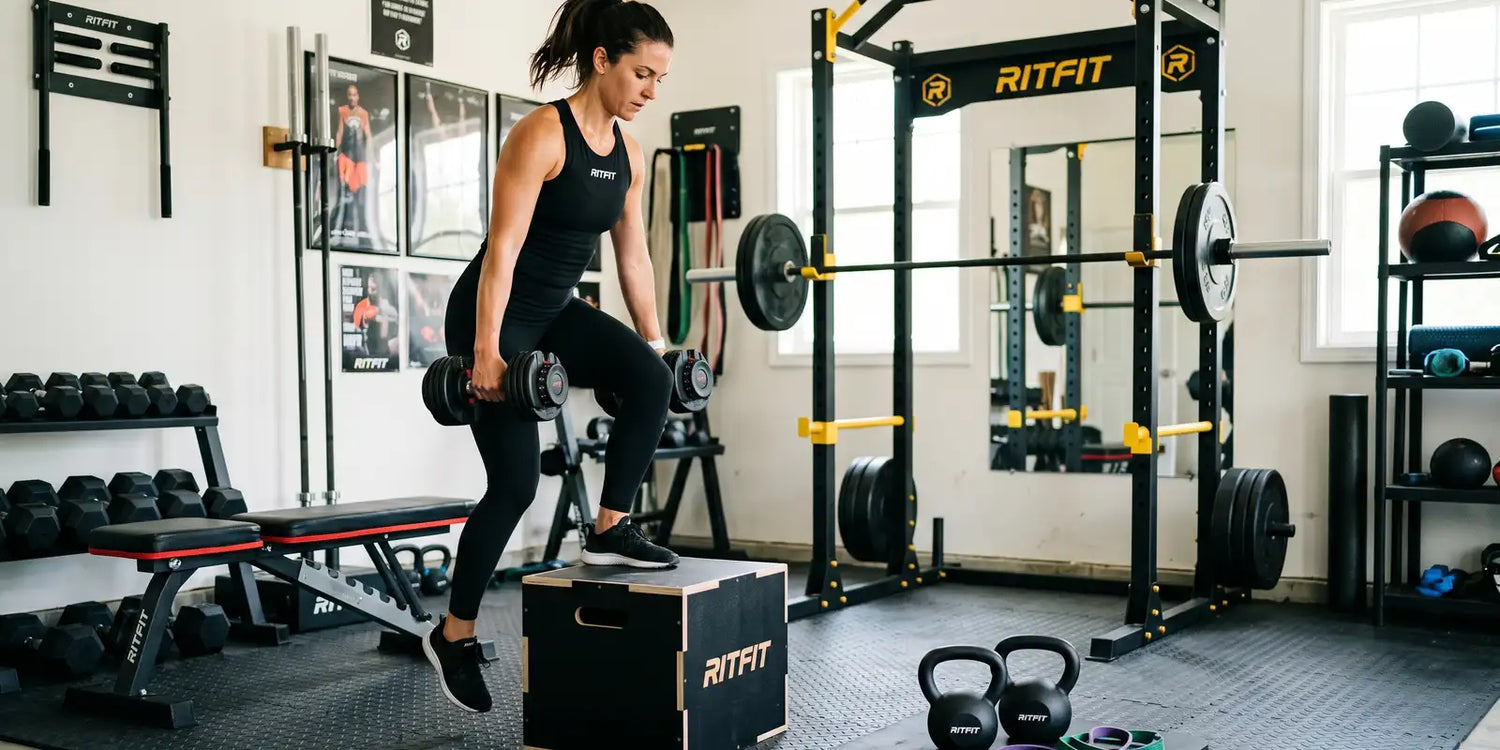
- Power: Plyometrics like squat jumps and box jumps build explosive force.
- Balance and coordination: Single-leg holds, balance boards, and ball-toss drills train stability and timing.
- Reaction time: Partner drills using random visual or audio cues train faster responses.
A systematic review found that core training can improve soccer players' power, speed, balance, and agility, although it could not pinpoint which component benefits most, and evidence on coordination and reaction time is still limited.[1]
For power work at home, a compact station like the RitFit M2 multi-functional home gym supports loaded presses and explosive strength training in one footprint.
This video breaks down how force, speed, and direction combine to develop speed and power, two of the most trainable skill-related components.
Why Does Skill-Related Fitness Matter Beyond Athletes?
Skill-related components are not just for competition; they shape how well people move at every age. The mix you need still depends on your goals and activities.
- Sport profiles differ: A study of 60 players found basketball athletes scored higher in agility, power, coordination, and balance, while footballers were better at reaction time and agility, showing each sport leans on a different blend.[2]
- Older adults: Balance and coordination help prevent falls and keep daily movement safe and confident.
- Children: Coordination, balance, and agility build the movement foundation for future sport and play.
One study of Korean seniors found that balance and motor coordination differed across blood pressure groups in women, suggesting these abilities stay relevant to health well beyond athletic years.[3] Many of these skills are easy to maintain at home, especially with fitness accessories for seniors, and they support active routines like fitness for women across all life stages.
FAQs About Skill-Related Fitness Components
What are the six skill related fitness components?
The six skill-related fitness components are agility, balance, coordination, power, reaction time, and speed. They focus on athletic and motor performance rather than general health. Athletes train them to move faster, change direction quickly, react to cues, and produce explosive force in their chosen sport.
What is the difference between skill related and health related fitness?
Health-related fitness covers body composition, cardiovascular endurance, flexibility, muscular strength, and muscular endurance, which support everyday health. Skill-related fitness covers agility, balance, coordination, power, reaction time, and speed, which improve sport performance. Most activities use both, but skill-related components matter most for competing and excelling athletically.
Can you improve skill related fitness components?
Yes, all six skill-related components respond to targeted practice. Agility ladders, cone drills, and plyometrics build agility and power, balance boards train balance, and reaction drills with random cues sharpen reaction time. Because of the specificity principle, you should train the components and movement patterns your sport actually demands.
Which sports rely most on skill related fitness?
Fast, reactive sports rely most on skill-related fitness, including basketball, soccer, tennis, football, gymnastics, and martial arts. Each weighs the components differently. A sprinter prioritizes speed and power, a gymnast prioritizes balance and coordination, and a goalkeeper prioritizes reaction time, so training should match the sport's specific demands.
Do older adults need skill related fitness?
Yes, balance and coordination are especially valuable for older adults because they help prevent falls and maintain independence. Reaction time and agility also support safe daily movement, like recovering from a stumble. Simple balance holds, coordination drills, and light agility work can keep these abilities sharp well beyond athletic years.
Conclusion
The six skill-related fitness components, agility, balance, coordination, power, reaction time, and speed, build the performance side of fitness. They complement, rather than replace, the five health-related components.
Start by testing your baseline, then train the components your sport or daily life demands most, and track your progress over time. To equip your home setup for less, browse the RitFit discount guide.
Disclaimer
This article is for general educational purposes only and does not replace professional fitness or medical advice. Consult a qualified coach or healthcare provider before starting any new training program, especially if you have an injury or health condition.
References
1. Luo S, Soh KG, Zhang L, et al. Effect of core training on skill-related physical fitness performance among soccer players: A systematic review. Front Public Health. 2022;10:1046456. doi:10.3389/fpubh.2022.1046456. PMCID: PMC9850239
2. Kariyawasam A, Ariyasinghe A, Rajaratnam A, Subasinghe P. Comparative study on skill and health related physical fitness characteristics between national basketball and football players in Sri Lanka. BMC Res Notes. 2019;12(1):397. doi:10.1186/s13104-019-4434-6. PMCID: PMC6624989
3. Kim A, Kim E, Baek S, Shin J, Choi S. Analysis of health-related, skill-related physical strength, and physique by blood pressure levels of Korean seniors. PLoS One. 2022;17(12):e0279264. doi:10.1371/journal.pone.0279264. PMCID: PMC9803284





