Soreness after a workout is one of the most common questions new and returning exercisers ask, and it is usually a normal sign your muscles met an unfamiliar challenge. This guide explains what actually causes it and what to do about it.
You will learn the difference between everyday soreness and delayed onset muscle soreness, why the ache shows up a day or two later, and practical, safe ways to feel better without overthinking it.
Table of Contents
Key Takeaways
- It is usually normal: Post-workout soreness, especially DOMS, is a common adaptation to unfamiliar or harder training, not a sign of injury.
- Eccentric work is the trigger: Lengthening contractions like lowering a weight cause the most soreness, while shortening movements cause very little.
- The delay is the immune response: Soreness peaks roughly 24 to 72 hours later because inflammatory and nerve signaling builds up over time.
- Soreness is not a scorecard: Being sore does not prove a workout was effective or that you built more muscle.
- Keep moving to recover: Light activity, sleep, protein, and hydration help more than complete rest for everyday soreness.
What Is the Difference Between Soreness and DOMS?
Soreness comes in two distinct forms: acute soreness felt during or right after a workout, and delayed onset muscle soreness, or DOMS, which is the dull ache that arrives a day or two later. The two have different causes and timelines.
- Acute soreness: The burning or fatigue you feel mid-set fades within minutes to hours and is linked to short-term metabolic stress.
- DOMS: A tender, stiff feeling that builds the next morning, worsens with stretch and pressure, and is usually felt across the whole muscle belly.
This article focuses on DOMS, since that delayed ache is what most people mean when they ask why they are sore after a workout.
What Actually Causes Soreness After a Workout?
Soreness after a workout is primarily driven by unfamiliar or strenuous eccentric exercise that stresses muscle fibers and triggers an inflammatory and nerve response. The pain you feel comes from chemical messengers sensitizing nerve endings, not simply from "muscle tears" alone.
Eccentric Loading and Microscopic Muscle Stress
Eccentric, or lengthening, contractions are the main driver of DOMS, producing tiny ultrastructural changes in muscle such as disrupted sarcomeres, while shortening contractions cause little to no soreness.[2]
- Eccentric example: Lowering a dumbbell, walking downhill, or the down phase of a squat stretches the muscle under load.
- Why it matters: Unfamiliar movements and added range or load stress fibers more, which is why new routines leave you the most sore.
The Inflammatory and Neural Response
The ache itself is thought to come from inflammatory mediators such as prostaglandins, histamine, and bradykinin sensitizing nerve fibers, so the muscle hurts with movement and pressure rather than at rest.[1]
Interestingly, soreness correlates only poorly with the actual extent of muscle damage, which is why how sore you feel is not a reliable measure of how hard your muscle worked.[1]
The short clip above breaks down why post-exercise muscle damage does not fully explain the delayed ache you feel later.
If your soreness shows up mostly after recovery work, pairing gentle tools from our recovery and training accessories with lighter sessions can keep you moving comfortably.
Why Do You Hurt 24 to 48 Hours Later?
You hurt a day or two later because the inflammatory and nerve signaling behind DOMS builds up gradually rather than instantly. DOMS typically appears 12 to 48 hours after exercise, peaks at 24 to 72 hours, and fades within 5 to 7 days.[1]
In a controlled animal experiment, blocking the B2 bradykinin receptor before lengthening contractions prevented soreness, and nerve growth factor rose over the same 12 hour to 2 day window as the pain, which helps explain both the delay and why lengthening movements specifically cause it.[3]
- Step by step: Some signaling starts right after exercise, but the immune and nerve sensitization peaks hours later, so the ache lags behind the session.
- Fitness level shifts it: As a movement becomes familiar, soreness arrives sooner and feels milder, a sign your tissue tolerance is improving.
This delay is normal and predictable, so feeling fine right after a tough new workout does not mean you escaped soreness.
Does Soreness Mean a Good Workout or More Muscle?
No, soreness is a poor indicator of workout quality or muscle growth. You can be very sore with little muscle damage, and you can build muscle well with minimal soreness, so it should not be your scorecard.
Soreness mostly reflects how unfamiliar or eccentric the work was, not how much you grew, which is why beginners and people trying new movements feel it most.
"In general, soreness is a terrible proxy for exercise quality. It's a really bad way to estimate whether it was a good or a bad workout. Even for our professional athletes, we do not use soreness as a metric of a good workout."
Andy Galpin, PhD, Professor of Exercise Science and Human Performance, Parker University
- Better progress markers: Track strength, reps, and how movements feel over weeks rather than chasing next-day soreness.
- Less soreness over time: Reduced soreness from the same routine signals your muscles have adapted, which is a good thing.
How Can You Relieve and Prevent Workout Soreness?
You can ease and prevent soreness with gentle movement, good recovery habits, and gradual progression rather than any single quick fix. Staying lightly active usually helps soreness fade faster than complete rest.
Active Recovery and Light Movement
Light walking, easy cycling, or mobility work increases blood flow and often reduces the soreness sensation more than lying still. A short session on exercise mats and flooring makes gentle stretching and mobility comfortable.
Sleep, Protein and Hydration
Quality sleep, adequate protein, and steady hydration support the repair process your body runs over the days after training. These basics matter far more than any single recovery gadget.
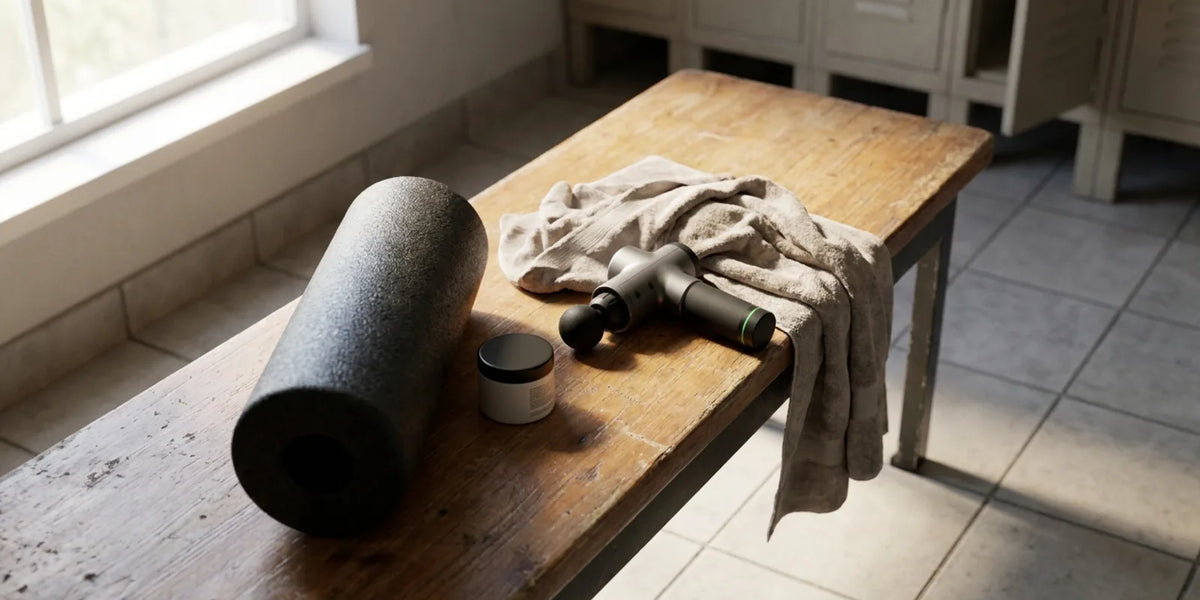
Foam Rolling and Massage Tools
Foam rolling and light massage can temporarily reduce the soreness feeling for many people by moving fluid and boosting circulation. You can explore options in our guide on maximizing your workout recovery with a roller stick.
- Roller benefits: Learn more in our overview of the benefits of using a massage body stick roller.
- Hands-on relief: Try these self-massage tips for sore muscles between sessions.
- Percussion tools: See whether you should use a massage gun for recovery.
Progress Gradually to Build Tissue Tolerance
Start lighter on new movements and add load slowly, roughly 10 percent at a time, so muscles adapt before you push hard. Allow about 48 to 72 hours before hammering the same muscle again.
- Ease into volume: Lighter tools like resistance bands let you train sore muscles gently while building tolerance.
- Lower-impact options: A RitFit 3-in-1 foam plyo box supports controlled, softer progressions for jumps and step work.
- Add load wisely: Once a movement no longer leaves you very sore, it is a reasonable time to increase weight.
When Should You Keep Training and When Should You Ease Off?
You can usually keep training through light to moderate soreness, especially with gentle work or different muscle groups, but you should ease off when discomfort goes beyond a normal dull ache. Knowing the difference keeps you safe and progressing.
- Normal DOMS: A dull, whole-muscle ache that eases with movement and follows the 24 to 72 hour pattern is fine to train around.
- Ease off signals: Choose lighter loads or swap to an easier movement for a muscle group that is very sore.
- Stop and seek help: Sharp or localized pain, joint pain, pain at rest, or soreness lasting well beyond 7 days warrants a professional opinion.
For context on structuring varied, lower-soreness sessions, see our metcon workouts guide and our tips on what helps sore muscles after a workout.
Common Mistakes to Avoid
The most common mistakes are chasing soreness as a goal and resting completely until every ache disappears, both of which slow progress. Eccentric, lengthening movements drive most soreness, so jumping into too much new eccentric work at once is the usual trigger.
- Do not chase soreness: More soreness is not more results, so avoid adding extra eccentric volume just to feel sore.
- Do not fully rest: Total inactivity often makes a sore muscle feel worse than light, easy movement.
- Do not progress too fast: Large jumps in load or new lengthening movements cause the harshest soreness, so build up gradually.
FAQs About Soreness After a Workout
Is it normal to be sore after every workout?
Some soreness is normal, especially after new or harder training, but you do not need to be sore to make progress. As your muscles adapt and build tissue tolerance, the same workout causes much less soreness. Persistent severe soreness every session usually means you are progressing load or volume too quickly and should ease back slightly.
How long should muscle soreness last after a workout?
Delayed onset muscle soreness usually starts within twelve to forty eight hours, peaks around twenty four to seventy two hours, and fades within five to seven days. If a dull whole muscle ache follows that timeline and eases with gentle movement, it is normal. Sharp pain, joint pain, or pain lasting well beyond a week deserves a professional opinion.
Should I work out again while my muscles are still sore?
Light to moderate soreness is generally fine to train through, and gentle active recovery often helps it fade faster than total rest. You can train other muscle groups freely. If a muscle is very sore, choose lighter loads or a different movement for it, and give it roughly forty eight to seventy two hours before loading it hard again.
Does being sore mean I built more muscle?
No, soreness is a poor indicator of muscle growth or workout quality. You can be very sore with little muscle damage, and you can grow well with minimal soreness. Soreness mostly reflects how unaccustomed or eccentric the work was, not how much muscle you built, so judge progress by strength and performance over time instead.
What is the fastest way to relieve sore muscles?
Gentle movement and active recovery, good sleep, adequate protein and hydration tend to help most. Foam rolling and light massage can temporarily reduce the soreness sensation for many people. There is no instant fix, but staying lightly active rather than completely resting usually helps soreness fade faster while supporting recovery.
Conclusion
Soreness after a workout is usually a normal response to unfamiliar or eccentric training, driven by an inflammatory and nerve response that peaks a day or two later. It is not a measure of how good your session was.
Keep moving gently, prioritize sleep, protein, and hydration, and progress gradually so your muscles build tolerance. If pain feels sharp, sits in a joint, or lingers well past a week, check in with a qualified professional.
Disclaimer
This article is for general educational purposes about normal post-exercise soreness and is not medical advice or a diagnosis. If you experience sharp, persistent, or unusual pain, consult a qualified healthcare or fitness professional before continuing to train.
References
1. Stozer A, Vodopivc P, Krizancic Bombek L. Pathophysiology of Exercise-Induced Muscle Damage and Its Structural, Functional, Metabolic, and Clinical Consequences. Physiological Research. 2020. https://pmc.ncbi.nlm.nih.gov/articles/PMC8549894/
2. Yang X, Zhang Y, Zhuang J, et al. Re-examining the mechanism of eccentric exercise-induced skeletal muscle damage from the role of the third filament, titin (Review). Experimental and Therapeutic Medicine. 2024. https://pmc.ncbi.nlm.nih.gov/articles/PMC10731162/
3. Murase S, Terazawa E, Queme F, et al. Bradykinin and Nerve Growth Factor Play Pivotal Roles in Muscular Mechanical Hyperalgesia after Exercise (Delayed-Onset Muscle Soreness). The Journal of Neuroscience. 2010. https://pmc.ncbi.nlm.nih.gov/articles/PMC6632252/