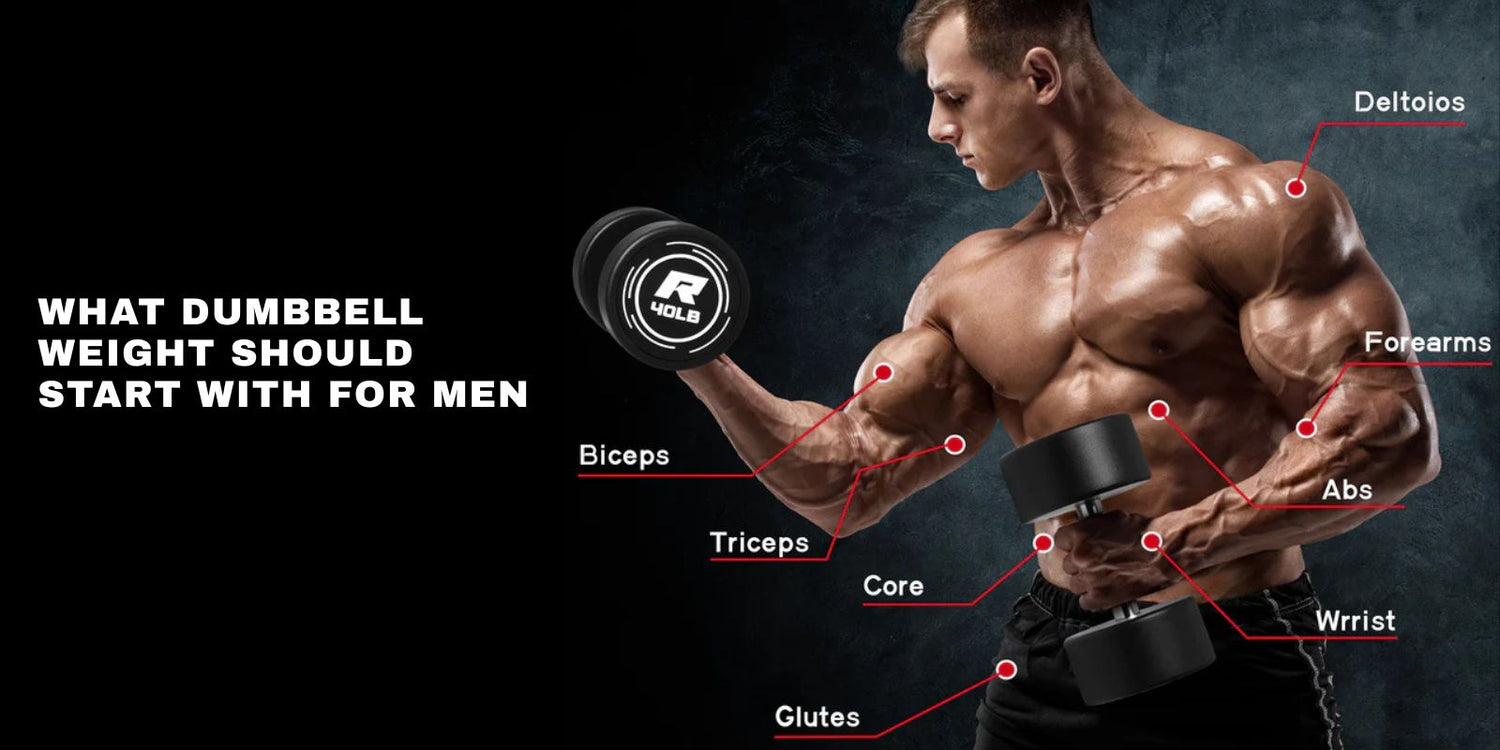
Most beginner men should start with 10 to 20 lb dumbbells for small upper body exercises and 20 to 50 lb dumbbells for stronger moves like rows, presses, squats, and carries. The right starting weight is not the heaviest weight you can lift once, it is the weight you can control for clean reps without pain, swinging, or losing position.
This guide gives practical starting ranges by exercise, a simple self test, progression rules, and home gym buying advice for men choosing their first dumbbells.
Key Takeaways
- Start with control first: Most beginner men should use a weight they can lift for 8 to 12 clean reps before moving heavier.
- Use lighter dumbbells for small muscles: Curls, lateral raises, and rear delt raises often start around 5 to 20 lb per hand.
- Use moderate dumbbells for compound lifts: Rows, presses, squats, Romanian deadlifts, and carries often need 20 to 60 lb depending on the exercise.
- Progress by reps before load: Add reps first, then increase dumbbell weight when every set looks controlled.
- Buy for progression: A small dumbbell range or rack package is usually better than one random pair because different exercises require different loads.
Quick Answer: Best Starting Dumbbell Weight for Men
A good beginner dumbbell weight for men is usually 10 to 20 lb per hand for arms and shoulders, 15 to 40 lb per hand for chest and back, and 25 to 60 lb total for lower body movements. Research on resistance training suggests that different rep ranges can support strength, hypertrophy, and endurance, so beginners should choose a load that matches the movement and allows clean execution.[1]
If you are completely new to lifting, start at the lighter end of the range for your first two weeks. Your first goal is to learn the movement pattern, not to prove strength.
Starting Dumbbell Weight Chart for Men by Exercise
The best dumbbell weight depends on the exercise because each movement uses different muscles and leverage. Use this chart as a practical starting point, then adjust based on form, pain, and fatigue.
| Exercise | Suggested Starting Weight for Men | Best Rep Range | Form Check |
|---|---|---|---|
| Bicep curl | 10 to 20 lb per hand | 8 to 12 reps | No leaning back or swinging elbows |
| Hammer curl | 15 to 25 lb per hand | 8 to 12 reps | Wrists stay neutral and elbows stay close |
| Lateral raise | 5 to 15 lb per hand | 10 to 15 reps | No shrugging or throwing the weight |
| Shoulder press | 15 to 30 lb per hand | 8 to 12 reps | No lower back arch or forward drift |
| Dumbbell bench press | 20 to 40 lb per hand | 8 to 12 reps | Dumbbells stay controlled over the chest |
| One arm row | 25 to 50 lb per hand | 8 to 12 reps | No twisting or jerking from the lower back |
| Goblet squat | 25 to 50 lb total | 8 to 15 reps | Chest stays tall and knees track cleanly |
| Dumbbell Romanian deadlift | 25 to 50 lb per hand | 8 to 12 reps | Hips move back and spine stays neutral |
| Farmer carry | 30 to 60 lb per hand | 20 to 40 seconds | No leaning, twisting, or grip collapse |
How to Know If Your Dumbbell Weight Is Right
Your dumbbell weight is right when you can complete the target reps with control and still feel the last 2 reps become challenging. If the first reps already feel unstable, the weight is too heavy.
- Rep test: Choose a weight you can lift for 8 to 12 clean reps. Stop the set when form changes, even if you think you can force more reps.
- Tempo test: Lower the dumbbells with control for about 2 seconds. If gravity drops the weight for you, go lighter.
- Pain test: Muscle fatigue is normal, but sharp pain in the shoulder, elbow, wrist, hip, knee, or back is a warning sign. Switch to a lighter weight or stop the movement.
- Stability test: Your torso should not twist, lean, or swing to move the dumbbells. If momentum is doing the work, the dumbbells are too heavy.
Should Men Start With Light or Heavy Dumbbells?
Beginner men should start lighter than they think for the first sessions because technique determines whether the weight trains the target muscle safely. Low, moderate, and high loads can all contribute to muscle growth when effort is high, but heavier loads usually require more skill, bracing, and joint control.[2]
Use light weights for isolation exercises and moderate weights for compound exercises. A 15 lb dumbbell may feel easy for a row but too heavy for a strict lateral raise.
What Dumbbells Should Beginner Men Buy?
Beginner men should buy enough weight variety to train arms, shoulders, chest, back, legs, and carries. One pair is rarely enough because a man who rows 40 lb per hand may only lateral raise 10 lb per hand.
For a simple home setup, browse the RitFit dumbbells collection first. If you want fixed weights for daily training, RitFit Hex Rubber Dumbbells are the most relevant starting point.
If you want multiple weight jumps in one setup, consider a dumbbells and rack package. A rack based setup keeps pairs organized and makes progression easier as your curls, rows, presses, squats, and carries improve.
Starter Dumbbell Set Recommendations for Men
The best starter range depends on your current strength and available space. These sample ranges help you avoid buying weights that are too light for legs or too heavy for shoulders.
- Very new beginner: Start with 5, 10, 15, 20, and 25 lb pairs. This range covers curls, raises, beginner presses, and basic rows.
- Average beginner male: Start with 10, 15, 20, 25, 30, and 35 lb pairs. This gives more room for chest, back, and lower body work.
- Stronger beginner: Start with 15, 20, 25, 30, 35, 40, and 50 lb pairs. This works better for men with sports, labor, or previous gym experience.
- Long term home gym: Build toward pairs from 5 to 50 lb or higher. This supports isolation work, hypertrophy training, and heavier compound lifts.
How to Progress Dumbbell Weight Safely
Increase dumbbell weight only after you can complete all target sets at the top of the rep range with clean form. Research suggests that adding repetitions before adding load can still drive useful muscular adaptations, which makes it a practical beginner progression strategy.[3]
- Week 1: Choose a weight you can lift for 3 sets of 8 reps with clean form. Keep several reps in reserve while learning the movement.
- Week 2: Try to reach 3 sets of 10 reps with the same weight. Add reps only if every set stays controlled.
- Week 3: Try to reach 3 sets of 12 reps. If all 12 reps look clean, move up to the next dumbbell pair.
- Next weight jump: After increasing weight, return to 8 reps and rebuild. This keeps progress steady without forcing sloppy reps.
Beginner Dumbbell Workout for Men
A beginner man can train the full body with dumbbells 2 to 3 times per week. Start with moderate volume, rest at least one day between sessions, and repeat the same workout long enough to track progress.
| Exercise | Sets | Reps | Starting Weight Guide |
|---|---|---|---|
| Goblet squat | 3 | 8 to 12 | 25 to 50 lb total |
| Dumbbell bench press | 3 | 8 to 12 | 20 to 40 lb per hand |
| One arm dumbbell row | 3 | 8 to 12 per side | 25 to 50 lb per hand |
| Dumbbell Romanian deadlift | 3 | 8 to 12 | 25 to 50 lb per hand |
| Shoulder press | 2 | 8 to 12 | 15 to 30 lb per hand |
| Bicep curl | 2 | 10 to 12 | 10 to 20 lb per hand |
| Farmer carry | 3 | 20 to 40 seconds | 30 to 60 lb per hand |
For more exercise specific help, read the RitFit guide on how to do dumbbell bicep curls, the shoulder workout with dumbbells, and the dumbbell leg workout guide. These related guides help match the right weight to the right movement.
Common Mistakes Men Make When Choosing Dumbbells
The biggest mistake is choosing dumbbells based on ego instead of clean reps. A dumbbell that makes you swing, twist, or shorten the movement is not building better strength.
- Buying only one pair: One pair cannot match every exercise. Smaller muscles need lighter weights while legs and back often need heavier weights.
- Starting too heavy: Heavy weights can hide poor technique for a few reps. Beginners should earn heavier dumbbells by controlling lighter ones first.
- Ignoring lower body work: Men often buy dumbbells for curls and presses, then realize they need heavier pairs for squats, deadlifts, and carries.
- Skipping warmups: Warmups help joints and muscles prepare for training. Use lighter sets before your work sets, especially for shoulders and back.
- Progressing too fast: Adding weight before the target reps are clean usually creates bad habits. Add reps first, then add load.
How Nutrition and Recovery Affect Dumbbell Progress
Dumbbell progress depends on training, recovery, and enough daily protein. A large meta analysis found that protein supplementation can enhance resistance training gains in muscle mass and strength in healthy adults.[4]
Most beginner men should also prioritize sleep, hydration, and consistent weekly training. You do not need a complex supplement plan before you have a consistent lifting routine.
Best RitFit Resources for Beginner Dumbbell Training
RitFit already has related beginner resources that support the next step after choosing your starting weight. Read best dumbbells for beginners to build muscle if you want a buying focused guide.
For arm training and toning, visit what weight dumbbells should I use to tone my arms. For chest training, use the best dumbbell chest exercises guide.
FAQs
What dumbbell weight should a beginner man start with?
Most beginner men should start with 10 to 20 lb dumbbells for curls, raises, and basic upper body work. For rows, presses, squats, and carries, many men need 20 to 50 lb depending on control, training history, and the exercise. Start lighter if form breaks.
How do I know if my dumbbell weight is too heavy?
Your dumbbell weight is too heavy if you swing, shorten the range of motion, hold your breath excessively, or feel joint pain. A good weight lets you finish 8 to 12 clean reps while keeping your shoulders, wrists, spine, and hips controlled.
Should men start with 10 lb or 20 lb dumbbells?
Men should choose 10 lb dumbbells for smaller isolation exercises and 20 lb dumbbells for stronger compound movements. If you are new to lifting, own both ranges if possible, because curls, lateral raises, rows, presses, and squats rarely need the same starting weight.
What dumbbell weight should men use for bicep curls?
Most beginner men should use 10 to 20 lb per hand for dumbbell bicep curls. The right weight lets you curl without leaning back, swinging your elbows, or rushing the lowering phase, because biceps respond better when the movement stays strict and controlled.
What dumbbell weight should men use for shoulder press?
Most beginner men should start around 15 to 30 lb per hand for dumbbell shoulder press. Use the lighter end if your shoulders feel unstable, and only increase when you can press smoothly without arching your lower back or letting the dumbbells drift forward.
Can men build muscle with light dumbbells?
Yes. Men can build muscle with light dumbbells when sets are taken close to fatigue and form remains strict. Light weights are especially useful for lateral raises, curls, rehabilitation style work, and high rep training, but long term progress still requires more reps, better control, or heavier loads.
How often should men increase dumbbell weight?
Men should increase dumbbell weight when they can complete the top of the target rep range for all sets with clean form. For most beginners, that means adding weight every one to three weeks, although smaller muscles may progress more slowly than legs, chest, and back.
Which dumbbell set is best for beginner men at home?
The best beginner dumbbell set for men includes light pairs for arms and shoulders, medium pairs for presses and rows, and heavier pairs for legs and carries. A rack package is more practical than one random pair because it supports progression without clutter.
Conclusion
Most beginner men should start with 10 to 20 lb dumbbells for smaller upper body exercises and use 20 to 50 lb or more for stronger movements like rows, squats, and carries. Choose the weight that lets you complete clean reps first, then build strength through consistent progression, better control, and smarter weight jumps.
Disclaimer: This article is for general fitness education only and does not replace medical advice, injury assessment, or personal coaching. If you have pain, past injury, surgery history, high blood pressure, or any medical condition, consult a qualified health or fitness professional before starting a new resistance training program.
References
- Schoenfeld BJ Grgic J Van Every DW Plotkin DL. Loading recommendations for muscle strength, hypertrophy, and local endurance: a re-examination of the repetition continuum. Sports Basel. 2021;9(2):32. doi:10.3390/sports9020032. PMCID: PMC7927075.
- Lopez P Radaelli R Taaffe DR Newton RU Galvao DA Trajano GS et al. Resistance training load effects on muscle hypertrophy and strength gain: systematic review and network meta-analysis. Med Sci Sports Exerc. 2021;53(6):1206-1216. doi:10.1249/MSS.0000000000002585. PMCID: PMC8126497.
- Plotkin D Coleman M Van Every D Maldonado J Oberlin D Israetel M et al. Progressive overload without progressing load? The effects of load or repetition progression on muscular adaptations. PeerJ. 2022;10:e14142. doi:10.7717/peerj.14142. PMCID: PMC9528903.
- Morton RW Murphy KT McKellar SR et al. A systematic review, meta-analysis and meta-regression of the effect of protein supplementation on resistance training-induced gains in muscle mass and strength in healthy adults. Br J Sports Med. 2018;52(6):376-384. doi:10.1136/bjsports-2017-097608. PMCID: PMC5867436.