








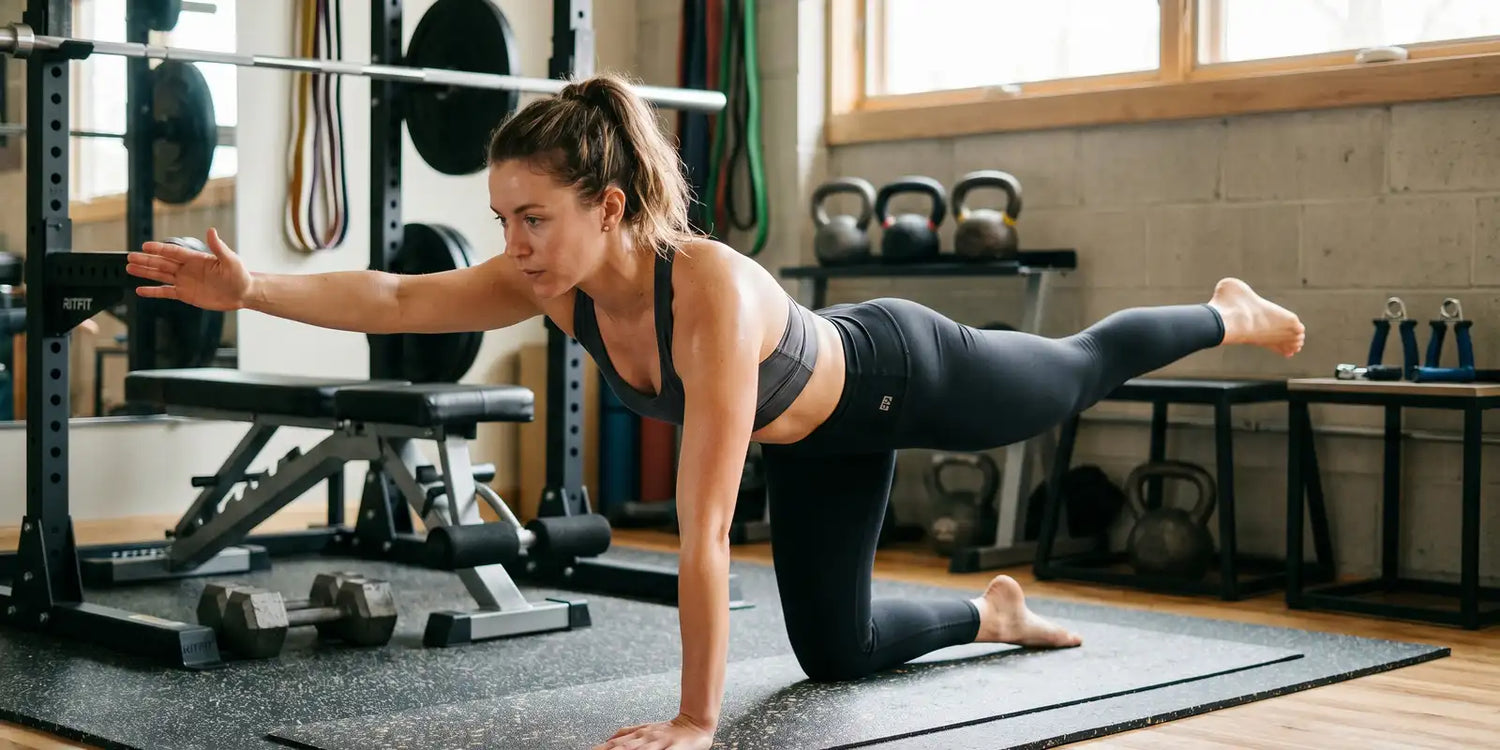
The bird dog is a simple bodyweight exercise that trains your core to stay stable while your arms and legs move. This guide explains what it is, the muscles it works, exact form, common mistakes, and how to program it.
It suits beginners and experienced lifters alike, needs only a mat, and is often used to support the lower back. Move slowly and stop if you feel sharp pain.
Table of Contents
Key Takeaways
- What it is: A quadruped core exercise where you extend one arm and the opposite leg while keeping your spine neutral.
- Muscles worked: It targets core stabilizers like the abdominals, erector spinae, and multifidus, plus the glutes and shoulders.
- Why it helps: It builds anti-rotation stability that supports the lower back during everyday bending and twisting.
- Form first: Keep hips and shoulders level, move slowly, and only lift as high as your back stays flat.
- Programming: Aim for two to three sets of eight to fifteen reps per side, and scale back if pain appears.
What Is the Bird Dog Exercise?
The bird dog is a bodyweight core stability exercise performed on your hands and knees, where you extend one arm forward and the opposite leg backward while keeping your spine neutral. It trains your trunk to resist rotation rather than to produce big movement.
- Position: You start in a quadruped, or tabletop, position with hands under shoulders and knees under hips.
- Pattern: The contralateral, or cross-body, action means right arm extends with left leg, and vice versa.
- Equipment: You need nothing but a mat, which makes it easy to add to almost any routine, including Kegel workouts and other core drills.
The name comes from the pointing posture a hunting dog takes, with one limb forward and one back. It is a foundational move for anyone learning core control.
Which Muscles Does the Bird Dog Work?
The bird dog mainly works the deep core stabilizers, including the rectus abdominis, transverse abdominis, obliques, and the erector spinae and multifidus of the lower back. It also recruits the glutes, hamstrings, and shoulder stabilizers as you hold the extended position.
Research on quadruped exercises describes them as effective for recruiting the core, trunk, abdominal, hip, and shoulder girdle muscles, with the cross-body bird dog showing balanced recruitment on both sides[1].
- Spinal stabilizers: One EMG study found the four point kneeling arm and leg lift activated the lumbar paraspinals at roughly 40% of maximum effort[2].
- Selective multifidus work: That same study reported a higher multifidus to erector spinae ratio than a prone trunk extension, suggesting more targeted multifidus activation at a lower load[2].
- Supporting muscles: The glutes and shoulder stabilizers fire to keep your hips and shoulders level throughout each rep.
This blend of stabilizer activation is why the bird dog pairs well with broader ab and core workouts for a balanced midsection.
How Do You Do a Bird Dog With Correct Form?
To do a bird dog, start in a tabletop position, brace your core, then extend one arm and the opposite leg until they form a straight line with your back. Hold briefly, return with control, and alternate sides while keeping your hips and shoulders square.
- Set up: Place hands directly under shoulders and knees under hips, with a flat, neutral spine.
- Brace: Draw your navel gently toward your spine before you move.
- Extend: Raise one arm forward and the opposite leg back to about body height, no higher than your back can stay flat.
- Control: Pause for a count or two, then lower slowly and switch sides.
The video below from the National Academy of Sports Medicine demonstrates the setup and tempo so you can match the cues to your own movement.
Sets, Reps, and Tempo
Most exercise libraries suggest two to three sets of eight to fifteen reps per side, with a brief hold at the top and a slow tempo throughout.
- Beginners: Start with shorter holds and 8 reps per side, prioritizing a flat back over range.
- Progressing: Build toward 3 sets of 10-15 reps per side as your control improves.
- Tempo cue: Imagine balancing a cup of water on your lower back to keep movement smooth and level.
What Are the Benefits of the Bird Dog?
The main benefit of the bird dog is improved core stability, which helps protect and support the lower back during daily bending, twisting, and athletic movement. Because it trains the deep stabilizers at a relatively low spinal load, it is a common choice in both fitness and rehabilitation settings.
- Anti-rotation strength: Holding opposite limbs out teaches your core to resist twisting forces.
- Balance and coordination: The cross-body pattern improves your mind to muscle connection and stability.
- Joint-friendly load: One EMG study of 30 healthy participants found the bird dog produced relatively moderate fatigue while still activating most selected muscles, unlike the more fatiguing prone bridge[3].
These qualities make it a useful base move before progressing to more demanding formats like a Tabata workout or other conditioning styles.
What Are the Most Common Bird Dog Mistakes?
The most common bird dog mistakes are letting the lower back sag or arch, rotating the hips or shoulders, lifting the limbs too high, and rushing the movement. Each of these reduces core tension and shifts the work away from the stabilizers you are trying to train.
- Sagging or arching: Keep your spine neutral and lift only as high as your back stays flat.
- Twisting hips: Square your hips to the floor and avoid shifting weight to one side.
- Moving too fast: Slow down so your core has time to engage and stabilize.
- Holding your breath: Breathe smoothly to maintain steady core pressure.
A standing-style stability routine within a barre workout can reinforce these same alignment habits.
What Bird Dog Variations Can You Try?
You can scale the bird dog easier or harder by changing the range of motion, adding holds, or introducing resistance. This makes it adaptable for true beginners as well as advanced trainees seeking more challenge.
- Regression: Lift just the arm or just the leg an inch off the floor until you feel steady.
- Standing bird dog: Hinge at the hips on one leg to add a balance demand.
- Dead bug pairing: Alternate with the dead bug for anti-extension work alongside anti-rotation.
- Loaded version: Add a light ankle weight or resistance band only after your form is solid.
For more no-equipment options to rotate in, explore these bodyweight workouts that complement core training.
How Do You Progress and When Should You Stop?
You progress the bird dog by adding reps, longer holds, or harder variations once you can keep a flat, level back for every rep. The key signal to advance is control, not just how many you can finish.
- Frequency: Train it 2-3 times per week, either as a warm-up or within a core block.
- When to add difficulty: Move to longer holds or a standing version once your back stays neutral for all reps.
- When to scale back: Reduce range or reps if your hips start twisting or your back sags.
- When to stop: Stop and rest if you feel sharp or radiating pain, and seek professional advice before continuing.
Pairing the bird dog with a structured bodyweight conditioning routine gives beginners a balanced full-body plan.
FAQs About the Bird Dog Workout
What is the bird dog exercise?
The bird dog is a bodyweight core stability exercise done on your hands and knees. You extend one arm forward and the opposite leg straight back at the same time, holding a straight line while keeping your spine neutral. It trains your core to resist rotation and stabilize your lower back during limb movement, requiring no equipment beyond a mat.
What muscles does the bird dog work?
The bird dog primarily targets core stabilizers including the rectus abdominis, transverse abdominis, obliques, and the erector spinae and multifidus along the lower back. It also recruits the gluteus maximus, hamstrings, and shoulder stabilizers. Because you move opposite limbs, the muscles must work together to keep your hips and shoulders level and prevent the spine from twisting.
How many reps of bird dog should I do?
Most exercise libraries suggest around two to three sets of eight to fifteen repetitions per side, moving slowly and holding each extension briefly. Beginners can start with shorter holds and fewer reps, focusing on keeping the back flat. Quality matters more than speed, so stop a set once your form breaks down or your lower back starts to sag.
Is the bird dog good for lower back pain?
The bird dog is widely used as a gentle core stability exercise because it activates the deep back and abdominal muscles at a relatively low spinal load. Strengthening these stabilizers may help support the lower back during daily movement. However, if you have a diagnosed back condition or feel sharp pain, stop and consult a qualified healthcare professional before continuing.
What are the most common bird dog mistakes?
The most common errors are letting the lower back sag or arch, rotating the hips or shoulders, lifting the arm and leg too high, and rushing the movement. Holding your breath also reduces core tension. Fix these by moving slowly, keeping your hips square, and raising your limbs only as high as your spine stays neutral.
Conclusion
The bird dog is a beginner-friendly core exercise that builds the anti-rotation stability your spine relies on every day. Done with a flat back and slow tempo, it strengthens the deep stabilizers without heavy spinal load.
Start with two to three sets of controlled reps per side, master the form, then add holds or variations as your stability improves. Pair it with broader bodyweight training for a balanced routine.
Disclaimer
This article is for general educational purposes only and is not medical advice or a treatment plan for any diagnosed condition. Consult a qualified healthcare or fitness professional before starting new exercises, especially if you have back pain or an injury.
References
1. Clemente PC, de Almeida LL, Vicente EJD, et al. Perceived exertion, postural control, and muscle recruitment in three different quadruped exercises performed by healthy women. Frontiers in Physiology. 2022;13:948469. https://pmc.ncbi.nlm.nih.gov/articles/PMC9473345/
2. Kim JS, Kang MH, Jang JH, Oh JS. Comparison of selective electromyographic activity of the superficial lumbar multifidus between prone trunk extension and four-point kneeling arm and leg lift exercises. Journal of Physical Therapy Science. 2015;27(4):1037-1039. https://pmc.ncbi.nlm.nih.gov/articles/PMC4433971/
3. Xiao J, Sun J, Gao J, Wang H, Yang X. The Activity of Surface Electromyographic Signal of Selected Muscles during Classic Rehabilitation Exercise. Rehabilitation Research and Practice. 2016;2016:4796875. https://pmc.ncbi.nlm.nih.gov/articles/PMC4853948/





